electrocd

Du noir tout autour

Armando Balice

The piece is far from inviting a peaceful listening experience; rather, it evokes a sense of unease in the listener, who is likely drawn into introspection. Revue & Corrigée, France

Du noir tout autour is not an easy record, and it has no interest in being one. It demands attention, patience, and a willingness to let images form slowly, then dissolve. But it’s also deeply lyrical in its own abrasive way. Chain DLK, USA

17-page PDF digital booklet (1 MB) included in download

CD-R (IMED 25199, 2025)

  • Label: empreintes DIGITALes
  • IMED 25199
  • 2025
  • UCC 771028219926
  • Total duration: 65:58
  • OGpak
  • 125 mm × 125 mm × 10 mm
  • 45 g

Download (IMED 25199_NUM, 2025)

Liner notes

Lyrical Collisions

In his acousmatic music, Armando Balice is working on raw material captured by a microphone on the spot or shaped by the oscillations of synthesizers, as if any chunk of sound already contained the shape to come and as if that form, once achieved, always had to retain something of its rugged origins. This is music made of sharp, almost caricatural contrasts: black and white, silence and noise, fullness and emptiness. It is as much editing work as telescoping work – delicate stained glass crashing into the concrete wall in breath-like movements. It is a dramatic yet unstable building consisting of elevations that won’t stop falling down and collapses that keep rebuilding themselves. Images are born out of these clashes, out of these balancing acts and their expertly maintained tensions. The meeting between a cello and flock of birds on the composer’s electronic dissecting table will automatically bring to mind the convulsive beauty that will be guiding the listener towards unimagined, dizzying landscapes. These sonic gardens are fantastical creations with dark lyricism, a tectonic force that pushes large flat surfaces out of the ground, and the seemingly monochromatic nature of those mobile surfaces is barely able to disguise the rich materials developing. In the dark, you’re always able to see more than you thought. And Armando Balice is drawing the ghosts out of that darkness and into apocalyptic light.

Guillaume Contré [English translation: François Couture, vi-25]

The Triptych

This is a triptych around the notion of the inner garden as a metaphor for one’s intimate perception of the world.

Black Garden is an exploration of the dark as an expression of that garden in terms of destruction and creation, shadow and light. This part, freely inspired by Japanese gardens, is dramatic and powerful despite its seeming peace and quiet.

Empty Garden features emptiness: a garden-to-be, inexistant for now, deep in the dark void that already contains everything and yet where everything has yet to be born. Here, emptiness is seen as pregnant origin, the source of all things.

Light Garden is an evocation of light springing out of the dark, the two being indissociable. Picture a beginning, a space where matter reveals light and guides us toward internal balance.

All three pieces share the same overall architecture: eight movements, three of which, entitled noir, are shorter (one to two minutes).These movements segue seemlessly, providing each piece with its structure.

Sound-wise, there are materials common to all three pieces, like sounscapes with ravens, forest recordings, sound originating from analog synthesizers, and recordings featuring the cellist Lola Malique.

I would like to thank Qingqing Teng for support and advice, Denis Dufour, Jonathan Prager, and Jean-Marc Weber.

Armando Balice [English translation: François Couture, v-25]

Some recommended items
In the press

Critique
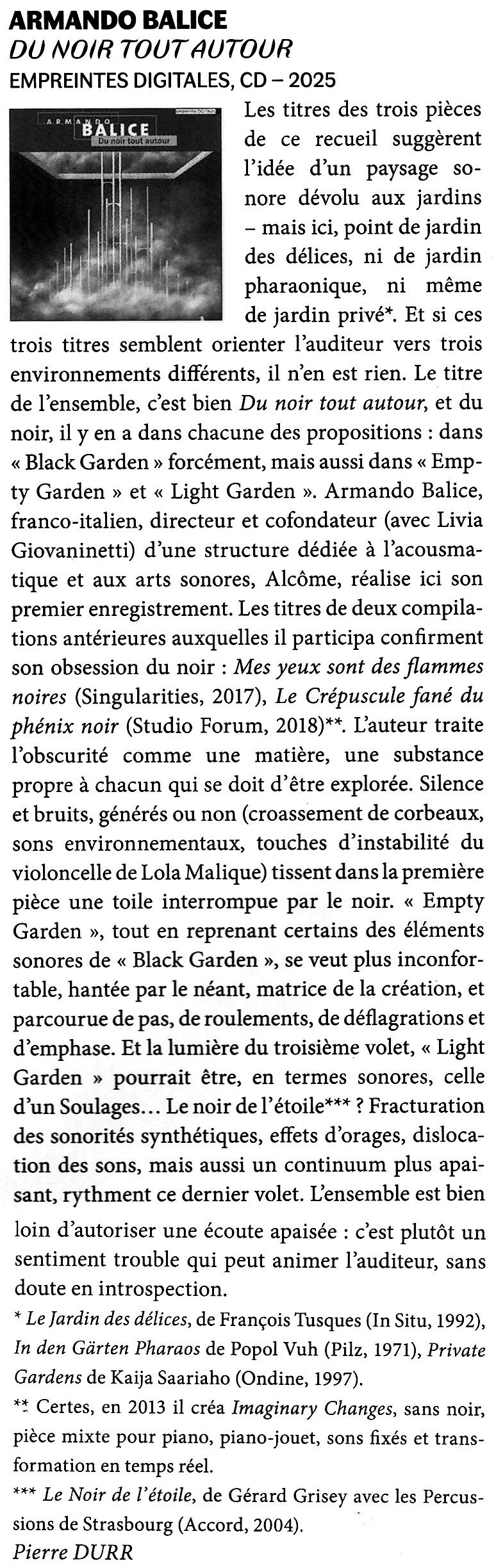
Pierre Durr, Revue & Corrigée, no. 147, March 1, 2026

Les titres des trois pièces de ce recueil suggèrent l’idée d’un paysage sonore dévolu aux jardins — mais ici, point de jardin des délices, ni de jardin pharaonique, ni même de jardin privé. Et si ces trois titres semblent orienter l’auditeur vers trois environnements différents, il n’en est rien. Le titre de l’ensemble, c’est bien Du noir tout autour, et du noir, il y en a dans chacune des propositions: dans Black Garden forcément, mais aussi dans Empty Garden et Light Garden. Armando Balice, franco-italien, directeur et cofondateur (avec Livia Giovaninetti) d’une structure dédiée à l’acousmatique et aux arts sonores, Alcôme, réalise ici son premier enregistrement. Les titres de deux compilations antérieures auxquelles il participa confirment son obsession du noir: Mes yeux sont des flammes noires (Singularities, 2017), Le Crépuscule fané du phénix noir (Studio Forum, 2018). L’auteur traite l’obscurité comme une matière, une substance propre à chacun qui se doit d’être explorée. Silence et bruits, générés ou non (croassement de corbeaux, sons environnementaux, touches d’instabilité du violoncelle de Lola Malique) tissent dans la première pièce une toile interrompue par le noir. Empty Garden, tout en reprenant certains des éléments sonores de Black Garden, se veut plus inconfortable, hantée par le néant, matrice de la création, et parcourue de pas, de roulements, de déflagrations et d’emphase. Et la lumière du troisième volet, Light Garden pourrait être, en termes sonores, celle d’un SoulagesLe noir de l’étoile? Fracturation des sonorités synthétiques, effets d’orages, dislocation des sons, mais aussi un continuum plus apaisant, rythment ce dernier volet. L’ensemble est bien loin d’autoriser une écoute apaisée: c’est plutôt un sentiment trouble qui peut animer l’auditeur, sans doute en introspection.

The piece is far from inviting a peaceful listening experience; rather, it evokes a sense of unease in the listener, who is likely drawn into introspection.

Review

Vito Camarretta, Chain DLK, February 6, 2026

This is one of those records that doesn’t arrive so much as surround you. You don’t press play and wait for something to happen. You step inside, and the light politely excuses itself.

Du noir tout autour is Armando Balice doing what he does best, which is treating darkness not as mood, but as material. Not metaphorical gloom, not cinematic dread, but darkness as a working condition. As substance. As a space where sound has to earn its right to exist. This is acousmatic music that remembers where it came from: microphones out in the world, analogue oscillations with rough edges still showing, edited with care but never sanded down to politeness.

Balice has been circling this territory for years. A French-Italian composer shaped by Ina-GRM and the lineage of Denis Dufour and Jean-Marc Weber, he carries both the discipline of electroacoustic tradition and a taste for density that flirts openly with noise, metal, and orchestral mass. His music often sounds like it wants to be larger than the speakers that contain it. This album is no exception.

The record is built as a triptych, three long-form works that function like different angles on the same inner landscape. Black Garden, Empty Garden, Light Garden. The titles might suggest a neat progression, but the experience is less linear than that. Darkness doesn’t disappear. It reorganizes.

Black Garden opens the set with a sense of dramatic restraint. Field recordings, ravens, forest textures, and the cello of Lola Malique are not presented as scenery, but as unstable elements. Silence and noise keep interrupting each other, like tectonic plates that never quite lock into place. The short noir movements puncture the flow, brief moments where the ground seems to drop out entirely. It feels calm only if you mistake stillness for safety.

Empty Garden is the most unsettling of the three. Here, emptiness is not absence. It’s pressure. A void that hums quietly with potential. Sounds emerge cautiously, hover, then withdraw, leaving afterimages behind. There’s something almost physical about the way Balice lets space breathe, then compresses it again. This is not ambient comfort. It’s the kind of quiet that makes you aware of your own listening.

By the time Light Garden arrives, the title risks optimism, but Balice avoids that trap. Light here is not resolution. It’s exposure. Refractions, iridescent textures, and spectral reflections rise from the same dark matter as before. The cello reappears, birds return, synthetic tones stretch and fracture. Light and shadow coexist, inseparable, like two sides of the same sound.

What stands out across the album is Balice’s sense of form. These pieces collapse and rebuild themselves constantly. Elevations fall. Ruins reorganize. It feels architectural, but unstable, like a structure designed to test how much imbalance it can survive. Editing plays as big a role as sound generation, but the edits never feel surgical. They feel like collisions.

There’s a quiet humor buried in all this severity. Not jokes, but a kind of wry awareness. The idea that in the dark you can see more than you expect. That monochrome surfaces hide complex materials. That a flock of birds and a cello can share a space without explanation. Balice doesn’t underline these moments. He lets them happen and trusts the listener to notice.

Du noir tout autour is not an easy record, and it has no interest in being one. It demands attention, patience, and a willingness to let images form slowly, then dissolve. But it’s also deeply lyrical in its own abrasive way. A reminder that darkness is not the opposite of clarity. Sometimes it’s the only place where things come into focus at all.

Du noir tout autour is not an easy record, and it has no interest in being one. It demands attention, patience, and a willingness to let images form slowly, then dissolve. But it’s also deeply lyrical in its own abrasive way.

Review

Alan Freeman, Audion, no. 86, February 1, 2026

My prior listening notes for Du noir tout autour (Blackness Al Around) state ’good, a bit Stockhausen in parts’ and ’extraordinary’ and on this third listen I’m no less impressed. It’s obvious that Armando is well versed in advanced manipulation of sound, and he’s also quoted a s quite an active improvising artist, and first came to the attention of the wider public as one of the finalists of the Prix Russolo 2016-17 competion.

Containing just three big pieces, the disc opens with Black Garden, credited as an eight part work in which elements of the three “Noir” phases are also revisited in the following tracks. My immediate impression of the opening this time is that it’s not so far removed from Boguslaw Schaeffer’s similarly Hymnen like (Stockhausen-esque) works on the Edition RZ releases Inventionen 1 and 2. It goes through a number of phases, with the final section the icing on the cake. Empty Garden then follows more subtly at the start, with environmental sounds, including footsteps, carrying the piece along, and again it culminates with a powerful phase. Light Garden opens with a record run-off and crackle, and then grows with grandiose electronic tones heralding two peaks during its length.

All impressive stuff, and with great use of combining acoustics, musique concrete and electronics, ranging from the subtle to the almost mind-blowing.

All impressive stuff, and with great use of combining acoustics, musique concrete and electronics, ranging from the subtle to the almost mind-blowing.

Critique

Dionys, Inactuelles, January 9, 2026

Quand la forêt dense des parutions cache un pur joyau…

Retrouvé par hasard dans mon stock de fichiers de disques, plus de deux mois après sa sortie, Du noir tout autour m’a rappelé à lui par son beau titre, en français, ça devient si rare…, et sa couverture, le graphisme de l’excellente maison de disques montréalaise empreintes DIGITALes, d’ailleurs trop peu présente ici, «Mea culpa…»

Un livret numérique (ou papier) exceptionnellement bien fait…

Tellement bien fait que le chroniqueur se voit mal en perroquet, si bien que je vous y renvoie pour l’essentiel: éléments biographiques concernant le compositeur franco-italien Armando Balice; présentation d’ensemble du triptyque par ce dernier, suivie d’une description détaillée de chaque partie, chacune précédée d’une magnifique épigraphe (respectivement, dans l’ordre: Eugène Guillevic, Gaston Bachelard et Samuel Beckett); sans oublier un brillant commentaire de Guillaume Contré titré Entrechocs lyriques.

Jardins d’Artifices et de Splendeurs

Un violoncelle surgit du néant en volutes bourdonnantes, une respiration brusquement arrêtée s’interpose, et tout dérape, s’éloigne en glissendo: c’est le début du premier jardin, Black Garden, structuré en huit parties comme les deux suivants (x + noir + x + noir + x + noir + x + x). Ici, jamais un geste sonore ne va à sa conclusion. Il éclot, s’épanouit et disparaît, relayé par d’autres, dans un feu d’artifices faramineux. En quelques secondes, on passe du silence aux bruits les plus étranges. Black Garden, c’est comme une série de déflagrations, de mises à feu, d’explosions, une série d’apparitions sonores, de vives esquisses. Soudain, ce serait un battement de pales d’hélicoptères, l’écho lointain du film de Coppola Apocalypse Now. On patauge dans la jungle des sons, au ras des frémissements et des soulèvements. Ce jardin noir est imprévisible dans sa puissance dramatique, son obscure clarté minée par la disparition. Il éblouit, stupéfie, véritable suite d’illuminations rimbaldiennes d’une tumultueuse beauté, ponctuée sur la fin par le chant envoûtant d’une sirène affolée en boucle crescendo. [en vidéo, une version de juillet 2019]

Empty Garden, que le compositeur considère comme un deuxième volet de la pièce précédente, envisage le vide, non comme une menace ou une absence radicale, mais plutôt comme «la matrice silencieuse de toute création». La dimension mystérieuse du vide s’entend exemplairement dans ce jardin qui est un chant des origines, l’actualisation d’un potentiel aux surgissements prodigieux. Des pas pressés dans la nuit, des collisions sonores entre la nature et l’artifice. Et le violoncelle au son énorme qui secoue la nuit pour en retirer les foudres dans des passages quasi rock, d’un rock épais, métal en fusion agité de frissons, de tintinnabulements hypnotiques. Dans ce jardin vide, qui marche ainsi? Une belle peut-être, poursuivie par des désirs, qui pousse des portes, rentre chez elle, source elle-même de visions magiques comme cette cloche qui tinte au loin et ces décharges possiblement torrides dans une atmosphère de mitraillage, de guerre. La musique d’Armando Balice mobilise tout notre imaginaire pour s’en jouer avec délectation. Ne retrouve-ton pas les pas de la marcheuse dans le jardin illuminé de détonations, près d’un temple (?) dont sourd une musique élégiaque poignante? Une nappe diaprée recouvre le tout de son scintillement énigmatique, comme la matérialisation du vide en lévitation. Suit une invasion onirique d’une puissance tellurique absolument splendide, enthousiasmante, le mélange détonnant de la lumière et de l’ombre annoncé par la dernière phase de la pièce! Un feu d’artifices ponctué de lourdes déflagrations termine cette composition fabuleuse!

Que peut-on encore attendre de Light Garden, dernière pièce du triptyque? Ce sont des amorces d’étincelles, les vrilles entêtantes de chants d’entités inconnues, des forages et des déchirements électriques. C’est la mise à feu de forces magnifiques, une exultation des matières en flamme. Et un chien qui aboie dans la nuit pendant l’orage, avant de grands froissements grondants. Ici le naturel côtoie l’artificiel: nulle opposition, une mutuelle émulation pourrait-on dire. Surgie de l’ombre, la lumière déferle, vibre, rayonne, et se métamorphose sans cesse sur fond de croassements de corbeaux. Le leitmotiv du feu d’artifice continue d’informer une masse sonore volontiers magmatique, éruptive, qui peut d’un moment à l’autre se calmer pour rappeler les bourdons de la musique indienne. D’autres pas encore animent latéralement cette composition avant de revenir au premier plan et de s’éloigner, annonciateurs de nouveaux surgissements impétueux. Armando Balice brosse alors une fresque apocalyptique d’une grandeur sauvage, un véritable incendie de la Lumière piquetée de sombres éclats et de zébrures multipliées.

Quand la forêt dense des parutions cache un pur joyau…

Recensione

Piergiuseppe Lippolis, Music Map, January 1, 2026

Du noir tout autour, uscito per la empreintes DIGITALes di Montréal, è il nuovo album di Armando Balice, compositore e improvvisatore elettroacustico franco-italiano, nonché docente e direttore artistico in ambienti sperimentali.

Il disco è stato pubblicato a ottobre dello scorso anno e si compone di tre suite, pensate come “giardini dell’ascolto”, in una dimensione profondamente viscerale e interiore.

Du noir tout autour, musicalmente, può essere catalogato come musica elettroacustica e acusmatica, ma rimane riconoscibile anche una certa vocazione sperimentale, in cui si manifesta un flusso incessante di paesaggi sonori più che brani strutturati in senso tradizionale.

Si tratta, dunque, di un’esperienza meramente emotiva e intima, che tanto ha a che fare con l’idea della percezione del mondo e della sua esplorazione. Idealmente, le tre sezioni dell’album, tutte di durata superiore a venti minuti, sono dedicate all’ombra (Black Garden), al vuoto (Empty Garden) e alla luce (Light Garden).

Balice indaga questi concetti attraverso soluzioni musicali volutamente cariche di contrasti, a partire dai paesaggi sospesi dell’opener, segnata da un violoncello lavorato e trasformato, passando per l’idea di assenza e spazio vuoto che è fonte creativa del secondo brano, quindi chiudendo con l’espansione e l’idea di un equilibrio ritrovato nel ritorno alla luce di Light Garden.

Du noir tout autour è un’opera elettroacustica densa di significato, ricerca e poesia: la sensibilità dell’artista si esprime attraverso ambiziose costruzioni di contrasti fra oscurità e luce, vacuità e pienezza. Un viaggio meditativo e sensoriale che richiede riflessione e pazienza, ma che rivela tutta la sua bellezza.

Du noir tout autour is an electroacoustic work dense with meaning, research, and poetry: the artist’s sensitivity is expressed through ambitious constructions of contrasts between darkness and light, emptiness and fullness.

Recensioni

Vasco Viviani, The New Noise, December 19, 2025

Un trittico che verte sulla nozione di giardino interiore come metafora di un’intima percezione del mondo, questo è Du noir tout autour del franco-italiano Armando Balice, nome per me assolutamente sconosciuto.

Black Garden, Empty Garden, Light Garden i titoli dei brani: nero, vuoto, luce. Armando utilizza i suoni registrati mantenendone le asprezze e utilizzandoli per costruire lunghi viaggi circoscritti, dove luci e ombre si intervallano e si accavallano. Spesso nel primo movimento sembra di essere alle prese con un decollo, con la partenza di una presenza misteriosa e possente. È il terreno stesso a vibrare, a mandare in agitazione fauna e flora, lasciando ad Armando il compito di armonizzare l’atmosfera con corde e sentori che abbracciano sia ipotesi carpenteriane, sia sperimentalismi senza compromessi. Ma se a chiudere il giardino nero sembra essere una riduzione operistica tra frequenze sconnesse, ad aprirci al vuoto sembra essere un viaggio dentro noi stessi. Empty Garden sembra creare uno squarcio attraverso il quale osservarci e rivivere tramite ciò che risuona dentro di noi. Una cavità drammatica e potente, dove — quasi rileggendo l’immagine di copertina di Pierre Barraud de Largerie — sembriamo in una fase di trasformazione che possa precedere una nuova e futuristica forma. La luce, così come la intende Armando Balice, sembra essere nelle mani della natura, quasi un elemento costante e associabile alla vita, all’espressione e alla trasformazione di energia che produce movimento e dialogo. Il contorno, quell’eterno sentimento di ascesa, di drammatica ascesa, è ovviamente costrutto umano che però non riesce a nascondere una speranza che non ci vede protagonisti. Un passaggio che dall’antropocentrismo passa ad un racconto fantastico, libero, dove esseri ed emozioni si uniscono in movimenti emozionanti. Le esplosioni che ci portano al finale sembrano essere libere e gioiose, forse per la fine di un tragitto forzato e tutto sommato inutile, più apprezzabile per il suono che può accompagnarlo che per il senso in sé. Ma se è vero che l’essere umano è l’unica specie a registrarsi e a lasciar traccia di sé, il viaggio di Armando Balice ha un suo senso e ci accompagna per i sentieri più oscuri, fuori e dentro di noi.

Armando Balice’s journey has its own meaning and accompanies us along the darkest paths, outside and inside ourselves.

Release Tipp

Radiohoerer, November 17, 2025

Imposant, beeindruckend und sehr dicht prallen hier die von Armando Balice kreierten Sounds und Field Recordings aufeinander. Das ist nichts für schwache Nerven, denn gerade die großen Lautstärkeunterschiede können ganz schön erschrecken. Der Aufbau der Stücke hat eine Wirkung der Überwältigung. Gerade unter Kopfhörern wird das zu einem Erlebnis. Nur ist bei der gewählten Lautstärke Vorsicht geboten. Du noir tout autour (Rundherum nur Schwarz) ist der Titel des Albums. Es enthält erschreckend viel Dunkelheit in all seinen imaginären Gärten, aber der Gang durch eben jene Gärten hat viele schöne Momente.

This is not for the faint of heart, as the large differences in volume can be quite frightening. The structure of the pieces has an overwhelming effect. This becomes a real experience, especially when listening with headphones.
Blog
  • Tuesday, March 31, 2026 / Press

    The piece is far from inviting a peaceful listening experience; rather, it evokes a sense of unease in the listener, who is likely drawn into introspection. More

  • Monday, February 9, 2026 / Press

    Du noir tout autour is not an easy record, and it has no interest in being one. It demands attention, patience, and a willingness to let images form slowly, then dissolve. But it’s also deeply lyrical in its own abrasive way. More

  • Monday, February 9, 2026 / Press

    All impressive stuff, and with great use of combining acoustics, musique concrete and electronics, ranging from the subtle to the almost mind-blowing. More