Stephan Dunkelman is a Belgian, born 1956, who composes for exhibitions (Charlotte Marchal, sculpture; Axel Miret, paintings [also represented with the cover of this issue]; Michèle Noiret, choreographies; Azniv Afsar, fashion design)
Of course the electroacoustic idiom is perfectly suited for these ends, even though this is the first time I’m aware of this art being utilized in the fashion business! However, I know that Swedish electronic music pioneer Ralph Lundsten sold his soul to the weapons industry with a piece to open the presentation ceremony of a new Swedish jet fighter, which eventually was sold to the new regime in South Africa, which one would think would have many domestic problems of poverty and education and fairness to deal with before bailing out all their money to the Swedish weapons sharks… so with that in view I certainly have no objections to this art accompanying the fashion movement, which, nonetheless, harbors sensuality and intuition too, while the weapons’ industry is 100% pure evil… no matter what Swedish double standards might say…
Dunkelman studied with legendary Annette Vande Gorne at the Royal Conservatory of Music in Mons, Belgium.
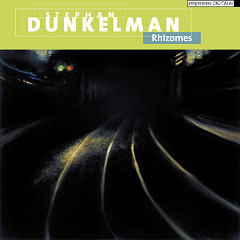
Stephan Dunkelman really is a “dunkel” man, in the German and Swedish meaning of the word; vague, obscure, mysterious… This became clear to me on spinning track one of Dunkelman’s new CD Rhizomes – Metharcana (1998) — under the bleak light of the laser beam. A beautifully rendered space of emerging spheres of shiny, metallic properties bring you into a state of hovering, of weightless existence in a shadow world between these soaring, tumbling spheres, of which you cannot get hold, ‘cause of their infinitely even surfaces…
Speed is appearing as an entity unto itself through the music, moving rapidly through this beautiful, but dusky and anonymous, extra-human spacescape… where sounds reminiscent of Bayle (Les Couleurs de la Nuit) or Parmegiani (La Création du Monde) artistry are scattered like sonic seeds of Christmas tree bliss… but all in the haze of a dream, a… hallucination… which appears in a world where humans have no say, where humans are not known, where the entities of existence swirl ’round cup grease, screws and bolts and anonymous machinery… and then, at 3:56, a surprise!
When I heard this the first time I was caught off guard, and instantly I was asking myself if I really heard what I thought I heard, or if I actually really was the victim of sonic hallucinations… because out of the speedily moving layers of dreamy, electroacoustic artistry a whisper rose, or rather swirled, round and around my head… and it appeared to me that it all sounded too familiar, until it suddenly dawned on me that the women who whispered spoke Swedish! I was completely unprepared for this on a Canadian CD featuring a Belgian composer, and the way in which the lingual aspect sort of rose hazily out of the rushing flow of sounds made the experience even more spectacular to the non-suspecting reviewer!
The “dunkel” aspect I mentioned initially is even more confirmed as the words and sentences uttered in this whispering female voice are not all clearly recognizable as to their content of meaning, but rather heard like loose thoughts inside someone’s head, registered on some fly-by extraterrestrial device inside one of the luxurious space ships of The Hitchhiker’s Guide to the Galaxy… Even more “dunkel” is Dunkelman’s way of not explaining who this Swedish whispering woman is, and what text she recites. I would like to be filled in on this! (If I am I will insert the information here!) As I look at the information on the sleeve I notice that Metharcana won first prize at the Stockholm Electronic Arts Award in 1998, so in there somewhere is a hidden explanation…
The effect of the voice, even if you can’t understand the language, adds even more of a dreamy, otherworldly or subconscious feel to the mix. Some of the whispers go: “Namnet på han som ritade kläderna” (“The name of the guy who drew the clothes…”, followed by “Jag tycker om att se på…” (“I like to look at…”), “…reklamen…” (…“the commercials…”), “…det gick inte, snart är jag gammal…” (…it didn’t work, soon I’ll be old…”). Ear-shattering (at least if heard through earphones) dark percussive effects pan wildly, hitting your tympanic membranes in a rage, as the whisper continues: “…tog bilder av mig; det var hans bilder, inte mina…” (“…took pictures of me; they were his, not mine…”), “…varje morgon när jag köper tidningen…” (…each morning as I buy the newspaper…”), “…namnet på han som ritade kläderna…” (“…the name of the guy who drew the clothes…”), “…jag tycker om att stå på perrongen…” (“…I like to stand on the platform…”) …and towards the conclusion the woman half whispers, half talks (for the first time), saying, again: “Jag tycker om att stå på perrongen, varje morgon när jag köper tidningen…” (“I like to stand at the platform, each morning as I buy the newspaper”), and the motion and commotion of the music is intense, to say the least.
It impresses me how good Dunkelman is at using a few elements of sound repeatedly, as sounding objects, inside the general haste of the forthwelling sound mass. Dunkelman writes in his introduction that he has used here material originally intended for a choreographic production. This piece should be played loud, like a rock n’ roll piece, so that you’re carried along in the forceful flow, while the whispers cut into your ears. Metharcana is a masterpiece!
The second work on the CD is Rituellipses (1993 – 1996). This is a work composed “by and for dance”, as Dunkelman, in his “dunkel” way puts it… he goes on to describe the piece thus:
The sonic objects, made from fragments of concrete or instrumental musical patterns, are swept along as if by [a] centrifugal force [but this description reminds the reviewer very much of the first piece too]. They follow each other in continuous rotational movements that only silence suspends. These studies of trajectory combinations are developed in short movements that are alternately lively, calm, restrained or uninhibited. […]
Stephan Dunkelman also lets on that he has had two movies in mind while he worked these sound worlds, Andrei Tarkovsky’s The Sacrifice (shot on the island of Fårö, Sweden) and Night Sun by Paolo and Vittorio Taviani. The composer points out that these movies deal with the kind of over-arching relationship that man may have with, say, a tree or a rock, in an atmosphere of reminiscences of lost wisdom, of the oneness.
The panning is formidable in the piece, right from the outset, and if you listen over earphones you will get dizzy! Little sounds are percussed (a new word, I trust!) and thrown about wildly, but in clean-cut audio, revealing much sonic beauty, flashing by, back and forth and all around, in a magic display of spatial playfulness, of a kind refined to a state which I haven’t experienced before under the looking-glass of the laser beam! The sounds that are treated in this way seem to stem from all kinds of concrete sources, like perhaps kitchen ware, pebbles and whatnot – but they are extremely percussed (second time this word has been documented in semantic and etymologic history!) and panned, and enjoyed thoroughly by this listener, this connoisseur of auditory pleasure! Some parts bring in influences from the formidable Frenchman Jean Schwarz (Suite Symphonique & Gamma Plus), but also from American citizen Morton Subotnick (The Key To Songs & Jacob’s Room).
The repetitious patterns that arise lure you into a kind of shamanistic sphere, your eardrums vibrating in brain-tickling cycles, conjuring up visions of annual rings of old oaks and strata of rock, sideways up out of the African soil. In this music Time is a vehicle; a probe in which top soar, down the slopes of thought, of dream – of unintent.
Hanna’ Duet (1998) is, says Dunkelman, “a geometric replica, a simple reproduction of a segment of choreography.” The drumming sweeps by real close, tapping both your temples, while incisive sounds – sharp, edgy — slice through space like samurai swords. Tilting planes dance about in a display of arithmetics, somewhat like the sight of South American ants carrying leaves; ah, yes, it’s a South American ant leaf dance on a branch of a tree in the rain forest! Ant choreography gone electroacoustic in Monsieur Dunkelman’s studio!
Track 4 has a mighty title: Dreamlike Shudder in an Airstream Part 1: for a crumpled woman (2000). Cryptically, in a shroud of “Dunkelheit”, Dunkelman talks about the communion between the real and the unreal, and of possible venues between the two – and this piece deals with it; not a small feat! Initially immediately overpowered by a whole room of grouchy furniture falling over me I proceed cautiously through this incarnate philosophy, expressed in sound waves of utter beauty and edge. An armada of upset doorways clashes in a wooden pile just outside my ears. Intense rubbery and wooden friction mix with the squeaking of grumpy hinges cutting loose of angered door cases, while a cloud of grasshopper legs fall down as black, thin-lined precipitation from some perversion of cruelty to animals above, in some outcast dimension bordering ours in the uncertainty of quantum mechanics… Then screws and bolts that sweep past move so densely and so fast that all that remains is an acrid smell of speedy metal and a hovering trace of metal dust.
Sounds reaching out like distant, trapped human screams of horror seep out through a tormented mass of mangled iron bar sounds, but at times I think I hear the sounds of feet across the floor of a gym! The speed is – as in many of Dunkelman’s works – enormous, and there is no way you can keep up, but enjoyment is guaranteed! He has poured all and everything into his sound machines, but the result is perfectly balanced anyhow, in the grand scope of things. The conclusion of this piece is even a bit melancholy, stretching a thin line of distant strings across and beyond the sonic horizon…
Aquaéra 1 (1996) was Dunkelman’s first attempt to work with sounds sampled from the so-called real world. It’s a successful attempt, I do say, with many sounds that are readily identified as fenders squeezed between a boat and the quay, crows, distant light houses in the fog etcetera – but brilliantly woven into the commotion of sound flurries… because the typical Dunkelman spatiality is present already in this piece. The feeling is a bit desolate, lonely, forlorn… and very, very beautiful.
Signallures (1991) is Dunkelman’s earliest work on this CD. He has equipped the piece with a few imperatives, not so unlike Stockhausen’s performance instructions for Aus den sieben Tagen:
Discover all that trembles sin you. Ridicule all that eludes you. Leap, knowing you’ll fail. Come alive to yourself less cold.
The composer says he’s worked this piece with rubbing and striking and using the width and depth of the sound space to distribute the sounds. To begin with this work is more sparsely populated – sounded! – than the others before it. There is more space, more air, maybe, between the sonic objects, which appear and disappear like fragments, flakes of matter in a cold wind. It appears Dunkelman has used a zither or some other stringed instrument for some of the quirky, springy events. Already in this early piece the spatiality is important to Dunkelman, and very nicely executed as the sonic fragments, which sometimes are extended to sonic progressions, rise and sink, move away and come close. Perhaps it’s a harp that Dunkelman uses in a good part of the piece. As I travel further along the evolution of the piece is starts reminding me of works by Horacio Vaggione. This is a very nice piece of electroacoustics, a bit pointillistic, but the really amazing works in the Dunkelman oeuvre are to be found in his later output.
The last entry is Thru, Above and Between (1998), which is Dunkelman’s first work for radio. The composer says he has regarded the city (the sponsor’s subject matter for the piece) – here Brussels – as an imploding dream. Indeed there is an inward feeling to the sounds rising out of the sound magician’s hat. Rain and distant foghorns are swept in a shroud of timbrally shifting electronic drones, a whirlwind turning into a worldwind, and mighty halls or pathways or gallerias open up, wherein the simmering, shimmering sound of the crowd twinkles and glares, like a flood wave of humanity behind the walls of concrete and marble and glass. This music is like present day city life bending in on itself in a metropolic introspection and self-contemplation, in poetic arithmetics of sound waves, carrying the happy sounds of children as well as the forlorn thoughts of old-timers on the park benches, with souls like leaves swept away by the wind of fall…
Stephan Dunkelman’s electroacoustic sound world is one of the most interesting places I’ve been in contemporary art music. It’s been a true pleasure to venture through this rewarding sonic artistry.

![Stephan Dunkelman [Photo: Bea Borgers, Ohain (Belgique), 24 octobre 2018]](https://res.electrocd.com/image.php/image/d/dunkelman_st.9186.jpg?width=n2&cropratio=1:1)
![Christian Calon / autoportrait [Photo: Christian Calon, 23 août 2010]](https://res.electrocd.com/image.php/image/c/calon_ch.6208.jpg?width=n2&cropratio=1:1)