Sauter au contenu principal
electrocd

Blogue

195 résultats
  • 1
  • 2
  • 3
  • 4
  • 5
  • 6
  • 7
  • 8
  • 9
  • Trouble at Jinx Hotel dans Splendid E-Zine

    «Review», Dave Madden, Splendid E-Zine, 26 juillet 2004
    lundi 26 juillet 2004 Presse

    The aptly named Molasses project is ultimately the work of singer/songwriter Scott Chernoff, but what reputable Montréal act would be complete without guys like Sam Shalabi and Godspeed’s Thierry Amar and Efrim Menuck?

    This is the group’s fourth album (and “group” here is an understatement, as the Polyphonic Spree barely outnumber them), and this time around they haven’t altered the formula — we’re treated to languid, spacy compositions that incorporate elements of folk rock, psychedelia, post-rock, field recordings and even a hint of shoegazing for good measure. Tension is created through the use of low frequencies, distant drones (supposedly emulating Iraqi air-raid sirens), creeping tempos (hence, “aptly named”), Chernoff’s whispered vocals and barely audible choirs, occasionally exploding into a riot (i.e. Coda’s bleeding amp, the everlasting GY!BE feedback on Miss Peach’s Pawnshop). The music never really seems to reach its destination, postponing its climax until the last second or simply avoiding it altogether, then whipping it out three tracks later. Again, that’s the sort of thing we’ve come to expect from this camp, but it’s still effective, despite the lullaby quality of many of the songs (possibly echoing the tension of world affairs and the leaders who sway them?).

    Maybe so Trouble at Jinx Hotel’s lyrics center around the Middle East vs. US troubles, specifically the attacks in New York. Chernoff is careful to avoid too many pointed remarks, but with titles such as La La La, Amerika, St. Christopher’s Blues, You Can’t Win and Sign of Judgment, he pretty much tips his hand.

    It’s clear that Molasses still has something to say, particularly about peace and war, as told by a prophet on the mount. Do we really need another folk singer? As long as Chernoff has his lush sonic congregation behind him, you can baptize me into his cult any day.

    Migrations dans Splendid E-Zine

    «Review», Justin Kownacki, Splendid E-Zine, 21 juillet 2004
    mercredi 21 juillet 2004 Presse

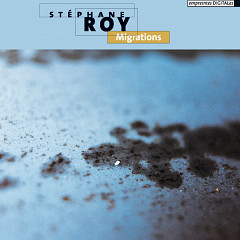
    The minimalist electronica movement probably appeals to the deep thinkers and armchair existentialists of the world, the ones who claim to find patterns in raindrops or, more precisely, who claim that such patterns could be found by anyone willing to take the time. Stéphane Roy, who has made a career of studying and teaching in the fields of electroacoustics and audio perception, might take that time. A Montréal native who’s spent an extended period in St. Louis, Roy seems as unlikely to provide a backing track for an audio book on chaos theory as he is to score a David Fincher movie, but that doesn’t mean he isn’t qualified. Methodical yet unpredictable, his challenging and sometimes semi-sonic Migrations enchants as it evolves, becoming something new with each passing reflection, adapting to its environment and seeming to say something different each time, while using the same set of notes.

    Of course, notes is a broad description. Roy’s controlled cacophony of feedback, found noises, sequencers and abstract percussion aren’t notes, per se, but they amount to something far more expressive than simple (or even complex) melodies can usually achieve: a quasi-intellectual reaction that’s half analytical and half primal. Why else would Appartenances’ middle stanza (Roy’s compositions come in three-part movements) appeal to my inner paranoiac, suggesting the possibility of danger behind every dormant car on the parking ramp? During the third stanza, the same holographic twinge used to signify the unreality of The Matrix blinks in and out of the background as a woman speaks gravely in French, like an airline stewardess on a nonstop flight to the afterlife.

    Then we’re off to the Orient Express as driven through a dolls’ house (Trois petites histoires concrètes) and a carnival in a house of flies (Masques et parades). Granted, these are my sonic descriptions, not Roy’s (his liner notes are far more acoustically explanatory), but the truth of Migrations is that everyone who hears it is likely to take away their own impression. There’s a lot of fun to be had in a disc that makes you feel like you’ve been caught up in a suspense film and a microprocessor at the same time.

    … makes you feel like you’ve been caught up in a suspense film and a microprocessor at the same time.

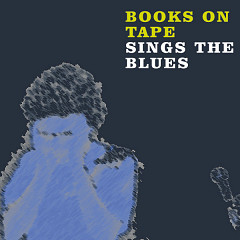
    Sings the Blues dans Neural

    «Recensione», Aurelio Cianciotta, Neural, 15 juillet 2004
    jeudi 15 juillet 2004 Presse

    Etichetta canadese, la No Type, per Todd Drootin, arista elettronico di Los Angeles, al suo secondo album, fra modulate e sperimentali combinazioni, a dar vita ad un melting-pot sonoro che annette (con estro) disparate influenze, campionando in abbondanza quello che più gli aggrada, senza particolari strategie ma guidato da gusti personalissimi (che gli fanno citare fra i ringraziamenti Albert Ayler ed i Pavement, i Neptunes e le Slits, Sonic Youth e Lee Scratch Perry). Non ci si annoia, questo è certo, ogni traccia è differente dall’altra, sorprendendoci con un dub sbilenco dopo schegge chitarristiche in Girls Up Front, oppure in Death In the Sex Shop, suonando sporco, come un gruppo no wave degli anni ottanta in preda ad una serata d’eccessi, sensazione che rimane anche nel brano successivo, Siberian Soundsystem, pur filtrata da altri innesti.

    Innocente, ironico, Books on Tape, fra riff rubati, atmosfere in prestito ed ispirazioni groove, imbastisce i pezzi, smanettando sulle molte macchine, collegate fra loro, le stesse che usa nei suoi live, come un musicista free jazz, che invece di uno strumento tradizionale suona invece campionatori, groove box ed effettiere. Combinazioni che diventano amabilmente funky, quasi ambientali, ipnotiche e reiterate, in Shake That, oppure scandite e misteriose in The Crucial, cinematica e ondeggiante prima dell’ultima traccia, Church Bus, dove la ritmica incede fra broken beats e schegge rock. Una produzione con suoni non certo innovativi e molto umorale ma che non dispiace nei risultati, nell’attitudine eclettica, spontanea, passionale ed inventiva.

    Rainbow Panda dans Hour

    «Spins», Dylan Young, Hour, 15 juillet 2004
    jeudi 15 juillet 2004 Presse

    What the fuck is this? The question quite springs to mind within the first samplerrific bars of Mixel Pixel’s third LP. The answer isn’t so easy to come by. Comparisons fall into their own complications, part Pavement indie bristle, part Unicorns aggro-cute, and a heavy dose of krautrock electro weirdness. The Pixelers pilfer sounds from vintage arcade and computer games (Desert Falcon for Atari 7800, Arkanoid and Pitfall II for C64), Gainsbourg, a Maytag drying machine and Mother Nature (rain and crickets). The result is half-dazed genius, not quite pretty, more pretty ugly — but beautiful on its own terms. Rainbow Panda is an aural disaster that sounds better than any of the individual sources that had to collide to make it.

    … not quite pretty, more pretty ugly — but beautiful on its own terms.

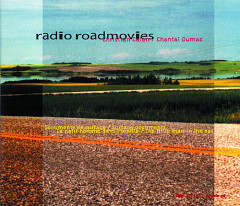
    Radio Roadmovies dans Splendid E-Zine

    «Review», Brett McCallon, Splendid E-Zine, 5 juillet 2004
    lundi 5 juillet 2004 Presse

    Surely it’s some sort of serendipitous combination of Canadian grant money and Splendid’s strong north-of-the-border label ties, but a dramatic preponderance of the most interesting experimental/electronic/noise-based work I’ve heard over my three-year tenure here has come from Montréal. Perhaps francophone Canadians, reacting to their province’s uneasy relationship with the rest of Canada, have converted discomfort into art. Perhaps it’s just something in the water. In any case, from the post-rock stylings of the Constellation roster to the very strangest soundscapes that issue from the empreintes DIGITALes folks, the work that comes out of this region is so intriguing as to make other areas’ artists seem deficient in both vision and their willingness to venture forth, assuming the audience will follow.

    Still, that public funding thing alluded to above can’t be overemphasized. In this case, two talented young artists/documentarians set out on a several-month-long trek across a wide swath of Canada, recording anything that piqued their interest. The result is this stunning two-disc set of field recordings and manipulated aural scenes, each of which conveys both a sense of narrative and a sense of the multifaceted nature of a geographically huge nation’s life. While each is a coherent artistic statement on its own, the two together are so complementary that it’s hard to imagine the one without the other.

    The first disc, “The Little Man In The Ear” (or, more mellifluously, Le Petit homme dans l’oreille), is the more manipulated-sounding of the two; the artists’ fingerprints are deliberately left all over certain sections, while others seem untouched from their original recordings. The prime example of the former comes during a visit to a carriage race: the announcer’s voice is sampled and manipulated as heavily as in any techno track, albeit sans the driving beat. As it swirls from one speaker to the other, the race’s sense of circular motion is recaptured and reimagined in the listener’s ear. It’s quite a trick, and a virtuoso production performance. At other points, sounds that had previously been presented in close to what I assume was their natural setting are subtly reintroduced in such a way as to give the listener both a sense of ongoing travel, and of the interconnectedness of things. For example, a track that begins with crickets chirping fades into people walking across gravel and eventually incorporates a barely-discernible conversation, then picks up each of the two previously added sounds once again, making you feel as if you’ve traveled some distance to visit with the speaking men, who have then graciously walked back with you to your point of origin.

    The latter disc, “Surface Documents” [Documents de surface], is approached somewhat differently. While the first disc appears to have been designed to be played on a radio program, the second seems more like a collection of compelling sounds that didn’t quite fit into the theme of the first. Therefore, this disc acts more as a roving, narrative-free travelogue that glances over the entire map, chooses a theme, and then touches down everywhere that that theme might apply. For example, one of the longer sections intermixes the sounds of water interacting with various surfaces at various volumes, blending the sounds of waterways that may have been thousands of miles apart into a single beautiful piece.

    If you can’t afford to take a few months and explore the backroads of Canada, I suggest that you take a couple of hours and let two people who clearly know their way around clue you in to the way life sounds in their country.
    … let two people who clearly know their way around clue you in to the way life sounds in their country.
  • 1
  • 2
  • 3
  • 4
  • 5
  • 6
  • 7
  • 8
  • 9