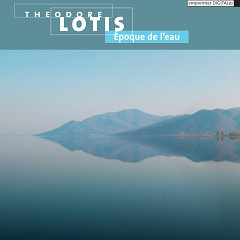
Époque de l’eau dans La Folia
Wind and water provide the background for

Wind and water provide the background for
I remember with a shudder the time in late August of 1967 passing through the Corinth Canal into the port of Piraeus, and how the leisurely atmosphere of the voyage turned into a brooding, guarded feeling, as if a cloud had suddenly moved in front of the sun. The reason was the military coup that had befallen the Cradle of Democracy in April the same year… The crew aboard M/S Messapia told me to stay in my berth the eight hours we’d be in the harbor, because I had long hair, and that was ruled out by the military junta. Accordingly, I bided my time in my little cabin in Piraeus, reading and sleeping, finally sensing with relief that the ship left the quay and headed back out onto the sea, making possible my ascension onto deck, from where I watched the silhouette of Athens sink back into haze and distance and military repression, as I took some deep breaths of air.
And this was around the time when
To me,
He studied guitar, flute, music analysis and composition in Greece, Belgium and England, and got his PhD in Music at the renowned City University of London. He has achieved a number of instrumental compositions and collaborated with artists within the dance, theatre and video idioms, arriving at the aspects of spectrum, timbre, sonic space and light where he invests his creative forces today.
Currently
“What most attracts me to the music of
Theodore Lotis is his mastery of the spatial image […] The spectral texture is distributed in multiple registers. Layers interact, come and go, relate sympathetically, or pressurize themselves as they seek their place, or move on […] ForTheodore Lotis , the distribution of sounds over spectral space and across time creates a diffused ambient space, in much the same way as natural light does […]”
Track 1.
It’s one of those coincidences that aren’t any coincidences — according to Deepak Chopra (SynchroDestiny
“I was […] interested in the spiritual aspects of the sonata.
Beethoven had just rebounded from a period of illness […]. Both the joy and the melancholy of life are merged in this movement as an omnipresent duality […]”
At 03:09 — 03:19 a clean quote from the
On both sides, however — i.e. backwards and forwards in linear time (which some of us hang on to as if our lives depended on it, in spite of its illusionary property) — this daunting realism floats in an unknown aspect of space and time that escaped the menacing laws of nature. Lotis’ music expands like unfolding rolls of tinfoil in absolutely steel blue space, touched upon by fingers of light and the eleven-dimensional thoughts of a towering thunderclap of a man
With the most delicate and brittle breath of electroacoustics,
This piece opens in shooting rays of piercing light between ominous, dark thunder clouds
There is a lot of motion inside this fabric of timbres, and you can sense upwards curves in transparent glissandi, like the fluffy hair of an infant stirred by a summer’s breeze. The murmuring in the back of the day provides a backdrop for incredibly beautiful, tiny events that curl and meander in metallic glares, like gold foil contracting and expanding on black velvet as humidity and temperature shift, as timbres swell and retract. Such is the delicacy of this soundworld
It was long since I heard such a nuanced and nano-emotioned sound web. At times the tiniest of sonic objects glare and tingle in flurries and swoops out of and back into the mineral realms of sound. The feeling is so abstract, yet physical, that I get a sensation of hovering weightlessness, and almost believe I’ve found a cure for gravity
At 06:42 a second brief, clear-cut piece of
Track 2.
The composer explains that he has used granular synthesis to mimic sand grains blowing, so he seems to be working the details and minuscule nuances here too.
As I get caught up in this second track of
I feel my senses arriving at an absolute awareness
Track 3.
The opening couldn’t be more ominous, with diminutive specks of sounding debris squirting over a dark, smoky progress of evil, relentlessly expanding down the duration. Watery, bubbling events turn back on themselves, like someone almost vomiting but managing to get it all down the pipe before it reaches the oral cavity — or like someone swallowing salty seawater, exhausted in the water, almost drowning… but simultaneously these swirling, swooping, bubbling sensations are beautifully chiseled out of the submerged moment.
At times I get the sensation of something really heavy in motion, like a huge locomotive, but with only the vibrations of the motion recorded
There are so many sounds of so many kinds in this piece that I can’t even begin to explain them, except that they’re all caught up in a grander motion. The composer just shifts his attention to different places in this moving contraption, like a diver sweeping his flashlight along the hull of a submarine that glides by. I hear all kinds of sonorities, like the rumblings of a dijeridoo and the monotonous rhythms of a small machine of sorts, plus grinding, frictional sonorities, as from the rubbing of a balloon, not to mention dark strokes of humus and clay, and lighter timbres like warm updrafts in the darkness of the void. This music absolutely has no end, although the piece stops after fifteen minutes and thirty-nine seconds…
Track 4.
Dedicated to
Lotis explains how he uses the violin and the human voice in this work, albeit heavily treated. His aim is to achieve “a strange vocal feel”. Of course, he refers to classical mythology in a piece named Sibylla’s Voice, i.e. the female prophets who were thought to have access to the god Apollo, from which they derived their cryptic messages, which were received with screams and shouts by the people gathered, who actually believed that they tapped into the mind of the god through the Oracles.
A cackling abstraction of a flock of seabirds opens this piece, white wings fluttering up over a torrential sea that hammers the lower chackras with the real motives of the day, like in a rugged coast by painter
A sequence of myriads of passing sonic strangers in varying pitches and of different durations ride a wave pattern through the score, be it a sound painting of the electromagnetic forces through interstellar space, the swell of an ocean
Lotis’ musical world is a highly abstract one, of course, in line with the prerogatives of distinct electroacoustic art, but this can be done at various levels of intensity, of abstraction. Lotis works the upper layers of this art, where the air is thin and the colors faint, and the perceptions sometimes white-outed by lack of oxygen — but that is also the altitude where you have the widest views. Before you faint, your visual field is breaking up into patterns of consciousness and unconsciousness, and this is the playground for
It may seem contradictory of me to point to
Track 5.
A quote from the composer’s introduction
“Shadows are the dark faces of light, the unexplored view of reality. Obscure or transparent, threatening or airy, a shadow always suggests motion. […] The generative idea throughout the piece is Heraclitus’ principle of the opposed duality. According to the Greek philosopher, an opposed duality contains two poles. Although seemingly opposing, these poles are interdependent and mutually connected. Light and shadow are the two poles of an opposed duality.”
[Heraclitus of Ephesus (500 — 440 B.C.), known as ‘The Obscure,’ was a pre-Socratic Greek philosopher from Ephesus in Asia Minor. As with other pre-Socratics, his writings only survive in fragments quoted by other authors. He disagreed with Thales, Anaximander, and Pythagoras about the nature of the ultimate substance, but instead claimed that the nature of everything is change itself
; he uses fire as a metaphor rather than his solution to material monism. This led to the belief that change is real, and stability illusory. ForHeraclitus everything is "in flux"]
This coin — through the first breaths of this piece — rotating on a marble step is so idealized it can only be envisioned as a cartoon coin on a cartoon marble step, spinning at such a high velocity that it would glow, were it a manifest object. In my musical mind, spun there by
If music is poetry, then this is
The metal of these sonorities wind and swirl in shiny, polished reflections of a surface, level and smooth down to the hastiest low-range reconnaissance, right in your face — and then suddenly from a space shuttle view, in planetary orbit… and back. The sonic flight, in all its fabulous, immaterial means of motion, magnifies and diminishes with the same
I
O wild West Wind, thou breath of Autumn’s being,
Thou, from whose unseen presence the leaves dead
Are driven, like ghosts from an enchanter fleeing,Yellow, and black, and pale, and hectic red,
Pestilence-stricken multitudes: O thou,
Who chariotest to their dark wintry bedThe wingèd seeds, where they lie cold and low,
Each like a corpse within its grave, until
Thine azure sister of the Spring shall blowHer clarion o’er the dreaming earth, and fill
(Driving sweet buds like flocks to feed in air)
With living hues and odours plain and hill: Wild Spirit, which art moving everywhere
;
Destroyer and preserver; hear, oh, hear! II
Thou on whose stream, ’mid the steep sky’s commotion,
Loose clouds like earth’s decaying leaves are shed,
Shook from the tangled boughs of Heaven and Ocean,Angels of rain and lightning
: there are spread
On the blue surface of thine airy surge,
Like the bright hair uplifted from the headOf some fierce Maenad, even from the dim verge
Of the horizon to the zenith’s height,
The locks of the approaching storm. Thou dirgeOf the dying year, to which this closing night
Will be the dome of a vast sepulchre,
Vaulted with all thy congregated mightOf vapours, from whose solid atmosphere
Black rain, and fire, and hail will burst: oh, hear! III
Thou who didst waken from his summer dreams
The blue Mediterranean, where he lay,
Lulled by the coil of his crystalline streams,Beside a pumice isle in Baiae’s bay,
And saw in sleep old palaces and towers
Quivering within the wave’s intenser day,All overgrown with azure moss and flowers
So sweet, the sense faints picturing them! Thou
For whose path the Atlantic’s level powersCleave themselves into chasms, while far below
The sea-blooms and the oozy woods which wear
The sapless foliage of the ocean, knowThy voice, and suddenly grow grey with fear,
And tremble and despoil themselves: oh, hear! IV
If I were a dead leaf thou mightest bear
;
If I were a swift cloud to fly with thee;
A wave to pant beneath thy power, and shareThe impulse of thy strength, only less free
Than thou, O uncontrollable! If even
I were as in my boyhood, and could beThe comrade of thy wanderings over Heaven,
As then, when to outstrip thy skiey speed
Scarce seemed a vision; I would ne’er have strivenAs thus with thee in prayer in my sore need.
Oh, lift me as a wave, a leaf, a cloud!
I fall upon the thorns of life! I bleed! A heavy weight of hours has chained and bowed
One too like thee: tameless, and swift, and proud.V
Make me thy lyre, even as the forest is
:
What if my leaves are falling like its own!
The tumult of thy mighty harmoniesWill take from both a deep, autumnal tone,
Sweet though in sadness. Be thou, Spirit fierce,
My spirit! Be thou me, impetuous one! Drive my dead thoughts over the universe
Like withered leaves to quicken a new birth!
And, by the incantation of this verse,Scatter, as from an unextinguished hearth
Ashes and sparks, my words among mankind!
Be through my lips to unawakened earthThe trumpet of a prophecy
! O Wind,
If Winter comes, can Spring be far behind?
Mythic birds croak and caw two thirds down the score, while bronze-light whirlwinds sway across the valleys in dusty sonorities. We’re deep inside a tale of enchantment by now, prey to the timbres of amnesia that pass like dark curtains over the windows of the mind. Our arms extend out from our bodies, our legs spread, until we’re hovering clouds of crumpling X’s, blown across the languages of the planet
Tracks 6 — 7.
La mer bleue
Lotis
“La mer expresses the joy and the purity of the water and proposes a listening in two levels
; […] an imaginary perception of the sea; serene and stormy […], sun sparkles on the water […]; the second a […] a symbolic perception […]; the passage to Hades and the road to new discoveries.”
Lotis reveals some of his methods in his introduction. He lets on that he uses the electronically treated hum of bees to paint the sounds of waves of the sea. He utilizes a string quartet, electronically chiseled, to take on the likeness of light on surface and liquid fluency.
The first movement of
Professor
”
Robert Erickson ’s Oceans is a composition for solo trumpet and a collection of instruments made byRobert Erickson . It evokes the many experiments that he and I (Jack D. Logan ) did when I was a graduate student at UCSD in the Ph.D. program from 1968-1971. In one such experiment, he and I ventured to a storm drain in La Jolla, California that emptied into the ocean for a recording of the acoustic long waves of the sound of the trumpet. Oceans is made from source tape make in St. Paul’s’ Cathedral in San Diego, California in 1971.”
Although this text takes on
“The composition had its origin in a sound, the remarkable reverberation of a five foot storm drain in La Jolla, California. This drain could be entered from the beach, and one strenuous afternoon of activity yielded tapes of trumpet, percussion and ocean sounds. A year or so later the idea for Oceans came into focus, an expansion and idealization of the sounds heard during that recording expedition. Nevertheless, there is nothing programmatic about the piece, although its long rhythms are more wave-like than are most land-based rhythms.
After exploring many spaces for their sound and reverberation potential, we decided to record in St. Paul’s Cathedral, San Diego. The original storm drain was ruled out — it was too wet, and the sounds of the ocean too insistent. The composition is a mix-down of six over-dubbed tracks, four of trumpet and two of percussion. The percussion sounds are produced by an aluminum bar, about four feet long, with an attached resonator, the same bar used in the original tests, and a single Bb tuning fork. Different beaters and striking points produce different pitches and timbres.”
The second part of
The alien, eerie whines near the conclusion of the piece, on that soaring, humming and wheezing darkness of a backdrop, coldly illustrates the dire situation of each lonely soul in transmigration through the frightening and completely objective — and therefore merciless — Bardo of Afterlife
Theodoros Lotis présentera
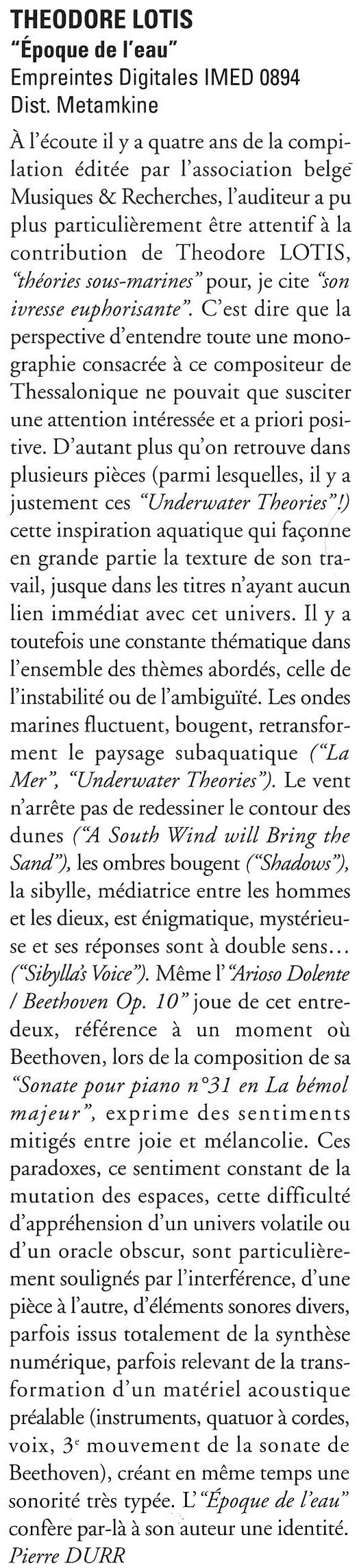
La 94e parution empreintes DIGITALes, Époque de l’eau de Theodoros Lotis, est maintenant disponible.