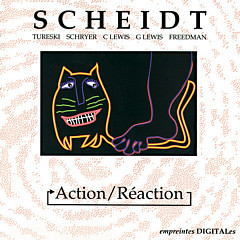
Action / Réaction dans Montreal Mirror
«Review», Andrew Jones, Montreal Mirror, 7 mars 1991
jeudi 7 mars 1991
Presse

Le directeur de l’Association pour la création et la recherche en électroacoustiques du Québec (ACREQ),
La musique électroacoustique est un
La musique populaire a trop utilisé l’électronique au niveau de la production d’album. Ce qui fait dire à
La musique électroacoustique est née vers 1950 dans des stations de radio.
L’exploration étant la plupart du temps un phénomène marginal dans le monde de la musique, il y a lieu de se demander à quoi peut bien servir une association comme l’ACREQ. Elle s’est d’abord donnée pour mission de promouvoir la musique électroacoustique québécoise. L’association édite des enregistrements musicaux sur cassettes d’artistes québécois et fait la promotion de ces derniers à l’étranger. L’association organise aussi des ateliers de création sonore dans les écoles pnmaires et secondaires. Les élèves peuvent alors s’initier à diverses techniques inhérentes à l’électroacoustique comme la prise de son, l’échantillonnage ou le montage par exemple.
Le directeur de l’ACREQ sort un premier disque compact sur étiquette empreintes DIGITALes au mois de juin. Un album qui aura l’air d’une trame sonore de film. Gageons que cette première offrande sonique est trés attendue des amateurs.
Demain soir au Théâtre Les Loges, deux électroacousticiens ayant endisqué sur l’étiquette empreintes DIGITALes bouclent la boucle d’une tournée canaclienne
D’un océan à l’autre, la tournée
Selon
Ne partons pas en peur, environ 400 exemplaires de chacune des productions empreintes DIGITALes ont été vendus
Deux productions
En quelques mois à peine, deux productions viennent d’être mises en marché. À l’occasion du festival Montréal Musiques Actuelles (en novembre dernier), l’équipe d’empreintes DIGITALes avait d’abord lancé le disque
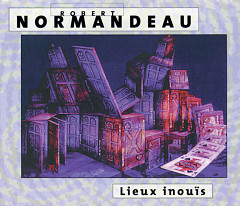
Le plus récent produit empreintes DIGITALes sera d’ailleurs lancé demain
Au terme de la tournee
Spécialiste de la forme multi-média,
Si l’on connait les ruades rythmiques et l’utilisation éclairée des technologies de pointe chez
Les œuvres de
This sampler contains works by a wide variety of mostly Canadian composers and sound artists, ranging from the sampler/manipulator par excellence,
It is clear from the sensitivity to pitch-type material that
The earlier works on the CD flesh out the background to these two works. About
Electroacoustics is only slowly coming to grips with the perceptual parameters of our field, and is now starting to develop an analytical vocabulary which begins to deal with sound as object, symbol, metaphorical object, and metaphor. If language is accepted as vocabulary and syntax in the service of a semantic (including the relationships of same), the acousmatic use of pre-existing sonic objects allows for the immediate creation, perception, and understanding of form(s). This is because the basic sonic object (vocabulary element) is a whole and complete object, not requiring hierarchical relationship(s) (syntax) to obtain meaning (semantic). The creation of a syntax is achieved through the transformation of these vocabulary elements.
Much more could be written about the textural nature of these two composers, and acousmatics in general
Each composer addresses the material and moves from a similar source type (concrete and digital transformations applied mostly to concrete, but occasionally electronic sources), but in different directions (in/out). The works on the
Careful headphone listening reveals a small number of minor technical flaws, but these works were not created for headphone listening, or for that matter, for listening in two-channel stereo. In the various electroacoustic concerts in Montréal (there are more than three regular series accounting for more than 30 concerts per year), these works are presented in sound projection systems with a minimum of eight channels, and as many as 24 and more. Eight to sixteen-channel diffusion is typical. In simple stereo listening, some of the material is spatialized as simple panning, but during the process of spatial actualization or sound projection in performance, these simple stereo localizations may become intricate directional weavings and spinning.
Much of the work carries with it an acoustical perspective (reverberation and basic localization characteristics). The use of various venues and types of loudspeakers provides the composer with means for physically expanding and contracting the source of the perceived sounds during this process of spatial actualization. It is because of this that individuals who have access to multispeaker systems, either for their own use or more importantly for public presentation, should consider that a two-channel presentation of these works is parallel to (for example) a piano version of
The series continues with a third CD of works by
En novembre demier Montréal accueillait la onzième édition du festival New Music America, rebaptisé par les organisateurs Montréal Musiques actuelles. Ce festival de 11 jours a présenté plus de 450 artistes venus du monde entier. De ce nombre, il faut souligner les performances de