Sauter au contenu principal
electrocd

Blogue

83 résultats
  • 1
  • 2
  • 3
  • 4
  • 5
  • 6
  • 7
  • 8
  • 9
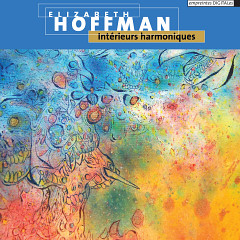
  • Intérieurs harmoniques dans Chain DLK

    «Review», Vito Camarretta, Chain DLK, 7 octobre 2012
    dimanche 7 octobre 2012 Presse

    Even if Intérieurs harmoniques is officially her debut album, it’s quite clear since the first seconds of listening that NYC-based composer Elizabeth Hoffman is not a callow improviser and the fact her solo-release comes out on Canadian label empreintes DIGITALes, one of the most appreciated in the field of electroacoustics and acousmatics by many demanding followers of the genre, is fairly meaningful.

    Once the listener can easily ascertain her skillfulness in modelling mainly percussive sounds, related to her passion for electroacoustics, which has been accrued over many years of academic background, the most remarkable aspect of Elizabeth’s sound maybe lies in the fey facets of her visionary (lasting about ten minutes each) sound collages. Listener’s imagination immediately meets its match in the intial (and most recently recorded) track Resonants, where the seducing texture of bells, glockenspiel and cymbals seems to echo back listener’s phosphenes after closing eyes and the following movement could be associated to a fictitious pebble nearby the rail in the act of listening the coming, the arrival and the departure of a train in the subway. This imaginary ear-transplant or cochlear implant into a molecular entity could be imagined while listening to Water Spirits — listeners could easily think about the vicissitudes of a water particle since the moment it arrives on earth from a storm cloud, which travels across conduits, sewer pipes, sinks, entrails and viscera afterwards — and Songstressed — its listening could let you think about microphones on a particle of dust which during its mishaps falls into a bird’s syrinx! Similarly fictional microscopic journey could be inspired by remaining tracks: Allamuchy reminded the initial track of Autistici’s Beneath Peaks I recently reviewed due to the recordings of different moments (including a nap), which have supposedly been recorded in the natural set of Allamuchy wood in New Jersey, while d-ness sounds like the sonic translation of some emotional set which couldn’t be explained but through sounds. The effected squeaks and every tessereas of the sonic mosaic of the final Soundendipities, which costantly sounds on the edge of a cliff, closes this interesting listening experience with a sinister note of acousmatic self-irony indeed!

    … fictional microscopic journey…

    Palimpsestes dans Vital

    «Review», Frans de Waard, Vital, no 850, 1 octobre 2012
    lundi 1 octobre 2012 Presse

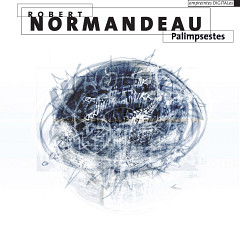
    By now I was looking for that first Normandeau CD on Empreintes Digitales, because I remembered it had some great acousmatic piece on it. And I can’t find it — another reason to work on a more serious attempt of putting my CDs in alphabetic order. Over the years Robert Normandeau (1955) has released some more releases, but I always seemed to like the first one best, but it made me also always curious about his new works, which I can’t say for all of the releases on this label. Maybe it’s because there is an element of anarchy in the music of Normandeau, which I like. It appears here in a piece like Jeu de langues, which uses breaths and whispers and sounds like a piece of erotic sound art — a genre that hardly exist (which Normandeau finds odd, since its regular to be found in literature, painting and cinema). It’s easily nicest piece on this CD. Some other pieces, like the title piece and Murmures seem to work within the very strict style of acousmatic music which the label is best known for, but really is not my cup of tea. Anadliad however is piece for two wind instruments and that works really. No rapid glissandi of computer processing but a thoughtful, almost drone like piece of music with some nice storm and thunder sounds. The CD closes with Palindrome which also has a more sustaining sound, almost orchestral in approach I’d say, but with various sound elements dropping in and out, in what seems irregular intervals. All of these pieces are quite long, between ten and fifteen minutes, but certainly the third, fourth and fifth pieces are excellent displays of electronic music, and don’t seem to be too ‘easy’. The other two however seem to do that, a bit too heavily as it is.

    … the third, fourth and fifth pieces are excellent displays of electronic music…

    Palimpsestes dans De:Bug

    «Kritik», multipara, De:Bug, no 166, 1 octobre 2012
    lundi 1 octobre 2012 Presse

    Hier hat sich das lange Warten doch gelohnt. Normandeau, einer der zentralen Proponenten und Pioniere der kanadischen Elektroakustik- und Akusmatikszene, wie auch deren Heimatlabel zuhause in Montreal, stellt nach sieben Jahren fünf neue Stücke vor, von denen jedes für sich zupackt und kalte Schauer über den Rücken jagt. Viermal klassisches Kino fürs Ohr: “Palimpseste” schließt den Onomatopoeias-Zirkel aus Sprachschnipseln ab, “Murmures” kehrt zurück zum Ort seines ersten Europa-Gastaufenthalts und dessen Klängen zurück (Ohain, Belgien), “Jeu de langues” versucht sich an einer erotisch gefärbten Komposition aus Nebenprodukten unterschiedlicher Sprach- und Blasinstrument-Artikulationen, “Anadliad” feiert mit Dudelsack, Hornpfeife und rauem Wetter keltischen Geist, “Palindrome” schließlich verabschiedet mit einem fesselnd dahinströmenden Deep-Listening-Werk. Jedesmal scheint man dabei in einem hyperrealen, zum Zerreißen gespannten Traumfluss zu stehen, dessen Bedeutung ungreifbar bleibt. Große Musik ist das.

    Große Musik ist das.

    Intérieurs harmoniques dans De:Bug

    «Kritik», multipara, De:Bug, no 166, 1 octobre 2012
    lundi 1 octobre 2012 Presse

    Sechs Stücke, die vorbeiziehen, ohne sich festzubeißen, fein und sanft mutieren, in sich gekehrt ihren Textur- und Farbraum auskundschaften, je nach Ausgangslage. Ob räumlich verwischte Rauschwirbel und Resonanzen metallischer Percussion, algorithmische Collage aus Wasseraufnahmen, deren Farbe durch Filter oder mikrozeitliche Verwirbelungen modifiziert wird, harmonische Analyse gedehnter kurzer Vogelrufe mit fast klassisch orchestral wirkendem Ergebnis: Die Musik von Elizabeth Hoffman, Gründerin und Leiterin des Computermusikstudios an der NYU, bleibt akusmatischer Ambient. Auch in den spannenderen Ausgangslagen der zweiten Hälfte, die sich klangfarblich auffächert, auch technisch vielseitiger wird, sich dem strahlenden Klang des D-Tonraums auf zwei Violinen widmet, Naturgeräusche eines Parks in den flugzeuglosen Tagen nach 9-11 in frei bewegliche Klangaggregate verwandelt, oder Physical Modelling körperloser Vibrationen zum Ausgang nimmt: Schön, aber zu brav, um herauszuragen.

  • 1
  • 2
  • 3
  • 4
  • 5
  • 6
  • 7
  • 8
  • 9