Sauter au contenu principal
electrocd

Blogue

68 résultats
  • 1
  • 2
  • 3
  • 4
  • 5
  • 6
  • 7
  • 8
  • 9
  • Pierre Alexandre Tremblay dans 5:4

    «HCMF 2016: Seth Parker Woods […] », Simon Cummings, 5:4, 26 novembre 2016
    samedi 26 novembre 2016 Presse

    Friday at HCMF began with a recital by rising star cellist Seth Parker Woods. I’ve had the opportunity to see Woods play once before (at HCMF 2014) and the experience was a highly impressive one, so I was very much looking forward to seeing him in action again. He did not disappoint, performing four challenging works, two of which involved live electronics. […] The unquestionable highlight of the concert, though, was Pierre Alexandre Tremblay’s asinglewordisnotenough3 (invariant), which provided both a composition masterclass in its seamless, aurally non-hierarchical interaction between acoustic and electronic, as well as a performance masterclass in its bravura display of frantic virtuosity from Woods. The work’s narrative was excellent, progressing through a series of evolving episodes each fuelled by the cello, many of them rhythmically taut (though never sounding metrically fixed) with a tendency later to expand out into more sustained soundscapes where the cello’s material was more buoyant. Utterly thrilling, and Woods unstoppable performance was outstanding. […]

    … a composition masterclass in its seamless, aurally non-hierarchical interaction between acoustic and electronic…

    Espaces tautologiques dans The WholeNote

    «Review», Paul Steenhuisen, The WholeNote, no 22:4, 1 novembre 2016
    mardi 1 novembre 2016 Presse

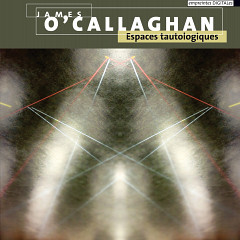
    On his recent electroacoustic CD Espaces tautologiques, composer James O’Callaghan takes us down the rabbit hole into a visceral, endogenous acousmatic wonderland. Although tautologies can be defined as “needless” repetitions, for O’Callaghan, they instead may be an ironic unifying premise for his vagabond auditory adventures, or append extra significance to compositional procedures such as varied repetition, imitation, and augmentation. The first three pieces (Objects-Interiors, Bodies-Soundings, and Empties-Impetus) form a triptych that “imagine(s) the sounding bodies of instruments as resonant spaces.” They contain crisp, natural, and remodelled recordings of passages through remote instrumental spaces, and at times it feels as though the listener is situated inside the instrument. From the rim to the spine of a piano (Objects-Interiors), an acoustic guitar and toy piano (Bodies-Soundings), or the surfaces and recesses of instruments in a string quartet (Empties-Impetus), each piece celebrates the percussions and resonances of a similar, colourful palette of instrumental and digital treatments. O’Callaghan demonstrates fluency with standard techniques of electroacoustic music, but it’s the impetus of the philosophical aspects that takes the pieces to their most compelling territories. The last piece, Isomorphic, is a particularly captivating jaunt through protractions of carefully ordered squealing, chattering textures. While the work shifts from one archetype to another, it’s coherently driven by consecutive, playful morphological relationships that extend from one sound to the next, despite differences of sound source and context. By virtue of the gesture, contour, pitch, and timbral coherence of his materials, O’Callaghan proposes contrasting ways to consider the ornithological chirps, industrial doors, and ambient environments. They can be heard as a perpetual flow, in which all sounds are related as one, or as a duality in which the listener simultaneously compares the ongoing profile similarities of the sounds with their wildly differing origins.

    … each piece celebrates the percussions and resonances of a similar, colourful palette of instrumental and digital treatments.

    Lépidoptères dans The Sound Projector

    «Through the Looking Glass», Stuart Marshall, The Sound Projector, 30 octobre 2016
    dimanche 30 octobre 2016 Presse

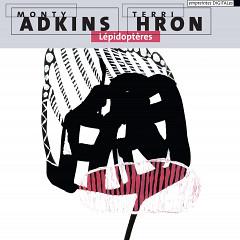
    Last heard purveying Rothko-esque, aquatic ambience in Unfurling Lines (the waterways of which having lulled but not quite committed me to my final rest), ambient composer Monty Adkins makes a stylistic metamorphosis and takes to the air with a new collaborator Terri Hron and her ‘consort of renaissance recorders’ for a five-section survey of moths, butterflies and other winged insects, each piece deriving from an idea about a particular order. This ‘display case’ approach makes sense in the empreintes DIGITALes catalogue, where each collection receives the taxonomer’s treatment; every piece given a full exegesis — often quite scientific in tone — in the liner notes.

    It also delivers straight into the action, avoiding the long narrative arc from minimal matter to maximal clatter that such singular, scientific surveys tend to take as the depth of field narrows on increasingly intricate detail. Each section constitutes its own field of activity, marked by a set of common features, such as the recorders’ sharp, electrified exhortations that weave, whistle and roll into granulated deconstructions of their own essence. Those of us with gardens might forget the butterfly’s decorativeness in this thick, processed churn of organic, primal matter, which really digs into the violence of full-blown physical change. It also reminds us of the truly alien aspect these creatures acquire when considered up close; their insect sensibilities airborne in dotted patterns, the quivering of internal cavities and the organic passage of events that finds its natural habitat when just shy of critical mass.

    … ambient composer Monty Adkins makes a stylistic metamorphosis and takes to the air…

    Espaces tautologiques dans Sigil of Brass

    «Review», Andy Backhouse, Sigil of Brass, 21 octobre 2016
    vendredi 21 octobre 2016 Presse

    So says the blurb — but what did I get from this album: genius, essentially.

    James O’Callaghan is a composer and sound artist based in Montréal praised for his “mastery of materials and musical form” (Électromania, Radio France) and “highly refined sense of colour” (Vancouver Sun).

    There is plenty of that is this recording.

    Using a blend of electroacoustic media, employing field recordings, amplified found objects, computer-assisted transcription of environmental sounds, and unique performance conditions this is an album to be reckoned with — there is everything from orchestral crescendos to the quietest of piano witterings.

    O’Callaghan’s work spans chamber, orchestral, live electronic and acousmatic idioms, audio installations and site-specific performances. His work has been variously commissioned by the Groupe de recherches musicales (GRM), NYO Canada, Ensemble Paramirabo, Quasar, and Standing Wave, among others.

    A composer with pedigree — and this album holds out.

    In many ways, this is a very busy recording — the listener does not get much time for peace. As the name of the album suggests — this is a very claustrophobic affair. But one worth pressing on with. Yes, there is the odd flirtation with solace; but that is soon knocked asunder for the betterment of noise.

    … genius, essentially.

    Antwood, Richard Chartier, Michel Chion, Francis Dhomont, Pita, Adam Stanović dans La Presse

    «Akousma», Alain Brunet, La Presse, 19 octobre 2016
    mercredi 19 octobre 2016 Presse

    Michel Chion, Troisième symphonie, l’audio-divisuelle

    À l’Usine C le 19 octobre, 18h

    Le compositeur français qualifie sa troisième symphonie d’œuvre «audio-visuelle». Il s’applique à y faire s’entrechoquer sons et images de différentes manières. Cette œuvre a pour objet de «célébrer la vie sans aucune référence religieuse» et d’évoquer la mort «plus solaire que pluvieuse». De plus, Michel Chion dit avoir eu recours aux principes musicaux de la composition pour monter les images et les faire interagir avec les sons.

    Pita, Get In

    À l’Usine C le 19 octobre, 20h

    Pita est le pseudonyme du fondateur des Éditions Mego, Peter Rehberg. Londonien transplanté à Vienne, ce vétéran de la scène électro s’inspire du bruitisme, de l’ambient, de l’industriel, du drone, de la techno, mais aussi des premières vagues électroacoustiques. Pita a enregistré une douzaine d’albums au cours des deux dernières décennies. C’est un habitué des plus grands festivals électro: Sónar, All Tomorrow’s Parties, CTM Berlin, Donaufestival. Il a reçu le prix Ars Electronica en 1999. Get In, qui sera présentée à Montréal, suit les œuvres Get Out (1999) et Get Off (2004). De la suite dans les idées… au cœur du son.

    Adam Stanović, Escapade et Mettallurgic

    À l’Usine C le 20 octobre, 20h

    Directeur du programme de maîtrise en art sonore de l’Université de Sheffield, Adam Stanović se spécialise dans la composition d’œuvres électroacoustiques de type acousmatique. On a pu entendre ses œuvres dans quelque 500 festivals et concerts à travers le monde. Escapade se veut un assemblage inédit de micro-fragments de musiques orchestrales. Quant à Mettallurgic, elle met en scène l’exploration sonore d’un morceau de métal via la résonance, la percussion et autres manipulations physiques de l’objet, et aussi via le traitement électronique de ces manipulations.

    Antwood, Pièces de l’album Virtuous.scr

    À l’Usine C le 21 octobre, 20h

    Antwood est le pseudonyme de Tristan Douglas, artiste canadien endossé par les labels Cocobass et B.YRSLF Division (sous le pseudo et jeu de mots Margaret Antwood). Il jouera à Akousma les versions alternatives de pièces tirées de son plus récent album, Virtuous.scr. L’idée de cet album se fonde sur la question suivante: l’intelligence artificielle peut-elle respecter un code d’éthique qui lui est propre si elle connaît un éveil «émotionnel»? Autour de cette thématique, la musique expérimentale investit les codes de la musique populaire se déployant dans un environnement électronique.

    Richard Chartier, Recurrence / Retracing

    À l’Usine C le 22 octobre, 20 h

    Actif depuis la fin des années 90, le Californien Richard Chartier s’est taillé une réputation dans les sous-tendances néo-moderne et micro-son de l’art sonore. Sa musique et ses installations ont été présentées en Europe, en Asie, en Océanie comme en Amérique du Nord. En 2000, il a fondé le label Line et assumé la direction artistique de nombreuses installations sonores. Son approche se veut autoréflexive: sa musique minimaliste explore l’espace sonore tout entier à travers les différentes caractéristiques de la relation entre émetteur et récepteur d’une œuvre: l’écoute, la perception, l’attention, le silence, etc.

    Francis Dhomont, Cycle des profondeurs I, II e III

    Au Conservatoire de musique de Montréal les 20, 21 et 22 octobre, 17h45

    Parmi les pionniers vivants de l’électroacoustique, Francis Dhomont a amorcé un très long cycle de création à la fin des années 40. Il a passé une large part de sa vie professionnelle entre la France et le Québec. Nombre d’œuvres importantes du répertoire lui sont attribuées, dont les trois volets de ce Cycle des profondeurs, présentés en autant de jours. Sous le regard d’un soleil noir (1979-1981) relate un naufrage intérieur, inspiré des écrits du psychiatre et psychanalyste Ronald D Laing. Forêt profonde (1994-1996) est un mélodrame acousmatique d’après un essai de Bruno Bettelheim. Le cri du Choucas (2014-2015) évoque l’approche psychanalytique de Marthe Robert.

    Michel Chion; Pita; Adam Stanović; Antwood; Richard Chartier; Francis Dhomont
  • 1
  • 2
  • 3
  • 4
  • 5
  • 6
  • 7
  • 8
  • 9