Sauter au contenu principal
electrocd
  • This website is also available in English.

Blogue

2899 résultats
  • 297
  • 298
  • 299
  • 300
  • 301
  • 302
  • 303
  • 304
  • 305
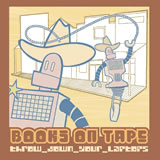
  • Throw Down Your Laptops, Books on Tape dans e/i magazine

    «Off the Spine», Tobias C van Veen, e/i magazine, no 1, 31 mars 2003
    lundi 31 mars 2003 Presse

    Cowboy techno? Acoustic breakbeats with a country twang? Y’all better throw down dem’ laptops, y’hear? While I think Todd Drootin’s call for laptop performers to “return to live gear performances” is a regressive and reactive solution if taken seriously, his playful acoustic jam-sessions play the South of electronic music & launch a critique reminiscent of — or at least the spirit of — Kid606’s Down With The Scene. Energetic ‘organic’ broken beats with plenty of pianos and guitars, injected with meticulous and miniscule sampledelia. Where Books on Tape excels is in the arrangement and composition of each track — a shot from a six-shooter, some bullets a dive into inventive indie d’n’b: hick Gold Chains? Effects and sounds are used with introduction, precision, and care, yet every confinement has its prisoners and here the live, gearbased performance risks an overdetermined audio palette for the potential multitude of animals in this vibrant jungle. Given the handcuffs, the restraints nevertheless provide a medium for experiencing pleasure, a stripped sonic canvas: Gear without Laptop (GwL). Whip me over that barstool in this forgotten backwater saloon filled with DVD pirates high on nanodrugs — some twisted William Gibson novel gone horribly awry in a Western timewarp — but Drootin is not John Wayne: he’s the sharp shootin’ fourth amigo missing from the trilogy of electronic music: gear, digital, and electroacoustic. A new cyborg from the T-series plant? What sounds will breed from this huevos rancheros hybridity? Whereas the melodrama and quirkiness of each track bodes well, the vocals on Sporty But Sensible Car don’t. The practical dada voicing on The Contenders spanks me better: it cries indielectro. (A spark in the naming engine?) As ‘acoustic’ as it is, this disc is experimental simulacra, each track a forensic foray attempting to breathe vitriol into a wired world through a sonic mirror. Its success depends on whether you like American dualisms.

    … broken beats with plenty of pianos and guitars, injected with meticulous and miniscule sampledelia.

    Isostasie dans e/i magazine

    «Off the Spine», Dwight Loop, e/i magazine, no 1, 31 mars 2003
    lundi 31 mars 2003 Presse

    Learning from a master, Jonty Harrison (University of Birmingham, UK), Barrett’s developed a distinctive voice on Isostasie. While at Birmingham, she was greatly influenced worked under the auspices of BEAST (Birmingham ElectroAcoustic Sound Theatre). Collaborating with those visual/theatrical artists further led to a doctoral degree in composition; now residing in Oslo and active in NICEM (Norwegian International Confederation for Electroacoustic Music), Barrett’s music on her hrst release for empreintes DIGITALes is a deep reflection of her intense interest in tape-splicing experiments. An integral element of tape composition, pre- and post-computer era, has been the use of mathematical equations in determining sound characteristics and, on Three Fictions (Northern Mix), Barrett utilizes loose algorithmic structures refracting sight, sound, and sensation. Section one is based on a statistical simulation of rain falling onto a two-dimensional surface; in the third section, locations of events are calculated by using a numerical system, in this instance, sound materials placed by hand, which have a lighter and more deliberate character. The result of this statistical realization? Randomness, in some ‘harmonious’ fashion, alluding to the idea the sounds were intentionally composed. Such a Cage-ean approach serves her well; however, an even better result is achieved when Barrett lets her senses take over, as in the remarkable Red Snow, composed after her relocation to Norway and a definitive representation of an awareness of the surrounding environment: swirling snowflakes at the mercy of wind, labyrinthine ice crystal patterns, stark moonlit landscapes. Imaginative, evocative music abounds as well on Viva la Selva!, inspired by the antithesis to Norway’s icy landscape: the forests and jungles of the world. Here, location recordings are transformed into abstract (mis)representations of the insect, bird, and animal kingdoms, electronic manipulations evoking the beauty of the natural world around us.

    Imaginative, evocative music…

    Hey Typical! dans Trax

    «Critique», Trax, 18 mars 2003
    mardi 18 mars 2003 Presse

    Voilà un bien étrange 10” bleu… Mélange de postures rock, de basses punk et de bric-à-brac électronique, Books nous fait son tour jongleur, découpant en break’à’brak le carambolage des compositions de Rubin Steiner, Roudoudou, Funki Porcini, Woodentops et quelques anciennes références bigbeat. En quelques sorte, une réactualisation du son Cup of tea.

    Throw Down Your Laptops, Books on Tape dans LA Weekly

    «Crossed Wires», Wendy Gilmartin, LA Weekly, 14 mars 2003
    vendredi 14 mars 2003 Presse

    Northridge-born and still a Valley dude, electronic manipulator Todd Drootin drinks a lot of coffee, smiles easily, and swivels his attention between L.A.’s charms and its cons, disparaging our pitiful radio selection, praising Claremont’s KSPC, then musing about the dearth of decent live venues. “I had a gig at the Bar Marmont, and they stopped me after three songs and were, like, ‘Uh, that’s good enough, thanks.’”

    Drootin’s musical incarnation, Books on Tape, can be heard more regularly ricocheting inside the Smell’s slimy walls downtown. BoT might look like a one-guy outfit onstage; really it’s a duo: a give-and-take between Drootin and his sampler. But where other electronic artists revel in that self-reflexive world of glitches, blips and buzzes, Books on Tape wants you to think it’s a band. Some call its sound “beat punk” — a tightly wound ruckus that’s composed completely on a wired box.

    “If people want to call it beat punk, that’s fine; to me it’s just music I made on a sampler,” says Drootin. “As long as things remain interesting, I have no need to be consistent.”

    Audiences seem to have a fairly immediate grasp of the 25-year-old Drootin’s noise now, in contrast to his wobbly first show alone at a straight-edge punk festival in Florida three years ago. “I was really thrown in the fire. Those guys didn’t know what to think of me, but in the end I got a pretty good reaction.”

    Now comes a souped-up, full-length CD excursion, Throw Down Your Laptops (Deathbomb Arc), recorded and produced by Drootin and Brian Miller via samples of generated and found sounds. One or two seconds of zooming guitar, run backward through the sampler, might serve as the beat of a song, while another two or three layers of amp hiss chop out a melody you’ll hum for days. Simultaneously electronic dance and sloppy punk, BoT submits warm & fuzzy bits of sound to mechanical bondage for its DIY-meets-DOS feel.

    Drootin’s last band — during his college days in Santa Cruz — played too loud for their practice space, and Drootin and his collaborator eventually pooled their cash for a sampler to generate beats. “He wanted to have his hands in everything, and so did I, so we stopped working with each other. That’s when I started going it alone.”

    Santa Cruz was also where Books on Tape’s amalgamative style originated. “I used to live up in the mountains. There was this one spot where all the radio stations would just bleed onto each other, and that was the best part of my ride home. I was such a spaz in my car for two minutes, just hearing all the combinations, like Spanish and jazz and this and that. I’d never heard indie and electronic, and I said, ‘There it is.’ It was the crossings of all these kinds of music that got me the idea of that sort of peanut-butter-and-chocolate mix. I thought, ‘Hey, what’s my Reese’s melody?’”

    The tastes in Drootin’s larder are not that simple a mash; they’re blended with great discrimination, as becomes apparent on a stroll through Amoeba Music. “I like Jim O’Rourke, but he’s not the savior of the world,” he says. Others who arouse polite uncertainty are Hot Hot Heat (“It’s all the same”), Missy Elliot (“I wanted to like it so bad”), Beck, Fischerspooner, and Dntel (“But there are good ideas on that album”). The positives are more varied: Watts Prophets, Daedelus, Foghat, Negativland, Scarnella, Derek Bailey and Jay Z.

    “Jay Z is a guy who knows the image he wants to put out, and there’s something very valid about that, even if it’s not always listenable. I appreciate that in bands, like with Sun Ra — he stuck with his story. I have Jay Z and Sun Ra fairly close together on my record shelf.”

    Drootin says he was thinking about that kind of unified approach more with Throw Down Your Laptops than he did with his previous releases. “Now I have to do my Todd’s United Front — which seems riddled with holes to me, but maybe someone else doesn’t know that.” The title is a direct reference to the cut-and-paste genre of IDM dudes like Squarepusher and Aphex Twin, though it’s not exactly a gauntlet thrown in challenge. Drootin says he’s not trying to start a cultural revolution: “I love MC5 and Kick Out the Jams — antagonistic, but playfully so.”

    He hesitates and sips his coffee. “I don’t want to end up in the ‘unusually experimental’ section at Amoeba with $160 box sets.” Then he smiles. “Well, maybe someday.”

    Some call its sound “beat punk” — a tightly wound ruckus that’s composed completely on a wired box.

    Throw Down Your Laptops dans Exclaim!

    «Review», Michael D Edwards, Exclaim!, 4 mars 2003
    mardi 4 mars 2003 Presse

    Books on Tape, one of the pseudonyms of Todd Books (which is in itself is a pseudonym of Todd Drootin), have made their mark up to now providing background music for MTV’s reality TV shows and providing the online community with quality MP3s that could best be described as indie-electronica. The neat thing about Throw Down Your Laptops is that it doesn’t follow the usual pathway that home-made dance music does. Books doesn’t rely on computers, preferring to layer beats, blips and beeps with guitars and other instruments to make some old-fashioned electronica performed live in the studio. Naturally, he had some help along the way, including members of Bright Eyes and Slowcoach, helping to keep that indie-rock philosophy. Throw Down Your Laptops is one of those albums that is fun to delve into, but it is exhausting to listen to the full album is one sitting. Some of that has to do with the growled vocals on some songs that really break up the flow because they seem out of place with the far superior music. Perhaps more care when picking collaborators next time round would help.

    … one of those albums that is fun to delve into…

    Isostasie, Parr(A)cousmatique dans Revue & Corrigée

    «Critique», Pierre Durr, Revue & Corrigée, no 55, 1 mars 2003
    samedi 1 mars 2003 Presse

    Natasha Barrett est une jeune acousmaticienne britannique installée à Oslo, Arturo Parra est, lui, un Colombien résidant au Québec. Les associer dans cette chronique relève ici d’une forte subjectivité, leurs univers sonores respectifs étant totalement différents, au-delà bien sûr de certaines techniques communes à toutes les musiques électroacoustiques.

    La première pratique une forme de juxtaposition de couches sonores en interaction mutuelle, les unes provenant de l’environnement direct (donc naturelles et parfois reconnaissables), les autres étant transformées. Arturo Parra superpose le travail d’un instrument acoustique, la guitare (un jeu profondément volubile et chaleureux qui caractérise le style latino-américain) et les bandes magnétiques. Tour à tour Gilles Gobeil, Robert Normandeau, Stéphane Roy, Francis Dhomont, piliers d’empreintes DIGITALes, l’assistent.

    L’association des deux créateurs peut se justifier par une partie de la thématique de certaines œuvres. Natasha Barrett s’attache à décrire des paysages naturels, avec sa sensibilité. Red Snow évoque les tourbillons de neige de sa patrie d’adoption. D’autres pièces font référence à cet environnement (Outside Snow Falls, Midnight Sun: Midday Moon… ); elle pratique en somme une météorologie sonore (Replaced). Son intérêt pour les paysages naturalistes se retrouve aussi dans Viva la Silva, évocation de la forêt vierge de Costa Rica a travers les grouillements, piaillements, de la faune (les oiseaux surtout) mais aussi les transformations de la voix humaine.

    Avec Arturo Parra, on retrouve un peu de cette thématique paysagère. Mais la sienne est plus axée sur des paysages dans lesquels il ressent une présence — voire une absence — humaine. La forêt vierge semble encore garder les traces des peuples anciens (La basilique fantôme), abriter un voyageur/aventurier (D’or et de lumière) ou être tout simplement la cadre d’une impression de solitude humaine (Soledad). Le résultat sonore chez lui est très emphatique, volontaire, dynamique, tandis que sa consœur réalise un travail d’une approche plus introspective.

    Le résultat sonore chez lui est très emphatique, volontaire, dynamique, tandis que sa consœur réalise un travail d’une approche plus introspective.
  • 297
  • 298
  • 299
  • 300
  • 301
  • 302
  • 303
  • 304
  • 305