Sauter au contenu principal
electrocd

Blogue

37 résultats
  • 1
  • 2
  • 3
  • 4
  • 5
  • 6
  • 7
  • Petites étincelles dans ATTN:Magazine

    «Review», Jack Chuter, ATTN:Magazine, 30 novembre 2017
    jeudi 30 novembre 2017 Presse

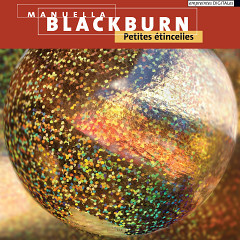
    These collages are like the obsessions that infiltrate dreams. Imagine, for example, that you have an epiphany about the beauty of photography. You spend the daytime taking photos or diving deep into the literature on lenses, shutter speeds, photographic film and aperture. And so sleep becomes an overspill for these incessant, excitable thoughts, twisted by the liberal logic of dreams. Shutters flutter outward like a startled bird flock, mechanisms whirr on either side… these sounds slosh from left to right, mimicking the movements of animals or draw bridges or hurricanes, conjuring an imaginary universe in which they exist as the only available building block. On Snap happy, the third track on Petites étincelles, cameras are everywhere. The compositions of Manuella Blackburn feel vital and thoroughly alive, imbued with her fascination for these noises and their charming twitches and intricacies, frenetic with the desire to drench the senses in more than can realistically be absorbed simultaneously.

    Yet this is not chaos. I may be overwhelmed at points, yet even the most spectacular of eruptions feels adherent to a common direction. The pieces inflate to fill the entire stereo space with acoustic resonances, then fade into a light rain of ticking minute hands, then reduce to vertical spindles of plucked string, then stretch into tufts of ambient mist. At any given moment, the kinetic energy feels extreme. Spilling, tumbling, exploding. Time will tell often sounds like a cluster of grandfather clocks spontaneously combusting, with springs hurled through space; Ice breaker drowns me in tides of carbonated liquid, blinded by bubbles and the splashes of a thousand ice cubes. Yet to view these pieces from an aerial perspective would be to witness the narrative that assuredly tugs the bedlam forward, left, right, up, down. Even amidst the rapture of sonic obsession, Blackburn never loses sight of the overall shape, and just how the whirl of life can be perceived as grander arcs of age and steady change, so these collages allude to the prescient, symbiotic understanding that exists between the sounds that hurtle past each other.

    The compositions of Manuella Blackburn feel vital and thoroughly alive…

    Flux dans Vital

    «Review», Frans de Waard, Vital, no 1106, 13 novembre 2017
    lundi 13 novembre 2017 Presse

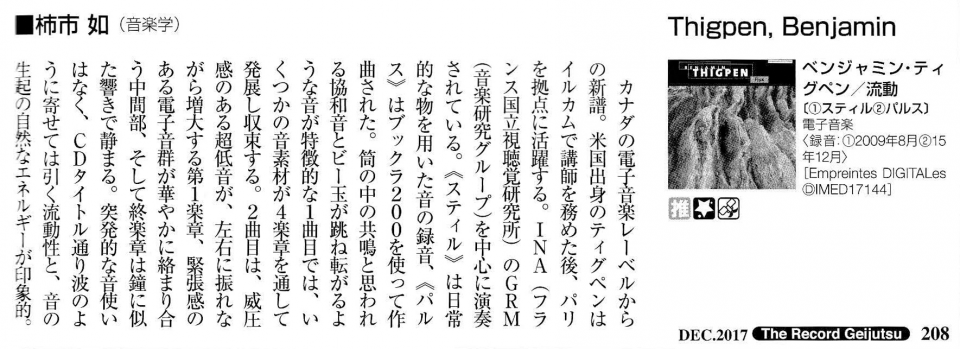
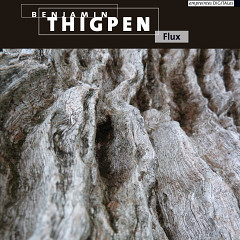
    Here’s someone who was born in the USA, now official inhabitant of France, but who refers to himself as a nomad. Although he dropped out of the conservatory, he taught at Ircam and now in Mons, Belgium. He creates music for loudspeakers and has a duo with Jean-François Laporte, called Rust and as Les Frères Bobine with Stefano Bassanese and with cellist Benjamin Carat as Fluid Identities. “He thinks that music is not a language but a lived visceral experience, and that is not the art of sound but the art of the transcendence of sound”.

    On his CD we find seven pieces, four of Still (2007-2009) and three that make up Pulse (2010-2015). In the first one “all the sound are recordings of common objects, used without transformation; the only processes applied are equalization, compression and reverberation”. It is not easy to say what these common objects are. In the three of the four parts it sounds like wind blowing down pipes, along with some amplified string object, set up in a hollow, reverb setting and in the other the amplified sound of rubbing objects over carpet; a very subdued, low, bass like sound.

    I thought these were great pieces, especially because they didn’t sound for a change like something on Empreintes Digitales; no endless amount granular synthesis here. On Pulse he uses the sounds of Buchla 200 Modular analogue synthesizer and it’s all about small fragments forever changing. This too is quite the different kind of music than we know from the label; it is much more an analogue feeling that we get from this piece of music, with the second part being a particular harsh one, even when more feedback like sounds are part of all three. Maybe this is Empreintes Digitales entering the domain of modular synthesizers? The third part of Pulse is a particular beautiful, shimmering piece of delicacy but also with that much needed edge that makes you sit up and listen closely. This was altogether an excellent release.

    This was altogether an excellent release.

    Histoires d’histoire dans SilenceAndSound

    «Critique», Roland Torres, SilenceAndSound, 11 octobre 2017
    mercredi 11 octobre 2017 Presse

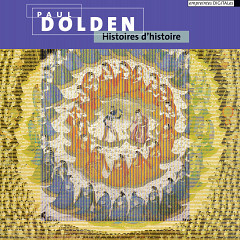
    Guitariste, violoniste et violoncelliste, Paul Dolden est un compositeur touche à tout qui a su depuis ses débuts, combiner l’héritage musical de notre passé, au sens global du terme, et modernité, via l’utilisation des nouvelles technologies pour tisser des liens étroits entre racines disparues et imaginaire mondialiste.

    Toujours à la recherche de ce que nos ancêtres ont composé et dont la plupart des œuvres ont complètement disparu, ne laissant pour toute trace que des systèmes de notations musicales au déchiffrage souvent approximatif, Paul Dolden invente un langage qui lui est propre, mixant sonorités du monde et approche contemporaine, dessinant de nouvelles contrées aux géographies abstraites, où l’on peut croiser harmonies moyen-orientales, free jazz, rythmiques tribales et expérimentations électroacoustiques, le tout formant un conglomérat impressionnant, aux images cinématographiques puissantes.

    Regroupant trois pièces créées entre 2012 et 2013, Histoires d’histoire manipule les temps et les astres pour nous faire voler sur des tapis volants au dessus de déserts magnifiés par les désaccords et les fuites en avant, plongée abyssale dans un chaudron magique aux vertus rafraichissantes, jonction entre les frasques de l’humanité et ses points communs, rapprochement des mondes et des modes, à coups de narrations sublimées par la richesse des vocabulaires employés, écourtant les distances entre l’histoire et l’infini. Sublime.

    Sublime.

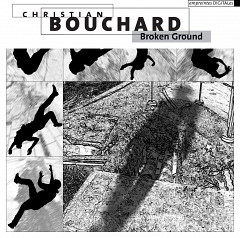
    Broken Ground dans The Sound Projector

    «Review», Ed Pinsent, The Sound Projector, 30 septembre 2017
    samedi 30 septembre 2017 Presse

    Enjoying Broken Ground by Christian Bouchard… this award-winning Montréal composer studied under Yves Daoust and has been involved in a number of cinema and installation projects. Matter of fact, this present album could be one of them. It’s the soundtrack for an exhibition put together by the visual artist Derek Besant, and the music premiered in Brighton in 2012. Besant is full of interesting ideas… Broken Ground is an attempt to do something with urban environments and address the way they are changing with non-stop development and profound infrastructure shifts going on everywhere. That is not an especially original idea, but I like Besant’s take on the theme, when he talks about treating urban sites as stage sets with “props, actors, exits and entrances”, and how this helps him perceive something about the underlying laws of chaos. I can’t say that Bouchard’s music exhibits the same intellectual depths, but he is trying hard to get into the spirit of the work. The titles in this 12-part suite all refer to phenomena which may be familiar to highly advanced architectural scientists who observe the decay of buildings, such as Intergranular attack, Kinetic Friction and Low Cycle Fatigue. Or they may simply be invented. Some of the pieces are bolstered with distorted speaking voices, women rattling off what sounds like scientific data, and these factual fragments are effectively collaged into the work, giving it some added sense of authenticity. There’s also a kind of open-endedness to the music which is refreshing, unlike the majority of over-cooked and hyper-dense works we often hear on this label, which exhaust me with their overladen abundance in digital form. If Christian Bouchard wanted to leave the listener with the impression of glimpses of the future and speculative ideas about what is happening to the fabric of modern cities, then he has come close to succeeding with his enjoyable and ambiguous electronic music.

    … enjoyable and ambiguous electronic music.

    Paul Dolden dans Chain DLK

    «Interviews», Vito Camarretta, Chain DLK, 29 septembre 2017
    vendredi 29 septembre 2017 Presse

    We recently had an in-depth conversation with Canadian electroacoustic composer Paul Dolden, following the review of his recent output Histoires d’histoire on empreintes DIGITALes. You’ll understand the reason why his musical production — focusing both on harmonic and tonal research as well as on the superimposition and juxtaposition of different music styles — deserves to be delved into.

    Chain DLK: Hi, Paul! How are you?

    Paul Dolden: I am good. Thank you for taking an interest in my music and contacting me. I always love to hear from people who enjoy my music.

    Chain DLK: Could we take some steps back for readers who are seeing your name for the first time, starting from the very first ones? How did you get closer to “experimental” music?

    Paul Dolden: My musical history is a classic North American West Coast baby boomer story. Born in 1956, I practised various musical instruments as a boy. I started playing professionally when I was 16. I grew up in a home where my mother’s side of the family were classical musicians and she was constantly playing the classical literature. My father was not a musician, but came from a long line of string players and was invariably listening to jazz. During these early years, I owned a tape recorder and became fascinated with audio technology.

    My curiosity about modern music began when I was about 14 years old. In the late 60s and into the 70s, the idea of a new music, a new art, a new society, etc. was on everyone’s mind. So there I was, a 14-year hippie child buying my Xenakis, Bartok, Muddy Waters, Coltrane and Hendrix albums. Although I had some music teachers as a kid, I am primarily self-taught in music. Therefore, when it came time to go to university, I skipped over music and studied liberal arts. Ultimately, I would have loved to be a historian or philosopher, but let’s just say my talent for music was stronger. During the university years, I started composing short works, mainly using technology to create this music. In Vancouver at that time, there were almost no performers who would play a contemporary score. Indeed, there was really no “new music” scene to speak of. Very quickly, the unique musical possibilities of the recording studio, computer music programming, and live electronics appealed to my musical imagination.

    During my 20s, I transitioned from a full-time performer to a full-time composer. Now I only perform on my own recordings and with a few friends just for fun. Composition and audio technology has taken over my life!

    Chain DLK: Do you remember the dreams of musicians and composers when technology began to spread into the scene? How did they change over the years, in your viewpoint?

    Paul Dolden: For sure, I remember the dream that we would all produce music, and through published recordings, people would hear your sound and you could access the musical thoughts of others without leaving home.

    Musicians would all become like Glenn Gould or The Beatles, with the studio being the centre of creation and performance. Many of us announced the death of the concert hall, but we underestimated people’s attraction to public rituals.

    In addition, many of us had the dream that a new music would transform culture and society.

    For sure, as time went on, and the 70s turned into Reagan, Thatcher, and Mulroney, just surviving as a full-time modern music artist became the dream!

    At the level of day-to-day tools, I can remember the excitement of getting my first 4-track tape recorder and then an 8-track tape recorder. I remember programming a mainframe computer in 1977 with Stochastic and Gaussian distributions and thinking I was hearing something new.

    Back then, I could have never imagined that today, on a home computer, I would be recording, mixing and processing hundreds of tracks of sound.

    Chain DLK: Is there anything you criticize about GRM precepts and teachings?

    Paul Dolden: GRM and the German school at Cologne were important for establishing the studio as a place of creation that did not involve live performances.

    They are also important for discovering ways to use audio technology to manipulate sound.

    Having restated the “official” history of electroacoustic music, I do hope that in the future they tell the full story of technique and tool development. For most of us, it was the development of these techniques, at the same time or earlier, by Les Paul, Hendrix, Pink Floyd and numerous Foley artists since the 1940s, that informed our sonic imaginations when we were younger.

    Chain DLK: Any complaints against contemporary musicians and their audience? Is there anything that audience had problems understanding regarding compositional experiments like the amazing ones you made?

    Paul Dolden: The “contemporary” music or “new” music scene is so wide and varied that it is hard to make a summary comment. Among the mid-century modernists I still really like are Ligeti and Berio. And there are a lot of composers since then I really like, for example, Adès, Abrahamsen, Sallinen, etc. However, I have to answer the question in a different way.

    When we say contemporary music, we usually mean music that does not sound like 19th-century music. By contrast, for years, I have been following a lot of composers who continued writing in the tonal tradition with clear structural articulations or “climaxes”. About 60 of these composers, living or recently dead, are documented by Robert R. Reilly’s book Surprised by Beauty. By definition, they are contemporary musicians, although largely ignored by the “new music” scene.

    Among my reasons for listening to these composers is that I still struggle with most modern music that is constantly dissonant in our tuning system. Twelve-tone equal temperament (12ET) was designed to create tonal music that can modulate rapidly. The most accurate representation of our 12ET semi-tone in the harmonic series is the distance between the 84th and 81st harmonic. Let’s face it; even heavy metal guitars or Peter Brotzmann’s saxophone do not produce 84 harmonics! There is an infinite amount of varying dissonance possible in new tunings, so why the semi tone over and over in “modern” music?

    As far as audiences go, there are lots of people who love my music in various ways, and when I do a concert the audience is enthusiastic about what I am presenting.

    Performers today are amazing, and I have had a chance to work with some of the best over the last 35 years. We often talk about how music language has developed so rapidly over the last 100 years. I suspect an ever-greater growth has occurred in instrumental technique.

    Chain DLK: Recently, I heard Histoires d’histoire, but the first time I met your music was on L’Ivresse de la Vitesse — wonderful release! — … Can you introduce it to our readers?

    Paul Dolden: The double CD, now two separate single CDs, L’ivresse de la vitesse (Intoxication by Speed) mainly includes works from 1989-1995 and is inspired by postmodern theory. The program notes suggest which part of post modernism I am taking on musically. The music is dominated by speed and density and quick changes in musical style. Indeed, many musical styles occur at once and are transforming at the speed of sound. Since 1983, I have had the same simple working method: first I compose the works with hundreds of musical parts on large manuscript paper, then I hire musicians to play the parts individually, and finally I mix and master all the musical parts or tracks separately. This working method allows for each part to have its own tuning system and/or tempo, if I want.

    I could talk on and on about compositional technique in the each work, but most of my concerns are clearly summarized in the introduction to the main score for the CD.

    Instead of talking on and on about the early works, I would like to take this space to clarify an important aspect of these works that many people are left confused by.

    Two times in my life, I have gone through a massive re-mastering of early works (everything before 2004). This often takes almost a year to do. I go back to the original recordings and remix and master. This habit is inspired by the ever-improving sound of modern audio technology. I also do this because it often takes me years to fully understand the music and how to maximize the mix for the work. Remember, the works involve hundreds of musical parts occurring simultaneously. This musical understanding of a work could be compared to the career of many conductors. Conductors often talk about conducting the same work for 30 years and preferring their later performances because they understand the work better. Likewise, I prefer the later masters and, yes, they are more true to my original music score for the work.

    The first major re-mastering job was done in 2000-2002. These re-mastered versions were published by empreintes DIGITALes at that time on CD. After years of listening, I re-mastered the works again in 2012. Only recently have I turned these new masters over to empreintes. I hope they will have these 2012 versions on their streaming service soon.

    I promise my listening public I will not re-master or “re-conduct” my works again! I am getting too old!

    Chain DLK: Why was the above-mentioned last release titled Histoires d’histoire? Sounding like a ‘best of’?

    Paul Dolden: Although I have lived in Quebec for almost 20 years, my French is still a work in progress. My understanding of the title of this new CD is “Stories of History.”

    Like my previous work, the main artistic inspiration is history or stories from the past. In this work, a different historical myth inspires each movement, hence the title.

    Chain DLK: Some reviewers labeled the triptych of Walls of Jericho as apocalyptic… Would you say the same?

    Paul Dolden: When I hear my work from the 80s and early 90s now, I understand why people thought they were apocalyptic. I prefer to think of those dense music worlds as creating a sublime music. Specifically, I wanted the music to create a sense of grandeur or power, and of inspiring awe and reminding us of the things that are larger than our banal lives.

    The program notes for the works usually had a historical/philosophical idea I was trying to capture in music. These ideas were based on topics as wide ranging as the biblical Walls of Jericho, the Romantic notion of music creating the social revolution, the postmodern idea that the speed and density of the information of our times are creating an intellectual and emotional stasis, etc., etc. With such big ideas, the music itself had to be larger than life!

    But whatever my artistic intentions were is of little importance. The listener will always decide for himself or herself the meaning of an aesthetic encounter. The real artistic or aesthetic moment happens in the relationship established between the listener and the music. For example, the Walls cycle of works has been described by some as transcendentally beautiful. By contrast, I know of two scientific experiments in which the same music was used to create an environment of pain for the test subject.

    Chain DLK: Regarding labels, your music has been often labeled as ‘maximalist’ (supposedly to highlight the fact it’s opposite to minimalist) … Do you agree with such a way of filing your music?

    Paul Dolden: Apocalyptic and maximal are adjectives that work for much of my music. I understand the need for labels and pigeonholes for music. Indeed, I spend great amounts of time on streaming services finding new music and I always put reductionist labels on it so I can remember what it is at a later time! That is just being human, with brains that only have so much RAM and so much hard drive space. But let’s not lose sight of the fact that music exists to express things beyond words.

    Chain DLK: As a former and current fan of drum ‘n’ bass and fast-paced music in general, I still remember a masterpiece by yours, Who Can Play The Fastest … what was the spark for that?

    Paul Dolden: This is from the “Who Has…” cycle of works. The largest work in the cycle is the 52-minute studio work called “ Who Has the Biggest Sound? ” which is published on Starkland Records (USA). Then there are five works for instrument (s) and tape. For example, “ Who Has the Strangest Melodies? ” is for chamber orchestra and tape, or “ Who Has the Biggest Noise? ” for electric guitar and tape.

    In this cycle of works, I am studying different musical styles and nature sounds to uncover their relationships. In short, nature’s sound patterns create most of the music and are everywhere in this cycle. For example, the same intense microtonal and polyrhythmic patterns of a swarm of insects are modeled onto brass, wind, and string parts. In this work, I found that country music sprang to life alongside the howling hounds of the open plains, and that Spain begat Flamenco alongside crickets that chirp in 6/8; I found Chinese and Thai tuning systems in the insects of south-east Asian rainforests, etc., etc. In short, in these works, I am considering the relationship between culture and geography and take it to its logical extreme.

    Many of the titles in this cycle of works are questions, because I am creating an imaginary battle of the bands in which, for example, our soloist tries to play faster than the accompaniment, which is music based on cricket sounds, or our string orchestra tries to play a more mournful melody than the combined pitch bends of a herd of cows.

    By the end of this cycle, my belief that I or other musicians were “original” music thinkers was shattered. With the musical styles I explored in the work, I found each of their fundamental music patterns pre-existing somewhere in nature. Perhaps we are only mimicking what already exists, given, for example, that it is now estimated that insects first appeared 480 million years ago.

    I should add that, for the listener looking for a Soundscape work, I would not recommend this cycle of works. All my source material, the nature sounds, were transformed into music, and the unsuspecting listener hears what I hope is a series of entertaining and engaging moments and goes on a musical journey unaware that they are listening to insects or barnyard animals. The lack of clear identification on my part, between human music style and natural source, is because I believe that any artwork that is totally complicit in its own absorption, so that it no longer makes apparent sense on the surface, will exercise a remarkable fascination. In short, an artwork fascinates by its esotericism, which preserves it from external logic.

    Chain DLK: Is there anything not explained by the liner notes of Histoires d’histoire that you would like to share with us?

    Paul Dolden: The program notes do not really discuss the musical problems I am working on. To summarize:

    1. I have been trying to figure out for years how to combine textural writing and density with the singular identity and memorable aspect of melody.
    2. I have become frustrated as a listener and as a composer with the metronomic or “steady tempo exactly on the beat” aspect of classical music. Therefore, I have been exploring how to use what are called groove rhythms as a basis for the “skeleton of time” in my work. These rhythms are based on performances of African, Latin, jazz or rock music.
      Secondly, the tempo of my work is almost always changing, usually quite slowly, inspired by Indonesian music but also observable in many ragas and Western improvised music, including rock and jazz.
    3. From the beginning of my career, I questioned the idea of only 12 tones to an octave fixed at set vibrational rates (i.e. A=440). During the 1980s, and for the last 15 years, I have developed my own tuning systems or used historical tuning systems. I often use the more “true” or “natural” Just Intonation, but I am also interested in discovering new types of irrational dissonances. For example, one of my favorites is to design non-octave tuning systems or tuning systems with no octaves or 5ths. By that point, throw out the entire ear training you ever did and start all over!
    4. Marshall McLuhan coined the term “global village” 55 years ago, and yet most musicians specialize in a specific style of a specific genre.

    I have always been fascinated with all the music of the world and have tried in my own humble way to bring it all together into one artistic vision.

    I am not interested in “cross over” music, or fusion. Instead, I want to understand and use the deep grammar of different music to create a unified aesthetic picture. I hope this is not another version of cultural imperialism.

    On the other hand, I do realize my ambition of combining diverse music and orchestrations is based on being a privileged Western educated male who can listen to Indian or Thai music on recordings and read books on this music. And the fact that I grew up in a surplus economy, which allowed me at age 16 to buy, at the same time, my first Les Paul and Sitar. The same surplus economy which has allowed me access to recording gear which meant I could learn how to balance all these different types of timbres and gestures through the use of equalization, compression, expansion, transient and sustain shaping tools, panning, spatial enhancement tools and extensive mixing.

    The listener will have to decide whether my music represents another brick in the wall of Western decadence and decline, or if it is part of a new perception and understanding of what it means to live in the Global Village.

    Chain DLK: The core of this release is the 5-piece set of Music of Another Present Era, a brilliant collage ranging from the reverie of Space Age music to African deities (Shango’s Funkyness refers to the god of storms in Nigeria’s old beliefs, if I remember correctly) … Can you tell us something more about this impressive composition?

    Paul Dolden: The previous answer covers my main concerns.

    Chain DLK: Any words about the other two wonderful ensembles attached to Histoires d’histoire?

    Paul Dolden: As I mentioned, I have had wonderful opportunities to work with great musicians over the years. Maurizio Grandinetti (guitar) and Lukasz Gothszalk (trumpet) are both great soloists and amazing musicians. In each of their works, there is a pre-recorded tape part. Like the rest of my works, the tape part creates different musical environments for the soloist and listener. For example, the tape may be in a heavy rock music mode with two drum parts, two electric basses and a wall of electric guitars with the soloist essentially going wild on their instrument. Within a minute or two, the soloist will be surrounded by soft wind instruments from around the world, usually playing the same musical material but in a soothing manner. As much as I love other people’s music, I still feel frustrated that 99 percent of most recordings document a performance. Why can we not have constantly changing orchestration, densities, and moods in our music? The string quartet is one of my favourite chamber ensembles, but after 15 minutes, I am tired of two violins, one viola and one cello. Can we not have, simply, 2 cellos, one viola and one violin, or two of each, or one of each, etc., etc. And why the constant buzz of a bow at 8khz? Can I have a cymbal ride up there, or a shaker every so often?

    Needless to say, these two “concertos” that appear on the CD pose a challenge for most listeners, who are expecting a set proscenium arch or background around the soloist. In this case, Maurizio and Lukasz rose to the occasion of a stage that is constantly changing size, shape, colour and mood.

    Chain DLK: Are you performing something on live stage, by chance? If so, are you going to make a jump in Europe?

    Paul Dolden: All I know right now is that I will be doing several concerts of my electroacoustic work in England in the Spring of 2019, for which I will be attending. Performances of my works for instrument (s) and tape go on without me knowing most of the time.

    Chain DLK: Any work in progress?

    Paul Dolden: I am doing research for my next cycle of works that will be inspired by String Theory and that our “reality” may be vibrational phenomena at its core.

    In addition, many of us had the dream that a new music would transform culture and society.
  • 1
  • 2
  • 3
  • 4
  • 5
  • 6
  • 7