Sauter au contenu principal
electrocd

Aussi dans le blogue

20 résultats
  • 1
  • 2
  • 3
  • 4
  • Au-delà, La marée dans Revue & Corrigée

    «Critique», Pierre Durr, Revue & Corrigée, no 100, 1 juin 2014
    dimanche 1 juin 2014 Presse
    … l’auditeur appréciera les développements de la clarinette basse, s’extasiera sur les sonorités curieuses de cloches issues du piano Baschet-Malbos, l’extension sonore constituée par la table de Babel et son aura mystérieuse…

    La marée dans Le son du grisli

    «Critique», Guillaume Belhomme, Le son du grisli, 2 mai 2014
    vendredi 2 mai 2014 Presse

    Sur La rupture inéluctable, la première des pièces de ce double CD, Pierre Alexandre Tremblay ne raconte pas notre histoire, mais j’y vois des coïncidences. Un homme (le soliste?) seul face à des haut-parleurs. En 2011 (c’est l’année de la composition). Une clarinette basse (celle d’Heather Roche) lui lance un appel. Il ne bouge pas. Une deuxième basse, maintenant, sur la première. Cela lui rappelle un air folklorique, ou plutôt (il hésite, maintenant), une composition de Braxton. L’acoustique contre les schémas électroniques, l’homme contre la machine. Un homme seul face à des haut-parleurs qui l’envoutent.

    Je remercie Pierre Alexandre Tremblay pour La rupture inéluctable et pour Mono no aware, ses pièces les plus récentes. Dans Mono no aware, je vois d’autres coïncidences. Dans ces rubans de sons qui m’encerclent et tournent. J’entends en eux la corne de brume de la table de Babel de Jean-François Laporte, mais elle est multipliée. Je cherche d’où vient l’appel et me tourne dans l’autre direction.

    Comme je ne vois pas des coïncidences dans tout ce que j’entends, je passerais à côté des trois autres compositions: Le tombeau des fondeurs, où le piano Baschet-Malbos de Sarah Nicolls sonne des cloches électronique, Still, Again, où la soprano Peyee Chen fait face à un désordre électronique aussi, et Un clou, son marteau, et le béton, où Sarah Nicolls revient au piano pour un exercice romantique que mon pauvre cœur ne peut souffrir… C’est le hasard des coïncidences et le vouloir des compositions. Deux, pour moi, coïncidaient.

    Je remercie Pierre Alexandre Tremblay pour La rupture inéluctable et pour Mono no aware, ses pièces les plus récentes.

    Topographies, Allusions sonores, Au-delà, La marée, empreintes DIGITALes dans The WholeNote

    «Four Discs from empreintes DIGITALes», Wende Bartley, The WholeNote, no 19:8, 1 mai 2014
    jeudi 1 mai 2014 Presse

    It’s been close to 25 years since the founding of the unique Montréal-based label empreintes DIGITALes (empreintesDIGITALes.com) in 1989 by Jean-François Denis and Claude Schryer. Solo-directed since 1991 by Denis, the label has produced 130 discs representing 107 composers and specializes in contemporary electroacoustic music, acousmatic and musique concrète. Although these genres of music are not the common fare for most of the concert events listed by The WholeNote, it is important to realize that the technical innovations and ways of thinking that have been pioneered by the practitioners of this music have had a wide influence on a vast array of musical forms and styles as well as media-based art forms.

    One of the most distinguishing features of electroacoustic music in general is that it is composed primarily within a studio environment and is designed to be listened to through loud speakers. And although the ingredients of melody, rhythm and harmony can be an aspect of electroacoustic music, its primary focus is on the sound itself, which can originate from recordings made in a particular acoustic environment, or generated and processed through purely electronic or digital technologies. Sometimes the original sound source is recognizable – such as recordings of ocean waves or the inside of a piano, and in other situations, the sounds have been studio processed beyond recognition of their original context.

    Back in 1990, empreintes DIGITALes offered its own vision of the wide array of possibilities within the electroacoustic genre. It published the groundbreaking Électro clips CD which featured three-minute miniatures by 25 different composers, each one representing a unique approach to working in a studio environment.

    More recently, the label has released four new albums by four unique composers: Martin Bédard (Montréal), Pierre Alexandre Tremblay (Montréal/UK), Andrew Lewis (UK) and David Berezan (Calgary/UK). Although the pieces are of longer duration than the three-minute clips, each disc presents four unique approaches and aesthetic visions.

    Each of Bédard’s five acousmatic compositions on his Topographies CD (IMED 13121) creates a sonic picture of specific acoustic environments, ranging from recordings made in restored jail cells to the soundworld of trains. He also weaves in tributes to what he calls “phonoculture” – lyrics from a Rush song or the audio heritage of a specific community. He is captivated by specific behaviours, whether those be of a night watchman or of metal under stress, and his compositions are expressions of his curiosity.

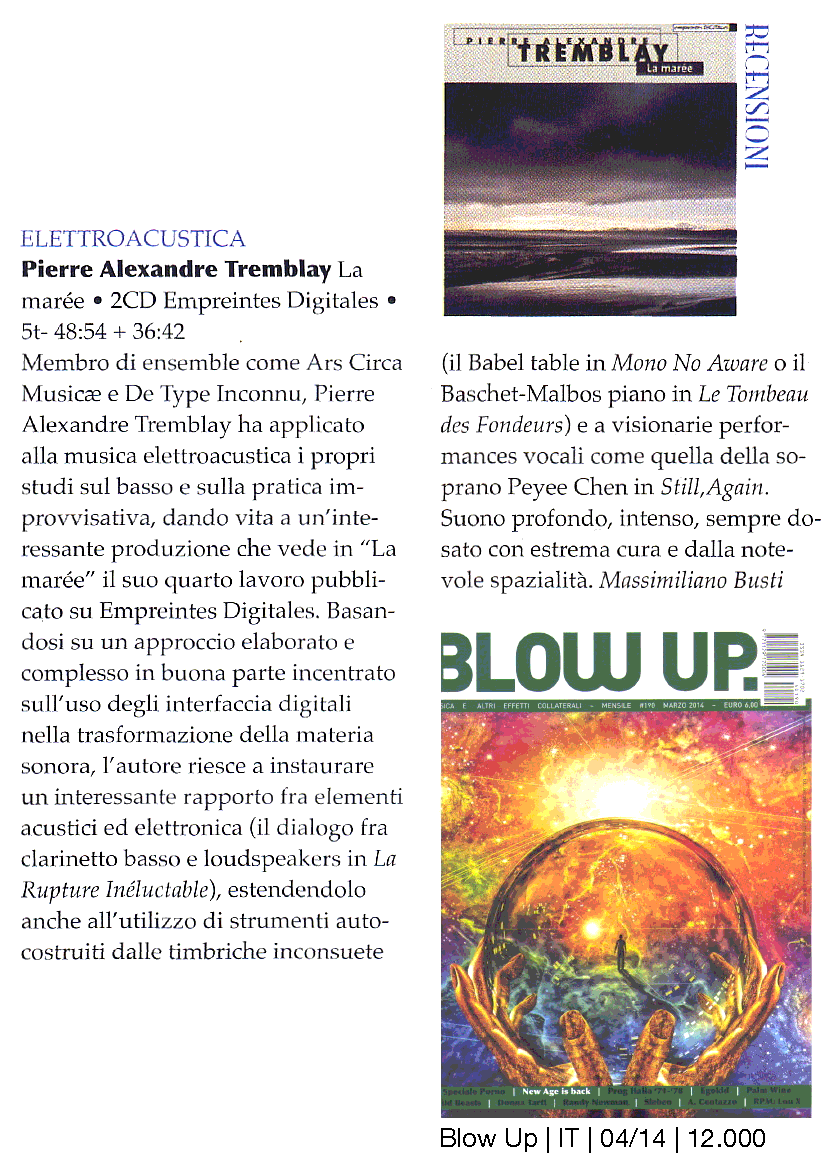
    The five compositions on Tremblay’s 2-disc set entitled La marée (IMED 13123/124) are excellent examples of the interaction between live performers and a form of live processing of the solo instrumentalist. I found his piece Le tombeau des fondeurs particularly engaging with its rhythmic and timbral pulsations that create a seductive sonorous quality suggestive of the casting of a metal or bronze bell or gong. All his pieces are meditations on life, a balancing of contradictions.

    The music of Lewis on his CD Au-delà (IMED 13125) is a great example of pure acousmatic music in which the original sound sources are heavily processed and the original context is predominantly unrecognizable. However, Lewis’ skill at weaving sounds together creates strong impressionistic and imaginary soundscapes. His track Cân, the Welsh word for song, takes the Welsh musical heritage beyond the traditional sounds of harps and male choirs. Short interjections of these traditional sounds are juxtaposed with more abstract sonic textures.

    And finally, the music on Berezan’s Allusions sonores (IMED 13122) offers the listener a window into the places he has visited. Seeing himself as a composer who collects and “uncovers” sounds as part of his creative process, each of the five pieces reflects places he has personally visited or interacted with. Ranging from the sounds of a Balinese thumb piano to recordings made in Alberta’s badlands to the chirping sounds of temple and palace floors in Japan, listening to Berezan’s music is similar to listening to the ocean. Each piece has a very distinctive wave-like motion with the constant ebb and flow of the sound textures rising up and then falling away.

    These four discs are a testament to the ongoing commitment this independent label has for a very unique and distinct genre of music. It is known and respected internationally and considered the go-to place for the keen listener and connoisseur of electroacoustic music in all its varied forms.
    … known and respected internationally and considered the go-to place for the keen listener and connoisseur of electroacoustic music…

    La marée dans Chain DLK

    «Review», Vito Camarretta, Chain DLK, 13 avril 2014
    dimanche 13 avril 2014 Presse

    According to the words by Professor Pierre Alexandre Tremblay, La marée could be considered as a sort of collection of challenges between five different soloists and their antagonist, the loudspeaker, which trascends its possible reciprocity: “this uneven relationship is reminiscent of the fragility of sandcastles and other human constructions with their daily facing of the patience of the elements. Are these ephemeral joys many revenges over the ineluctable?” Right after you will have listened to the impressive dynamics of this “dialogues” between instrument and loudspeaker, you’ll think Tremblay’s one is just a rethorical question as the perpetual metamorphosis within each track could easily mirror the impetuosity of any kind of event, both “spiritual” or emotional and physical or natural, where the flair for real-time processing by Tremblay, who manages to move heaven and earth by quick and sometimes unpredictable sequences of dissonances and consonances, stillness and excitement, chaos and order, makes each composition really intense. The bass clarinet (played by Heather Roche) on La rupture ineluctable, the opening track of the first of the two cds, let me think about some stuff by Colin Stetson, Wade Matthews or João Pedro Viegas before the strife against loudspeakers gradually escalates over awesome electric interferences and resonant discharges, and some similaraties with other electroacoustic experiments can be perceived in the last piece of the second cd, Un clou, son marteau, et le béton, where piano tones got mingled with electric glops for an intense emotional soup by moving from vertiginous tumbles to suspenseful stagnations. The engaging soprano voice by Peyee Chen on the funny Still, Again, which performs many great stunts and a sort of artistic manifesto about the controversial concept of “okeyness” amidst bouncing balls, plastique-like noises, malleable piano tones, electronic strokes and noise interferences, could be mirrored by some precedent in the wide field of experimental music, but Tremblay’s explosive creativity culminates on the other two tracks where he also tests two invented instruments: the most fascinating integration is maybe Baschet-Malbos piano, which was extensively used on the occasion of a number of celebrative performances for John Cage centennial in 2012. This fascinating instrument and its flower-like head of stainless steel and polycarbonate cones has been played by Sarah Nicolls on the highly cinematic Le tombeau des fondeurs, while Jean-François Laporte’s Babel table elicits the labyrinthine vibrations on the tidal waves of Mono no aware.

    Tremblay […] makes each composition really intense.
  • 1
  • 2
  • 3
  • 4