
La marée
Pierre Alexandre Tremblay / Sarah Nicolls, Heather Roche, Peyee Chen, Jean-François Laporte
… une acuité rare dans ces compositions de musique de chambre. — Présent continu, France
… the magic residing more in the frictional spontaneity of a theatre of operations […] providing some fascinating terrain for our continued exploration. — The Sound Projector, Royaume-Uni
Prix Opus 2013-14: Disque de l’année
Livret numérique PDF de 23 pages (4 Mo) inclus dans le téléchargement
- Compositeur·trice(s): Pierre Alexandre Tremblay
- Interprète(s): Sarah Nicolls, Heather Roche, Peyee Chen, Jean-François Laporte
- Image de couverture: Alex Bonney
- Matriçage: Dominique Bassal
- CeReNeM — Centre for Research in New Music — University of Huddersfield
2 × CD (IMED 13123/124, 2013)
Disque 1
- 1La rupture inéluctable (2010-11), 14:20clarinette basse, traitement, système interactif et supportHeather Roche, clarinette basse
- 1Vanitas vanitatum omnia vanitas [Vanité des vanités, tout est vanité] + Memento mori [Souviens-toi que tu mourras] + Timor mortis conturbat me [La peur de la mort me perturbe] + Carpe diem quam minimum credula postero [Cueille le jour présent et sois le moins confiant possible en l’avenir], 14:20
- 2Le tombeau des fondeurs (2008), 17:02piano Baschet-Malbos, traitement, système interactif et supportSarah Nicolls, piano Baschet-Malbos
- 3Mono no aware (2013), 17:23table de Babel, traitement, système interactif et supportJean-François Laporte, table de Babel
Disque 2
- 1Still, Again (2012-13), 14:07soprano, traitement, traitement interactif et supportPeyee Chen, soprano
- 2Un clou, son marteau, et le béton (2008-09), 22:29piano, traitement, système interactif et supportSarah Nicolls, piano
- Étiquette: empreintes DIGITALes
- IMED 13123/124
- 2013
- UCC 771028212354
- Durée totale: 85:38
- OGpak
- 125 mm × 125 mm × 10 mm
- 70 g
Sur le web
Téléchargement (IMED 13123_NUM, 2013)
- Cet article peut être téléchargé et/ou écouté sur le site empreintesdigitales.bandcamp.com.
- 1La rupture inéluctable (2010-11), 14:20clarinette basse, traitement, système interactif et supportHeather Roche, clarinette basse
- 2Le tombeau des fondeurs (2008), 17:02piano Baschet-Malbos, traitement, système interactif et supportSarah Nicolls, piano Baschet-Malbos
- 3Mono no aware (2013), 17:23table de Babel, traitement, système interactif et supportJean-François Laporte, table de Babel
- 4Still, Again (2012-13), 14:07soprano, traitement, traitement interactif et supportPeyee Chen, soprano
- 5Un clou, son marteau, et le béton (2008-09), 22:29piano, traitement, système interactif et supportSarah Nicolls, piano
- Étiquette: empreintes DIGITALes
- IMED 13123_NUM
- 2013
- UCC 771028212385
- Durée totale: 85:38
Notes liminaires
À propos de La marée
Toutes les pièces de cet album sont des musiques mixtes où le soliste a une dynamique complexe avec son antagoniste, le haut-parleur
—
Remerciements
J’aimerais remercier
Évidemment, un album de musique mixte n’existerait pas sans la générosité des interprètes tout au long des périodes de composition, de création et d’enregistrement
J’aimerais aussi remercier, pour leurs commentaires judicieux tout au long de la production de cet album,
Finalement, cet album est rendu possible grâce à l’aide du CeReNeM de la University of Huddersfield (Angleterre, Royaume-Uni).
—
Réalisation et post-production
Toutes les pièces ont été réalisées dans le studio du compositeur et dans les studios de la University of Huddersfield (Angleterre, Royaume-Uni). Une fois enregistrées, elles ont été montées et mixées par le compositeur dans les studios de la University of Huddersfield en juin et juillet 2013, et mastérisées par
— [viii-13]
Images
-
![Jean-François Denis accepte (pour Pierre Alexandre Tremblay visible sur le grand écran) le Prix Opus 2013-14 du «Disque de l’année — musiques actuelle, électroacoustique» lors du 18e Gala des Prix Opus à la Salle Bourgie à Montréal. Les animateurs de la soirée sont Pierre Vachon et Stanley Péan [Photo: Anis Hammoud — CQM, Montréal (Québec), 1 février 2015]](https://res.electrocd.com/image.php/image/t/tremblay_pi.7138.jpg?width=n3)
Jean-François Denis accepte (pour Pierre Alexandre Tremblay visible sur le grand écran) le Prix Opus 2013-14 du « Disque de l’année — musiques actuelle, électroacoustique» lors du 18e Gala des Prix Opus à la Salle Bourgie à Montréal. Les animateurs de la soirée sontPierre Vachon etStanley Péan [Photo: Anis Hammoud — CQM, Montréal (Québec), 1 février 2015]
Quelques articles recommandés



La presse en parle
Sélection musicale #4
Dans cette
Review: Negotiation and Irresolution
For his fourth release on the ever-exemplary empreintes DIGITALes label,
I’d not heard of the Baschet-Malbos Piano prior to hearing
Compiled very patiently across two discs, these five pieces demonstrate a different level of psychological control to the exhibitions of electroacoustic control that empreintes DIGITALes has presented thus far
Critique
Quatrième opus solo du compositeur québécois maintenant établi au Royaume-Uni, ce substantiel double CD regroupe cinq œuvres mixtes, composées par
L’album débute par l’interprétation de la Canadienne
Le deuxième disque met en scène un court opéra de chambre de 14 minutes pour une chanteuse. Cette histoire
Toutes les interprétations et les enregistrements sont d’une qualité irréprochable et chaque œuvre nous révèle de purs moments de grâce. En somme, ces musiques sont comme une grande marée qui nous emporte et dans laquelle nous souhaitons replonger à de multiples reprises.
Kritiek
De vierde uitgave van
Critique

Critique
Critique
Sur
Je remercie
Comme je ne vois pas des coïncidences dans tout ce que j’entends, je passerais à côté des trois autres compositions
Four Discs from empreintes DIGITALes
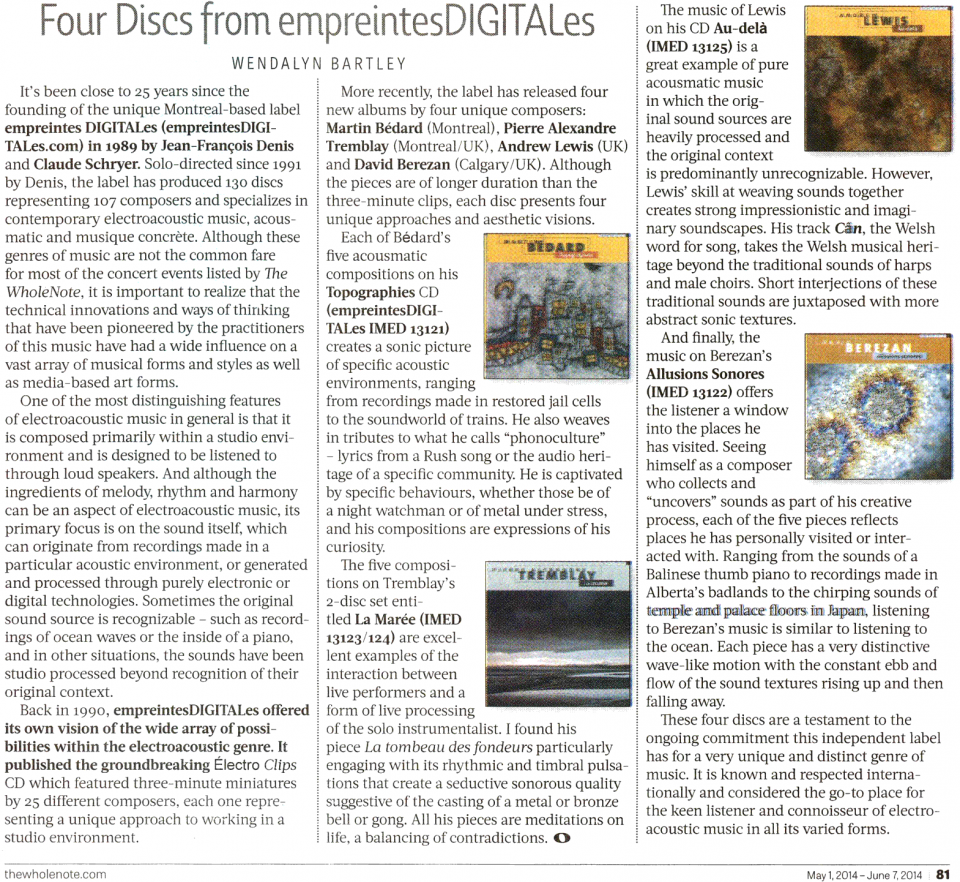
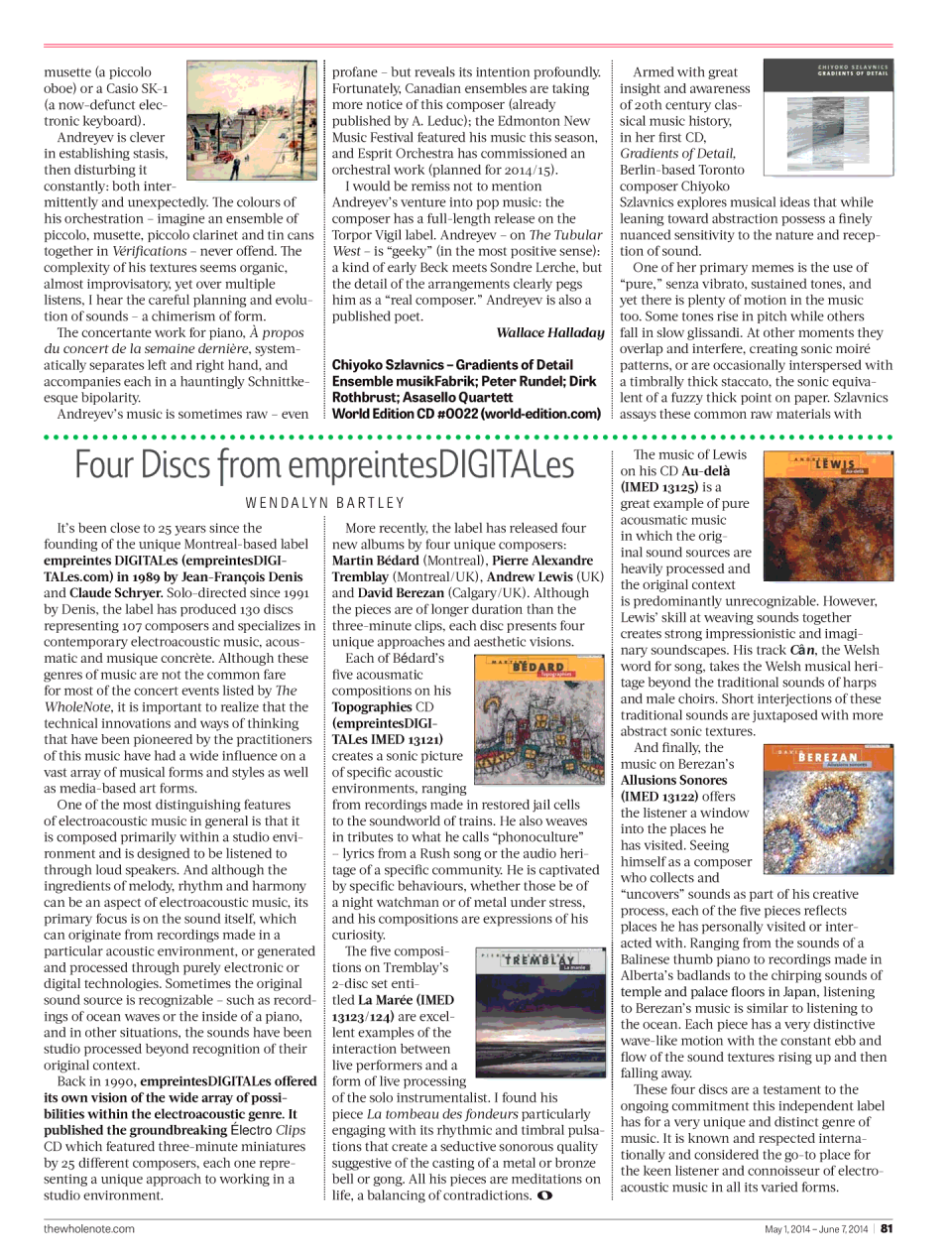
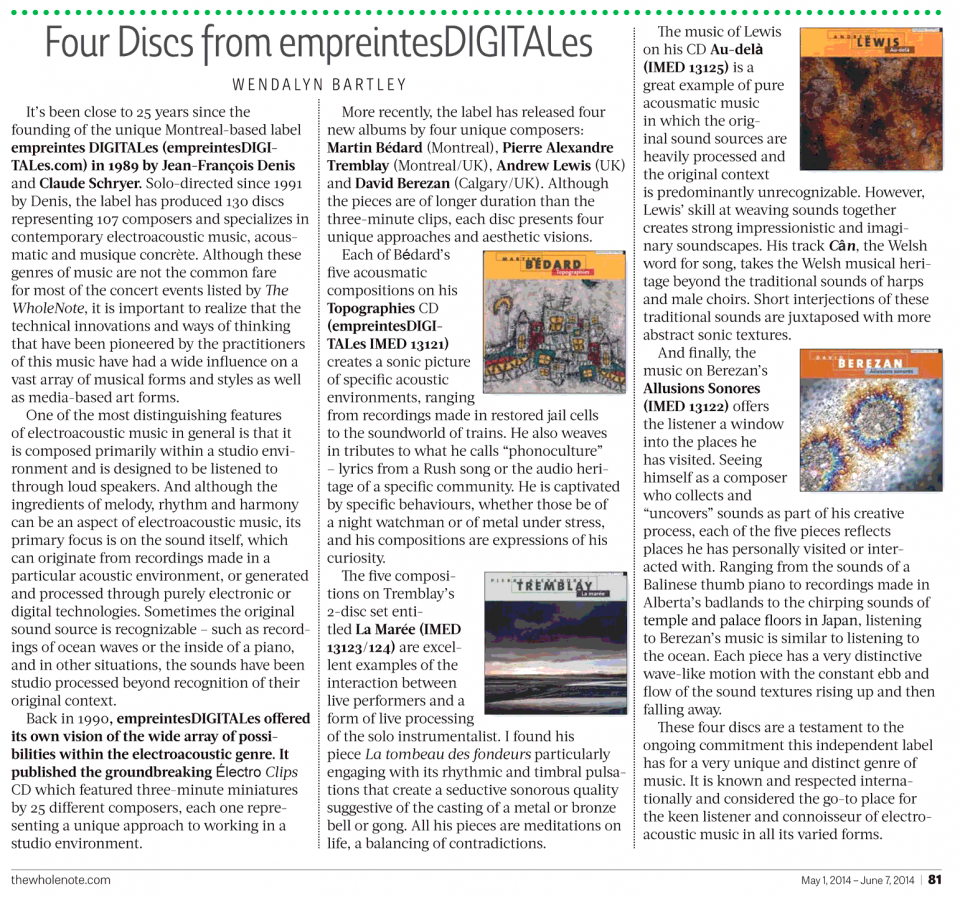
It’s been close to 25 years since the founding of the unique Montréal-based label empreintes DIGITALes (empreintesDIGITALes.com) in 1989 by
One of the most distinguishing features of electroacoustic music in general is that it is composed primarily within a studio environment and is designed to be listened to through loud speakers. And although the ingredients of melody, rhythm and harmony can be an aspect of electroacoustic music, its primary focus is on the sound itself, which can originate from recordings made in a particular acoustic environment, or generated and processed through purely electronic or digital technologies. Sometimes the original sound source is recognizable – such as recordings of ocean waves or the inside of a piano, and in other situations, the sounds have been studio processed beyond recognition of their original context.
Back in 1990, empreintes DIGITALes offered its own vision of the wide array of possibilities within the electroacoustic genre. It published the groundbreaking
More recently, the label has released four new albums by four unique composers
Each of
The five compositions on
The music of
And finally, the music on
These four discs are a testament to the ongoing commitment this independent label has for a very unique and distinct genre of music. It is known and respected internationally and considered the go-to place for the keen listener and connoisseur of electroacoustic music in all its varied forms.
Review
According to the words by Professor
Love on the Bits
Vous en doutiez
Review
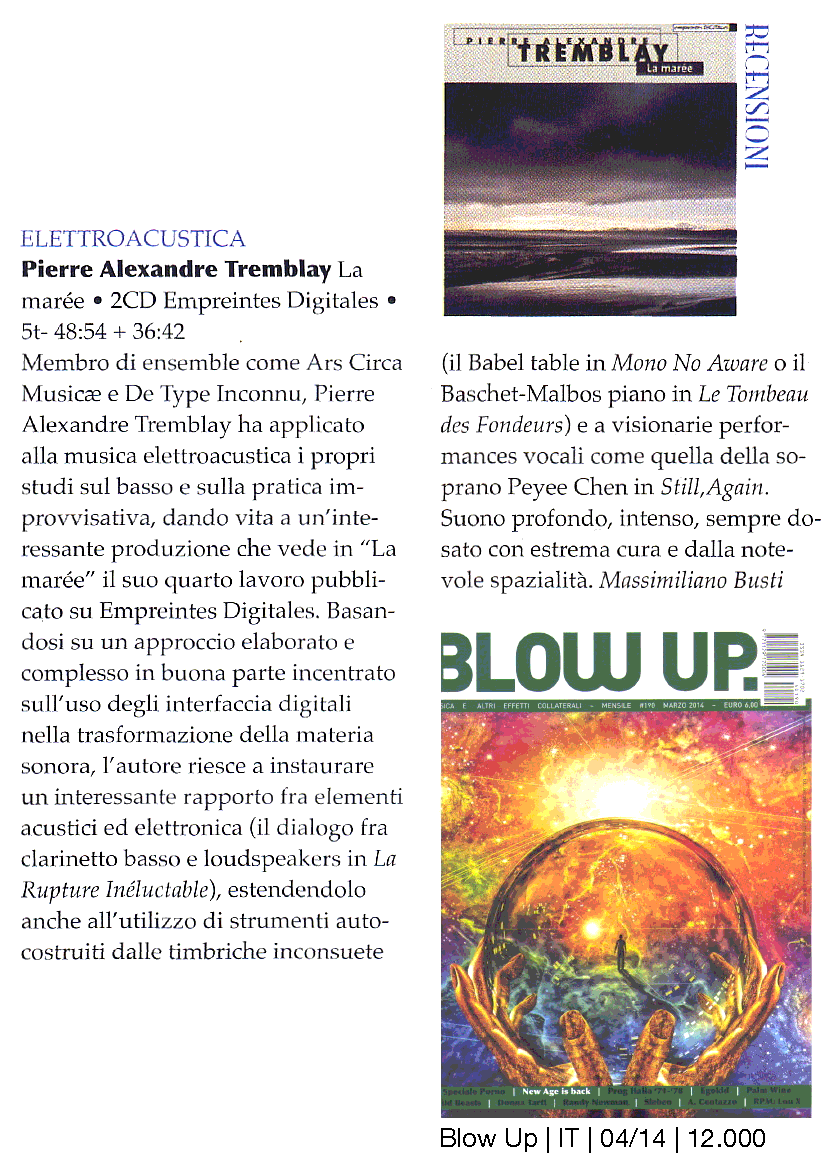
Kritiek
Hedendaagse gecomponeerde muziek
Midden tussen sonische complexiteit en conceptuele eenvoud slaagt
Journal d’écoute
Le quatrième album de
Kritik
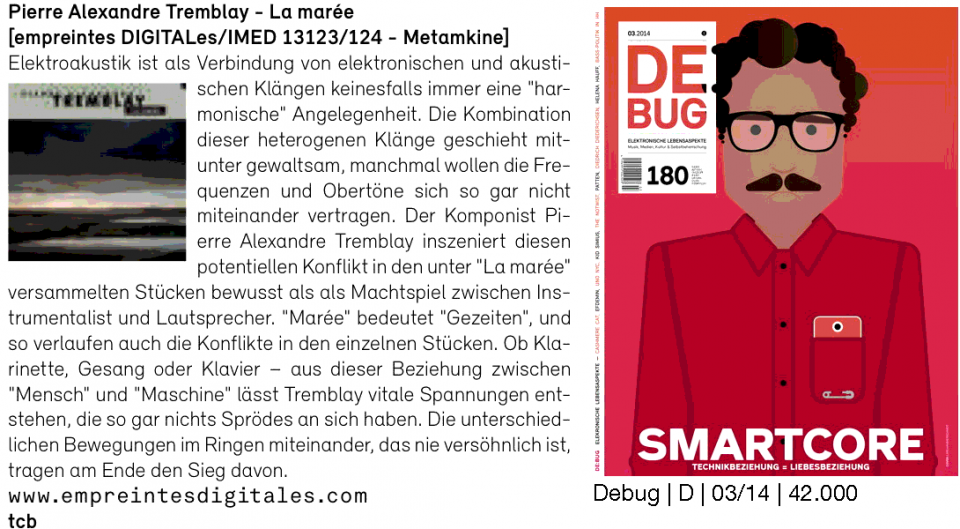
Review
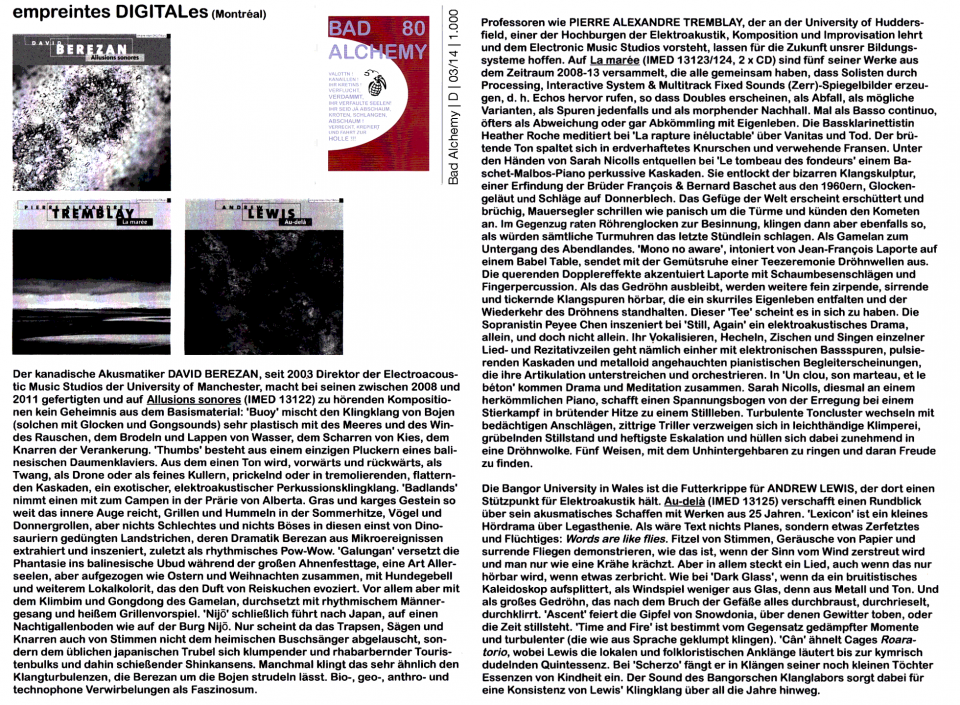
Tune of the Tides
On
For
Tell me about the challenges of meeting your personal quality standards when writing the pieces on
Each piece had its own struggles and epiphanies during the composition period. I would say that I am happy with them because I left enough time within my writing process to be able to trash everything I was not happy with. In certain cases, it was a lot of the early versions that went to the bin
Now, I can say that mixing the album of 5 mixed pieces was a great reality check
The contrasts between ‘acoustic’ and electric/electronic sound sources is just one of the many polarities on
I think that dualities are interesting and potent as they are immediate and allow the discourse to move forward. I also think that, in mixed music, a listener will identify with the human agent, and again this is full of expressive potential.
Now, to nuance a little
You’ve described some of the interactions on the album as “power games”. What, to you, is rewarding in a confrontational approach, rather than one based on consensus
First, let me say that I think there are always powers at play, even in consensus. So, in line with the idea of exploring the nuances between extremes, I also consider the full range of power relations, from equal-powered-consensual, to power struggles with cohabitations of contrasting ideas, to sheer domination by one part, to negotiation/seduction dance
What are benefits and challenges of real-time processing from your perspective
As often as I can, I do lazy real-time processing
On a more technical level, there are many different approaches to how ‘real-time’ things are in my pieces. Sometimes, the liveness is strictly in the ear of the listener, sometimes it is all live and sounds as tight as pre-recorded material… but most times it is a combination of many approaches. The only important aspect is how it works musically, both for the performer and the listener.
On
Simply, I don’t separate them at all
Over on Facebook, you wrote, “Huddersfield rocks”. In which way
I was told to be careful about Facebook
Moreover, the support we get here is impressive, with great studios, well equipped, and other different helping gestures on our current projects. There are also two festivals, the world-leading HCMF, and the more modest Electric Spring, the latter which I co-curate with Monty Adkins. Both festivals bring to this lovely Yorkshire countryside town some of the world’s most inventive musicians, which is great.
Finally, we have some fantastic students, again all busy pushing their research on where music should be and go next. A vibrant environment
What are some of the personal enjoyments of teaching music for you
There are mainly two reasons for which I like teaching. The first is the same reason why I really enjoyed my past experiences as a record producer
The other reason is a little more selfish. Sharing musical and intellectual space with the new generation is keeping me in touch with a wide range of music that I could not explore just by myself. Also, it keeps me on my toes
So teaching can be a win-win situation.
Does having a “day-job” feel like a compromise or does it instead give you a real independence and freedom to write exactly the kind of music you want
Apart from the win-win situation described above, the access to resources and the salary do provide a level of freedom that none of my friends who make a living as musician/composer have. Now, reality is much more nuanced than this idyllic description
That said, when I was partly freelance in Montréal, I had to spend a lot of time doing admin for free, almost as much as the ‘compromised’ side of my current position… for no salary and no resources and no interaction with good students and colleagues
It has taken many years to establish music at university, awarding it a more objective characteristic. How do you personally feel about the idea of music as a science
For me practice-based research in music is not as science… but it does not have to be to be a valid research field. I am surrounded in my family by many scientists of post-doctoral level, and I think they share my view
If you systematically explore a musical universe that is pushing the limits of its current existence, you are doing research. Scientists are doing the same thing. They have their own set of constraints, as musicians have theirs. If you do this systematically enough, there are elements that will be transferable to others
You recently shared an article — http://www.timeshighereducation.co.uk/features/feature-why-do-some-academics-feel-like-frauds/1/2010238.article — about academics feeling like frauds, indicating that it may actually be right in some points. What’s your position on the state and ongoing relevance of universities and academia for music
I think this article is right on a lot of points. What it says is that people in my job are overwhelmed by the expectations placed on them… mostly by themselves, to be honest
Academic posts, and artistic careers, usually attract a certain type of person that will want to do well what they set themselves to do. I think that in our overwhelming, information-overdosed world, perfectionists are always under the pressure of self-doubt, of pushing boundaries, of exploring new avenues, of knowing everything… there is so much to do, and so little time. Books and albums are being churned out at an every increasing speed, it is just impossible to stay afloat. With a little more nuance to this dramatic view though, there is also the factor that the more you know, the more you are aware of the immensity of what you don’t know.
Couple this with academia being busy with fake accountability, it makes the job worse than ever. Artists are stuck with the same problem
Review
Sometimes it takes a while to grasp a composer’s own specific angle how he/she perceives the sonic reality and composes with it. Usually and compared to the older generations, a modern composer became much more like sound painter. For this, they also use a couple of tools of preferences of their own.
The improvisational pallet used in the first composition,
The second piece,
The third piece,
The fourth recording (on CD2),
The last piece,
The liner notes mention that a part of the enhanced extras to the acoustic instruments come forth from the exploration of the relationship between the loudspeaker and the instrument. Let’s say that besides actual playing and resonance this could also includes the effects used in the recording, during the amplification, in the feedback, but even via the interruption and change of certain qualities.
Autres textes
- Tony Young, blackaudio, 22 juillet 2014
- Matteo Meda, Rockerilla, no 403, 1 mars 2014
Blogue
-
mercredi 1 avril 2015 / Presse
… une acuité rare dans ces compositions de musique de chambre. Suite
-
dimanche 1 février 2015 / Général
-
mercredi 21 janvier 2015 / En concert
Au CTM Festival 2015, Pierre Alexandre Tremblay et Sol Rezza se partagent le concert du 26 janvier 2015 au HAU2 — Hebbel am Ufer. Pierre Alexandre Tremblay y présentera la création de la pièce acousmatique asinglewordisnotenough I alors que… Suite