Sauter au contenu principal
electrocd

Blogue

2899 résultats
  • 428
  • 429
  • 430
  • 431
  • 432
  • 433
  • 434
  • 435
  • 436
  • Délirantes dans The Sun-News

    «Gravikords, Whirlies & Pyrophones», Dwight Loop, The Sun-News, no 9:3, 1 février 1997
    samedi 1 février 1997 Presse

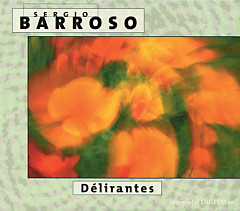
    Havana, Cuba-born [Toronto-based] composer Sergio Barroso’s recording Délirantes (empreintes DIGITALes, IMED 9628/29) is an outstanding assemblage of electroacoustic music with the flavor of his homeland a major influence. This music proves that new technology and old world sounds do mix.

    … outstanding assemblage…

    Zoo dans The Sun-News

    «Gravikords, Whirlies & Pyrophones», Dwight Loop, The Sun-News, no 9:3, 1 février 1997
    samedi 1 février 1997 Presse

    Canadian-based DIFFUSION i MéDIA has released a batch of interesting new experimental electronic and new music releases. The label is the world’s leader in experimental electronic and electroacoustic music or in other words, altered acoustic sounds.

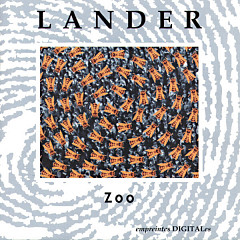
    Radio art has been discussed here in previous columns and Zoo (empreintes DIGITALes, IMED 9526) from Dan Lander, features one of the most interesting treatments ever heard on the cut Talking to a Loudspeaker with its “variations on broadcast quality and the snicker at our phobia with dead air.” This recording is a fascinating technical achievement as Lander also makes interesting soundscapes from disembodied voices, nature and animal sounds.

    Zoo
    … fascinating technical achievement…

    La théorie des nerfs creux dans Exclaim!

    «Review», Richard Moule, Exclaim!, 1 janvier 1997
    mercredi 1 janvier 1997 Presse

    That Québec has always had a strong tradition in electronic and electro-acoustic music is a given; what continues to surprise is the health, depth and scope of the work being created. The Québec label OHM/AVTR seems interested in exploringsound sources and found sounds. At its core, OHM/AVTR seems to be following the esteemed traditions of people like John Cage, Pierre Schaeffer, Brion Gysin, and more recently Robin Rimbaud’s project, and Panasonic, in creating musique concrete and sound collages.

    Jocelyn Robert -La theorie des nerfs creux is no less manipulative, but its intentions are more in creating waves and frequency-based glitches, similar in style to the german duo Oval. Robert’s sounds collages appear to come more from the electro-acoustic side of musical experimentation.
    La mécanique des ruptures dans Computer Music Journal

    «Review», Rick Bidlack, Computer Music Journal, no 20:4, 1 décembre 1996
    dimanche 1 décembre 1996 Presse

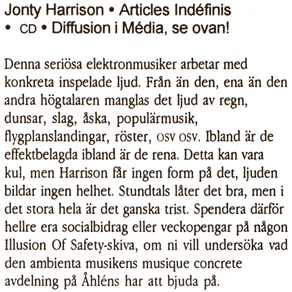
    Over the past three or four years, I have had the privilege of hearing several of Gilles Gobeil’s pieces performed and diffused live in concert. His work has always impressed me for its exquisite craftsmanship and extraordinary attention to detail, the sheer interest of his raw materials and their juxtapositions and transformations. Nonetheless, I have always had a nagging suspicion that what I was hearing was not music — something interesting and provocative, but not music. In reviewing this CD, I have had to face this suspicion, and I have come to the startling conclusion that Mr. Gobeil is, in fact, not a composer at all, but a sculptor. He is a sculptor whose medium is sound, or rather, the sonic by products of mechanical events, which are the real subject. Indeed, Mr. Gobeil comes close to admitting this himself in the short note that accompanies the present recordings, in which he mentions his fascination with medieval stone work and the behavior of materials under stress, of, for example, a rock “on the verge of splitting apart… brought to its breaking point.” His source materials include all manner of mechanical bangings, screeches, sunderings, throbbings, and whistles, many of which contain a strongly repetitive element. It is this repetition that lies at the center of my assertlon.

    Music is a temporal art. Fundamentally, the music of any style, in any historical period, serves to articulate the passage of time. We humans perceive the passage of time through that wonderful invention we call rhythm, which is also a form of cyclic repetition. What distinguishes human rhythm (and our own heartbeats) from mechanical repetition is that rhythm is always a deviation from the mechanical norm. It is the deviation from mechanical perfection that gives rhythm its ability to propel music forward in tirne, and it is the corresponding lack of any deviation that makes the ticking of a clock so static. It is not paradoxical to state that a clock cannot articulate time, it can only measure it.

    Sculpture, in contradistinction to music, is about the articulation of space, light, and texture. Translate these domains into the sonic realm and the discussion revolves around space, reverberation, intensity, and timbre. These are the fundamental elements that Mr. Gobeil’s works manipulate. Hence, a piece such as La ville machine contains a strongly cinematic quality that is apprehended more visually than aurally. In fact, there is a very strong sense of place in all of the pieces on this CD, as though one is wandering through a world populated only by factories, garages, and railroad crossings. Fascinating, too, is the sense that the sound components of pieces like Le vertige inconnu and its cousin Nous sommes heureux de… are clearly related to one another, but in what way? We still have no adequate means of coherently describing complex timbral relationships. Perhaps sculptors like Mr. Gobeil can shed light where composers have stumbled.

    I was frankly disappointed in the two works for Ondes Martenot, Voix blanche and Là où vont les nuages… not because they are lesser works than any of the others on this CD, but because the sound world of the Ondes Martenot integrates too well with that of the tape. Neither piece provides a contrast between the instrument and the tape, nor a soloistic focus — the Ondes Martenot is simply one more sound component, on a par with the others in the work. This is a pity, as the Ondes Martenot has an intriguing sound, and one would want to hear it in a setting that shows it off to better advantage.
    He is a sculptor whose medium is sound…
  • 428
  • 429
  • 430
  • 431
  • 432
  • 433
  • 434
  • 435
  • 436