
La mécanique des ruptures
Gilles Gobeil
… an industrial tableau of gears, pulleys, springs, turbines, belts, and steam materializes. — Weirdosphere
Décidément, le Québec […] regorge de compositeurs créatifs qui ne cessent de repousser les limites de leur discipline et d’être reconnus internationalement. — La Scena Musicale, Québec
Le vertige inconnu : Prix Ars Electronica 1995 — 2e prix
Livret numérique PDF de 25 pages (5 Mo) inclus dans le téléchargement
- Compositeur·trice(s): Gilles Gobeil
- Auteur·trice(s): Lyette Limoges
- Interprète(s): Suzanne Binet-Audet, René Lussier
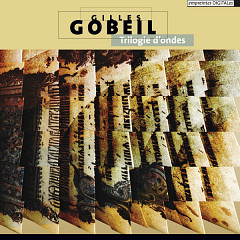
- Image de couverture: Luc Beauchemin
- Conseil des arts du Canada • Ministère des affaires culturelles du Québec
CD (IMED 9421, 1994)
- 1Le vertige inconnu (Gilles Gobeil) (1993-94), 8:23support
- 2Voix blanche (Gilles Gobeil) (1988, 89), 12:58ondes Martenot et supportSuzanne Binet-Audet, ondes Martenot
- 3Associations libres (Gilles Gobeil) (1990), 3:00guitare électrique et supportRené Lussier, guitare électrique
- 4support
- 5Rivage (Gilles Gobeil) (1986), 8:44support
- 6Nous sommes heureux de… (Gilles Gobeil) (1991), 0:57support
- 7Là où vont les nuages… (Gilles Gobeil) (1990-91), 11:20ondes Martenot, système interactif et supportSuzanne Binet-Audet, ondes Martenot
- 8Traces (Gilles Gobeil) (1985), 6:31support
- Étiquette: empreintes DIGITALes
- IMED 9421
- 1994
- UCC 771028942121
- Durée totale: 67:07
- Boîtier Jewel
- 125 mm × 142 mm × 10 mm
- 115 g
Sur le web
Téléchargement (IMED 9421_NUM, 1994)
- Cet article peut être téléchargé et/ou écouté sur le site empreintesdigitales.bandcamp.com.
- 1Le vertige inconnu (Gilles Gobeil) (1993-94), 8:23support
- 2Voix blanche (Gilles Gobeil) (1988, 89), 12:58ondes Martenot et supportSuzanne Binet-Audet, ondes Martenot
- 3Associations libres (Gilles Gobeil) (1990), 3:00guitare électrique et supportRené Lussier, guitare électrique
- 4support
- 5Rivage (Gilles Gobeil) (1986), 8:44support
- 6Nous sommes heureux de… (Gilles Gobeil) (1991), 0:57support
- 7Là où vont les nuages… (Gilles Gobeil) (1990-91), 11:20ondes Martenot, système interactif et supportSuzanne Binet-Audet, ondes Martenot
- 8Traces (Gilles Gobeil) (1985), 6:31support
- Étiquette: empreintes DIGITALes
- IMED 9421_NUM
- 1994
- UCC 771028942183
- Durée totale: 67:07
Notes liminaires
La mécanique des ruptures , le disque
L’histoire rapporte que les tailleurs de pierre du moyen-âge frappaient ce matériau, le faisait
Mon travail en composition se révèle avoir beaucoup d’affinité avec cette spécialité du génie civil qui consiste à explorer et évaluer le comportement des matériaux au voisinage de la rupture. Il privilégie les formes nettes, fortes et tranchées, les mouvements d’alternances et les jeux marqués de tensions et de détentes.
Les matières que j’utilise sont soumises à des contraintes, à d’énormes énergies, jusqu’à ce qu’elles se déforment, qu’elles éclatent, se métamorphosent. Jusqu’à leur point de rupture.
—
Quelques articles recommandés
-

-
-
 Artistes divers
 -
-

-
-
 Artistes divers
 -
-
-
-
-
La presse en parle
Untethered Sounds — Gilles Gobeil , La mécanique des ruptures
10 compositions québécoises: musique électroacoustique
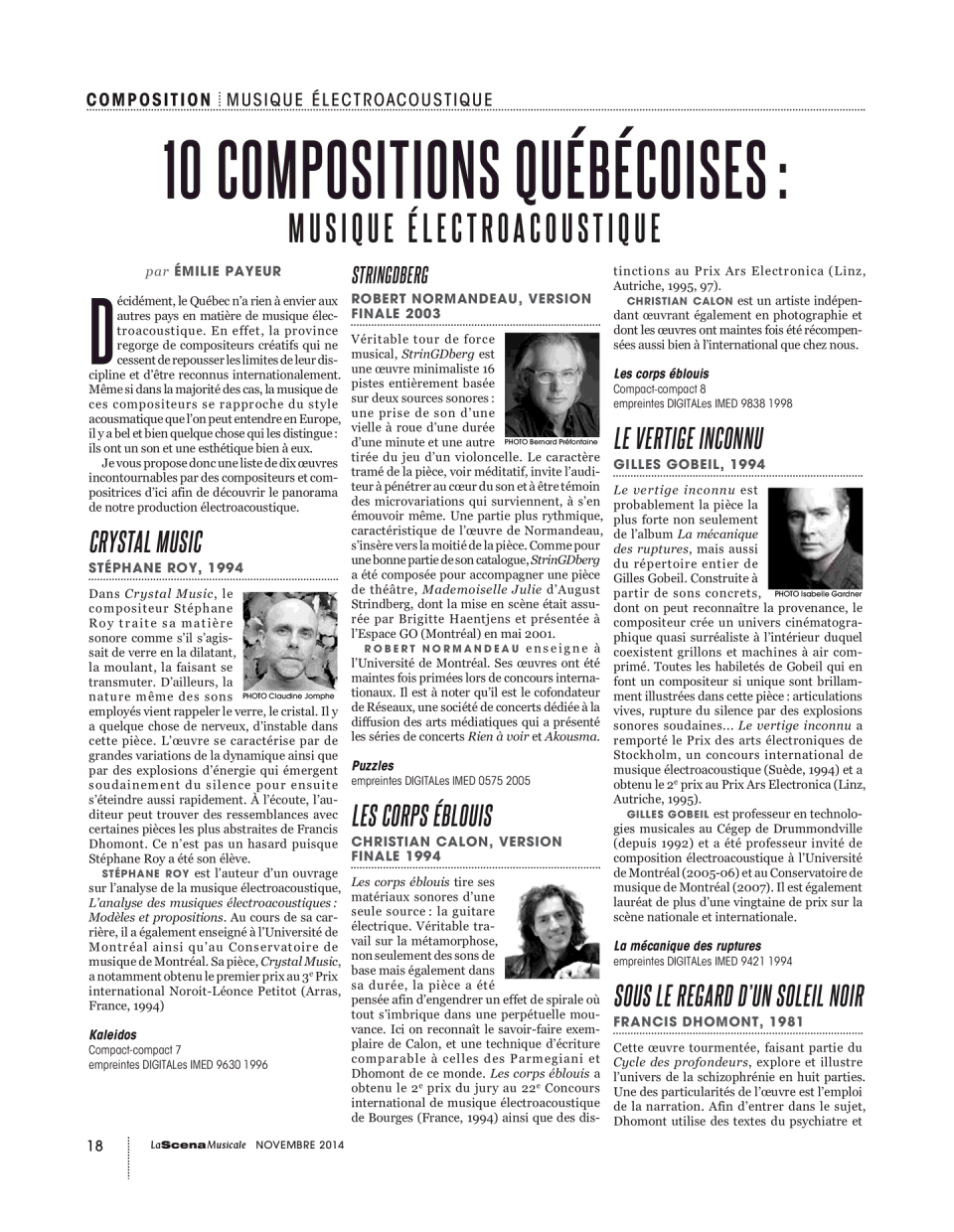
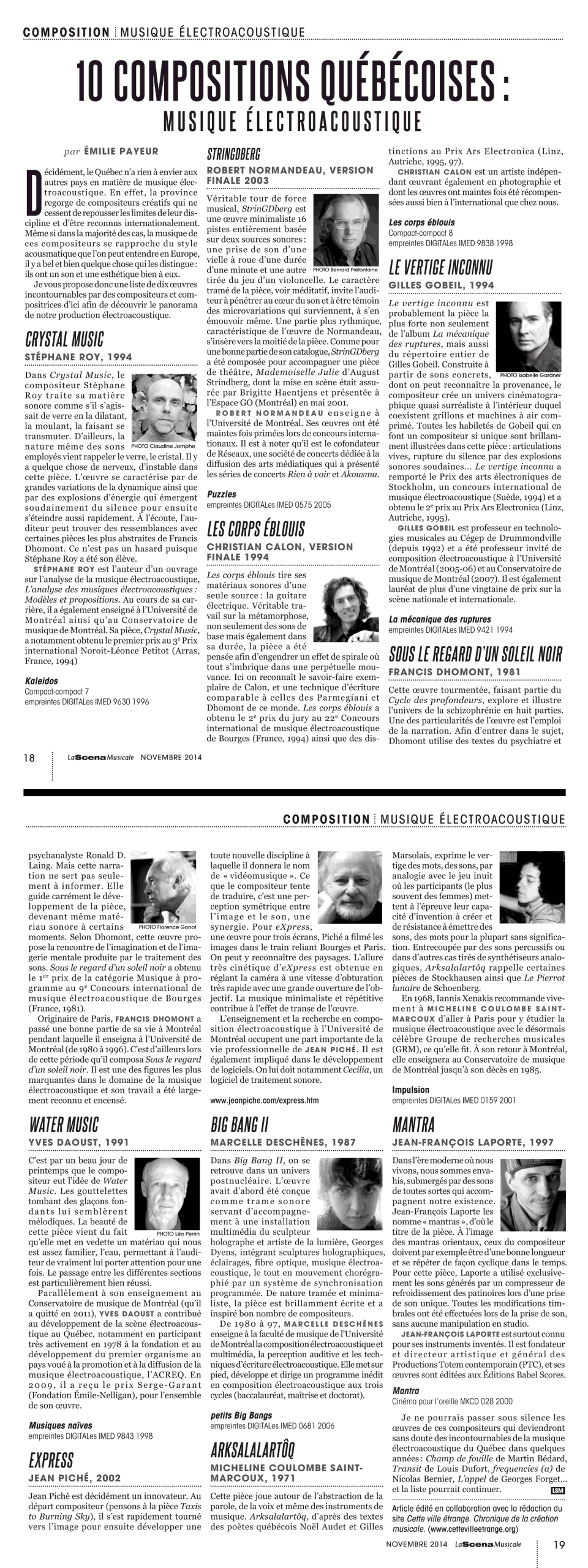
Décidément, le Québec n’a rien à envier aux autres pays en matière de musique électroacoustique. En effet, la province regorge de compositeurs créatifs qui ne cessent de repousser les limites de leur discipline et d’être reconnus internationalement. Même si dans la majorité des cas, la musique de ces compositeurs se rapproche du style acousmatique que l’on peut entendre en Europe, il y a bel et bien quelque chose qui les distingue
Je vous propose donc une liste de dix œuvres incontournables par des compositeurs et compositrices d’ici afin de découvrir le panorama de notre production électroacoustique.
Crystal Music (1994) de Stéphane Roy
Dans
Kaleidos, empreintes DIGITALes, 1996
StrinGDberg (2001, 02, 03) de Robert Normandeau
Véritable tour de force musical,
Puzzles, empreintes DIGITALes, 2005
Les corps éblouis (1992-93, 94) de Christian Calon
Les corps éblouis, empreintes DIGITALes, 1998
Le vertige inconnu (1993-94) de Gilles Gobeil
La mécanique des ruptures, empreintes DIGITALes, 1994
Sous le regard d’un soleil noir (1979-81) de Francis Dhomont
Cette œuvre tourmentée, faisant partie du
Originaire de Paris,
Sous le regard d’un soleil noir, empreintes DIGITALes, 1996
Water Music (1991) de Yves Daoust
C’est par un beau jour de printemps que le compositeur eut l’idée de
Parallèlement à son enseignement au Conservatoire de musique de Montréal (qu’il a quitté en 2011),
Musiques naïves, empreintes DIGITALes, 1998
eXpress (2001-02) de Jean Piché
L’enseignement et la recherche en composition électroacoustique à l’Université de Montréal occupent une part importante de la vie professionnelle de
www.jeanpiche.com/express.htm
Big Bang II (1987, 95) de Marcelle Deschênes
Dans
De 1980 à 97,
petits Big Bangs, empreintes DIGITALes, 2006
Arksalalartôq (1970-71) de Micheline Coulombe Saint-Marcoux
Cette pièce joue autour de l’abstraction de la parole, de la voix et même des instruments de musique.
En 1968,
Impulsion, empreintes DIGITALes, 2001
Mantra (1997) de Jean-François Laporte
Dans l’ère moderne où nous vivons, nous sommes envahis, submergés par des sons de toutes sortes qui accompagnent notre existence.
Mantra, Cinéma pour l’oreille, 2000
Je ne pourrais passer sous silence les œuvres de ces compositeurs qui deviendront sans doute des incontournables de la musique électroacoustique du Québec dans quelques années
[Article édité en collaboration avec la rédaction du site
Le Québec électroacoustique
On dit que le gazon du voisin est toujours plus vert que le nôtre, mais quand il s’agit d’électroacoustique, croyez-moi, le Québec n’a rien à envier aux autres régions du monde. Accusez-moi de chauvinisme, je n’en ai cure
Je ne veux pas m’embarquer dans un exposé analytique, mais, en tant que critique et auditeur invétéré, il existe pour moi une électroacoustique québécoise. Malgré la diversité stylistique de nos compositeurs, je perçois un
L’origine partielle de cette unité dans la diversité découle probablement de l’influence de quelques compositeurs-clé dont l’enseignement en milieu universitaire a marqué la relève d’ici. Je pense d’abord à
Si l’œuvre de
À ces deux noms d’une importance incontestable, il faut ajouter ceux de
Si ces quatre compositeurs représentent la crème du milieu académique, on trouve aussi au catalogue d’empreintes DIGITALes de jeunes compositeurs et des artistes dont le travail renouvelle en profondeur le discours électroacoustique de leurs collègues.
Mentionnons Fractures, le premier disque, tout frais, de
Sérieuse ou facétieuse, abstraite ou évocatrice, la musique électroacoustique québécoise s’est taillée une place de choix sur la scène internationale. À vous maintenant d’en explorer les multiples facettes.
Pistes d’introduction aux beautés de l’électroacoustique
La musique électroacoustique est un goût acquis. Qu’on le veuille ou non, la radio et la télévision nous conditionnent à accepter un certain nombre de modèles musicaux (tonaux, rythmiques) comme étant
Avec cette piste d’écoute, je veux simplement pointer quelques titres qui m’apparaissent susceptibles d’encourager plutôt que de décourager, des titres qui ouvrent une porte sur un autre monde musical. Bien sûr, cette sélection ne peut qu’être subjective. Mais avec un peu de chance elle pourra servir de guide aux nouveaux enthousiastes du genre et aux apôtres qui cherchent des idées-cadeaux pour répandre la bonne musique. Après tout, la période des Fêtes s’en vient
Des passerelles
On développe généralement un nouvel intérêt par excroissance d’un intérêt précédent. C’est-à-dire que l’on explore un genre musical qui nous est inconnu parce qu’un intérêt connexe nous y a mené. C’est pourquoi, dans le cas des musiques électroacoustiques, des œuvres mixtes (bande et instrument) ou qui abordent un sujet concret peuvent fournir cette passerelle qui ouvrira les horizons d’un nouvel auditeur. Par exemple, les amateurs de récits de voyage trouveront dans le Corazón Road du duo
Les amateurs de guitare peuvent se tourner vers le fabuleux projet Parr(A)cousmatique d’
Des essentiels
Pour ceux qui veulent pousser vers une électroacoustique plus abstraite, je conseille d’abord de visiter les compositeurs québécois. Chauvinisme
Cela dit, les œuvres de
Des idées courtes
L’album compilation a le pouvoir d’ouvrir toutes grandes les portes de l’électroacoustique, en offrant une large sélection d’artistes et d’approches stylistiques. Disponible à petit prix, eXcitations offre un échantillon intéressant des productions sur étiquette empreintes DIGITALes. Les albums Electro clips et Miniatures concrètes, ainsi que le tout nouveau volume de la série DISContact
Enfin, pour ceux qui désirent avancer tranquillement, à petits pas, la collection Cinéma pour l’oreille de l’étiquette française Métamkine offre une superbe série de mini-disques compacts d’une durée de 20 minutes chacun à prix moindre. Le catalogue comprend des compositeurs renommés tels
Bien sûr, tout cela, ce ne sont que des suggestions. Le meilleur parcours de découverte est celui que vous vous défrichez au fil du temps.
Bonne écoute
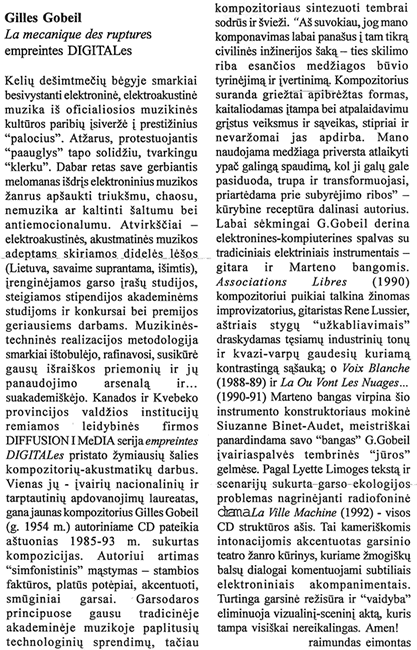
Recenzijos
Commentary
Date
To
From
Subject
I picked up the two
His more recent pieces, which are featured on
I’m very happy to find that empreintes DIGITALes is proving wrong my long held, but kind of uninformed opinion that there hasn’t really been any good academic electronic music since the 70’s. And the electrocd.com site is really great. So many audio samples to check out. I probably wouldn’t have picked up the
Review
Spectro-morphological Structuring Process in Gilles Gobeil’s “Le Vertige Inconnu”
Introduction
The purpose of this analysis is to explain the perceived integrity of a work that continues to achieve a positive consensus among composers, students, and audiences, or what
This analysis makes use of spectrographs to document the sounding energy of
Below is a spectrograph of a basic attack-decay gesture
Attack-decay Archetype

This image from 58 second into
Attack-decay Archetype

The morphologies that exist within a sound are reflected on various structural levels of the composition. The generative role of the onset, the motion towards termination or a new onset, and the presence of sustain portions of the sound, or continuants, occur at the lowest structural level. Likewise, larger structures will move away from the generative onset gestures towards terminating gestures. As textural-carried material is concerned with internal motion and not with external goals, it presents the higher-level corollary of the continuant. At the highest structural level, texture and gesture work as a dynamic dichotomy, reflecting similar motion patterns found at lower structural levels.
Spectral Overview
The perception of sectional structuring is very common even among first time listeners in beginning electronic music classes. The work has been divided into five sections for this analysis. The dividing marks have been placed at the following times

Section A
A reverse attack-decay gesture opens the work, functioning as an anacrusis to the first descending attack-decay gesture. The opening gesture is extended from 2 to 5 seconds by several descending gestures (visible in the spectrograph below) before a second decisive descending attack-decay gesture signals the termination of the first gestural area. While the tessitura of the terminating gesture remains constant, the faster decay of the high frequencies creates a prolongation of the descending gesture, preparing the listener for the first texture-carried subsection.
Gesture-carried Subsection — 0:00 to 0:15

The first texture-carried area is delineated by the primary descending attack-decay motive, acting as an onset to the subsection. The main textural area consists primarily of mechanical iterations. A great deal of motion is visible in the spectrograph, but it is motion without direction. The attack-decay gesture terminating the texture-carried area is weaker than those heard previously. Thus the texture continues beyond the gesture until a second descending attack-decay gesture brings the subsection to a more decisive close. The terminating gesture itself exhibits the same construction as the higher structural levels, as illustrated below
First Texture-carried Area — 0:16 to 0:34


One of the curiosities of this composition is the collection of disparate sounding sources, particularly the presence of both naturally and mechanically produced sounds. In examining the second textural subsection, however, one discovers the morphological connection between the sounding sources. Textural areas throughout the work are dominated by repeated iterations – short periodic sounds without gestural direction. The second textural subsection consists primarily of insect noises sounding over a rooted pitch-space. However, a need for termination develops as the rooted pitch-space begins to climb in tessitura. It cannot continue indefinitely and therefore tension is created, transforming the texture-carried material into gesture-carried material. The gestural nature is reinforced both by tessitura and with an increase in aggregate spectral energy as the sounding objects increase in amplitude. A third sounding object is introduced between the frequencies previously occupied, complimenting the frequency spectrum to produce maximum effect. At 55 seconds the continuant stops with an interrupting gesture, clearly different than the preceding sounds due to its complimentary pitch-space. However, the terminating function is inconclusive since the gesture lacks the descending morphology of the primary onset/termination motive.
End of Second Texture-carried Area — 0:41 — 0:57

The tension created by the ambiguity of this gesture is increased by the silence that follows. At 58 seconds the interrupting gesture is repeated, followed by a strong descending attack-decay gesture, bringing the subsection to a decided close. Within the first minute of
0:51 — 1:03

The third texture-carried area contains a similar structural process to the first texture-carried subsection. An increase in spectral density creates motion away from the texture-carried continuant towards termination. A descending attack-decay gesture at 1:32 anticipates the final build towards termination. However, the gesture at 1:37 lacks the terminating spectral energy to bring the section to a close. It is followed by a return of the mechanical iterations, which function as a textural prolongation. The final terminating gesture is a strong descending attack-decay gesture, prepared sufficiently though the prolongation of the terminating gestures to act as a final decisive termination to Section A.
End of Section A — 1:31 — 1:46

Section A contains four subsections. The opening gesture-carried subsection serves to introduce the primary descending attack-decay motive. The following texture-carried subsection presents three important concepts
Section A — 0:00 to 1:46

Section B
Section B provides a contrast to the more gesture dominated section A. The gestures within section B fail to give a sense of direction and therefore function as what
The following subsection appears as a different sounding environment through the use of reverb and resonance. Also significant to this subsection is the strong presence of harmonic frequency spectra, contrasting with the inharmonic spectra that dominate most of the work. This transition to the second subsection of B is shown below. The resolution and color are varied to better highlight the harmonic spectra.

Iterations from another source, perhaps a flute or an air brake, are mixed with the more harmonic iterations. Like previous textural areas, the continuant moves towards termination through increasing spectral density. Underscoring the importance of the principle motive, one can now intuitively hear how the final descending attack-decay gesture fulfils the terminative function that the upward gesture, bisecting this section, could not.
Section B — 1:47 to 3:10

Section C
Whereas section B is marked by a lack of gestural direction, section C brings back the mechanical iterations with an increase in gestural direction. This forceful motion is interrupted by the descending attack-decay gesture and is followed by a return of the high-frequency iterations from section B. Another descending attack-decay gesture acts as the onset to a slow textural build, as previously heard in section A. As in previous instances, the strong gestural activity of this section cannot be easily concluded with a single gesture. For this reason, the textural section at 4:14 is heard as an extension of section C. This section is decisively concluded at 4:24 with the descending attack-decay gesture, indicating the onset of Section D.
Section C — 3:13 to 4:27

Section D
Like section C, section D serves to further develop both previously heard sounds and structuring principles. The textural iteration motif from section A returns in section D. The spectro-morphological connection between the mechanical sounds and insect sounds was presented in section A when they were introduced in consecutive textural subsections. Now

The role of the iterations is no longer textural. As they increase in amplitude they lead towards termination or a new onset. Their alignment serves not only to demonstrate their structural similarity, but also to increase the gestural direction. Their ultimate termination in the descending attack-decay archetype is strengthened by the careful alignment of this motive to the tempo of the iterations.

A second subsection of D is reminiscent of the slow textural build heard in section A. However, this motive is now combined with the sort of interrupting gesture heard in section A (0:55). Instead of being immediately followed by the concluding gesture, the gradual build starts again after the interruption, increasing the tension as the sectional termination is further postponed. Strong gestural activity terminates this build and acts as an onset to the return of the iterations, now in their new gestural role. The iterations move the listener to the climax of the work at 6:45, the strongest descending attack-decay gesture yet heard.
Section D, although containing previously heard material, is unprecedented in gestural activity. The direction towards termination never wavers as interruptions only serve to heighten the tension. Just as the interruption of the middle subsection at 5:30 serves to prolong the tension, the middle subsection itself acts as an interruption of the gestural iteration motive which dominates this section. The material presented in the opening of this work has been transformed into the primary engine of structural motion towards the work’s ultimate goal.
Section D — 4:37 to 6:57

Section E
The need for preparation and balance before termination demonstrated in the individual sections and subsections of the work can also be found at the highest structural level of the work as a whole. The sudden conclusion of this piece at 6:45 would be anticlimactic. Therefore, the final section presents a simple structural idea that is consistent throughout the work
Section E — 6:57 to 8:20

Summary
The continuity of this work is based on repeated and varied use of similar material
Spectral Overview
As stated previously, spectro-morphology describes but one aspect of a composition. Elements such as space and the meaning and contextualization of sounding sources may provide still deeper and richer insights into this work. However, spectro-morphology is the language of sonic experience. Masterworks of western music have traditionally been considered those works demonstrating skillful mastery of their fundamental materials, be they pitch/rhythm motifs or spectro-morphological motifs. Further, the development of these constructive materials into large-scale formal structures reflected on various structural levels is also a hallmark of craftsmanship. Finally, as
Review
The English title is “The Mechanics of Cleavage,” and brings you 8 tracks of mysterious music. In a few tracks
It is mysterious music that brings you a soundscape of sounds as you think you are walking on a outer space planet where you have go through several places with obstacles. Doors of sounds opens, sounds apears and go away again. It is almost moviemusic or music that can be used in a dark space movie. The first track
The second track
All other tracks has the same atmosphere apart from some details in the tracks who changes the mood of the tracks in an other direction. We encounter hypnotic moods, industrial sounds and…
Different is the track 4
The last track is his most earlier work, without using sounds that you almost can find anywhere in the world for creating his atmospheres, he uses sounds that comes from synthesizers and electronics. Here you can hear which way he wanted to go to, and we must say that his later work where he plays in a magnificent way with sounds from our civilisation (street, home, industry…) is better for creating his musical worlds. A thick little booklet is added in this brillant CD, with full explanation of the artists and the tracks, in French and English.
Review
Comprised of eight compositions dating from 1985 through to 1993,
Fitting words indeed
The first piece,
The third piece features the dynamic improvisational talents of
The fourth piece, probably the most ambitious and unique among this grouping, incorporates a text and scenario by
Further into the disc we find the tightly arranged piece
Intense, noisy and complex,
Review
If ever there was an audio equivalent of a horror movie, this one’s it. Cacophonous crashes, jungle noises, water dripping in a cave, slamming boobym traps, tolling-for-thee bells, screaming machines, chattering air hammers, and
Review
“I’ve discovered that my work as a composer has much in common with this branch of civil engineering (stone cutting) — exploring and evaluating the behavior of material on the verge of splitting apart.” (from liner notes). This CD features work from 1985 to 1993. Much of the work is a roller coaster for the ears
Review
Over the past three or four years, I have had the privilege of hearing several of
Music is a temporal art. Fundamentally, the music of any style, in any historical period, serves to articulate the passage of time. We humans perceive the passage of time through that wonderful invention we call rhythm, which is also a form of cyclic repetition. What distinguishes human rhythm (and our own heartbeats) from mechanical repetition is that rhythm is always a deviation from the mechanical norm. It is the deviation from mechanical perfection that gives rhythm its ability to propel music forward in tirne, and it is the corresponding lack of any deviation that makes the ticking of a clock so static. It is not paradoxical to state that a clock cannot articulate time, it can only measure it.
Sculpture, in contradistinction to music, is about the articulation of space, light, and texture. Translate these domains into the sonic realm and the discussion revolves around space, reverberation, intensity, and timbre. These are the fundamental elements that Mr.
I was frankly disappointed in the two works for Ondes Martenot,
Critique
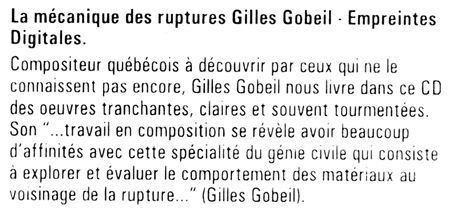
Critique
Parmi les parutions québécoises de ces dernières années en musique électroacoustique, le disque de
AVIS
Review
Winner of this past year’s Stockholm Electronic Arts Award and of numerous other international and national prizes over the past decade,
The disc begins with
Two works on the disc,
The earliest work presented on
The reverse chronological order of the works on the disc takes us from concision and refinement back to a time of searching and discovery. Try reprogramming your CD player and follow the composer’s original journey
Review
Not a name I’d heard of before, though like France, the French Canadian sector does tend to proliferate radical new-music composers
Critique
Titulaire de décorations internationales pour ses musiques électroacoustiques de caractère souvent dramatique,
Énoncé du jury
Le
Le jury a considéré que l’œuvre de
Les principales caractéristiques du style de
Le jury tient également à souligner son professionnalisme, tant esthétique que technique, notamment dans les contrepoints sonores et dans sa maîtrise à conférer une unité formelle à la diversité du matériau utilisé.
Critique
Le propos, souvent musclé, est parfaitement maitrisé mais hélas un peu trop similaire d’une pièce à l’autre, surtout que l’on retrouve souvent, en plus du procédé, des éléments sonores identiques. C’est un très bon disque mais il faut l’écouter pièce par pièce, jour après jour. À consommer avec modération.
Blogue
-
mardi 28 avril 2026 / Presse
… an industrial tableau of gears, pulleys, springs, turbines, belts, and steam materializes. Suite
- samedi 1 novembre 2014 / Presse
Décidément, le Québec […] regorge de compositeurs créatifs qui ne cessent de repousser les limites de leur discipline et d’être reconnus internationalement. Suite
-
lundi 22 mars 2004 / Presse
Sérieuse ou facétieuse, abstraite ou évocatrice, la musique électroacoustique québécoise s’est taillée une place de choix sur la scène internationale… Suite