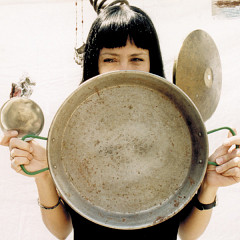
Magali Babin is active on the Montréal sound art scene. Mr Dontigny of the No Type label lets on that it was almost by chance that this CD became the third (or second; the previous one was a double) issue with the No Type logo. Mr Dontigny happened to hear – just days prior to the label’s birth – that Magali Babin’s audio project at the CBC had been cancelled, and that she was looking for other venues of diffusion. As Mr Dontigny says; “the timing could not have been better,” and No Type signed Babin on.
The booklet – displaying the regular high-quality fold-out magnificence that is has in common with empreintes DIGITALes proper – explains that most of the sounds we hear on this set are derived from metallic instruments and objects (instruments being objects made with the specific purpose of being… instruments, while objects were made for other reasons, but demonstrating instrumental qualities as a by-product of their humble object existences… and the third alternative is the case of found objects which could be just natural findings like rocks and ice, which weren’t designed – I suppose… to act as sounding objects, much less instruments… but sound persistently anyhow and anyway!)
Most of the events herein are improvised by Magali Babin, with the exception of track 7, which was “crafted in joyous collaboration with Alain Chénier and Mario Gauthier”, and track 9, which has been mixed with the piece Rain from Ian Nagoski’s CD Warm Coursing Blood.
That said, on to listening!
The beginning is a start, but there is no actual beginning or end to this piece; Triturations… The sliding of rocks over rocks, granite across gneiss, or boulders over rock bottom expanses keeps on keeping on, and to me this sound world is the murmur of Time itself passing through these lonely worlds. The sounds are subdued but grave, humble but terrible – and these minutes of Babin time rubs off on your own calendar, making it obsolete in this vast void of minerals and millennia…
Track 2 – Petit jardin – is more French, more detailed, more microscopic, tingling, trickling and seeping… as little elves and fairies hover in the shadows over at the garden pond – and it makes me recall some worlds by Finnish guru electroacoustician Kaija Saariaho. There is a fair amount of deep wood enchantment in Finnish culture, you bet, and this property shines and shivers inside Petit jardin. Masterly, how Babin builds this dense atmosphere with sparse means in but a few minutes!
La corde is chordal in its attributes, you would have guessed! This comes close to some latter day guitar improvisations by the likes of Ernesto Diaz-Infante and Chris Forsyth, even though I’m certain Babin did not use any guitar. The chordal elasticity and picking pluck feel is ever present, anyhow, and close mikings enhance the experience. It is indeed very nice, almost pick-pocketing, fingers moving about around those mashed up remains of chewing gum wrappings…
Number 4 – Monsieur et madame Watt – sports a thin, droning current of electricity, making me think of Joni Mitchell’s Electricity from For the Roses: “input, output, electricity…,” maybe for the lines that go: “she don’t know the system, plus she don’t understand, she’s got all the wrong fuses and splices, she’s not gonna fix it up to easy, the masking tape tangles, it’s sticky and black…” and so forth, and simply because of this humming current that could easily start emitting sparks and charges all over the room, and Babin’s very peculiar and amiable picking keeps up, like some old maid of the 19th century nervously picking and picking her apron while she waits for a secret lover or hell from her master. Babin’s piece once again gives rise to many fantasies and visions, which in my world is one of the best things I can say about music! Towards the end the electricity gets dangerous! Suddenly I wake up inside a power plant, the electromagnetic force field overwhelming…
5 – E – talks at me through the jerky and stiff jaws of tinplates or slabs of sheet metal, revealing some of the inner psychology of such materials. The metals are like drugged and just recently awakening ants on the inside of the hard matter. It has got to be the atomic jitter I’m sensing in this piece. On the other hand, sometimes this could appear to me like the slow motion rendition of tin can talk; all those truckloads of tin cans traveling all over the Americas, all over Europe, to reach those super market shelves… Is this their small talk in the road?
Havoc is administered on track 6 – L’entonnoir – in the manner of barrels rolling down endless slopes in some painting that Chagall never got around to do… but his age is the time of these events. It might even be winter, and black craws are flying up and fluttering around as the battalion of barrels roll and tumble on down like friendly but helplessly dangerous metallic speed freaks, in vain hoping – yes, thirsting! – for a valley which never comes, since this is the world of never-ending slopes… and the religion of tumbling barrels aims at the valley at the end of barrel existence…
Track 7 –Jogging dans la maison hantée — opens in a tweeting, tweaking manner, elastically, rubbery, forcefully seeping through cracks, emitting molten or mashed matter like hot rubber through the cracks of wooden horizons… The shrill sounds, which are rare here, sort of escape the tough goings-on behind and beyond those coniferous horizons, and the events that are hinted at and revealed in traces and remnants can’t be anything else but creation per se, or maybe a human mind finally at work with changing his views, trying to understand something else, and if so, it’s that something else that keeps tweeting and seeping through those wooden cracks, and I can already smell something; don’t know exactly what. Babin’s imaginative sound worlds are excellent mind tumblers!
Piece number 8 – Ma tribu – indeed conjures up pictures and archetypical memories of village get-togethers down the millennia of the African continent, rising in volume and presence to an almost painful drum dance across the dry, beaten piece of ground in the center of village and ceremony. A wheezing character of the drumming lets on its shamanistic, dream-like state, far on the inside of any real-time here-and-now occurrence, summing up the force and strength om the good medicine of thousands and thousands of years in one, wild, intense drum-beat, lashing out at you from the true state of Time…
The last entry on Magali Babin’s CD is Pluie de homards. First it appears like some early electroacoustic – or rather electronic – piece of ingenuity, but soon it travels into the realm of timelessness that seems to be the breathing air of the composer. The watery property is clear, but it’s massive, as if a closely miked gush of water at high pressure down a tin bucket! The force is magnificent and the speed immense! Overtones and obscure timbres swirl around the running water like a thick layer of gleaming, gleaning grains of sound and light. You name it, we like it!
This No Type release of the sound artist Magali Babin has is a true sonic adventure, revealing true ingenuity and artistic splendor!