Sauter au contenu principal
electrocd

Blogue

83 résultats
  • 2
  • 3
  • 4
  • 5
  • 6
  • 7
  • 8
  • 9
  • 10
  • Automacité dans Vital

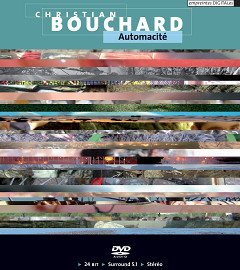
    «Review», Frans de Waard, Vital, no 844, 13 août 2012
    lundi 13 août 2012 Presse

    A student of composer Yves Daoust, winner of various prizes for electroacoustic compositions and founder of the live electroacoustic quartet Theresa Transistor. He seems to me the typical sort of composer you’d find on this label. In 24-bit they present three of his pieces, Impasto, Parcelles 21 and Objet menacé. The first is the longest and a triptych about expressionist abstract painters (Pollock, Riopelle and Shiraga), and it sounds indeed like expressionist abstract music. Lots of sounds thrown together and then mixed, edited and treated further. At least that’s my best guess upon hearing this music. Sounds roll about like thunderous storms and walls of snow bursting into masses tumbling down the mountain. A nice piece for sure, but perhaps at forty-five some minutes all a bit long. Luckily Parcelles 21 — a revised version of Parcelles 1 and Parcelles 2 — provides a more quiet piece, but is also moving all over the place. It’s hard to say, in both of these pieces what it is that Bouchard is using sound wise. Field recordings perhaps, but also down right electronic matter, and maybe acoustic instruments being treated in one way or another. It’s hard to say, as the level of abstraction is quite high on this release. The final piece is Objet menacé and the cover says it’s a symphony for parking meters, and brings up the massive attack again of the first piece. While some of this music sounds alike what similar composers do on this label, but throughout I seemed to like this more than some of the others on the label, but it’s not easy to pin down why that is. Maybe it’s the level of disturbance, or the notion of improvising with his sound material and the editing thereof? Maybe it’s the overkill in sound anyway? I am not sure. Maybe it’s the heat that provides me from thinking straight.

    Maybe it’s the level of disturbance, or the notion of improvising with his sound material and the editing thereof? Maybe it’s the overkill in sound anyway?

    Contrechamps dans Psyche Music

    «Review», Psyche Music, 1 août 2012
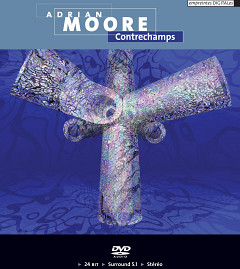
    mercredi 1 août 2012 Presse

    Adrian Moore is director of the University of Sheffield Sound Studios (USSS). His own research delves into the acousmatic tradition in electroacoustic music, the performance of electroacoustic music, signal processing, and human-computer interaction in music. The pieces collected here show the amount of mastery of sound processing and some of the prepared ideas for live interactions.

    Especially the first piece, Sustain made a certain impression. It was composed after he discovered the wide spectrum of variety pitch shifting transformation could produce. It is his most physical piece too and shows his mastery control of sound engineering. We hear compressed notes with aggressive activity, percussive, burbling, slightly echoing in space, expressed with very detailed sound and controlled restrictions and fast abrupt changes.

    All other pieces play with sounds too but not as physical, natural and transformative as the first piece. All other pieces show change, but also the process of filtering, exceeding tempos etcetera and seem to occur more randomly with its variations over time. Three pieces are meant for reuse and show recorded changes of piano / horn / violin into different shapes of sound caused by changed speeds and other controls and filters. Pieces like this can be interactions of live recording with computer-processed playing in the same way real-time computer interaction is done, although Adrian Moore’s order of recording is different. Other pieces show the deformations coming back to the original sounds and then back to the returning studio world of sounds area.

    … his most physical piece too and shows his mastery control of sound engineering.

    Perdu et retrouvé par Glen Hall

    «Review», Glen Hall, 18 juillet 2012
    mercredi 18 juillet 2012 Presse

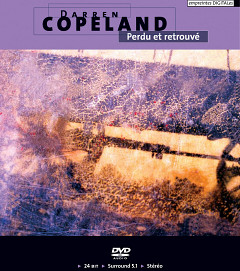
    Duration and density. Sonority and spatialization. Canadian electroacoustic / sound composer Darren Copeland creates intricate, engaging pieces that make commonplace sounds mysterious, evocative or just plain interesting. How long a sound is becomes malleable, and this makes listening active. Stretched or segmented, environmental sounds’ nature is tested, questioned, reframed in this 5.1 Surround Sound DVD-Audio’s 8 compositions. The voice of a single 9/11 witness becomes an entire soundscape through Copeland’s ingenious editing and processing in They’re Trying to Save Themselves. The phonemes of Streams of Whispers title are sifted, repositioned, transposed, deconstructed and, in general, ‘messed with’ to create an immersive soundscape. On Schedule was created using a demanding procedural strategy, which itself was subject to modification if sonic results were not satisfying. His willingness to make ‘theory’ subordinate to aesthetic sensitivity and judgement marks Copeland as an artist. Based on the train schedule between London and Moscow, each of the piece’s 27 sections focuses on differing facets of overtones and sound spectra, giving shape and movement to its selected elements. Listeners with a surround sound system can get the full effect of Copeland’s specialty: spatialization. At art space he founded, New Adventures in Sound Art, he can move sounds around a multichannel, surround and overhead sound system. On this disc, sounds move independently, rather than in the traditional back-and-forth of stereo panning. An offshoot of Copeland’s spatialized sound art is that it makes us more aware of the richness of our day-to-day sound world.

    … it makes us more aware of the richness of our day-to-day sound world.
  • 2
  • 3
  • 4
  • 5
  • 6
  • 7
  • 8
  • 9
  • 10