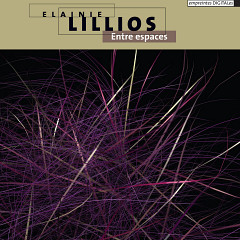
Elainie Lillios is a new music / deep listening composer whose full length Entre espaces collects a number of her previously completed works ranging from 5 to 15 minutes length. The tracks could be described as close-mic texture studies that interweave electronic elements and digital manipulation with high fidelity recordings of nature and every day elements of civilization.
Aside from the occasional decisive thunderclap or slamming steel door, Lillios’ music is a blanket of white quietude huddled around a single wriggling / writhing element, a texture of remarkable crispness, sybillance and spacial precision, presented with origins obscured. As with many field recording artists, through the sparsitude of her compositions Lillios encourages us to pay attention to the microcosmic details. We are intended to read meanings into the rustling, scratching, and scraping, and indeed, with the infinitely complex timbres of nature, there is always more information to process upon repeated listening.
The album opens with Dreams in the Desert, one of the greatest tracks on the album with beautiful ambient transparency. It begins with a strengthening trickle of water, fed through some kind of divine vocoder that enriches the sound with translucent murmers of synthesizer chords. I could listen to this one sound for hours. The middle third of the 11 minute track is occupied by brittle crackling leaves, and sharp ‘whoosh’ sounds like tiny blow darts being shot. In the final third there is a welcome and cleansingly human wash of deep synth drone which rapidly draws us back into the industrialized world. In the warping and windblown sound of the synthesizer I see clouds rapidly passing in fast forward.
Arturo, another epic, changes tone considerably with the addition of male spoken vocals, presumably by “Arturo” on account of his accent. It’s an extended existential monologue containing such repeated phrases as “There is no such thing as a self-fulfilling prophecy.” The lyrics seem to be discussing the tarot and prophesies of death, an obscure subject with little emotional connotation for me. Arturo’s voice continues to dart between and behind cold quivering echo chamber effects for the 14 minute duration. There is some deliciously chaotic abrasive manipulation in the middle of the track, but this track still feels very long, and without the overt beauty of the previous one.
Hastening Toward the Half Moon is full of whispers and rapid, ragged breathing, and when a darkly glimmering string tone enters, pitched drastically down into a primordial undercurrent, I’m reminded of the weathered, isolationist mysticism of Lustmord and Lull. The breathing later fragments into a swarm of abrasive slices, and shadows of remote howls cascade through the soupy fog across the hilltops.
With the 3 concise parts of Backroads, the album becomes more easily listenable and engaging again. Torrential rain sounds recurr in each movement, as well as the screeching and skidding of cars lucky to have nearly missed a wreck. Undoubtedly, this is the most curious 10 minutes of the album, from the strangely ominous sounds of children playing in Tree Tunnel (as if a group of children had discovered something dangerous), to the sudden and welcome break into beat-driven electronica in the second half of Elevator.
The final Listening Beyond… is organic and wet in texture. There are drips and streams of pristine and pure mallet percussion, electronically arpeggiated in neon bright clarity. Lillios’ whispers cluster first into a nebula, then later are separated, chopped, and granulated. “If you listen deeply, can you hear infinity?,” she speaks. Simple words, but the point is felt in the quietude.
Many tracks are quite long (10+ minutes) and sparse, and the album is over 70 minutes, just near the maximum capacity for a CD. To listen and focus to the entire album is certainly challenging, and I’m sure if I saw these pieces live I would leave the auditorium with a similar feeling of uneasiness. However, I think this is absolutely intentional, as ‘new music’ is not made for simple entertainment or to conform to anyone’s expectations, but to attempt to express something that has thus far eluded all previous expression, as well as examine the human attention span and listening apparatus. It is a context that allows every gestural sound and its placement to be taken with utmost symbolic seriousness.
I highly recommend Entre espaces to anyone with patience, a quiet listening environment, and an ear for detail. As far as deep listening recordings go, you can’t do much better than this. There is a world of textural oddness to explore.