Sauter au contenu principal
electrocd

Aussi dans le blogue

7 résultats
  • 1
  • 2
  • Écraser l’autre dans The Sound Projector

    «Unbiased Reportage», Ed Pinsent, The Sound Projector, 30 mars 2026
    mardi 31 mars 2026 Presse

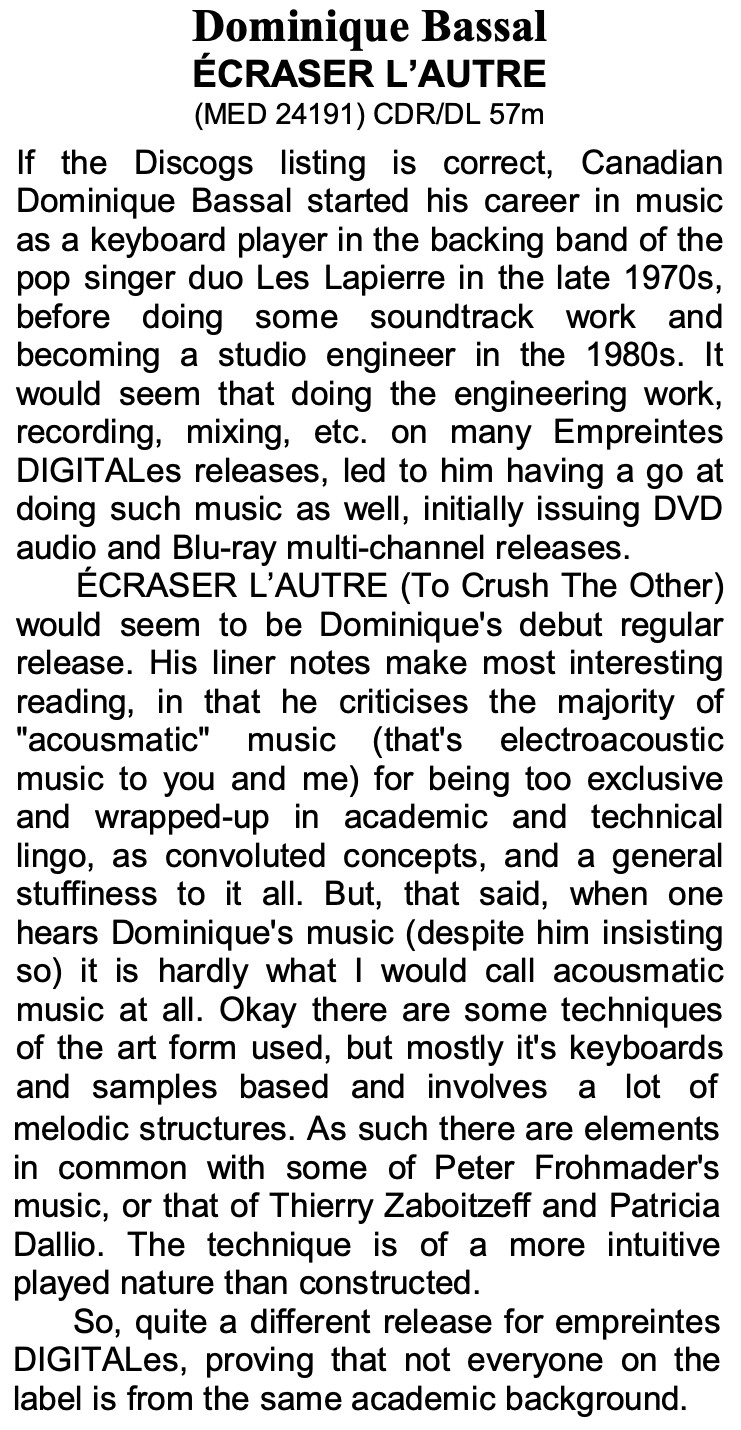
    Dominique Bassal (born Cairo, now living in Montréal) started out with an academic training, but cut his teeth in the commercial world as an engineer and studio genius working on various pop music productions, apparently applying avant-garde methods to these genres. He’s also something of a “house engineer” for this particular label, with multiple mastering credits to his name.

    He has released his own compositions before, such as Ubiquité in 2009, but today declares he wishes to move beyond the “allegories” that used to characterise his early work. This new get-tough “tell it how it is” attitude is reflected in the title of this album and the six tracks which make direct reference to the rise of various historic dictators and or other instances of human rights abuses, taking in everything from the KKK to Rwanda, by way of the Deir Yassin massacre, Adolf Hitler, and even Joe McCarthy. “We have let a handful of hallucinated prophets convince us to turn the other cheek,” is his hard-hitting warning, “unsurprisingly, the psychopathic minority seized the opportunity to take control of the world.” Stirring words — and it doesn’t take much effort to read between the lines and apply this lesson to our contemporary global situation.

    He’s also got some harsh words for the genre of modern electroacoustic music itself, which he regards as being driven by a “geek complex”, apologising for the generally poor music, and dismissing a large corpus of work as “infinite variations of the most insipid and predictable sonic material”. One problem might be that composers have simply forgotten how to communicate with an audience, deliberately draining their work of any emotional content or any element that might be mistaken for “story-telling”, in favour of the purity of abstraction. To hear Bassal’s attempt to redress this balance, tune into these six pieces, which contain plenty of exciting shifts in timbres, exotic spice and flavours, and near-cinematic grandeur in their narrative sweeps.

    While I find myself caught up in the thrill of the moment more than once, I’m also feeling a slight sense of sprawl — no real beginning or end to these colourful lakes of sound. The emotional register throughout is somewhat gloomy and pessimistic, given the themes he has taken on, and while there’s much to admire in his feisty spirit, the actual music isn’t quite as incisive or forthright.

    … découvrez ces six morceaux, qui regorgent de changements de timbres saisissants, de notes et de saveurs exotiques, ainsi que d’une grandeur presque cinématographique dans leurs vastes envolées narratives.

    Écraser l’autre dans RNE3: Atmósfera

    «Crítica», RNE3: Atmósfera, 22 décembre 2024
    jeudi 9 janvier 2025 Presse

    Hoy exploramos una crítica mordaz a la música acusmática, esa rama vanguardista que se ha convertido en prisionera de su propio elitismo. Su estética rechaza cualquier forma emocional o narrativa comprensible, atrapándose en un universo de ruido insípido y predecible. Paradójicamente, sus creadores, a menudo orientados al marketing, recurren a la jerga académica para impresionar, perdiendo de vista una conexión genuina con la humanidad que experimenta la música. ¿El resultado? Sonidos difíciles de disfrutar, alejados del trabajo minucioso y colaborativo de otros géneros comerciales.

    El autor, un compositor acusmático, propone una ruptura: humanizar estas composiciones y aprender de quienes hacen música para un público real. Mientras en el ámbito comercial se perfecciona cada detalle con herramientas innovadoras, la música experimental desprecia esas técnicas, tachándolas de “comerciales”, olvidando que están basadas en estudios profundos sobre cómo percibimos los sonidos.

    La conclusión es clara: el esnobismo ha aislado a esta música, alejando talentos que podrían enriquecerla. El álbum que os estamos proponiendo ahora de Dominique Bassal, titulado Écraser l’autre — descrito como incómodo y provocador — busca desafiar esas normas. ¿Puede la música experimental conectar nuevamente con las emociones y la sociedad? Es una pregunta abierta, que nos hacemos muy seriamente en nuestra Atmósfera vertebrada por este tipo de sonoridades. Escuchamos ya algunas de estas respuestas de la mano de Dominique Bassal en forma de sonido.

    No quería dejar pasar por alto la portada de este disco, describe a la perfección toda esta problemática en tan solo una imagen, potente y arrolladora.

    L’album que nous vous proposons aujourd’hui de Dominique Bassal, intitulé Écraser l’autre — décrit comme inconfortable et provocateur — cherche à remettre en question ces normes. La musique expérimentale peut-elle renouer avec les émotions et la société?

    Écraser l’autre dans Bad Alchemy

    «Kritiek», Rigobert Dittmann, Bad Alchemy, 1 décembre 2024
    dimanche 1 décembre 2024 Presse

    Peng!! Der da austeilt und mir die Arbeit abnimmt, ist Dominique Bassal (*1955, Kairo). Dabei ist das ästhetische Elend noch das geringere, angesichts der Tatsache, dass wir uns von einer Handvoll halluzinierter — und/oder kontrollierter — Propheten davon überzeugen ließen, die andere Wange hinzuhalten, und — wenig überraschend — hat die psychopathische Minderheit die Gelegenheit ergriffen, die Kontrolle über die Welt zu übernehmen. Beispielhaft zeigt er das mit Écraser l’autre, einem mit „pour le plaisir et pour le profit“ untertitelten Zyklus (2018-21). Mit dem Massaker an den Hugenotten in der Bartholomäusnacht 1572 (Saint-Barthélémy, le party), wobei Bassal den Protestanten auch ihrerseits blutige Verheerungen in der Welt ankreidet. Und das elegisch orchestriert mit perkussiv angerührten, betrübten Streicher — und Bläserklängen und emotionalisiert in der Manier von Jóhann Jóhannsson. Mit Harfe, Streichermoll, Keys, dräuendem Paukenschlag und Klapperbeat beklagt er die Blutorgien vom Ku Klux Klan bis Ruanda (Pogroms énergisants). Bei Bon matin, Adolf wird er so kryptisch, dass ich ihn nur zitieren kann: Here’s a fine demonstration of elected psychopaths’ complete incompetence, their power too, and the passive stupidity of the majority: to arm highly unstable Nazis in the hope of using them to strike down communism, see them fail, then slaughter them in a single, long, uninterrupted nightmare. And then we drew inspiration from this stellar failure to do the exact same thing with other crazy people, in various places, especially in countries we didn’t like. Wenn die ’gewählten Psychopathen’ die Nazis sind, ist es das Großkapital, das sie bewaffnet und dann, von ihnen enttäuscht, von Roosevelt und Churchill abschlachten lässt? Bassal mischt dabei düstere Martialik mit tänzelndem Duktus, schweres Blech mit fragilen Klängen. Bei Deir Yassin mon amour verkürzt er den Bürgerkrieg 1948 in Palästina auf die Formel: Shortly after the defeat of their European persecutors, these victims began to slaughter a people that had absolutely nothing to do with their past tribulations. Und erinnert mit tremolierender Oud, Trauermarsch, paradiesischem Gesang, zartem Glockenspiel und Orgelklang an ein Massengrab (eins von vielen auf beiden Seiten). Danach kann er mit Sénateur Joe Pet-pet die McCarthy-Kampagne als burleske Petitesse abtun, mit schneller Rhythmik, knarrigem Brasssound, wieder Orgel. Wen er als L’informaticien à la seringue des feigen und verschleierten Divide et impera beschuldigt, das den Begründern der Great Criminal Civilization so gut taugt, da müsste ich raten. Das tolle Cover zeigt dazu nur eine KI-generierte Königin als barocken Avatar. Der schnelle Beat zu dunklen Hörnern dominiert weiterhin, zusammen mit der Möglichkeit, Bassal als Pharisäer und Angeber zu betrachten, der auch nur mit Wasser kocht, oder zu schätzen als Stolpersteinleger und Befruchter mit Besserem als fadem Krach.

    […] la minorité psychopathe a saisi l’opportunité de prendre le contrôle du monde. Il le montre de manière exemplaire avec Écraser l’autre

    Écraser l’autre, Contemplations dans Nieuwe Noten

    «Kritiek», Ben Taffijn, Nieuwe Noten, 26 novembre 2024
    mardi 26 novembre 2024 Presse

    Sinds de eerste verkenningen met elektronica in de hedendaags gecomponeerde muziek in de jaren ’50 van de vorige eeuw, bijvoorbeeld in de WDR studio’s in Keulen, waar ik gisteren bij stil stond, is er veel gebeurd. Steeds meer componisten zijn in de afgelopen decennia met elektronica gaan werken. Een belangrijk platenlabel dat zich sinds 1990 volledig richt op componisten die op de één of andere wijze met elektronica werken is het Canadese empreintes DIGITALes. Als vervolg op Radio Cologne Sound is aandacht besteden aan een aantal recente uitgaves van dit label dus een prachtige volgende stap. Vandaag daarom een begin met Écraser l’autre van Dominique Bassal en Contemplations van Emma Margetson.

    En dan kun je als componist kiezen voor twee vormen waarin je elektronica inzet. Je kunt louter met elektronica werken, iets dat Bassal en Margetson doen en wat we ook wel acousmatische muziek noemen, of je kiest ervoor om elektronica te combineren met akoestische instrumenten, de elektronica ligt dan meestal vast, ‘fixed media’ is de term die vaak wordt gebruikt, terwijl de musici zorgen voor een verdere uitvoering van het stuk, iets wat ook bekend is onder de term ‘elektro akoestisch’. Voorbeelden hiervan komen later nog voorbij. Vanzelfsprekend is in een live setting die tweede vorm het meest interessant voor de luisteraar / kijker. Louter een paar luidsprekers op het podium of in een surround opstelling is nu niet bepaald aantrekkelijk om naar te kijken. Vandaar dat dit soort composities ook niet zo heel vaak live uitgevoerd worden, wat op zich dan wel weer jammer is, want qua geluidskwaliteit, zeker als met surround systemen wordt gewerkt, is een live uitvoering wel degelijk zeer de moeite waard. Met een Cd is dit natuurlijk niet aan de orde en dat is wel waar het in dit verslag over hebben. Twee componisten, met ieder een totaal andere aanpak.

    Écraser l’autre van de uit Egypte afkomstige Bassal begint met Saint-Barthélémy, le party, waarin Bassal, overigens zoals in een groot deel van de stukken op dit album, allen stammend uit 2018, verwijst naar een historische gebeurtenis. In dit geval de Bartholomeusnacht, van 23 op 24 augustus 1572 waarin tientallen hugenoten, Franse protestanten werden vermoord in Parijs. Bassal geeft er klank aan in een uiterst duister en spannend stuk. Wat een progrom is weten we inmiddels allemaal. De exclusieve betekenis van het in grote getalen vermoorden van Joden, het woord stamt uit het Russisch, rekt Bassal hier echter in het al even ongenaakbare Pogroms énergisants op tot iedere vorm van genocide. Een stuk dat ook duidelijk maakt dat je met elektronica heel andere muziek kunt maken dan met louter akoestische instrumenten, waarbij de invloed van popmuziek hier duidelijk hoorbaar is. En wie Bassal bedoelt met Bon matin, Adolf laat ook al niets te raden over. Maar denk nu niet dat Bassal onverdeeld partij kiest voor de Joden, want in Deir Yassin mon amour staat hij stil bij het bloedbad dat Israelische soldaten in 1948 in het Palestijnse Deir Yassin aanrichtten. Het duister wil maar niet wijken, ook niet in dit stuk waar Bassal ook nog op prachtige wijze Arabische muziek doorheen weeft. Resten nog twee wat meer neutrale en dus ook meer opgewekte stukken: Sénateur Joe Pet-pet en L’informaticien à la seringue.

    De muziek van de Engelse componiste Margetson staat dichter bij de musiqe concrète, zoals de vroege elektronische muziek ook wel werd genoemd, dan die van Bassal. Reeds in Tick, “a piece made of sounds of a ticking metronome. Shifting,splintering, and refracting via the temporal and spatial domain” horen we dat mooi terug. Bijzonder is ook Abstracted Objects, bestaand uit een soort van geluidscollage van munten, folie, cellofaan, bubbeltjesplastic, een metalen pan en de nodige ruis. Dat Margetson ook gebruik maakt van veldopnames hoeft dan ook niet te verbazen. In Water Waves horen we de getijdenwerking, ingenieus hoe ze hier met dynamiek speelt. Voor Cimbaal gebruikte de componiste dan weer opnames, gemaakt met een contactmicrofoon van dit gelijknamige slagwerkinstrument, die ze verwerkte tot een opvallend spannende en enerverende compositie. “Disrupted”, “troubled” en “Unbalanced” zijn termen die ze aan “Gestört” meegaf, muziek die je de rillingen over de rug laat lopen. Voor Isochrone gebruikte Margetson wederom veldopnames, onder andere gemaakt in de Elbetunnel, Hamburg. En ook hier verwerkte ze deze op bijzonder ingenieuze wijze tot een geheel nieuwe geluidswereld, het is dat het boekje bij de Cd iets vertelt over die locatie in Hamburg, het eraan afhoren doe je niet. Bij Distorted Illusions schrijft de componiste: “The sensations of falling, walking, moving vehicles, flowing water… what does this symbolise in our dreams? What images and thoughtsdoes this evoke as we meander through the conscious-unconsciousstates of our minds? Awake? Or still dreaming?” De muziek verklankt dit gevoel op prachtige wijze. Tot slot noem ik hier nog het prachtige geluidskunstwerk Sketching Froanna, een stuk dat je eigenlijk, gezien het voor acht kanalen is, live moet horen.


    Les ténèbres ne bougent pas, même dans ce morceau [Deir Yassin mon amour], dans lequel Bassal tisse magnifiquement de la musique arabe. […] Enfin, je mentionnerai ici la magnifique œuvre d’art sonore Sketching Froanna [de Emma Margetson], une pièce qui, puisqu’elle est pour huit canaux, devrait vraiment être entendue en direct.

    Écraser l’autre dans ambientblog.net

    «Review», Peter van Cooten, ambientblog.net, 28 octobre 2024
    lundi 28 octobre 2024 Presse

    Dominique Bassal‘s new album is released on empreintes DIGITALes, the label specializing in electroacoustic / acousmatic music and musique concrète since 1990. If you’re familiar with the label, you probably know what sort of sonic adventures to expect.

    But Bassal obviously wanted ‘to throw a cat amongst the pigeons’ with Écraser l’autre (‘Crush The Other’), to shake up his fellow acousticians with provocative statements. There are quite a lot of those in the self-deprecating liner notes — some of which I will quote here:

    “Acousmatic music exists only as the prisoner of an unsympathetic, exclusivist, and ascetic convention.[…] Shielded as I am by acousmatics’ total lack of exposure, I can allow myself to disobey any and all rules. So here’s my “process”: we still sound pretty bad. And why is that? Because acousmatic music is foremost the victim of a geek complex both deeply ingrained and highly paradoxical: the absolute rejection of emotional musical content, of an understandable narrative arc, of any compromise in terms of predictability.” […] Our avant-garde esthetics do not automatically turn sound materials into something listenable, let alone enjoyable.”

    He then continues to rub some extra salt in the wound by stating that acousmatic composers wrongfully ignore (or avoid with disdain) the technical skills of commercial producers and the new tools being developed in other genres.

    “And yet, some of those techniques are based on serious analytical research, for instance on treating potential conflicts — or unexpected collisions — between sound materials themselves and the human ear. And those techniques (often) work. […] A quick survey of the big names of acousmatic music shows that no one in the “community” has exhibited a fraction of the creative genius required to compete with the massive knowledge and techniques collectively gathered by pop music producers in recent decades.”

    Ouch!

    Does this mean that Bassal’s music on Écraser l’autre sounds different — more pop-oriented perhaps — from other releases on empreintes DIGITALes?

    Not really, if you ask me — these fascinating soundscapes still perfectly fit the label. At times, parts may be more accessible than some of the more hardcore acousmatic music. And maybe Bassal used some of the ‘commercial’ producer’s techniques to achieve his results. As he says himself: “I’m not pretending I’ve gotten there yet, but it’s a fair step in the right direction… ”

    In any case, this is not only a fun read (full text on the Bandcamp page), but it’s also a fun listen — especially if you can appreciate these kinds of wild-ride, abstract compositions created from amazing sounds.

    … a fun listen — especially if you can appreciate these kinds of wild-ride, abstract compositions created from amazing sounds.
  • 1
  • 2