Sauter au contenu principal
electrocd

Diane Labrosse

33 résultats
  • 1
  • 2
  • 3
  • 4
  • 5
  • 6
  • D’autres critiques peuvent se trouver dans les pages des albums de cette artiste.

    Portrait: Diane Labrosse

    François Couture, AllMusic, 1 juin 2002

    Keyboardist and sampler artist Diane Labrosse is a core member of the Montréal avant-garde music collective Ambiances Magnétiques. In the 1980s she took part to a string of avant-pop feminist groups. Later she switched from keyboards to the sampler and from rock to electronica improv. Although she has released solo albums, her best known works have been with collaborators Ikue Mori and Martin Tétreault. She also appears on numerous albums by other Ambiances Magnétiques artists, especially Jean Derome, Joane Hétu and Michel F Côté. She is co-founder and artistic co-director of the Montréal-based concert production company Productions SuperMémé.

    Labrosse was gravitating around L’Enfant Fort and the Pouêt Pouêt Band, collectives of left-field musicians that predate the beginnings of Ambiances Magnétiques. There she met saxophonist/singer Joane Hétu and drummer Danielle Palardy Roger. Together they formed the all-girls group Wondeur Brass. Her quirky keyboard playing which made use of unusual “post new-wave” sounds gave the band its signature on the two LPs Ravir (1985) and Simoneda, Reine des Esclaves (1988). The trio also performed under the name Les Poules, recording one album in 1986 (the unit was revived as an improv project in the early 2000s) and with bassist Marie Trudeau as Justine in the early 1990s, Labrosse’s closest brush with fame, at least in Eastern Europe where the group built a cult following.

    In 1985, along with her colleagues she was asked to join Ambiances Magnétiques. There she developed a special affinity with drummer Michel F Côté both in and outside music. She contributed to his first two Bruire albums (especially Les Fleurs de Léo), recorded a duo CD with him (Duo Déconstructiviste) and together they wrote the music for Robert Lepage’s play La Géométrie des Miracles (Geometry of Miracles) and toured with his technological cabaret Zulu Time.

    Labrosse released her first solo CD Face cachée des choses in 1995, at the end of Justine’s career and before joining Hétu’s new group Castor et Compagnie. It focused for the first time on the sampler as an instrument, a soft-noise direction she would stick to from then on. Île Bizarre (1998) with Ikue Mori and Martin Tétreault revealed her work to an international audience. With Tétreault she toured Europe and eventually released the duo CD Parasites (2001).

    Keyboardist and sampler artist Diane Labrosse is a core member of the Montréal avant-garde music collective Ambiances Magnétiques.

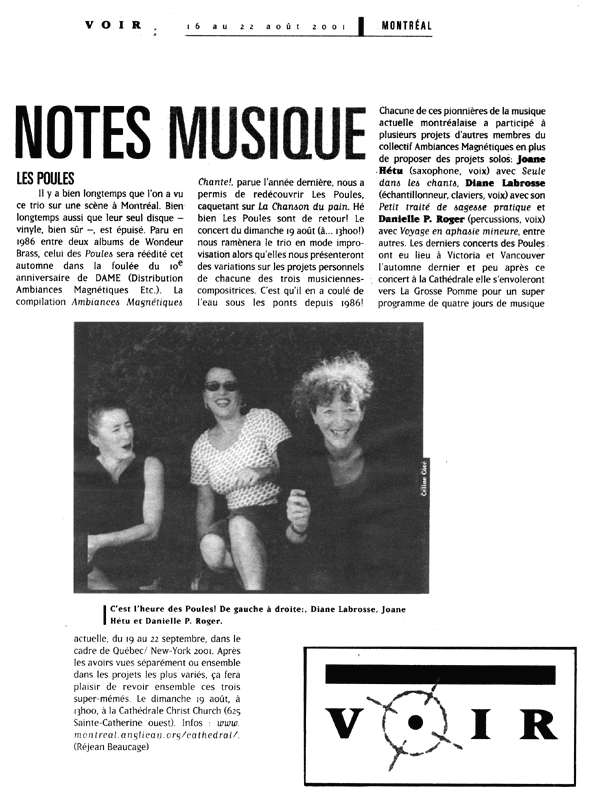
    Les Poules

    Réjean Beaucage, Voir, 16 août 2001

    Il y a bien longtemps que l’on a vu ce trio sur une scène à Montréal. Bien longtemps aussi que leur seul disque — vinyle, bien sûr —, est épuisé. Paru en 1986 entre deux albums de Wondeur Brass, celui des Poules sera réédité cet automne dans la foulée du 10e anniversaire de DAME. La compilation Ambiances Magnétiques volume 5: Chante! 1985-2000 parue l’année dernière, nous a permis de redécouvrir Les Poules, caquetant sur La chanson du pain. Hé bien Les Poules sont de retour! Le concert du dimanche 19 août nous ramènera le trio en mode improvisation alors qu’elles nous présenteront des variations sur les projets personnels de chacune des trois musiciennes compositrices. C’est qu’il en a coulé de l’eau sous les ponts depuis 1986! Chacune de ces pionnières de la musique actuelle montréalaise a participé à plusieurs projets d’autre membres du collectif Ambiances Magnétiques en plus de proposer des projets solos: Joane Hétu (saxophone, voix) avec Seule dans les chants, Diane Labrosse (échantillonneur, claviers, voix) avec son Petit traité de sagesse pratique et Danielle Palardy Roger (percussions, voix) avec Voyage en aphasie mineure, entre autres. Après les avoirs vues séparément ou ensemble dans les projets les plus variés, ça fera plaisir de revoir ensemble ces trois super-mémés.

    Après les avoirs vues séparément ou ensemble dans les projets les plus variés, ça fera plaisir de revoir ensemble ces trois super-mémés.

    Éloge de la musique libre

    Luc Bouquet, Écouter voir, no 106, 1 octobre 2000

    Labrosse, Diane, Tétreault, Martin: Le Mystère magnétique

    Experte en échantillonnage de sons bruts et pénétrants, Diane Labrosse aime à détourner la masse sonore pour en extraire l’inattendu (Face cachée des choses / AM 036). Compositrice instantanée, improvisatrice de l’instant, elle n’a de cesse d’explorer toutes les techniques électroacoustiques existantes dans une ode à la bizarrerie avouce (Île Bizarre / AM 055). Aimant à explorer la face cachée des choses, cette accordéoniste, chanteuses et adepte de l’échantillonnage libre signe de nombreuses musiques de films (Montréal vu par, L’entrevue, Les décrocheurs d’étoiles), travaille pour le théâtre (38 contes shakespeuriens), collabore avec la chorégraphe Catherine Tardif et et obtient en 1997 une bourse du Conseil des arts du Canada en vue de l’écriture d’une pièce pour treize instruments commandée par les Espaces Sonores Illimités. Martin Tétreault aime à utiliser des disques coupés ou recollés sur ses platines tourne-disques. Comme Otomo Yoshihide, autre grand incontournable du vinyle détourné, le sociétaire d’Ambiances Magnétiques agence les sons et fait œuvre d’archivage en épinglant la voix de Maria Callas (La diva et le vinyle / AM 059) ou en faisant se rencontrer science fiction et cartoons (21 situations / AM 69).

    Reviews — Improv & Avant-Garde

    Eric Hill, Exclaim!, 31 mai 2000

    Diane Labrosse’s album is a beast of another colour. Translated roughly as Small Treatise On Practical Wisdom, the album is a examination of 37 proverbs and their guiding power on daily life. What further marks this ambitious project is that each of the 37 tracks is presented in a different musical style and titled after a virtue or human failing: thus Freedom with the proverb “all madness is in nature” is delivered as a canon; “Ignorance” as a psychedelic piece; Séduction as a ballad and so on. Labrosse is aided and abetted by many of the label’s other artists, including Joane Hétu. These 37 pieces are (necessarily) short and either flow together like water or strain like tectonic plates, but in the end they are little windows onto the lives we live.

    … flow together like water or strain like tectonic plates, but in the end they are little windows onto the lives we live.

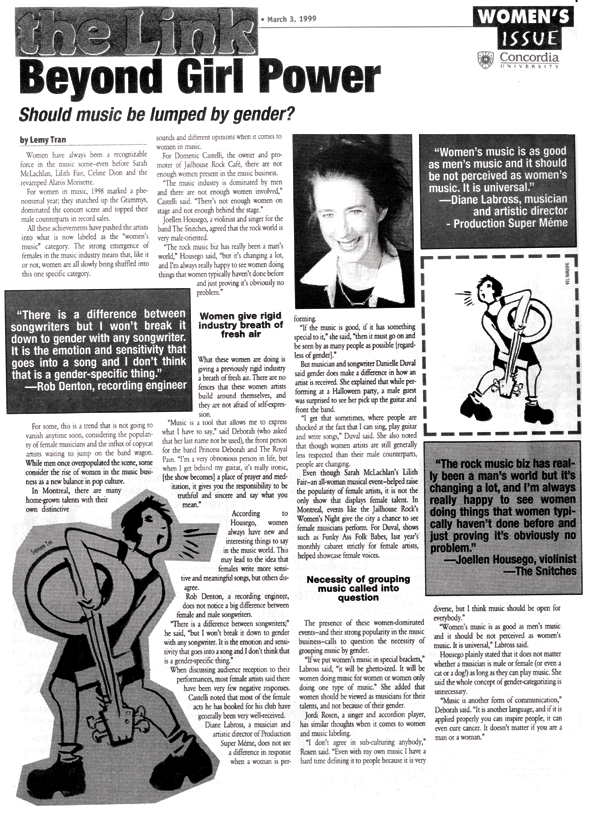
    Beyond Girl Power

    Lemy Tran, The Link, 3 mars 1999

    Women have always been a recognizable force in the music scene-even before Sarah McLachlan, Lilith Fair, Celine Dion and the revamped Alanis Morisette.

    For women in music, 1998 marked a phenomenal year; they snatched up the Grammys, dominated the concert scene and topped their male counterparts in record sales.

    All these achievements have pushed the artists into what is now labeled as the “women’s music” category. The strong emergence of females in the music industry means that, like it or not, women are all slowly being shuffled into this one specific category.

    For some, this is a trend that is not going to vanish anytime scon, considering the popularity of female musicians and the influx of copycat artists waiting to jump on the band wagon. While men once overpopulated the scene, some consider the rise of women in the music business as a new balance in pop culture.

    In Montréal, there are many home-grown talents with their own distinctive sounds and different opinions when It comes to women m music.…

    … When discussing audience reception to their performances, most female artists said there have been very few negative responses.

    Castelli noted that most of the female acts he has booked for his club have generally been very well-received. Diane Labrosse, a musician and artistic director of Productions Super Mémé, does not see a diffference in response when a woman is performing.

    «If the music is good, if it has something special to it,” she said, then it must go on and be seen by as many people as possible [regardless of gender].»

    … Women’s music is as good as men’s music and it should be not perceived as women’s music. It is universal,” Labrosse said.

    Housego plainly stated that it does not matter whether a musician is male or female (or even a cat or a dog!) as long as they can play music. She said the whole concept of gender-categorizing is unnecessary.

  • 1
  • 2
  • 3
  • 4
  • 5
  • 6