Sauter au contenu principal
electrocd

Blogue

87 résultats
  • 3
  • 4
  • 5
  • 6
  • 7
  • 8
  • 9
  • 10
  • 11
  • Île bizarre dans Exclaim!

    «Release Tour Mind…», Spike Taylor, Exclaim!, 1 juillet 1998
    mercredi 1 juillet 1998 Presse

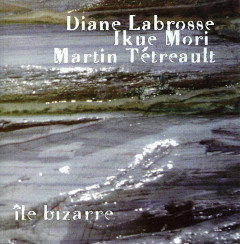
    On Île bizarre, Tétreauit is joined by Diane Labrosse (keyboards, sampler) and Ikue Mori (drum machines) to make hell of their technologies in a full-length search tor noise redemption. This is a found paradise of sound where the buzzing of bees is replaced with trying wires and the sun shines angry and grey. Each member contributes brilliance to the mood, a soundtrack to a boiler room chase scene. This is one of the most captivating listening hours I’ve spent in days and days of wandering from town to town.

    This is a found paradise of sound where the buzzing of bees is replaced with frying wires and the sun shines angry and grey.

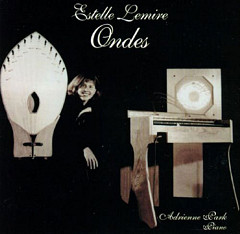
    Ondes dans Le Devoir

    «Des ondes Martenot au clavecin, la musique pour clavier sait prendre tous les visages», François Tousignant, Le Devoir, 20 juin 1998
    samedi 20 juin 1998 Presse

    […] On tient ici une pièce de grande qualité [Voix blanche de Gilles Gobeil], où l’intégration entre la bande et l’instrument en direct est formidablement réussie. Un univers mixte, s’inspirant de la panoplie acousmatique, d’un certain langage harmonique traditionnel, et de trucs (glissando, écho, attaques supprimées…) qui produit d’abord un effet, puis une impression. Étonnant et gratifiant, surtout aussi bien joué…

    … formidablement réussie.

    Île bizarre dans Montreal Mirror

    «Review», Chris Yurkiw, Montreal Mirror, 11 juin 1998
    jeudi 11 juin 1998 Presse

    No man is an island––not even a bizarre one — so turntable torturer Martin Tétrault hooks up with compatriot Diane Labrosse and Japan’s Ikue Mori for this updated take on musique concrète. Labrosse sounds like she’s reconstructing the didgeridoo on her sampler, Mori evokes Africa with her “talking” electronic drums and Tétrault colours between the lines, playful, provocative and proving that those who get called musique actuelle are just as good at electroacoustics. 8/10

    8/10

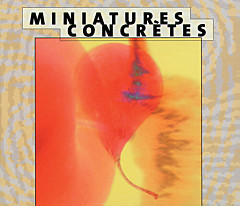
    Miniatures concrètes dans New York Press

    «Music Xtra», Kenneth P Goldsmith, New York Press, no 15, 10 juin 1998
    mercredi 10 juin 1998 Presse

    There have been two iconic pocket symphonies written in the 20th century: Érik Satie’s Vexations and Brian Eno’s Windows 95 Startup Sound. Both are concentrated miniatures, both are resistant to familiarity and both stand up to countless repetitions of enjoyable listening (the big difference is that Satie never got thousands of bucks to write his). Today both hold up so well because of the precise way that each sums up their respective moments’ tiny, eloquent statements. Sandwiched between these two works have been numerous attempts to commission or compile pocket symphonies on record, the most outstanding being The ResidentsCommercial Album and Miniatures: A Sequence of Fifty-One Tiny Masterpieces edited by Morgan Fisher from 1980.

    Now two new attempts have caught my attention: Four Years in 30 Seconds and Miniatures concrètes. Both deal in extremely experimentaf music, but one reeks of nostalgia while the other catches our moment with precision. Miniatures concrètes celebrates the 50th anniversary of musique concrète by commissioning 24 electroacoustic musicians from around the world to create three-minute works. The composers, all born after the invention of musique concrète (the oldest is 49, the youngest 26), stick close to the stock vocabulary of tweaks and thumps, whooshes and echoes that was defined by pioneers of the genre half a century ago. And although most of the work is composed on computer, there’s precious little recognizable sampling, appropriated or plundered sounds.

    In this way, the disc is disappointing in its traditionalism, as radical as that tradition might be. I wish these composers would break some rules. However, there are a few exceptions: Roger Doyle’s The First Spirit Level uses manipulated organs and voices to achieve a cut-up action-flick soundtrack feeling. Justice Olsson’s A Man is a Delicate Flame boils down 1500 samples to create something that sounds like a three-minute vocal outtake from The Pet Sounds Sessions. The most interesting track, by far, is Richard Karpen’s Mass which embeds tiny sampled riffs from Hendrix’s Little Wing into a mass of mantric electronics. With this sly use of music history samples, Karpen seems to be the only one on the disc bringing electroaoustic music up to date. […]

    Léone dans Splendid E-Zine

    «Review», Noah Wane, Splendid E-Zine, 8 juin 1998
    lundi 8 juin 1998 Presse

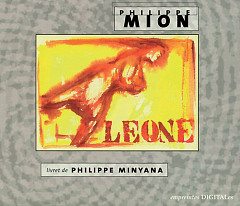
    To be honest, this is the first opera recording Splendid has reviewed. Before you envision 300-pound sopranos belting out Wagnerian arias in Viking garb, let me assure you the Léone is nothing like any opera you’ve heard before. The score for Léone is entirely electronic — disembodied sound blaring through loudspeakers — a symbol of detachment and alienation. The music is sparse yet expressive — punctuating the libretto. It is subdued, foggy almost, as if bubbling up from some subconscious recess of the mind. The plot, while perhaps tame by “Natural Born Killers” standards, is by operatic standards intense to say the least. Its treatment of such topics as schizophrenia, fetishism, bestiality, murder, and infanticide clearly sets it apart from even the most sordid of 20th-century operas. Remarkably, the vernacular style of librettist Philippe Minyana lends a sense of whimsy to the atrocities described in the story, resulting in a sort of “black fairy tale” atmosphere to the whole thing. Perhaps most importantly, the existence of Léone this close to the end of the century bodes well for opera surviving the turn-of-the-century mark.

    … bubbling up from some subconscious recess of the mind.

    Les dérives du signe dans Computer Music Journal

    «Review», Stéphane Roy, Computer Music Journal, no 22:2, 1 juin 1998
    lundi 1 juin 1998 Presse

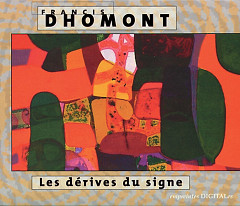
    The other cycle, Les dérives du signe, includes four works Novars, 1989; Chiaroscuro, 1987; Météores (Meteors), 1989; and Signé Dionysos (Signed Dionysus), 1986, rev. 1991. These pieces make subtle play on the ambiguity generated by shifts in meaning. We find here misappropriations of pre-existing musical sources in Novars and Chiaroscuro, the synaesthetic transfer of the sensations of speed and kinetic energy in the morphological shapes of the sound materials in Météores and the clouding of the paths that lead from natural sounds to novel, artificial sounds in Signé Dionysos.

    It is evident that Mr. Dhomont has a predilection for musical eyeles. Their themes allow us to understand some of the aesthetic concerns he has wanted to explore in his art. Throughout his treatment of these subjects, however, Francis Dhomont has never tried to preseribe any specifie way to listen to his music. Indeed, there is a perpetual concern in his music to encourage different listening strategies: formal, referential, programmatic, and so on. He has even tried to create unity between those diverse dimensions that can shape the musical work during the listening process. The program note Points de fuite serves as evidence of that fact:

    Audition/reading on many Ievels:

    1. Technical (kinetic study: glides in tessitura, mutations of masses, of densities; modifications of timbre; energetic eruption/dispersion; spatial mobility).

    2. Impressionistic (encounters, crossings, fusion of heterogeneous events which carry similar connotations; trajectories, velocities, displacements; the near and the distant; the passage)

    3. Symbolic (flight: running away; departure, wandering, lapse obliteration. The horizon, Kafka: Disappearing America).

    4. Ad libitum…

    To sum up, in these four CDs covering almost two decades of achievement, Francis Dhomont offers us acousmatic works of real substance that transcend very well the technological orientation implied by such music. When we listen to these pieces we discover many things about music, and something of its breathtaking vertigo.

    When we listen to these pieces we discover many things about music, and something of its breathtaking vertigo.
  • 3
  • 4
  • 5
  • 6
  • 7
  • 8
  • 9
  • 10
  • 11