Sauter au contenu principal
electrocd

Blogue

195 résultats
  • 2
  • 3
  • 4
  • 5
  • 6
  • 7
  • 8
  • 9
  • 10
  • Migrations dans Exclaim!

    «Review», Kevin Hainey, Exclaim!, 23 juin 2004
    mercredi 23 juin 2004 Presse

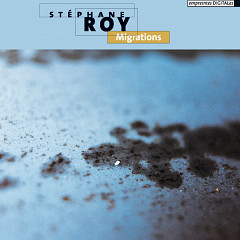
    One of Canada’s leaders in innovative compositional music, Stéphane Roy’s blend of musique concrète and electroacoustic composition is as fresh and exciting as any of either genre’s best names. Migrations compiles three lengthy sonic triptychs recorded between 1998 and last year. 2003’s Appartenances studies the tendencies of Celtic, Latin and Oriental musics through a veiled sensibility on par with the riveting dynamic structures and tape-splice techniques Karlheinz Stockhausen demonstrated on ground-breaking works such as Kontakte and Gesang der Jünglinge. Trois petites histoires concrètes is just that: three small pieces that commemorate the history of musique concrète, and Masques et parades is a study of the tragic-comic nature of the circus. Migrations wins not only because Roy’s concepts and theories are adventurous and uncompromising, but because his final product, the music, is so damned engrossing. But don’t try to use this album at your dinner party or while you read — Migrations is music for the intellectual mind that’s willing to concentrate on its complexity and details.

    … as fresh and exciting as any… adventurous and uncompromising…

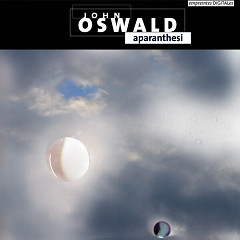
    Aparanthesi dans Exclaim!

    «Review», Nilan Perera, Exclaim!, 23 juin 2004
    mercredi 23 juin 2004 Presse

    The thing about John Oswald’s music that has always impressed me is that it is, quite simply, masterful. The sheer completeness of his individual works is something quite startling in and of itself: nothing, in my opinion, could possibly be subtracted or added. If you were to ask me about the “plundered” elements that form the music on this CD, I would say: thunder, the sound of water, single notes out of a piano, ambient drones, whispers and you’d roll your eyes when the new age warning buzzer would instantly go off. Nothing could be further from the truth. The two pieces on this CD total over an hour and they contain all the mystery, power and sheer craft of the very best orchestral classical music I have heard. It was a curious impression, considering the fact that I was listening to a sampled work, but one that kept recurring. My attention was not only kept, but I was as intent on hearing the next event as I would be in reading the next page of an amazing novel. The experience was very much the same. Some of the best plunderphonia to date, from the master himself.

    … I was as intent on hearing the next event as I would be in reading the next page of an amazing novel.

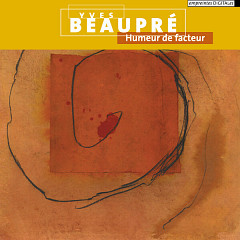
    Humeur de facteur, Fractures dans SAN Diffusion

    «Review», Adrian Moore, SAN Diffusion, 23 juin 2004
    mercredi 23 juin 2004 Presse

    The Compact Disc label empreintes DIGITALes currently numbers some 65 discs and embraces a diverse range of electroacoustic music. Yet there are many common motivating forces in this collection, the most notable being the ‘quest’ for sound. The variety of sounds on offer is well highlighted by these two discs, yet the techniques and methods used are remarkably similar and are rooted in this desire to search out the right compositional material.

    Humeur de facteur (The Maker’s Humour) is some 54 minutes in length and consists of six movements, each one an individual making up part of the whole. Beaupré, a harpsichord manufacturer and composer (in both cases a builder) seems to bring the same sense of attention to detail to his music as he does to his harpsichord construction. The work itself resides in the world of the harpsichord; mainly pitched material treated and resynthesised to offer new timbral worlds. Inharmonic drone-textures shelter granulated plucked strings whilst small metallic percussion hint at the delicate interior of the harpsichord. There is a highly fluid method of mixing, a delicacy often left behind when working with so many disparate sources. It would be all too easy to wallow yet Beaupré manages to create a polyphony that offers a unique combination of weight and power, with enough breathing room to take it all in. The polyphony relies upon submersion in pitch and mode and Beaupré creates transitions between modes through spatial dissolves and other ‘ethereal’ scenes. At times, Beaupré forces his sounds upon us through mechanical repetition, but we are quickly lured back inside his world through bell-like sonorities and other more ominous textures.

    Without being in any way melancholic, the work hints at the solitary life of the instrument maker, alone (but at one) with his work. Perfectly mastered — if you want to hear some of the bass attacks you’ll have to endure a fair degree of midrange pitch material – Humeur de facteur presents some wonderful sound-worlds. It seems apparent that after listening several times, the uniqueness of each movement is not as obvious as it might have first appeared. Moreover, the relationship between the movements becomes more beguiling as the work develops. It would not be naïve to assume however that no matter where in the 54 minutes the form became unfathomable, it is possible to ‘readjust’ ones hearing, enjoy the sonorities on offer, and quickly come back to the piece as a whole. In fact this work raises some of the most fundamental questions about so-called ‘old school’ electroacoustic music: Sound over form; a polyphony of disparate sources and pseudo-narrative structures (despite the abstract sound-world, the vast landscapes afford visualisation and to a certain extent, quantification). It is Beaupré’s mixing that offers us some answers. It is colourful and delicate yet purposeful and at times profound. In a dark corner, this is perhaps where the Humeur de facteur can be found.

    Fractures on the other hand finds itself rooted in a world of noise, chimeras born of real world sounds and synthetic noises. Whilst Beaupré placed emphasis on the vertical through mixing, Bouchard directs his attention to the horizontal, focusing our listening towards the passing of time: The montage here is timed to perfection.

    Angle mort is a Kingdom hospital of sound, dealing with ‘the struggle between antibodies and viruses and the auditory point of view of the patient surrounded by machines in a hospital room’. Sounds are clear and well balanced; given their individual complexity, too much mixing would be inappropriate. At times, metallic drones provide a skin for the scars of glitch. But this is not really ‘glitch’. These small sounds, driven by dark rhythms possess a certain resolve. They are the right sounds at the right place at the right time. Whilst these small glitches could be heard as the sounds of mechanical error outside of the work, their contextualisation is definite; not only from sound to sound but within the sound itself. Each sound seems clinically prepared and the mastering is excellent. Bouchard draws you in to his dark and strangely impersonal world through a fairly frenetic opening section. We are suddenly made self-aware – and perhaps we are patient – as the sound world turns in on itself. As the piece draws on it becomes increasingly difficult to follow the pace of the music. The timbral invention of the first ten minutes loses some of its vitality, leaving one feeling slightly empty at the close of the work.

    Bouchard then presents us with his sketches in the form of Trois miniatures en suite. These short vignettes shed light upon the remainder of the disc and give us an insight into Bouchard’s working method.

    Without conjuring an inevitable Deleuze & Guattari moment, it seems safe to say that in Parcelles, a work focusing upon sounds that seem to organize themselves from what appears to be chaos and ‘create a music I am often the only one to hear’, Bouchard is talking about the elusive rhizome. Both Parcelles 1 and Parcelles 2 (some 20 minutes in total, split into 7 and 5 movements respectively) draw naturally upon Trois miniatures… but also incorporate the darkness of Angle mort. Dark however becomes bleak and impersonal becomes inevitable. The inevitability of sound pervades Bouchard’s music, as indeed does his compassion towards the recorded ‘scenes’ (something that transpired only after numerous auditions). At once a contradiction appears. We are borrowing Bouchard’s memories – it is wonderful but at the same time it is not enough. In Bouchard’s words these are ‘incredible moments’ he wanted to share but they are but ‘fragments of moments’. (I actually prefer the French, partager which doesn’t sound as personal.) We are continually invited to grasp at the moment but it is continually torn away.

    These may sound like negatives but over a good pair of loudspeakers, one can almost touch these invitations of sound, such is the clarity of recording and mastering involved. So in a sense, one is offered a chance of being part of ‘the moment’, not too much so as to become overly attached and not too little so as not to recognise it.

    Naturally one must go beyond the traditions and forms of the past: these are short movements of between one and four minutes. Must they have a form? Can they not just be structured? What is fascinating about these two pieces is the continuity between cuts and the bizarre concoction of real life (albeit filtered and edited) and a lurking synthetic residue. Try to focus upon the ‘moment’ and physically edit the cuts out of the work and this music becomes frustrating. Let it wash over you and you will be disappointed. In short, Parcelles (and to some extent Angle mort) require extended, attentive listening, preferably over a good pair of loudspeakers that can project the beautifully crafted full range sounds, glitches and hard edits. I particularly liked the energy of the penultimate movement in Parcelles 2, Brazil Wins. We are presented with some truly original work on this compact disc.

    … truly original work…

    Podweek dans Sodapop

    «Recensione», Emiliano Grigis, Sodapop, 20 juin 2004
    dimanche 20 juin 2004 Presse

    Questo disco mi ha fatto fare un salto indietro nella memoria davvero fenomenale… Nella prima metà degli anni novanta erano diffusi programmi musicali dai nomi come scream tracker e fast tracker, spesso poco più che semplici sequencer, che permettevano di comporre suonando campioni: anche se molto molto rozzi, avevano il vantaggio di essere i primi strumenti che permettevano di comporre musica con campioni personalizzati a costo nullo. All’epoca venivano usati da molti, per comporre un po’ di tutto: dalle cover di tutti i generi, a tutta la sottocultura electronica dell’epoca: techno, trance, commerciale; da qualche parte in casa ho ancora una pila di floppy disk con campioni e pezzi vari. Dopo la metà dei novanta vennero soppiantate dall’arrivo di Windows, con cui non erano più compatibili; Podweek è registrato esattamente con quelle tecniche, e ha nella composizione dei pezzi quella semplicità data proprio dalla “archeologia digitale” degli strumenti, ma allo stesso tempo mostra come con la povertà di mezzi si aguzzi l’ingegno (avendolo a disposizione, naturalmente…). Come già nell’epoca d’oro succedeva, c’era chi sfruttava al massimo le possibilità portando l’ascoltatore a chiedersi “ma come fa?: di seguito si andava a curiosare nel suo codice per imparare un trucco dopo l’altro… Frédérick Blouin ha classe e gusto da vendere, e da vero “tracker” si cimenta con più generi, dalla rotterdam geniale di King of the Elephants, a brani ambientali, pezzi simil hiphop, cafonate hardcore come i nove minuti della splendida A Ride in Elephant City… Poliedrico e davvero sorprendente il suo repertorio, in questi quindici brani composti tra il 1995 e il 2001, tutti a base dei suoni che cominciavano già ad abbandonare la freddezza del midi, tastiere ariose della prima ondata ambient e batterie ancora in odore di synth pop; nota per la confezione cartonata davvero originale. Questo disco oltre ad essere valido documento del legame tra questa sottocultura e i mostri sacri di metà novanta (Orb e Aphex Twin per citarne solo due), è anche pieno di belle invenzioni sonore ed elettronica di gran classe.

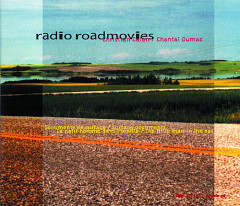
    Radio Roadmovies dans Vital

    «Review», Frans de Waard, Vital, no 427, 14 juin 2004
    lundi 14 juin 2004 Presse

    This is one of those things that fall out of the sky and you have no idea who or what it is about. One Chantal Dumas and one Christian Calon made a trip through Canada, and this double CD is the sort of Hörspiel about it. Recording natural elements on their trip, as well as say rain falling on the tent but also them speaking about places they visit (not always as a clear narration) or the meeting of people, like ‘the chiefs in the Gitskan village of Kispiox’. It’s hard to say wether a lot of post-processing took place. There are moments in there in which I think all the sounds are as they are, but in some cases there might be also some sort of post-processing. Not that’s really important at all, because it’s a fascinating journey to hear. You could wonder if it’s something you’ll find spinning a lot, but in all it’s a captivating recording. On the second CD Documents de surface (Surface Documents) nine tracks are presented of sounds as they actually were but then presented in collage form. Grouped together are various wind sounds or water systems. Here no talking but instead pure soundscapes, which are quite delicate and nice. The narrative aspect is all gone here, but on the other hand I can imagine people playing this disc more often. Quite a surprise this double pack, in a very nice digipack.

    … a captivating recording… in a very nice digipack.

    Spells Disaster… dans Le Devoir

    «Critique», Fabien Deglise, Le Devoir, 12 juin 2004
    samedi 12 juin 2004 Presse

    Et du chaos naît l’harmonie… Il y a des pans de la musique électro qui font réfléchir, d’autres qui laissent perplexe, qui font sourire ou encore qui inspirent des petits déhanchements sur le côté. Avec Spells Disaster, le duo montréalais Crackhaus — formé de Steven Beaupré et de Scott Monteith — offre tout ça à la fois. À travers des compositions ludiques qui, dans leur anarchie sonore, finissent par faire émerger étrangement des mélodies délicates. Et on s’étonne d’en redemander.

    L’exercice est étonnant, même s’il puise beaucoup dans les créations d’une autre formation d’ici: Akufen. C’est que les deux magiciens de l’échantillonneur de Crackhaus aiment visiblement jouer avec des sons incongrus mis en boucle, amplifiés ou encore placés sur des rythmes saccadés pour en détourner le sens. Avec succès. Résultat? Onze créations uniques qui, si elles semblent parfois sortir d’un vinyle qui saute, explorent finalement l’univers kétaine de la musique country ou même pop, à la sauce électro. «Ce n’est pas un album, précise, en anglais sur la pochette, les deux hommes derrière ce troisième CD produit par Mutek, c’est le cliché d’une année remplie de beaucoup de rires et d’expériences inoubliables, mais aussi la célébration d’une communauté à laquelle nous sommes heureux, comme des enfants dans un magasin de bonbons, d’appartenir.»

    Et la communauté le leur rend bien avec quatre pièces remixées par Mole, Mike Shannon, Egg ainsi que Flabbergast placées, au nom de l’appartenance, sur la partie inférieure de cet album. Forcément, au premier contact, l’ensemble peut donc sembler fort hermétique. Mais le sentiment s’étiole à force d’en abuser.

    Et du chaos naît l’harmonie…
  • 2
  • 3
  • 4
  • 5
  • 6
  • 7
  • 8
  • 9
  • 10