Sauter au contenu principal
electrocd

Blogue

114 résultats
  • 3
  • 4
  • 5
  • 6
  • 7
  • 8
  • 9
  • 10
  • 11
  • Nicolas Bernier, Darren Copeland, Francis Dhomont, Louis Dufort, Gilles Gobeil, Robert Normandeau, Barry Truax, Hildegard Westerkamp dans Computer Music Journal

    «trans_canada Festival: Trends in Acousmatics and Soundscapes», Wibke Bantelmann, Computer Music Journal, no 29:3, 1 septembre 2005
    jeudi 1 septembre 2005 Presse

    The trans_canada festival of electroacoustic music by Canadian composers at the Zentrum für Kunst und Medientechnologie (ZKM) in Karlsruhe was certainly no everyday experience for the interested German public. A festival of acousmatic music—and acousmatic music only—is quite unusal. The German avant-garde music scene is still uncommonly lively, but most composers prefer either instrumental music (with electroacoustic elements) or multimedia works. The idea of invisible music seems not to touch the German musical sensibility.

    Despite this, 460 visitors found their way to ZKM. During 10-13 February, 2005, they experienced a four day-long plunge into the Canadian way of composing, and had the opportunity to learn more about the “Canadian Example” as Daniel Teruggi of the Groupe de recherches musicales (GRM) called it in his paper. According to Mr. Teruggi, the liveliness and outstanding quality of the electroacoustic music scene in Canada is the result of good composers but also of academically sound research and training and a wide range of philosophical approaches to music. The opening of the festival showed another aspect of this “example.” Paul Dubois, the present Canadian ambassador to Germany, came from Berlin to open the festival—cultural policy in Canada apparently knows and supports the electroacoustic scene intensely, quite contrary to German policy.

    Francis Dhomont, Robert Normandeau, Gilles Gobeil, Nicolas Bernier, Hildegard Westerkamp, and Louis Dufort took part in the festival and presented works (Ned Bouhalassa was invited but for health reasons was unable to attend). Nine pieces were commissioned by ZKM and received their world premieres at the festival.

    trans_canada not only offered an occasion for Germans to learn about Canadian acousmatic music; apparently, it also connected the Canadians themselves. “It seems we had to come to the ZKM in Karlsruhe to get together,” said Robert Normandeau at the last concert. And so, the Francophone composers from the east, rooted in the Paris school of “musique concrète,” met the Anglophone soundscape composers from the West coast. “I was very much surprised when Francis Dhomont told us that he does not like the original sounds to be changed so much that you can’t distinguish their origin any longer,” said Hildegard Westerkamp. “We are not as far away from each other as I used to think.”

    This proved to be quite true, as could be heard. The parallels between their new works, Brief an den Vater by Mr. Dhomont and Für Dich—For You by Ms. Westerkamp, were striking. Both compositions were not only inspired by but also formally based on literature and the structure, the sound, the rhythm of the text. The work by Mr. Dhomont, with the scraping of a pen as a sort of leitmotif, was no less abstract than Ms. Westerkamp’s music with its sea-sounds (gulls, wind, waves). And her fantasy land called “home” is not more “real” then his world of inner struggle. Both works showed an extreme sensitivity for subtle, delicate sounds which were spread in many layers, throwing shadows of sound, and constantly and slowly developing into new shapes and shades. The differences between the works seemed after all (to this listener at least) to be ones of personal style and expression than of basic principles.

    Another new work with words came from Darren Copeland. I don’t want to be inside me anymore was quite singular in the festival due to its definite focus on content, on a “real story.” This fact gave the piece a strong dramatic quality leaving hardly any room for imagination. The intention of the sounds to build around the absorbing, sometimes even vexatious, words seemed to force the listeners to constantly keep their full attention on the meaning of the text. It was a deeply impressive piece, even if it was to a certain extent more dramatic than musical. (Although other listeners might experience it differently if they do not understand the German text.)

    In a way, this work resembles a compositional style of a very different kind, that of Barry Truax. The connection may be found in the very sense of reality in both composer’s works: the reality of the feeling of isolation on one hand, and the reality of an existing landscape (streams, peaks, caves) on the other.

    Even Gilles Gobeil’s magnificent medieval drama, Ombres, espaces, silences…, followed roughly this direction. This piece was not about feeling or landscape, it was about reality, too, in this case the reality of history, only by far more sublime, sensitive, and imaginative. Not “cinema for the ear” but a “novel for the ear” (something like The Name of the Rose?)! However, the form and structure of this work is by far more of a narrative nature than strictly abstract-musical.

    It was Robert Normandeau and the youngsters of trans_canada who were most abstract, and therefore the strongest advocates of a true “invisible music.” It was not only not to be seen, it was not to be imagined. There was nothing real, nothing you could get hold of, it was more or less a complete deconstruction of sounds, ideas, narration. They appeared not to start from any landscape, be it imagined or real, inside or outside the head; they started from ideas, ideas of sound, ideas of form. Even the antique Writing Machine in the work by Nicolas Bernier was more a (slightly exotic) sound than a sense, more a historical reminiscence than an element of form.

    Coincidence shows her unaccountable face, experiment and surprise follow. You could hear experience and mastery in the work of Robert Normandeau, of course. You were always sure that it was him who played with coincidence and not the other way round. His world premiere, ZedKejeM, was highly dynamic, with the energy and rhythm from a dancefloor, but still showed the deepness, density, and versatility of a deep-thinking organizer of energy and fantasy. Every single sound seemed well calculated, the effects carefully set.

    The music of his younger colleagues, Mr. Bernier and Louis Dufort, was more spontaneous, wandering dreamily through all the possibilities of technique and sound, to find out what would happen. Mr. Dufort spread a richness and variety of colors in a free, open structure that simply followed the beauty of the sounds created. In contrast to that, Mr. Bernier followed an intellectual plan, he set his rules and let them work. One always sensed the will behind the music, one always tried to follow and understand the experiment instead of just enjoying the result. But, on the other hand, this method produced a certain strong energy in the work. This composer had the power to raise and hold the intellectual interest of the listener.

    All in all, it was fascinating to take in over a few days such a wide range of styles and personalities, and to learn a little about their methods.

    trans_canada also provided the chance to meet the composers in person. Each of them delivered a paper about their work. They could only give a rough survey, of course, in a 45-min talk. Rather than concentrating on techniques or software, most composers just tried to acquaint their colleagues and the small number of other interested people with their sources of inspiration, their opinions, their philosophy. Remarkable was the clear delivery of all the composers and the relaxed atmosphere of these sessions. There seemed to be no need to impress anyone, and not so much need to discuss, let alone debate. Everybody was open-minded and respected the others, as if trying to learn and understand, not to question fundamentals.

    It was like a good talk between colleagues and friends. Mr. Normandeau provided insight into his large archive of sound and his permanent work on the human voice. Mr. Gobeil expressed his preference for the sound of exotic instruments (like the Daxophone) and his dislike of techno music (inducing him to write a techno-piece). Mr. Dhomont talked about the relation between accident and control in his work, marking his own position somewhere between Pierre Boulez and John Cage:Boulez would say: ‘This is incidental, throw it away;Cage would say: ‘This is incidental, so I take it;’ I say: ‘Look, there is an interesting incident, but should I take it?’” He also used the opportunity to call for more polyphony in electroacoustic music instead of the exclusive concentration on creating the most original, most exotic new sound: “In an orchestra, you mix different instruments, but the single instrument becomes not less beautiful.”

    The exceptional environment of ZKM supported this beautiful richness of sounds and the inventiveness of the composers immensely. The two concert venues offer exquisite acoustics. They were equipped with 70 concert loudspeakers, placed in either circles or in a kind of “acousmonium surround environment.” This, in conjunction with the timbral and spatial qualities of the works, created an extraordinary musical experience.

    … it was fascinating to take in over a few days such a wide range of styles and personalities…

    Luc Ferrari dans Le Monde

    «Luc Ferrari, compositeur de musique électroacoustique», Renaud Machart, Le Monde, 23 août 2005
    mardi 23 août 2005 Presse

    Le compositeur français Luc Ferrari est mort d’une pneumonie à Arezzo, en Italie, où il se trouvait pour des vacances, lundi 22 août. Il était âgé de 76 ans.

    Luc Ferrari n’était pas un auteur connu du grand public, mais son travail dans les domaines de la «musique concrète» (un terme inventé par Pierre Schaeffer, en 1948) pour sons enregistrés était admiré par beaucoup pour sa singularité, sa poésie, sa variété.

    Né le 5 février 1929, à Paris, Luc Ferrari poursuit d’abord des études de piano. Ses études de composition avec Arthur Honegger et Olivier Messiaen ne le marquent guère. Mais, comme beaucoup de jeunes compositeurs de l’après-guerre, il fréquente les cours d’été de Darmstadt, en Allemagne, le QG annuel de l’avant-garde sérielle: «La grande rencontre musicale, (ce fut) avec John Cage, qui faisait exploser toutes ces idées qui commençaient déjà à devenir un peu institutionnelles.»

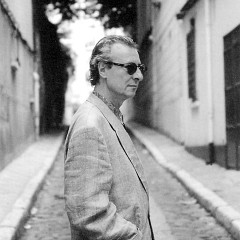
    Son sens de l’humour et de la provocation, ses interventions dans des champs divers — film, documentaire, radio, théâtre musical —, n’aideront pas à repérer la place précise de ce créateur pris par certains pour un bricoleur de génie. David Jisse, compositeur, homme de radio et actuel directeur du centre de création musicale La Muse en circuit, que Ferrari fonda en 1981, explique: «En fait, la première impression de ‘bricolage’, souvent relevée, est contredite par l’analyse de ses œuvres, qui révèle une précision diaboliquement rigoureuse au service d’un monde abstrait et personnel aux portes du réel. Il était perméable à son temps, mais toujours d’une manière singulière.»

    Dans la préface de l’enregistrement de sa très belle pièce de 1999, Far-West News 1, le résultat d’un périple avec un «micro voyageur» dans le sud-ouest nord-américain, le compositeur livre un prière d’insérer applicable à son œuvre entière: «Ce n’est ni un reportage, ni un paysage sonore, ni Hörspiel (pièce à écouter), ni œuvre électro, ni portrait, ni une exposition d’enregistrement du réel, ni une transgression de la réalité, ni une narration impressionniste, ni… etc. C’est une composition. […] Ensuite j’ai appelé ça poème sonore autour d’un voyage réel tant il se peut que la poésie joue avec la réalité comme d’un accordéon, que la composition dans certains cas, surtout dans le mien et progressivement dans ma vie, est un jeu pervers avec la vérité.»

    Dissension fondamentale

    La brouille entre Luc Ferrari et Pierre Schaeffer, le fondateur du Groupe de recherches musicales, en 1958, sera retentissante et fondée sur une dissension fondamentale: «Schaeffer faisait un travail de recherche presque fondamentale sur le son, il voulait bannir le sens. Ferrari, avec sa première grande composition de musique, dite «anecdotique», Hétérozygote (1963-64), gagnée par des sons du réel, démontait l’idéal schaefférien», déclare Daniel Teruggi, actuel directeur de l’Ina-GRM. «Pour lui, il n’y avait pas de catégories. Tous les sons pouvaient être utiles. Son œuvre est très variée, constituée de petits jardins, qu’il arrosait régulièrement.» Le site du GRM propose une écoute interactive de cette pièce fondamentale.

    Luc Ferrari, qui devait écrire d’abord de la musique strictement instrumentale (notamment pour le piano), continuera à associer instruments et sons «concrets». Il écrira aussi de la musique instrumentale «pure», comme en témoigne par exemple son Histoire du plaisir et de la désolation (1979-81), d’une gourmandise (volontiers dévoratrice de la musique d’autrui) et d’une vitalité sonores proprement enthousiasmantes.

    Le musicologue et homme de radio Daniel Caux, un proche de Luc Ferrari, souligne: «C’était un créateur passionné par l’observation du réel: les désordres du corps seront la source d’inspiration de ses deux dernières œuvres. Créés [en] juin à La Chaux-de-Fonds, en Suisse, Les Arythmiques prennent en compte ses récents troubles cardiaques tandis que Morbido Symphony explore la gamme des sensations liées à la maladie. Son dernier commentaire sur cette pièce est qu’elle allait être très drôle.»

    … admiré par beaucoup pour sa singularité, sa poésie, sa variété.

    Plays the Music dans Montreal Mirror

    «Green Machine», Lorraine Carpenter, Montreal Mirror, 18 août 2005
    jeudi 18 août 2005 Presse

    “Our keyboard stands are all medical walkers and supports that I pulled out of the garbage,” says The Unireverse’s man in Ottawa, Michael Caffrey. “I love producing electronic music, and my goal in life is to not use other people’s resources in anything I do.”

    Taking after classic Moog cover bands, The Unireverse are all about reusing and remodelling. Ever since Montréal’s Brian Damage and Alex Moskos founded the band in 1999, they’ve crafted astral electronic music with antique analog synths, samples, canned beats and other people’s songs, spinning familiar and obscure tunes way out into the stratosphere. Not surprisingly, there’s often a fine line between the trio’s tangents in covers and original The Unireverse material.

    “Sometimes a new song sort of materializes from a cover,” Damage explains. “Other times, when we’re doing warm-up jams in rehearsals, just getting loose and taking it out a bit, Michael will throw down a beat and we’ll all get in on that and see where it leads. Sometimes it goes in pretty interesting directions, and sometimes we even remember how to reproduce it later.”

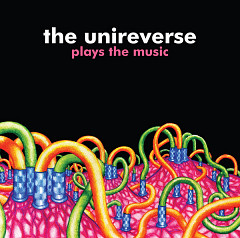
    Plays the Music is the band’s new CD, their debut with local label No Type following a series of ultra-indie CDRs. Although the disc features several original tracks alongside covers of The Beatles, Donna Summer et al., The Unireverse’s production methods remain greener than thou.

    A wheelchair technician by day, Caffrey is the band’s go-to guy for discarded goods and modified gear, but his freegan finds aren’t limited to the medical industry.

    “Car audio is such a fashion,” says Caffrey, describing vanity items like decorative wiring and plexi-glass plates used to show off name-brand speakers. “Really absurd stuff, but it runs well on batteries, batteries that will no longer [power] really elaborate medical chairs. I’ve been using them in our soundsystem, so we can set it up absolutely anywhere. Soon we’ll be able to play in the middle of the woods in a blackout.”

    Moskos shares Caffrey’s love of plundered gadgets, like a device he used on Daemon Bubbles, a track from the new CD. The “toy,” as he calls it, attaches to clips that grip your fingers, allowing the user to create “corny” hip hop sounds by wiggling their digits. Just add loops to make it bubbly, stir in slowed-down samples from a decrepit recording of The War of the Worlds (“It sounds like a demon MC,” Moskos says), record a cheesy chorus for R&B flavour, and voilà, Daemon Bubbles.

    There’s no shortage of original incidental sounds on Plays the Music — such as power tools and the band members’ approximations of barnyard animals — but 20 Rats At Once has its roots in old sound effects records.

    “One of them was ‘Rats,’“ says Moskos, “and as we were listening to it, we were like, ‘Uh, there’s more than two rats there.’ We kept saying, ‘Ugh, that’s like 20 rats at once!’ A lot of this stuff comes out of our weird sense of humour — Brian and I both have mice at home, so there are some vermin issues. Basically, I think we spend too much time together.”

    Taking after classic Moog cover bands, The Unireverse are all about reusing and remodelling.

    Puzzles dans EtherREAL

    «Critique», Fabrice Allard, EtherREAL, 11 août 2005
    jeudi 11 août 2005 Presse

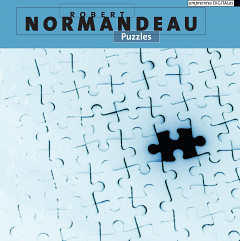
    On découvrait Robert Normandeau il y a quelques années à l’occasion de Sonars, paru chez Rephlex, compilation de quelques unes de ces précédentes œuvres, déjà publiées chez empreintes DIGITALes. Puzzles est le cinquième album de cet artiste de renommée mondiale, maintes fois primé, et professeur de composition électroacoustique à l’Université de Montréal, à être publié sur ce label canadien, également largement reconnu pour la qualité de ses sorties, son packaging original, et son approche didactique (les notes de pochettes permettent aux compositeurs d’expliquer leur travail).

    Puzzles regroupe des pièces composées pour des pièces de théâtre mises en scène par Brigitte Haentjens, et écrite par Feydeau, Duras, ou Sophocle pour ne citer que les plus connus. Celles-ci sont ici présentées dans leur version originales ou parfois recomposées a posteriori en studio afin d’en faire des œuvres indépendantes. Petit avertissement enfin, Puzzles n’est pas un CD-Audio, mais un DVD-Audio, lisible par toute platine DVD, et proposant au choix une version mixée en 5.1, et une classique version stéréophonique, sachant qu’a l’origine ces pièces sont prévues pour une diffusion sur 16 pistes!!

    Mais laissons là ces considérations techniques, et prenons le temps de découvrir ce nouvel opus qui propose des pièces assez variées. Le morceau titre qui sert d’ouverture nous surprend par son côté ludique, sont aspect très concret avec un véritable collage de frétillements, gargouillis, frottements, couinements de jouets et voix lançant des onomatopées. Ludique donc mais aussi très rythmé.

    Après cette courte introduction, le disque se divise en quatre pièces d’environ 15 minutes chacune. On change complètement de registre avec Eden, un magnifique morceau ambient composé de choeurs et nappes orchestrales, lumineuses, cristallines. Les sons se superposent, s’enrichissent mutuellement, et forment une pièce mélancolique que quelques percussions viennent encore aggraver. Dans une même veine, on trouvera l’envoûtant StrinGDberg qui superpose deux boucles, l’une de vielle à roue, l’autre de violoncelle. Les deux éléments sont triturés au fil du morceau et finissent par former une puissante nappe texturée, source d’une belle tension, mais aussi pleine de rythme, repartant sans cesse dans un nouvel élan.

    Si ces deux morceaux sont très liés au travail du matériaux sonore à la manière d’une sculpture, les deux autres sont plus orientés technique de composition, et collages. On est donc plus proche de la musique concrète, avec le développement d’une idée, d’un concept. Chorus a pour thème la tolérance, et est dédié à toutes les victimes du 11 septembre 2001. Il est découpé en sept mouvements, dont trois d’entre eux reprennent des éléments des religions juive, chrétienne et islamique, pour ensuite créer des combinaisons, des mélanges entre elles. Il s’agit d’une œuvre assez facile d’accès, toujours à la limite en ambient classique et électroacoustique purement expérimentale.

    La dernière pièce, Hamlet-Machine with Actors, est beaucoup plus complexe. Il s’agit d’une relecture a posteriori, en mélangeant la musique de la pièce avec des enregistrements sur scène de répétition et de la première représentation. Aux musiques se joignent donc bruitages des acteurs dans leur jeu, et voix, pour un résultat assez dérangé, mouvementé, chaotique.

    De part les différents types de composition, on a du mal à adhérer à l’ensemble du disque, mais il possède suffisamment de moments envoûtants pour ne pas hésiter à l’écouter plusieurs fois en boucle, et même à donner envie de puiser dans les œuvres passées de cet artiste.

    Chemin de fer, Magali Babin dans Bagatellen

    «Record of the Week», Michael Anton Parker, Bagatellen, 17 juillet 2005
    dimanche 17 juillet 2005 Presse

    The first time I heard the music of Magali Babin was in an evening that included, among other rather distinctive ploys for my attention, two men shoving a few dozen sticks of butter into their mouths and letting it dribble down their chins and onto an amplified table, beneath which John Berndt was crouched on four limbs stark naked uttering animal sounds. It was the touring Québécois performance trio of Babin, Éric Létourneau, and Alexandre St-Onge. In total contrast to the perplexing conceptual extremes of their two pieces and the utterly disgusting, abominable, shameful attempt at music-making by the trio of Donald Miller, Jack Rose, and Ian Nagoski that began the non-festivities that evening, Babin performed a solo set that gave me an unequivocally sublime experience I still fondly recall some five years later. Instead of indulging a sado-masochistic obsession with loud volume like Miller, et al, she presented an impeccably focused improvisation on a sound vocabulary of her own creation at a medium volume that was ideal to draw the listener into careful and comfortable attention to the nuances of each passing moment without the slightest hint of pretension or bombast.

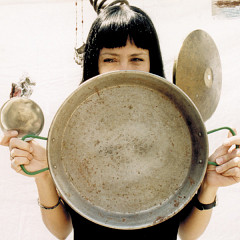
    Babin used a modest array of small metallic objects with pickups and guitar pedals, gently amplifying the hidden world of complex sound as metallic objects touch each other in sundry ways. Her methods are simple, but her music is exquisitely rich in detail and variation. A year or two after that memorable performance I saw in Philadelphia, her solo masterpiece Chemin de fer was released by the Canadian label No Type, and if you listen to the very first track, Triturations, you’ll have a pretty good idea of the delicate electroacoustic sound sculpture I heard that evening. As the album artwork suggests, however, Babin’s array of equipment is quite a bit more extensive than what she’d brought on that tour. In her native recording environment she explores the microscopic idiosyncracies of a much wider array of metallic objects, especially pots, pans, and kitchen utensils. The notes accompanying the disc report that Babin created this music by improvising, a simple fact that becomes meaningful when I recall the live performances I’ve enjoyed from her.

    Triturations is nine minutes of electroacoustic micro-timbral heaven. Some layers of the piece sound like heavy breathing muted and compressed into a detached, nonreferential, yet still vaguely biological texture. With its evenness of texture and density amidst the cornucopia of crackling, rustling, and rubbing details, it feels like a warm cloud of gentle, unpatronising sound that envelops and comforts me.

    When Steve Roden coined the phrase “lowercase sound” in the mid-90s he was expressing an incredibly elegant and timeless concept that both echos and splits away from the Cage/Oliveros paradigm. The sounds sought were simply the ones usually hidden or masked, the details that don’t call attention to themselves. The phrase went on to be widely misunderstood as having specific implications about volume, velocity, and density, but all of this is extrinsic to that jewel of aesthetic crystillization Roden proffered. Triturations and so much other work by Magali Babin stands as an eminent prototype for lowercase music in my mind. It’s worth noting that there’s nothing especially quiet, nor loud, about it. In fact, it’s rather medium-volume, medium-velocity, and medium-density music as a whole. It’s at just the right volume so you can hear everything clearly, which seems like the point to me. It’s simply the sonic microscopy of moving metal, sounds heretofore unknown and otherwise inaudible. I happen to find most of them sublime and intoxicating.

    The second track, Petit jardin, is methodologically continuous with Triturations but the soundworld is fresh. Two sounds complement each other: a beautiful, softly resonant gong-like sound (probably obtained via a pot or pan) and the tinkling of small metal objects (perhaps something like paperclips?) being dropped against a metallic surface. It’s the hidden world of an ad hoc metallic idiophone. Monsieur et madame Watt is another track based on lucid juxtaposition, this time between some faint Erstwhilian amplifier hum and some indistinct rubbing (suggesting to me the sound of a microphone’s metal grating moving against another metallic object). I found something ecstatic in these humble sounds, though my feeling dissipated later in the piece as the hum began modulating and assuming greater prominence in the mix; it became mundane.

    For more years than I can recall I’ve had this perversely cherished Kevin Drumm CD listing neither a title nor release date, but it has a solid green cover and says it was recorded to tape in 1996; the label is Perdition Plastics and it’s catalog number per007. I don’t know much about Drumm’s discography and have only lightly sampled his other work because I really hated this CD. In fact, I probably never made it all the way through. But it’s always persisted in my thoughts because it’s so rare I have a such a strongly negative reaction to any music. It symbolizes something for me, the very extremes of harsh and difficult music. I have no problem with conventional harsh noise; heck, it’s just a twist on new-age music in a way, but this Drumm disc is mostly silence sporadically and irregularly interrupted by loud, screeching, painful sounds made by fucking with an electric guitar and amplifier. It was just too much for me and the thought of playing it still scares me. The reason I mention it is that some of Babin’s music sounds like the precise opposite—gentle and smooth—yet draws from the same dangerous sound vocabulary of conductive surfaces and amplifiers operating at the threshhold of functionality. It’s a fascinating contrast.

    This disc is studded with jewels, but it’s time to report on the rarest, Jogging dans la maison hantée, which was “crafted in joyous collaboration with Alain Chénier and Mario Gauthier”. Its seven minutes are filled with some fairly generic electronic interjections, but they comprise fairly neutral background to one of life’s greatest pleasures: extremely clipped squeaks. A major piece of background information is required here. If there’s one piece of music I’ve played most often in my life, probably upwards of 2000 times by a rough estimate, including a six-month stretch where I played it at least once per day and typically a good handful of times, it’s Bluebird by Judy Dunaway and Yasunao Tone, from Dunaway’s seminal Balloon Music. A piece that should stand in the public consciousness of the current era as an analog to Duke’s Take the A train or the like, it is in fact unknown to virtually every person I’ve broached it to among the relevant demographic. Without attempting to account for its unyielding grip on my aesthetic relationship to sound, I’ll describe it here for you. It’s a seven-minute excerpt of a recording made by Tone applying his standard technique to a CD of solo tenor balloon improvisations by Dunaway. In other words, it’s glitching balloon sounds. So to account for my experience of Babin’s Jogging dans la maison hantée I need to make it clear that there is a thrilling resemblance in these clipped and irregular squeaky sounds that flit across the piece’s uncluttered canvas (mingling marveously with the many birds outside my open windows this lovely hot summer afternoon I might add). Further, I don’t want to mince any words here: Bluebird is by far my single favorite musical composition among all I’ve heard in my 28 years so far. It’s the pinnacle.

    A non-squeaky moment in this piece demands special mention. Among self-contained musical events I’ve heard of roughly one to two moments in duration, [6:22-6:27] is exceptionally exciting, a kind of split-second burst of somewhat ordinary electronic sound that merges with a sine-wavish tone that evenly decays across four seconds. It’s not that there’s anything special about these two sounds, just like the greatest moments of violin music are made with essentially the same notes that appear in countless other contexts, but the timing and the dynamic contours combine these two gestures into a single unified event that functions as a higher order version of the note, where I’m referring to the familiar category of sound events prototypically represented by a short episode of relatively constant pitch and timbre. It’s as if an impossible decay pattern suddenly occurred for an unruly burst of noise. This is a kind of sound event I often fantasize about, but rarely encounter in the external world. It is part of my objection (with respect to individual aesthetic desiderata, aka taste) to the typical high levels of density found in so-called noise music that these kinds of momentary shapes are masked. In the brave new sound world of the technologically-facilitated explosion in timbral possibilities for music in recent decades, I perceive a bifurcation in the way new aesthetics are derived from the new sounds. In one direction, exemplified by the sound event being discussed presently, the new shapes and internal structures of the sounds justify a topology of gesture. In the other direction, the sounds are maximally and continuously generated to create texture and immersion in their brute timbres. I’d argue that because the latter aesthetic can often be achieved with such a lack of technical refinement or effort that it has become undeservedly ubiquitous, regrettably displacing the former aesthetic.

    Three of the pieces on the disc — La corde, L’entonnoir, and Pluie de homards — don’t go much beyond pleasant for me. L’entonnoir is instructive in its contrast with the main thrust of Babin’s work. It feels a bit ugly and overbearing, with a sound palette and approach close to conventional textural electronic noise music. The key word here is “electronic”. The distinction between electroacoustic sounds and electronic sounds is fascinating and truly central to contemporary music, a topic I find myself returning to again and again, always winding up in a theoretical quandary. Concretely experienced distinctions like that provided by L’entonnoir are surely the key to sorting this out. In the pieces I’ve praised from Chemin de fer there is a resonance and spatiality I associate with acoustically derived sounds. There’s also a wealth of odd non-repeating details. These are qualities that I’d cite to account for enjoying Mikrophonie vastly more than any other work by Karlheinz Stockhausen, most of which suits me well. Thinking about the metal objects Babin patiently manipulates, I’m driven to speculate that perhaps the true musicological antonym of “electronic” is not “acoustic”, but rather “mechanical”. In fact, it’s the similarities I feel between Babin’s work and Howard Stelzer’s (arguably prototypically electroacoustic) abstract hissing and crackling cassette vocabulary that inspired me to revisit this disc recently after being immersed in Stelzer’s art. Surely it’s not trivial that the monumental Stelzer-curated Intransitive Twenty-three features Thermidor, a work by Babin that I would cite among her best.

    The placement of Pluie de homards as the final track here was wise. An album of moderation concludes with some annihilatory extremes. Babin created the piece with Mario Gauthier’s assistance by mixing some of her characteristic sounds with Rain by Ian Nagoski, a track from Ian’s drone classic Warm Coursing Blood, a 1998 recording released by Colorful Clouds for Acoustics. As Ian recounted to me recently in a chance encounter that allowed me to broach my recent revisitation of Chemin de fer (recorded in 2000 and released in 2001), he created the piece by recording the water from a shower striking a huge metal pot designed for cooking lobsters and subsequently layering the recording on top of itself more than a few times. When Babin learned of this kindred metallophonic endeavor, she enthusiastically sought to adapt it to her world. Rain was already an extremely thick and static slab of sound; with Babin’s additions it’s that and a lot more sound. I took this review as an opportunity to revisit Warm Coursing Blood, a truly brilliant album in a style of music I have only a nominal attraction towards. One of my listening sessions was a breakthrough for me. One day I somehow found myself in the mood to lay down for a bit and see if I could enjoy being enveloped by Ian’s music played at room-filling (but not biologically irresponsible) volume, something I’d not actually tried before. Ian’s textures opened up for me and I was mesmerized for two long pieces, Feather and Rain. It was a smashing success. Comparing this to my experiences of Pluie de homards, I’ve concluded that Babin’s augmented version of Rain is a pleasant and novel whole, but her distinct vocabulary actually subtracts from the eminently cohesive power of the original, which relies on the shading revealed by an extremely narrow and focused range of sound.

    Her methods are simple, but her music is exquisitely rich in detail and variation.
  • 3
  • 4
  • 5
  • 6
  • 7
  • 8
  • 9
  • 10
  • 11