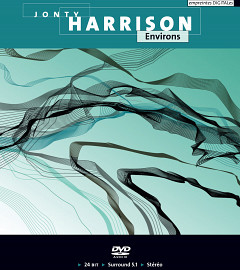
Contemporary sound art rarely deals with our environment directly. Instead, it prefers culling source material from its chinks and corners, picking up emissions usually too quiet for the human ear to perceive. On Environs, Jonty Harrison has not decided to deny or defy this process completely. What distinguishes his approach from that of many colleagues is that it focusses on more readily accessible surface-timbres and comes integrated into an even more ambitious purpose: Using everyday sounds to build new environments.
In a way, the use of synthesizers and electronic equipment to recreate certain parameters of the world around us is a classic thought and it should be fitting, then, that Harrison can be counted among the longstanding masters of his trade. Ever since joining the Music Department of The University of Birmingham in 1980, he has been an inspirational player on the scene, working both as a conductor and composer, picking up awards on a yearly basis, but only raising his voice when the necessity to say something truly presented itself.
His tendency to think in works instead of albums has meant that his discography has remained limited to some sampler contributions and a few, carefully selected solo records. The liaison with Canadian imprint empreintes DIGITALes has slightly mended this situation, but hardly made him more prolific: Predecessor Évidence matérielle was released a full eight years back.
This, though, does not mean that Harrison is a slow worker. His most recent full-length greatly differs from comparable endeavours and from standard practise in the sense that it is a collection of pieces all (but one) written within direct temporal proximity of its release. Streams, the end of the epic ReCycle Quadrilogy, is the noteable exception here, dating back to 1999, but then again this is easily overcompensated by the fact that two tracks, opener Undertow and closer Afterthoughts, are barely a year old. Environs is therefore not a random selection of thematically compiled scores, it is an album which presents us with an up-to-date picture of the composer’s interest and methods.
In relation to the latter, it is an immediately striking fact that Harrison eschews the typically high degrees of post-processing academic sound art is often prone to. His sounds are occasionally pitched, tuned down and transposed or treated with a bit of reverb, but even more often, they are left untreated and in their natural state. He has a point: Why meticulously assemble the gravelling noises produced by his garden roller making contact with the cobble stones of the pathways, of various car engines, different water sounds, of air being sculpted by objects moving through and against it, of data streams being sucked and pulled through fiberglass cables and of lazy Sunday afternoons spent in a dilusional surburban utopia, when you’re going to change them beyond recognisability afterwards? His pieces, then, for all of their abstractions and metaphorical meaning, have a familar ring to them, facilitating access and understanding — seldomy have liner notes been as entertaining and yet unnecessary as in this case.
This technique of course places Harrison outside of most current niches and communities. His processes contain no mysteries or transfigurations, his aesthetics are not connected to intellectual philosophies and his music is of a highly descriptive nature — 21st century programmatic musique concrete, if you like. And yet, this sidelined position allows for fresh perceptions. Freed from any superimposed ballast, you can sit back and simply listen, enjoy this music as much as you would a rock or pop song. Harrison’s pieces are surprising short stories written in the naive language of sound. They can make you happy, sad, aroused, high or melancholic — depending on your point of view and the material at hand.
It is not a modest music by any means. Harrison has a penchant for striking cinematic effects and uses them strategically like a movie director would apply his palette of daunting special effects: On aforementioned Undertow, he captures his audience’s attention right away with a sensory overwhelming introduction, in which he acoustically simulates the moment when a diver collects his breath and splashes beneath the waves. On Free Fall, meanwhile, he delivers blows of shock tactics by shooting the listener miles into the sky to allow him to hear himself tumbling down through the clouds. Already on my humble stereo setup, these pieces develop a disturbing intensity so everyone capable of playing a 5.1. DVD-Audios should be in for something special.
On other occasions, the situations may be less of a Hollywood-nature, turning more towards the vageries of quotidian life, but Harrison never deals with them in an ordinary way. You can almost imagine him rolling his garden roller, loosing himself in his thoughts, as the imaginary stones grow to the size of gigantic boulders, crushed by the greedily gnashing teeth of his destructive garden tool. And on Streams, it is less a photorealistic approximation of a physical reality of water or wind he is after, but rather the aural depictation of movement.
Harrison offers his listeners a veritable real rollercoaster ride here and you can enjoy it both with your eyes opened and closed. What’s more, the emotional proximity of these noises and our immediate environment also allow for the inclusion of humour as a musical means. On Internal Combustion, horns, bycicle bells, engines and the sounds of cars speeding by are juxtaposed with such absurd radicality and at a hyperrealistic pace that I couldn’t help laughing. It’s not the most typical reaction one would expect from a piece of contemporary sound art — but not the most unwelcome either.