
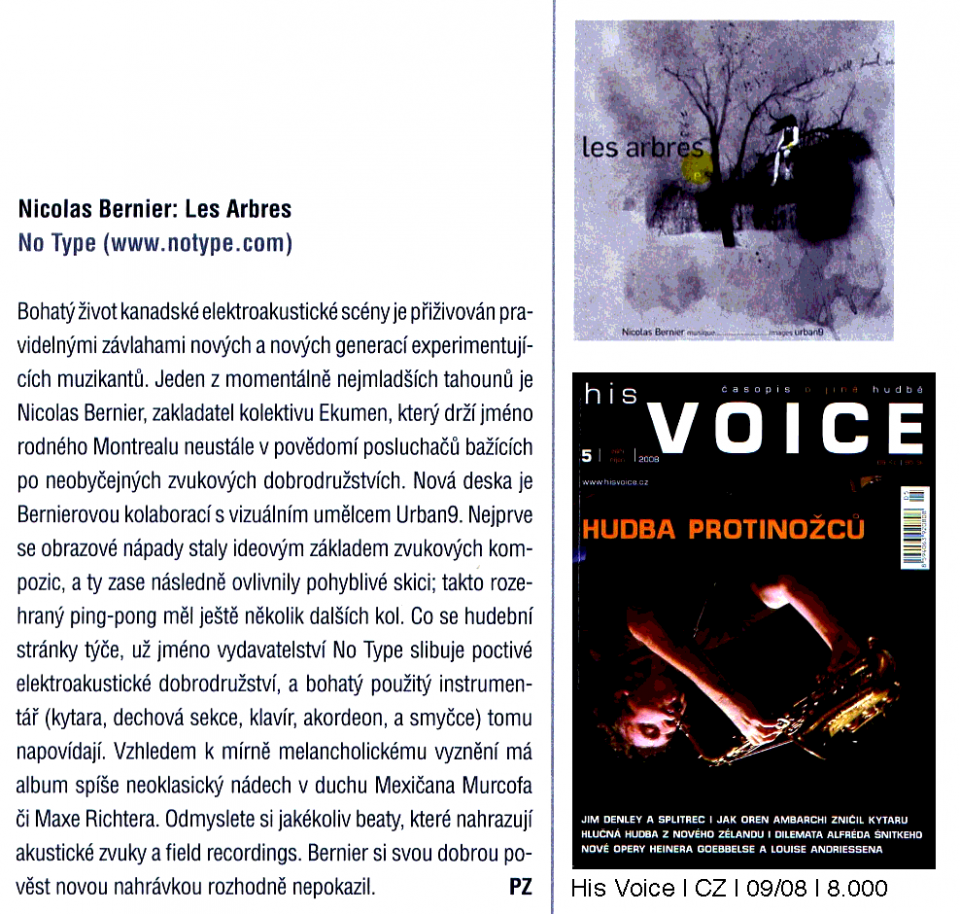
Les arbres
Nicolas Bernier
It is sweet, it is bitter. It is fragile, it is rough. It is sentimental, it is cool. It feels spontaneous, it has been carefully constructed — there’s no end to the list. — Tokafi, Allemagne
…
Bernier a gagné un prix Opus pour ce disque; croyez-moi, il ne l’a pas volé. — Monsieur Délire, Québec
Les arbres : Prix Ars Electronica 2009 — Mention
Prix Opus 2008-09: Disque de l’année
On ne peut être qu’attiré par la splendide musique de
Des paysages sonores et des lentes textures côtoient des articulations précises, le tout reposant sur une orchestration minimaliste composée de guitares, de cuivres, de vibraphones, d’accordéons et de cordes. Bref
- Compositeur·trice(s): Nicolas Bernier
- Interprète(s): Nicolas Bernier, Delphine Measroch, Catherine Chaumont, Jacques Poulin-Denis, Pierre-Olivier Gaudreau
- Image de couverture: Urban9
- Conseil des arts du Canada • SODEC
CD (IMNT 0816, 2008)
- 1Les arbres (2004-08), 43:21support
- 1// Post, 8:40
- 2// This Is a Portrait, 7:36
- 3// Piano, 7:07
- 4// Spleen, 6:11
- 5// Bora, 7:45
- 6// Ouverture, 5:49
- Étiquette: No Type
- IMNT 0816
- 2008
- UCC 771028081622
- Durée totale: 43:21
- 127 mm × 143 mm × 10 mm
- 115 g
Sur le web
Téléchargement (IMNT 0816_NUM, 2008)
- 1Les arbres (2004-08), 43:21support
- 1// Post, 8:40
- 2// This Is a Portrait, 7:36
- 3// Piano, 7:07
- 4// Spleen, 6:11
- 5// Bora, 7:45
- 6// Ouverture, 5:49
- Étiquette: No Type
- IMNT 0816_NUM
- 2008
- UCC 771028081684
- Durée totale: 43:21
Images
-
![[2008]](https://res.electrocd.com/image.php/image/i/imnt_0816_b.jpg?width=n3)
[2008] -
![[2008]](https://res.electrocd.com/image.php/image/i/imnt_0816_a.jpg?width=n3)
[2008]
Vidéos
-

Création de Les arbres de Nicolas Bernier à Mutek 2008, Théâtre du Nouveau Monde, Montréal; mercredi 28 mai 2008; 2:05
Quelques articles recommandés
-
-
-
-
-
 Artistes divers
 -
-
 Artistes divers
 -
-
 Artistes divers
 -
-
 Artistes divers
 -
La presse en parle
Interview with Nicolas Bernier
To the outside observer, Canada must sometimes seem as though it were founded on paradoxes. An industrial powerhouse sporting some of the leading cultural metropolises, it is also torn one of the most thinly populated countries on the planet, with vast, uninhabited planes opening up right next to its sprawling economic centres. It should seem only logical that a nation as complex as this should give birth to an artist like
Could one regard the strong contrasts in your music as a direct reference to the contrasts of Canada, with a big city like Ottawa lying next to vast patches of wild nature
Clever
What are the fundamentals of this dichotomy
It’s all about this love/hate relationship with the computer. I admire the computer in a way. As a freelancer, I can do so much work, from business to communication and creation with one single piece of electronics — truly incredible. And I can take the core of my studio and travel with it to anywhere in the world. On the other hand, the computer is such a boring, anonymous, unpleasant interface, especially when it’s time to make music. It is making everything virtual and I still hope to live in the real world, a world that I can feel with all my senses, not only from a computer screen. So I find ways to work in the real world. Performance is one way of achieving this, collaboration and field recording are others.
Is that why the term “handmade" is so prominently featured in your biography
Yes, that’s how I manage to beat that computer down
How has this influenced your perspective on recording in the field
In 2009, I spent a lot of time in the Canadian West. It is the perfect cliché of what a foreigner will imagine Canada to be like
How do you feel about the idea that if we attune our senses and expectations, we are constantly surrounded by the most wonderful music
I’ve always thought it difficult to make any clear statement with music unless it uses voice. During the Iraq war, I composed an electroacoustic piece with a rapper singing an anti-war, anti-Bush text, but it didn’t really work out. Nobody but me actually heard that piece. I would situate myself far from the
In which way did folk and acoustic music, as typical symbols of purity, play a role in your early musical education
This question of purity is interesting because what one could consider as pure in my early musical education is, in fact, not so pure. This is, in a way, because I started with real instruments and punk rock. I began my musical life within a wall of distortion. Now I deal extensively with timbre, with unidentified materiologies. But stage performance and distorted guitars remain my own personal folk, my roots. And I think that sometimes I still make use of that punk rock energy and those hooks when composing musique concrète or audio performances. One thing I have to mention is that even in my punk rock phase, I was immediately attracted to blending all the different kinds of music I loved, from jazz or new age to grindcore.
You indeed seem to consider these genres as options in a giant toolbox. Can you trace this back to the music that surrounded you when you were young
I’ve definitely always considered music as a “field of possibilities”, to paraphrase
How and when did sound as a musical element enter into your world
It entered progressively. It entered timidly in my early teenage years by trying to produce weird chords, weird rhythms and so forth. The big bang occurred when I arrived in Montréal. I brought my band from rock to improv-based ambient rock. Sound was entering more deeply into the practice and I was discovering modern music. I soon attended my first concert of electroacoustic music. It took place in complete darkness, with no performers on stage, nothing to see, everything to be heard. That was a turning point. There was something I did not understand about it — and I loved it. So I’ve tried to understand it better to be closer to that unknown.
You seem to have a special relationship with sound.
Yes, I am in a relationship with sounds. No doubt
How has this relationship changed over the years
It’s hard to say. I think that it began with a poetic relationship and grew into a more technical one. I am not a technical guy at all, but I am becoming more sensitive to technique — maybe because I feel that my relationship with sound is now mature.
In the notes to
In that single object, the tuning fork, I’ve found not only a symbol of my musical objectives, but also of my general interest for that dichotomy between the old and the new. I think it has something to do with the relation between the inside of the mind and the real outside world. I like to spend time on old bazaars and in antiquaries. When I compose, I think I feel closer to antiquaries than to avant-garde artist. In the meantime, I just love to be in a white museum room or to listen to minimal electronic music. I feel there is this obsession for clarity and sobriety in the art world. This is maybe what would segregate the official and the underground scene. The underground is more rough, more drafty, the works are less organized, they don’t give an impression of perfection. So maybe I feel closer to the underground, maybe it is still that punk-rock thing running after me, bearing me to not cross-over into the official realms. This obsession for dust is also a counter-reaction to my tool, the oh so white — or grey or black but please not beige — the oh so sterile laptop. With
Tuning forks, as the project suggests, have become symbols of the occident’s entire musical heritage. In which way has this lineage and tradition played a role in your life
There this extremely purist approach in electroacoustics, based on space and timbre as the most important parameters for music. When I started out with electroacoustics, instead of falling into the endless possibilities of creating completely new sounds, I quickly faced the fact that the timbres of traditional musical instrument are the most high-class timbres of all. They’ve been developed over centuries to achieve perfection and richness. So I never really understood why one should not use them when doing sound art. I am not that much engaged in occidental classical music. I am engaged in it, but for me it is just another aspect of this giant toolbox called music. What
It’s funny to bring that project up. I’ve put it in my list of works just because I don’t want to forget it and also because I don’t want to forget that
When did you decide you wanted to be an artist
After those years, I’ve tried to convinced myself that music was not an option, as you could barely live as a musician. But you cannot decide to become an artist. There’s a force that make you involved in what you like the most. It’s not a choice, you either do it or you don’t. When I was about eighteen, I tried to convince myself that I had to study something more common. So I studied radio, which I thought was close to music but it’s not at all, and marketing — I actually wanted to be a graphic designer. Always keeping some rock and improv projects, I worked as a web programmer/designer for almost ten years. And that’s how I made my musical education
With its Honorary mention at the Prix Ars Electronica 2009,
It was a huge highlight indeed
Would it be correct to refer to
I’ve always been producing like crazy actually. I just can’t help it
What have been your main compositional challenges over the past two years
One of my main challenges was… to find myself
In the preface to
I would never say that sound is the art form, not in an absolute way. Of course it is for me because it suits my personal interests. But this is only a personal matter. Besides, as soon as you get into a concert hall or exhibition space, it’s not just about sound anymore. It’s a ritual, it’s a show, it’s always a multi-sensorial, multi-aspect experience. Shows are great. But this is maybe why I love so much to compose for a fixed medium — CD, digital, DVD — because I know that some of the audience will be appreciating the work quietly, in the intimate setting of their homes, not expecting any spectacular show but with the more modest aim of simply listening to the music. Besides, there are art forms that impress me even more. In dance, for example, all you basically need is a body. Most of the shows are complex and involve music, stage design and lighting. But in its most simple form, when the movement of a body can move me, this is a truly amazing thing.
Concerning the abolition of boundaries, we come back again to that question about this giant toolbox, this “field of possibilities”. I just don’t see the point of segregation. The world is rich and sharing this richness is about all we can do here. A couple of years ago, when I was active in different fields of sound creation, I was putting all my different approaches into different boxes made for different sensibilities, different people. But over the years, those different approaches have all collapsed into one entity made of various components, that still can be identified as one single thing. I hope you are following me
Perhaps one could say that
Yes, they are combining tonal perspective alongside some noise, drones, clicks, acousmatic gesture, pop and rock influences. When I did
And still, despite aiming at the eradication of borders, your artistic world is not without its delimitations.
I guess there is always a frontier after all
As you can see, I am not in a good position to label myself. I guess there are people better equipped at doing this. But my fundamental objective would probably be to make music that feels human despite the fact that is made with a computer. The fundamental aesthetic of my work will probably always rely somewhat on the tension between conceptual rigidity and intuition.
Journal d’écoute
Paru en 2008, mais je ne l’avais jamais reçu, alors j’ai saisi l’occasion du concert de
Review
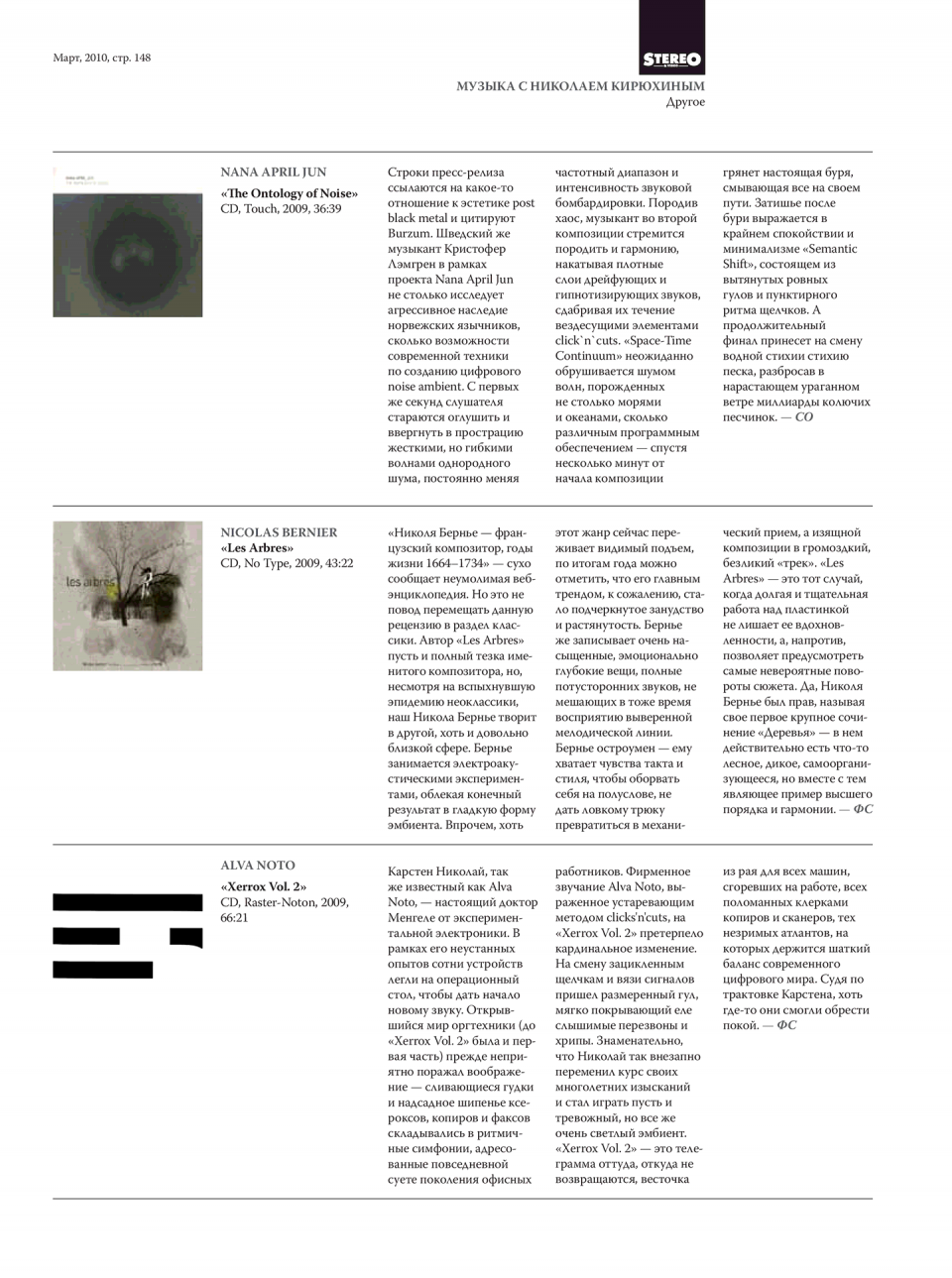
“
Traduit du russe.
Chronique
Décrire un disque comme
C’est que l’ensemble est sûrement trop bien pensé et orchestré pour y avoir quoi que ce soit à redire. Basé sur de longues envolées solitaires d’un piano qui s’abandonne à des improvisations presque aléatoires, les titres composés par
À ce titre, la prose de
C’est que finalement
Sound
Acoustic and electronic sounds in
Critique
C’est la première fois que l’on parle de
Du coup, et rien qu’avec le nom du label, on se doute un peu de la musique que l’on va trouver sur cet album alors que l’on ne connait pas encore
Bien au contraire, la musique de
On arrêtera là les compliments, de toute façon
Vous l’aurez compris, quelle que soit votre sensibilité musicale (entre néoclassique et electronica le champ est assez large), vous pouvez vous jeter sur cet album surprenant. S’il est peut-être un peu moins abouti, on vous conseille tout de même le très beau
Nicolas Bernier & Urban9 : Sound Dimensions
It is easy to see why two dynamic media, like music and film, should be able to complement each other. But what happens when the equation becomes asymmetrical and moving sounds are juxtaposed with static images
That, for sure, are a lot of open questions. But they are definitely leading somewhere. The images of
“Even tought we are often speaking about ‘static’ music, we could refute the theory that images are static because the mind is extrapolating so much with images. And the way our mind works is not static, it is moving in time”,
Physical Qualities
After contributing a track for the
That, as it turns out, is what
Review
I first came across
Critique
Décrire un disque comme
C’est que l’ensemble est sûrement trop bien pensé et orchestré pour y avoir quoi que ce soit à redire. Basé sur de longues envolées solitaires d’un piano qui s’abandonne à des improvisations presque aléatoires, les titres composés par
À ce titre, la prose de
C’est que finalement,
Discos
Nos gustan los discos que empiezan a llamar nuestra atención desde la misma portada, cuando atacan no sólo a uno sino a dos o más sentidos. Y hay algo en la fachada exterior — sombría, entre grisácea y verdosa, no especialmente vistosa pero sí extrañamente sugestiva — de este álbum que intriga, que invita a imaginar.
Esa sensación no hace sino multiplicarse cuando entra en juego el sonido. Sin titubeos, a pesar del perfil marcadamente abstracto de la propuesta, el disco reclama tu atención desde el primer momento, desde que un estruendoso rechinar mecánico introduce en cuestión de segundos la atmósfera silbante, microscópica y abisal de
El canadiense
Si necesitas nombres para ubicarte, piensa en algo próximo a lo que saldría de viajar hacia el norte agitando en una misma maleta los discos de
Tapage nocturne
Critique
Connu pour ses créations à caractère expérimental, le canadien
Au programme 6 compositions qui chacune trouve une correspondance avec une carte postale livrée avec le disque. Une manière de plus de faire coïncider le son et l’image. Dans les compos de
Expérimental dans la forme et dans l’idée, mais très facile à écouter,
Oursins chroniques
C’est dans un climat d’étrange transfiguration qui n’est pas sans rappeler les ambiances floues, autant mystérieuses que nostalgiques, du
Recensione
Neo-modernista per eccellenza,
Un timore dall’animo fantasma e una pioggia di drones e sottili stratificazioni ambientali, manipolazioni sonore, dilatae note che si riflettono nello spazio e vuoti silenzi che disegnano forme e rifugi per poi riscoprirsi rotolati in nuovi luoghi oscuri (
Review
Good experimental sound-track of the Fall from Québec boy
Kritik
In deze tijden waarin zelfs groepen steeds korter op de bal spelen en pas twee dagen voor de release aankondigen dat hun plaat te downloaden valt, met dien verstande dat een fysiek exemplaar later volgt, is dat laatste een verademing, vooral als het artwork een pareltje is.
De Canadese electro-akoestische componist
In
Het verloren gelopen jongetje dat een lammetje vastklemt, belooft niet veel goeds voor
Vreemd genoeg loochenen de spelende kinderen (en de boom die ze beklimmen) net de track die ze vergezellen. Want ook al is
De snijdende klanken roepen niet alleen de geest van de wind op maar impliceren ook een blazerssectie die er niet is. Geen enkele andere track op het album weet niet alleen zo goed muziek en titel te verzoenen maar ook minimalistisch electroklanken te koppelen aan een klassiek intermezzo (opnieuw de cello). De trompet op
Net als in de afbeelding, een vreemdsoortige zeppelin boven een kaal en uitgedund bos, weerklinkt iets tragisch-heroïsch in het nummer. Een verval dat eigenhandig ingezet werd, wordt nog steeds beweend. Wanneer de violen spreken, verdwijnt alles tijdelijk naar de achtergrond om daarna het contrast nog duidelijker in de verf te zetten. De ene huilt terwijl de andere registreert en voortleeft in verminkte vorm.
In
Critique
Électroacousticien de formation, musiciens aux multiples projets, nouveau directeur artistique de Réseaux, on ne peut pas dire que
Album tout en douceur, c’est d’abord une ambiance que nous propose le musicien. Composé avec précision, c’est avec plaisir que notre oreille accroche sur la variété de sons qui nous sont proposés. On perçoit toute la profondeur du compositeur dans sa musique, ses mélodies qui nous portent, qui veulent se faire écouter. L’artiste apporte une touche d’harmonie en utilisant des instruments
Un album qui mérite qu’on s’y arrête, que l’on soit amateur ou non. Il ne s’agit peut-être pas là de la musique la plus accessible, mais elle n’est certainement pas indigeste. Ceux qui sont déjà plongés dans l’électroacoustique aimeront la fraîcheur et la technique de l’artiste
Recensione
Nato dalla collaborazione col visual artist
7
Review
Review
A real coffee-table book of a package. Housed in its handsome slipcover are a slim CD case and six quality postcards, each featuring a montage by visual artist
Each title naturally corresponds to a complementary track by composer
The montages of
I am also very attracted by the music for this piece, which features longtime
With his computerized hammer and chisel,
At times his interpretations are much more literal — “sound-effect-y,” if I may coin an unwieldy term — than expected, or necessary. When this happens it appears that more restraint at the computer keyboard would have been preferred.
However, most of the time his electronics complement his acoustics admirably, lending them just the righ patina.
An exciting, possibly even profound work from a young composer, and an introduction to the work of one very interesting visual artist.
Kritiek
Drie nieuwe releases van over de hele wereld
[…]
De derde nieuwe release is die van de Canadees
Wie aus Laptop und Kammerorchester ein Baum wird
Große Erfolge feierte
Wenn es hauptsächlich um Musik geht, verwendet
Auf vielfältige Weise schafft der kanadische Komponist in 43 instrumentalen Minuten die Kombination verschiedener Ebenen, die sonst unabhängig voneinander existieren, sich hier aber ganz selbstverständlich ineinander schlingen wie DNA-Stränge.
Zart und filigran ist
Eine gesunde Skepsis ist beim weiten Feld der ‘Neuen Musik’ anzuraten
Review
So far the name
Just Another Genius: Nicolas Bernier
In concert with
First of all, there’s a fine EP of collective improvisation music to fetch at No Type. Alongside
Second — and here we need a drum roll
“Sonic landscapes and slow textures meet with precise articulations, all this resting on a minimal orchestration made of guitars, brass instruments, vibes, accordions and strings. In short
: a stimulating record, a remarkable attention to detail and excellent production quality, making for an unfailingly rewarding listening experience.”
Purchase, baby
Blogue
- mardi 22 mars 2011 / Presse
It is sweet, it is bitter. It is fragile, it is rough. It is sentimental, it is cool. It feels spontaneous, it has been carefully constructed — there’s no end to the list. Suite
-
mercredi 26 mai 2010 / Presse
…
Bernier a gagné un prix Opus pour ce disque; croyez-moi, il ne l’a pas volé. Suite -
lundi 1 mars 2010 / Presse
… there is indeed something of the forest, wild and organic, but at the same time with a sense of higher order and harmony. Suite