Sauter au contenu principal
electrocd

Blogue

87 résultats
  • 1
  • 2
  • 3
  • 4
  • 5
  • 6
  • 7
  • 8
  • 9
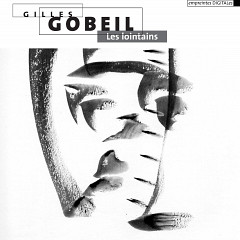
  • Les lointains dans Revue & Corrigée

    «Critique», Kasper T Toeplitz, Revue & Corrigée, no 106, 1 décembre 2015
    mardi 1 décembre 2015 Presse
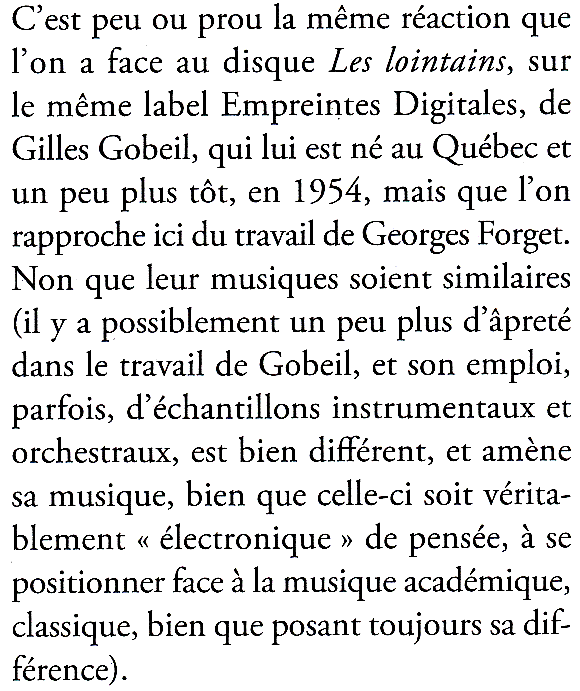
    Il y a possiblement un peu d’apreté dans le travail de Gobeil, […] et amène sa musique, bien que véritablement «électronique» de pensée, à se positionner face à la musique académique classique, bien que posant toujours sa différence.

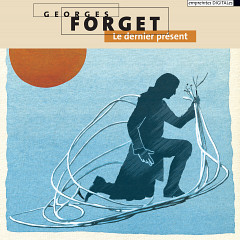
    Le dernier présent dans Chain DLK

    «Review», Vito Camarretta, Chain DLK, 25 novembre 2015
    mercredi 25 novembre 2015 Presse

    Georges Forget could be considered a proper poet of sound and field recordings as you can easily infer since Urban Adagio, the first long suite that opens this collection, where he inspires the poetic description of an urban environment and a city as a tired woman at the end of the day in opposition to the typical saying that some cities never sleep: “My own city is very tired when evening comes, weary of the uproar and hubbub. I can see her struggling to accompany citizens to their final occupations. Here she is, streets and boroughs blinking as she yawns and stretches out at the bottom of streets that are emptying slowly… my city falls asleep; she quitely lets erode away the forlorn destinies of the handful of souls still up to contemplate her, their shadows fading away under the pale light cast by the lampposts”, according Wahed Gotref’s introductory words. Premiered on April 23rd, 2010 as part of the concert Con sordino by Code d’acces, which commissioned it, at Relais Mont-Royal in Montreal, the suite renders such a portrait in a very astonishing and somehow cinematic way, but it’s only the first assay of the remarkable skills of representation, transfiguration and translations into sounds that got displayed on Le dernier present: the following suite Metal en bouche — awarded at the 25th Concorso internazionale di musica elettroacustica e rumore Luigi Russolo-Rossana Maggia at Annecy in France and at the 3rd Destellos Electroacoustic Composition Competition in Mar De Plata, Argentina — seems to render an attempt of asphyxiation of someone by means of faggots made by impressively resounding minced metallic objects; the noise of creaky boards, forestays and shroads could surmise the physiological outputs of a living entity on Une île, the suite that precedes the narrative one Orages d’acier, whose alternation of moments here violence becomes hallucinatory and suspended anxious moments of emptiness render the inspiration that Georges took from Ernst Junger’s novel Storm of Steel (published in French as “Orages d’acier”), where the author releates his combat experience in World War I, and the more recent motion picture The Thin Red Line by Terrence Malick. Forget quotes the translation by Jack Collings Squire of the first stanza of The Invitation to the Voyage from Baudelaire’s Fleurs Du Mal as framework of the more intimistic suite Seul et septembre (2008) and an extract from Melville’s Moby Dick — ‘Whenever I find myself growing grim about the mouth; whenever it is a damp, drizzly November in my soul; whenever I find myself involuntarily pausing before coffin warehouses, and bringing up the rear of every funeral I meet; and especially whenever my hypos get such an upper hand of me, that it requires a strong moral principle to prevent me from eliberately stepping into the street, and methodically knocking people’s hats off’ then, I account it high time to get to sea as soon as I can. This is my substitute for pistol and ball. With a philosophical flourish Cato throws himself upon his sword; I quietly take to the ship. There is nothing surprising in this. If they but knew it, almost all men in their degree, some time or other, cherish very nearly the same feelings towards the ocean with me.’ — as a description of L’appel, the acousmatic masterpiece that closes this collection.

    L’appel, the acousmatic masterpiece that closes this collection.

    Suzanne Binet-Audet, Gilles Gobeil dans Randomia

    «Cinema for the Ear», Suzette Chan, Randomia, 18 novembre 2015
    mercredi 18 novembre 2015 Presse

    At Holy Trinity Anglican Church on Friday night, New Music Edmonton presented an evening of electronic music by Gilles Gobeil, the award-winning Quebec composer. Joining him on this, the final date of a seven-city Canadian tour, was Suzanne Binet-Audet, who was featured in the program’s first half, playing three pieces, composed by Gobeil, the ondes Martenot.

    The ondes Martenot is an electronic instrument invented by French cellist Maurice Martenot in 1928. Martenot made seven sets of the instrument. He made the instruments by hand until 1974; it was this last unit that Binet-Audet brought on tour.

    I had never seen an ondes Martenot, so seeing it before the concert started was like a bonus pre-show. The player sits at a small electronic keyboard built on a hand-crafted wood stand that had the clean, unfussy lines of early 20th century modern furniture. The unit is wired to two speakers, one that looks like a traditional floor speaker, and a second one that looks like a hexagonal cabinet. This second unit is called a gong and provides resonance.

    The set-up looked compact and quiet, but when Binet-Audet started to play, we were engulfed in a huge, sonic experience. Binet-Audet’s live performance incorporated sounds programmed by Gilles Gobeil, who was at the soundboard throughout the evening. Sound was all around us, emanating from the speakers of the ondes Martenot, as well as speakers set up all around the perimeter of the sanctuary.

    The first notes from the ondes Martenot reminded me of many different sounds: a Theramin; a songbird holding a note for too long; music made with air, like an accordion, a saxophone, or human breath. Later, wholly original sounds were interleaved with sounds that recalled running water, rotating metal blades, pumping pistons. These were noises associated boiler rooms, waterworks, light industry and utilities – that is, common settings for film noir and dystopian movies.

    In fact, the ondes Martenot has been used in many movie soundtracks. Gobeil describes his own music as “cinema pour l’oreille” (cinema for the ear). We fully entered Gobeil’s cinema pour l’oreille in the second half of the program, when the lights were turned off. We were officially in cinema mode, although there was no projection. The only screen was our imaginations. During a passage that reminded me strongly of airplanes and trains, I reflected on the irony a roomful of people sitting quietly, riveted by the sounds of transportation, but going nowhere, yet feeling transported.

    After the concert, Binet-Audet and Gobeil stayed to answer questions. Binet-Audet gave a demonstration of how the ondes Martenot worked. What I was not able to see during the concert was a modulator housed in a drawer of the ondes Martenot and a string-and-ring system that was responsible for the Theremin-like aural effects.

    The engagement with the audience after the formal concert was a rare treat, and particularly generous as this performance marked Binet-Audet’s retirement from the stage. Thanks to both Suzanne Binet-Audet and Gilles Gobeil for sharing their artistry and experience.
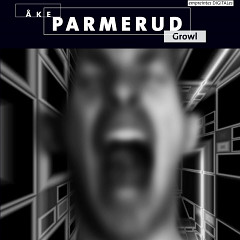
    Growl dans Le son du grisli

    «Love on the Bits», Fabrice Vanoverberg, Le son du grisli, 1 novembre 2015
    dimanche 1 novembre 2015 Presse

    Vétéran de la scène électroacoustique, Åke Parmerud est d’autant plus précieux qu’il est rarissime. Septième disque du sexagénaire suédois, malgré des débuts qui remontent à 1980, Growl (Empreintes DIGITALes) parcourt le temps des machines et l’impact constant qu’elles ont sur notre quotidien d’homme moderne. Avec ses atours robotiques et ses pulsations régulières, le premier titre La vie mécanique renvoie carrément à la motorique de Kraftwerk (et nul doute que si Ralf und Florian avaient un jour décidé de s’intéresser au genre, on les aurait retrouvés sur l’officine québécoise ED). La suite s’intéresse aux craquements du disque vinyl (Grooves, moins original), avant un étonnant et radical rapprochement entre la vie aviaire captée par Chris Watson et une électronique cosmique remodelée par Felix Kubin vs. Philippe Petit. Grandioses et comiques, ces Electric Birds. Qui disait que la musique électroacoustique manquait d’humour? D’autant que le suivant Growl dépote avec une envie fendarde tous les clichés vocaux de la scène métal. Jouissif, avant la conclusion un rien chiffonnée Transmissions II.

    Grandioses et comiques […] Jouissif…

    Growl dans Rif Raf

    «Love on the Bits», Fabrice Vanoverberg, Rif Raf, no 215, 1 novembre 2015
    dimanche 1 novembre 2015 Presse

    Vétéran de la scène électroacoustique, Åke Parmerud est d’autant plus précieux qu’il est rarissime. Septième disque du sexagénaire suédois, malgré des débuts qui remontent à 1980, Growl (Empreintes DIGITALes) parcourt le temps des machines et l’impact constant qu’elles ont sur notre quotidien d’homme moderne. Avec ses atours robotiques et ses pulsations régulières, le premier titre La vie mécanique renvoie carrément à la motorique de Kraftwerk (et nul doute que si Ralf und Florian avaient un jour décidé de s’intéresser au genre, on les aurait retrouvés sur l’officine québécoise ED). La suite s’intéresse aux craquements du disque vinyl (Grooves, moins original), avant un étonnant et radical rapprochement entre la vie aviaire captée par Chris Watson et une électronique cosmique remodelée par Felix Kubin vs. Philippe Petit. Grandioses et comiques, ces Electric Birds. Qui disait que la musique électroacoustique manquait d’humour? D’autant que le suivant Growl dépote avec une envie fendarde tous les clichés vocaux de la scène métal. Jouissif, avant la conclusion un rien chiffonnée Transmissions II.

    Åke Parmerud est d’autant plus précieux qu’il est rarissime.
  • 1
  • 2
  • 3
  • 4
  • 5
  • 6
  • 7
  • 8
  • 9