Sauter au contenu principal
electrocd

Blogue

68 résultats
  • 1
  • 2
  • 3
  • 4
  • 5
  • 6
  • 7
  • 8
  • 9
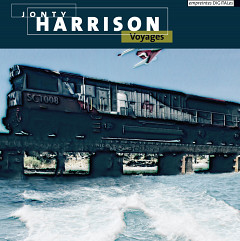
  • Voyages dans The Wire

    «Soundcheck», Julian Cowley, The Wire, no 391, 1 septembre 2016
    jeudi 1 septembre 2016 Presse

    One of the big beasts roaming the electroacoustic savannah, Jonty Harrison combines technological sophistication and psychological subtlety with insatiable hunger for sound. His hour-long Going / Places ranges far and wide, quite literally, grazing materials from around the globe: railroad horns from Ohio; bubbling geothermal pools in Iceland; calls to prayer in Istanbul; Mexican bagpipers; frogs in Borneo; market callers in Melbourne. A travelogue of bewildering discontinuities, it rushes on with the uplifting fluency of a dream. Voyages also features Espaces cachés, a series of scenes and apparitions also crafted from found sounds. Originally conceived in 30-track expansiveness, the piece is here condensed into unusually vivid stereo. And Harrison never allows studio expertise to sideline potential for enchantment.

    A travelogue of bewildering discontinuities, it rushes on with the uplifting fluency of a dream.

    Les lointains dans The Sound Projector

    «Review», Gunter Heidegger, The Sound Projector, 3 août 2016
    mercredi 3 août 2016 Presse

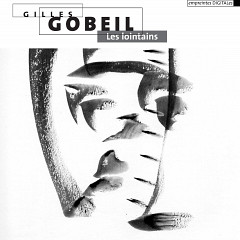
    My latest encounter with the estimable empreintes DIGITALes label following my recent review of Erik Nyström’s brings me in touch with Canadian composer Gilles Gobeil in what has proven to be one of the label’s less immediate releases, yet which becomes more threatening / welcoming with each play. That ‘five of the six works on this disc were realised while in residence in studios abroad’ might lead one to infer a psycho-geographical undercurrent to each, which is true at least in Les lointains noirs et rouges. Opens in a living room animated by its contents: a weaving together of innocuous objects like grandfather clock, and church — and doorbells that by and by reveals its true character: a psychodrama of hypnic jerks and electric shocks.

    Following this hurricane of free association, Castalie initiates shock treatment with incessant alarms, more machines and doors slammed by no visible human agency. Though ‘inspired freely’ by Hesse’s The Glass Bead Game, its moments of stillness have the lurking menace of a Thomas Ligotti factory upon the protagonist’s passive and helpless body. Moving deeper into Bol-Hydre, Gobeil sets a ‘stunning musical instrument… (which) produces weird, menacing sounds’ against the mythical, multi-cephalic monster whose immunity to decapitation was finally thwarted by Hercules. It’s a case of reading the instructions here: Gobeil’s ‘weird and menacing’ is indeed the rickety groan of whatever passes for dentist music in the infernal regions.

    Clearly more important to this collection than the geographical origins is its seat in the imagination, literary conceits being the order of the day, plus the odd whiff of radio drama. Drawn from The Aenid for instance, Sybille mixes moist whispers with yet more alarms and a dread-inducing drone through episodes of blackout, demonic intimacy and death by water, conveying a vapour-heightened state with unwelcome and unshakeable visions. Golem is perhaps the least startling piece here for the very reason that it’s pretty much a gestalt of everything else, though it’s unlikely that Gustav Meyrink would have disapproved of claustrophobic alarms (again), ticking clocks, and sudden swipes as an approximation of his paranoid Prague. In lieu of end credits, Des temps oubliés adds to this malaise a faint congregation of strings, choir, piano and gut-level rumbling, a human presence as distant from the listener as faceless bystanders in a nightmare. One though that the participant might feel reluctant to leave.

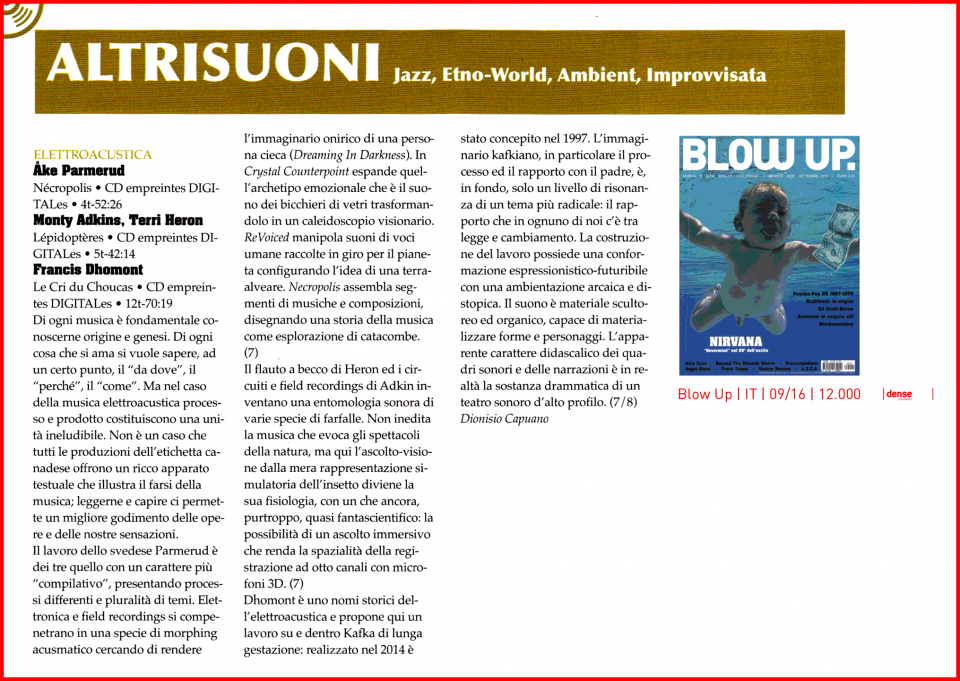
    … which becomes more threatening / welcoming with each play.

    Morphogenèse dans The Sound Projector

    «Review», Gunter Heidegger, The Sound Projector, 29 juillet 2016
    vendredi 29 juillet 2016 Presse

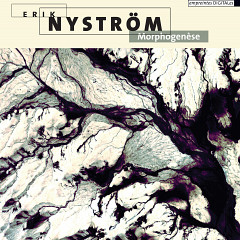
    ‘Music that produces its own forms in the continual weaving of a spatial fabric’ is how Swedish sound engineer and electroacoustician Erik Nyström likens ‘his’ music to seemingly arbitrary cosmogonic forces as they pass almost accidentally through humanly appreciable forms. Something of a Serious Seeker of ‘spatial textures in acousmatic music’, the dazzling descriptions of his four compositions don’t quite deliver the shock of primordial violence I’m somehow expecting, though I do get the feeling that these pieces are quite happy to be left to their own devices.

    Like a vague approximation of the Lorenz Attractor, the resounding void of Latitudes mutates like the weather filmed in time lapse, shifting too rapidly for our deep inner peace yet glazed with smoother surfaces than your usual jump-cut sound-editing shenanigans. This sounds quite typical of the empreintes DIGITALes establishment: sci-fi space-scapes and processed sounds turned inside out; their interior lives bleeding into infinity as our own universe is condensed into one of many microdots that go pinging off your shiny surfaces and windows.

    Lucent Voids adds squelches of mechanised bird twitter and virtual reality sea spray to this vertiginous feat of sonic telescoping, but with a little more rough-housing before the end of the rainbow. Unsurprisingly, Cataract is of the same stratosphere, providing similarly psychotropic scenery and eventual pre-landing disillusion. While far from bucking this trend, Far-from-equilibrium is a sort of hapless A.I. accident that might have bubbled out from a table-top improviser’s set of material-testing stretch and strain. The most dynamically vivid of the four pieces, it seems designed to disorient the listener into seeking respite back at the start of the CD, where things are unlikely to have remained the way they were.

    … their interior lives bleeding into infinity as our own universe is condensed into one of many microdots that go pinging off your shiny surfaces and windows.

    Voyages dans Amusio

    «Kritik», Stephan Wolf, Amusio, 27 juillet 2016
    mercredi 27 juillet 2016 Presse

    Der zu Birmingham emeritierte Komponist und Elektroakustiker Jonty Harrison hat auf Voyages (empreintes DIGITALes) zwei aktuelle Stücke für das Stereoformat der CD aufbereitet, ohne wesentliche Abstriche in der klanglichen Raumdimension eingegangen zu sein, die seine auf Multi-Kanal-Repräsentation ausgerichteten Werke prinzipiell mit sich bringen. Dank Ambisonics, einem bereits in den siebziger Jahren entwickelten Verfahren zur Aufnahme und Wiedergabe von Klangfeldern, eröffnet diese Veröffentlichung Welten aus der Welt.

    Das 2014 in Montpellier uraufgeführte Espaces cachés (13:54) kompiliert imaginative Sachverhalte, die wohl dem Leben an sich „abgelauscht“ wurden und dennoch eine davon unabhängige Meta-Existenz konstituieren. Insbesondere wird das Spiel mit dem Erinnerungsvermögen und seinen Trugbildern exemplifiziert. Inszenatorische Aushöhlungen oder Auffüllungen spielen allenfalls eine marginale Rolle, wenn „die Welt“ mit natürlicher Konsistenz und Resonanz poliert wird.

    Der zweite Track, Going / Places (59:55), kompiliert und strukturiert in 23 Episoden die Welterfahrung des Komponisten, wie sie aus seiner in über 25 Jahren gepflegten Sound Library nun auch zu uns spricht. In der Gesamtheit eine Weltreise, im Detail eine Einladung zur Fusionierung aus (eigener) Lebenserfahrung und dem Abgleich mit der geradezu fantastischen Grenzenlosigkeit des akustischen Vermögens. Vielleicht gehören die Voyages zu jenen Veröffentlichungen, nach deren Genuss man von der Welt nicht nur mehr weiß, sondern auch versteht.

    Nécropolis dans Jazz ’n’ More

    «Kritik», Christof Thurnherr, Jazz ’n’ More, no 4, 16 juillet 2016
    samedi 16 juillet 2016 Presse

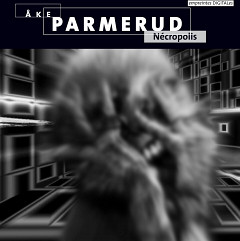
    Diese CD zeigt für einmal, dass es der Kunst nicht immer zuträglich ist, wenn sie in ein formatiertes Gefäss gepresst wird. Titel und Gestaltung der Veröffentlichung beziehen sich nur auf eine von vier voneinander komplett unabhängigen Kompositionen und erwecken damit nicht die richtigen Erwartungen. Hinter jedem Stück steht nämlich ein eigenständiges, spannendes Konzept. Crystal Counterpoint (2009) beispielsweise besteht aus Klängen von Kristallgläsern aus dem Haushalt von Parmeruds Eltern; er habe als kleines Kind dieses Glas klingen gehört, wenn bei ihm zu Hause eine Party gefeiert wurde. Oft sei er zu diesen Klängen auf der Treppe horchend eingeschlafen. Oder Dreaming in Darkness (2005) ist eine Co-Produktion mit Natasha Barrett, welche sich der Frage widmet, wovon jemand träumt, der nicht sehen kann. Das zu Hörende ist also insgesamt weder morbid noch gruselig, sondern es sind vier Klangbilder, in die sich wohlig eintauchen lässt.

  • 1
  • 2
  • 3
  • 4
  • 5
  • 6
  • 7
  • 8
  • 9