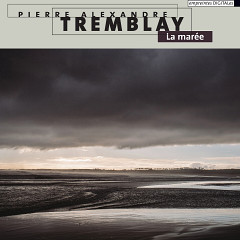
On La marée, Pierre Alexandre Tremblay is exploring the nuances between extremes.
For Pierre Alexandre Tremblay, composer and professor of composition at Huddersfield University, tea is vital. In his home studio, next to his note books with ideas and thoughts, a keyboard and an ipad, “there will be my Taiwan kettle probably brewing oolong”. Little wonder, then, that he should dote on the miracles of the tea ceremony in the booklet to his latest double-CD La marée: “What a nice way to contemplate various life cycles at a glance! So much beauty within these infinite nuances, when one takes the time to dwell upon them”, Tremblay writes about the gradual development of sound, aroma and taste in his favourite leaves. Tea and music go hand in hand: The reflections serve as an introduction to Mono no aware, a seventeen minute composition for “processing, interactive system, multitrack fixed sounds” and the custom-made Babel table. Just like the four other works included on the album, it is a mixed composition pitting a human soloist against dynamic amplified processes and observing the results in real-time. Although Tremblay has referred to these processes as “power games”, the music is less about confrontation, as it is about the gentle gradations between extremes, about evanescence, transience and constantly changing constellations. To an outside observer, these intense games may sometimes be emotionally overwhelming and confusing to the senses. And yet, just as with a good cup of oolong, the real effects are taking place on the inside, leading the listener to a realm of pure, undiluted experience — and complete clarity.
Tell me about the challenges of meeting your personal quality standards when writing the pieces on La marée.
Each piece had its own struggles and epiphanies during the composition period. I would say that I am happy with them because I left enough time within my writing process to be able to trash everything I was not happy with. In certain cases, it was a lot of the early versions that went to the bin! I usually work with the performers a fair amount of time, doing different trial-and-errors with ideas of sound worlds, processing and interactions. This allows me to finalise a piece that I am happy with, as many ideas have been rejected at the onset.
Now, I can say that mixing the album of 5 mixed pieces was a great reality check: these works were composed over a long enough period to let me forget my mannerisms and putting them in close proximity on an album was an interesting experience: I could see clearly what constituted my approach of mixed music between 2005 and 2013. There are definitely common elements in the vocabulary, elements that I have moved away from — and elements that I did quite well but should stop doing!
The contrasts between ‘acoustic’ and electric/electronic sound sources is just one of the many polarities on La marée, but it may be one of the most exciting ones. How do you see this relationship and why does it form such a fruitful point of departure for you?
I think that dualities are interesting and potent as they are immediate and allow the discourse to move forward. I also think that, in mixed music, a listener will identify with the human agent, and again this is full of expressive potential.
Now, to nuance a little: I tend to consider every duality as extremes of an axis, of which I allow myself to explore the intermediary nuances. Acoustic/electronic is one of those axes. An example of such an intermediary position is where the electronic part is merely extending the acoustic sound, allowing me to gel the sound world as a single unified whole, bridging the gap between acoustic and electronic sounds.
You’ve described some of the interactions on the album as “power games”. What, to you, is rewarding in a confrontational approach, rather than one based on consensus?
First, let me say that I think there are always powers at play, even in consensus. So, in line with the idea of exploring the nuances between extremes, I also consider the full range of power relations, from equal-powered-consensual, to power struggles with cohabitations of contrasting ideas, to sheer domination by one part, to negotiation/seduction dance! I think that varying levels of power relation are again a very potent imagery. How it is perceived by the listener is more complex and probably equivocal; nevertheless it allows me to move the discourse forward.
What are benefits and challenges of real-time processing from your perspective?
As often as I can, I do lazy real-time processing: I will do everything I can in deferred/studio time. But, going back to my goal of making sure the performer owns the music, I make sure the music is adaptable to the performer’s interpretative decisions, in the moment: playing a section slower, more legato, louder, sharper, etc. These elements of freedom are important for them to feel that they play in a chamber music setting, and not with a karaoke track! This most probably stems from my work as performer within my bands: I appreciate the freedom and the nuances that playing with other musicians procure, and I make sure that the electronic part in my pieces is (almost) as comfortable as playing with a human counterpart.
On a more technical level, there are many different approaches to how ‘real-time’ things are in my pieces. Sometimes, the liveness is strictly in the ear of the listener, sometimes it is all live and sounds as tight as pre-recorded material… but most times it is a combination of many approaches. The only important aspect is how it works musically, both for the performer and the listener.
On La marée, questions of timbre and questions of composition are intricately interwoven. Tell me a bit about your view on these two aspects and how they manifest themselves in your writing.
Simply, I don’t separate them at all: I think of it as a multi-dimentional entity. In most music that I enjoy, the ‘sound’ and the ‘composition’ form a single unity. Pop acts, free improvisers, electroacoustic composers, all have a strong sonic signature made of preferred modes, timbres, gestures, forms, etc. And I stand by this idea in all my musical endeavours: when I was producing rap beats, the same way I do when I compose (post)-acousmatic, or when I perform with my bands, the timbre is part of the complex musical phrasing, and will induce a sound world which I hope is unique to the piece.
Over on Facebook, you wrote, “Huddersfield rocks”. In which way?
I was told to be careful about Facebook! Seriously, the music department here is amazing. First, it is department with a strong agenda of defending the highest level of practice-based research, where composers and performers push the limits of their field by proposing new ways of practicing their art. My colleagues here are fantastic, and by that I don’t mean that we all do the same things. We actually cover a wide range of positions, converging or diverging with respect, questioning each other.
Moreover, the support we get here is impressive, with great studios, well equipped, and other different helping gestures on our current projects. There are also two festivals, the world-leading HCMF, and the more modest Electric Spring, the latter which I co-curate with Monty Adkins. Both festivals bring to this lovely Yorkshire countryside town some of the world’s most inventive musicians, which is great.
Finally, we have some fantastic students, again all busy pushing their research on where music should be and go next. A vibrant environment!
What are some of the personal enjoyments of teaching music for you?
There are mainly two reasons for which I like teaching. The first is the same reason why I really enjoyed my past experiences as a record producer: you help an artist develop and give birth to a work they are proud of. Moreover: a single voice is emerging, and they discover a lot more than writing techniques. This is a moment of shared pleasure. It requests a certain amount of discipline to forget what I would do at their place and to try to find out how to help them do what they want to do. It can be exhausting, but with good students, the result is amazing! I was lucky to get such good teachers, and I hope to be able to give back what I received.
The other reason is a little more selfish. Sharing musical and intellectual space with the new generation is keeping me in touch with a wide range of music that I could not explore just by myself. Also, it keeps me on my toes: they take nothing for granted, and their questioning forces me to question myself and what I assume as obvious. This feeds directly in my music, be it composition or improvisation.
So teaching can be a win-win situation.
Does having a “day-job” feel like a compromise or does it instead give you a real independence and freedom to write exactly the kind of music you want?
Apart from the win-win situation described above, the access to resources and the salary do provide a level of freedom that none of my friends who make a living as musician/composer have. Now, reality is much more nuanced than this idyllic description: teaching the less-than-good students is definitely not a win-win situation, marking is very difficult if you want to do it properly, and the administrative burden is awful.
That said, when I was partly freelance in Montréal, I had to spend a lot of time doing admin for free, almost as much as the ‘compromised’ side of my current position… for no salary and no resources and no interaction with good students and colleagues! So in the real world where I need an income as much as freedom to pursue musical research outside of current trends of financially sustainable music, this is the best situation by far!
It has taken many years to establish music at university, awarding it a more objective characteristic. How do you personally feel about the idea of music as a science?
For me practice-based research in music is not as science… but it does not have to be to be a valid research field. I am surrounded in my family by many scientists of post-doctoral level, and I think they share my view: what imports is to push further the limits of human knowledge.
If you systematically explore a musical universe that is pushing the limits of its current existence, you are doing research. Scientists are doing the same thing. They have their own set of constraints, as musicians have theirs. If you do this systematically enough, there are elements that will be transferable to others: the works, its goals, its failures, its influences, its approaches, its techniques.
You recently shared an article — http://www.timeshighereducation.co.uk/features/feature-why-do-some-academics-feel-like-frauds/1/2010238.article — about academics feeling like frauds, indicating that it may actually be right in some points. What’s your position on the state and ongoing relevance of universities and academia for music?
I think this article is right on a lot of points. What it says is that people in my job are overwhelmed by the expectations placed on them… mostly by themselves, to be honest! But this applies to artists too.
Academic posts, and artistic careers, usually attract a certain type of person that will want to do well what they set themselves to do. I think that in our overwhelming, information-overdosed world, perfectionists are always under the pressure of self-doubt, of pushing boundaries, of exploring new avenues, of knowing everything… there is so much to do, and so little time. Books and albums are being churned out at an every increasing speed, it is just impossible to stay afloat. With a little more nuance to this dramatic view though, there is also the factor that the more you know, the more you are aware of the immensity of what you don’t know.
Couple this with academia being busy with fake accountability, it makes the job worse than ever. Artists are stuck with the same problem: they are expected to be publicists, web designers, producers, tour managers, grant application specialists… and be at the top of their art if they find the time! So I often feel that I would need a couple of lifetimes to get to do what I am credited for already, let alone what I want to do next! But I am also aware of how lucky I am in my current position… a Facebook post is quite a dangerous half-confidence!