Sauter au contenu principal
electrocd
  • This website is also available in English.

Blogue

2899 résultats
  • 309
  • 310
  • 311
  • 312
  • 313
  • 314
  • 315
  • 316
  • 317
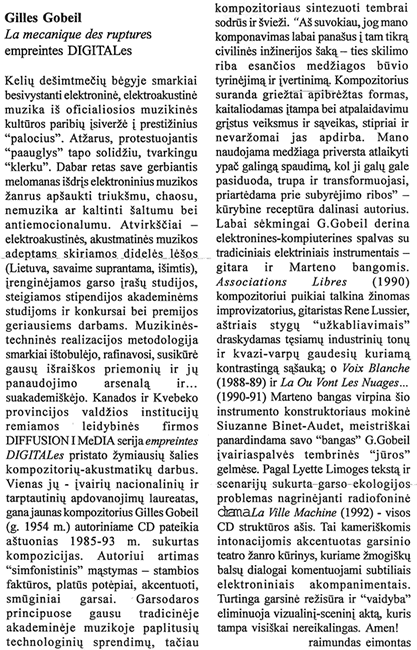
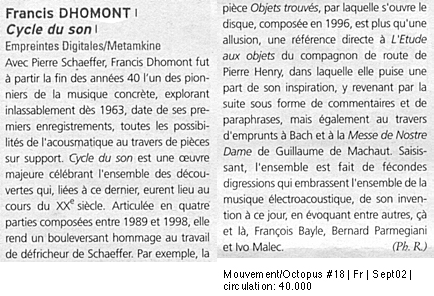
  • Cycle du son dans L’entrepôt

    «Kritiek», L’entrepôt, 1 septembre 2002
    dimanche 1 septembre 2002 Presse

    … ik deze release van Francis Dhomont. Dit geeft reeds aan wat een veelzijdig beestje de Electroacoustiek is. En daar draait het Francis Dhomont ook allemaal om. Het is een lofzang en een eerbetoon aan het genres en zijn grote voortrekkers. Vooral ‘inventor’ Pierre Schaeffer maar ook voortrekkers als Pierre Henry, Stockhausen, Ferrari en Varèse, … krijgen een vermelding in deze homage. Cycle du son is dan ook een zeer onderhouden en vooral gevarieerde stuk geworden. Een luisterervaring die je van de ene ‘emotie’ in de andere brengt, en die je maar zelden zal vervelen. Cycle du son is een spannend, zelfs entertainend stuk, dat elke avontuurlijke muziekliefhebber zal verblijden.

    It is pure entertainment for the adventurous music-lover.

    liberum arbitrium, morceaux_de_machines dans Blow Up

    «Recensione», Nicola Catalano, Blow Up, no 52, 1 septembre 2002
    dimanche 1 septembre 2002 Presse

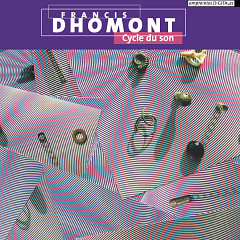
    Animatori dello show radiofonico Napalm Jazz presso l’emittente quebecoise CKIA-FM, presto mutatosi in vero e proprio progetto musicale, Aimé Dontigny e Érick d’Orion hanno da qualche anno mutato denominazione in morceaux_de_machines mantenendo peraltro inalterata l’energia apocalittica della band originaria. Lo dimostra nitidamente l’album d’esordio liberum arbitrium che, prendendo le mosse dall’opera di Anthony Burgess e Luigi Russolo, si distende o piuttosto si aggroviglia in un infernale impasto impro-rumorista di ferocia inaudita. Un urticante attacco massimalista via carta vetra all’apparato uditivo, ed era da tempo che non se ne sentiva di così convincenti. (7/8)

    … un infernale impasto impro-rumorista di ferocia inaudita.
    7

    Chemin de fer, Magali Babin dans AllMusic

    «Review», François Couture, AllMusic, 30 août 2002
    vendredi 30 août 2002 Presse

    Did you ever stop in your tracks while cooking dinner to listen to the sonic possibilities of this pot or that pan? Well, you should. Magali Babin acted on this impulse and has since developed an art form out of kitchen utensils and discarded metal objects. Chemin de fer is her first album. The title means “railroad” but is more accurate when translated literally: “road of iron.” This is not bang-on-a-can noise. Babin studies metallic sounds up close, using close miking to capture all the subtleties of her tappings and scrapings. Her approach bears similarities with lowercase and microsound esthetics — indeed, she puts her “instruments” under the microscope. Looping, filtering, but most of all exploring all the sonorities contained in them, she improvises strange, captivating pieces. However odd they sound, they remain vaguely familiar. Triturations and Petit jardin stand out, simply because they take a form more constant and eventful than the other pieces. Jogging dans la maison hantée was created with producer Mario Gauthier and sound engineer Alain Chénier taking part (although their roles are not specified). Pluie de homards is an improvisation over the noise piece Rain by Ian Nagoski. Ma tribu begins with a simple sound (what?) and builds up to an abrupt end, Francisco López-style. L’entonnoir is the noisiest track, recalling some of GX Jupitter-Larsen’s experiments, but without the macho “subliming violence” vibe. Even in her harsher moments, Babin keeps her art under a feminine touch. Impressive.

    Impressive.

    Podweek, Oeuf Korreckt dans AllMusic

    «Review», François Couture, AllMusic, 30 août 2002
    vendredi 30 août 2002 Presse

    Of the four CDs the label No Type released upon its launch in May 2002, Podweek is the most straightforward. Compared to Magali Babin’s microsonic metallic studies and morceaux_de_machines’ digital noise, the tunes of Oeuf Korreckt (aka Frédérick Blouin) derive from early techno and keep rhythm and melody as immutable constants. The quirk in Oeuf Korreckt’s music resides in the means of production. He still uses pre-Windows assembling software like Scream Tracker, connecting him to the 1980s pioneers of the techno scene. Still, besides an affiliation to the “vintage” sound, similar results could have been obtained with more up-to-date techniques. The real interest in these pieces is more in the way they sound fresh, positive, and entertaining. If it weren’t for the heavy rhythm tracks, one could think of naive electro-pop figures like Felix Kubin or Reznicek. The pieces collected on this very generous album (78 minutes) date from 1995 to 2001, making it a retrospective of sorts. There is plenty to go around, maybe a bit too much considering the rather limited sound palette used. But the tracklist offers many highlights, from the crude opener Get Binary and the cute Alright Well Okay (featuring a child’s voice) to hardcore rompers like King of the Elephants and A Ride in Elephant City.

    The real interest in these pieces is more in the way they sound fresh, positive, and entertaining.
  • 309
  • 310
  • 311
  • 312
  • 313
  • 314
  • 315
  • 316
  • 317