Sauter au contenu principal
electrocd
  • This website is also available in English.

Blogue

2899 résultats
  • 420
  • 421
  • 422
  • 423
  • 424
  • 425
  • 426
  • 427
  • 428
  • L’ivresse de la vitesse, L’ivresse de la vitesse 1, L’ivresse de la vitesse 2 dans N D - Magazine

    «Review», Jeff Filla, N D - Magazine, no 20, 1 juin 1997
    dimanche 1 juin 1997 Presse

    One of my favorites, if only because of the Veils piece. Most of the music on these two disks is a stylistically heterogenous jumble of orchestral, jazz, and choral arrangements—all meticulously assembled from thousands of pre-recorded tracks. Such a grandiose production of acoustic instrument track layering has surely never come before this. Sometimes the instruments are so densely layered they become a storm of harmonics that approaches white noise. The whole compositional temperament—impatient, violent, and spastically bursting and whirling relentlessly—makes me wonder who has the mental energy to listen attentively to the whole length of it, much less labor to compose it. Possibly, it’s brilliant (I should mention that a composer friend of mine thinks these tracks are the most original new music he’s heard in years), but I found it oppressively cluttery. At the tail end of the second CD is the piece titled Veils; another study in multi-tracking which is stylistically the flipside of the coin. Veils is an ambient masterpiece where, atypical of ambient music, genuine compositional events are as important as the arrangement at any given time. No electronic effects were used, but extensive multitracking between 180 to 280 tracks of acoustic instruments is responsible for a consistency and flow of this phenomenal work. Very artfully done.

    Very artfully done.

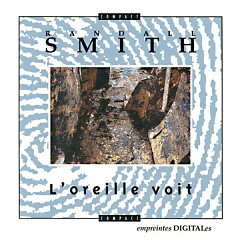
    L’oreille voit dans N D - Magazine

    «Review», Jeff Filla, N D - Magazine, no 20, 1 juin 1997
    dimanche 1 juin 1997 Presse

    A bit more patient and slowly evolving than your average electroacoustic work. This gives a lot of emphasis to stimulating, grainy textures and raw imagery, without constantly interrupting you with that sterile “electronics-in-a-void” sound that can make me blase about electroacoustic work sometimes. Satisfies the same tastes that enjoy John Watermann’s “Calcutta Gas Chamber” or David Dunn’s “Chaos and the Emergent Mind of the Pond.” Pretty potent stuff, especially at high volume levels.

    … It took some talented hands to shape these little tracks.…

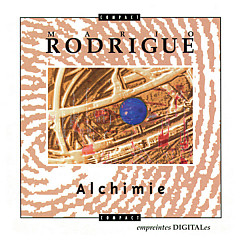
    Alchimie dans N D - Magazine

    «Review», Jeff Filla, N D - Magazine, no 20, 1 juin 1997
    dimanche 1 juin 1997 Presse

    A lot of great music is packed into this slender, discount-format CD, one of the best on this label. Rodrigue’s electroacoustic pieces have a fluid style that is refreshingly different from the jarringly erratic nature of most tape-music. Like a roller coaster ride through a spectacle of stereophonic fireworks. Not merely entertaining either: compositionally, the pieces are compelling, and they are no less artful for all their seeming concern with impressive technical tricks. It took some talented hands to shape these little tracks. Rodrigue is my top recommendation to insomniacs who listen with headphones.

    It took some talented hands to shape these little tracks.

    Claire-voie dans N D - Magazine

    «Review», Rob Forman, N D - Magazine, no 20, 1 juin 1997
    dimanche 1 juin 1997 Presse

    Yet another compelling release from [empreintes DIGITALes] in their “affordable” series. Bartley is based in Toronto and has been involved with electroacoustic sounds for over ten years. This CD contains compositions spanning her career and is characterized by spacious, slightly icy, and ethereal works. Two of the pieces use vocal sources to solid, but differing effects. The intensity (without the drama) of the other two pieces is something we could hear more of in a genre that often overemphasizes “dramatic” sounds.

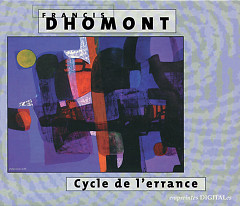
    Cycle de l’errance, Les dérives du signe, Mouvances~Métaphores dans N D - Magazine

    «Review», Jeff Filla, N D - Magazine, no 20, 1 juin 1997
    dimanche 1 juin 1997 Presse

    Before reading the [original 1991 edition] accompanying booklet (over 200 pages) I had no idea Dhomont was considered a major figure in electroacoustic music. Though his GRM album has always been one of the most interesting discs on that label. What Dhomont’s music exhibits on these two CDs is a command of sequential events, a syntactic order, that surpasses any such achievement that the LP had. This “order” is something I start to pick up on upon repeated listenings and it’s the hallmark of talent for any self-respecting acousmatic egghead. While much of this seems like amorphously structured ear candy, I entertain hopes of finding brilliance in some of those parts too someday.

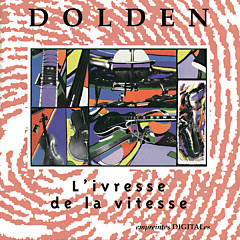
    L’ivresse de la vitesse, L’ivresse de la vitesse 1, L’ivresse de la vitesse 2, Paul Dolden dans Array Online

    «Review», Hal London, Array Online, no 17:2, 1 juin 1997
    dimanche 1 juin 1997 Presse

    There is so much musical output contained on these two discs that it took me several listenings to come to grips with it all. In the liner notes, Dolden describes his current artistic intentions as involving the “speeding up of an excess of musical ideas so that the composition and its materials exhaust themselves in the shortest time possible”. Most of the works here reflect this principle in different ways. Another perceptual factor in listening to these pieces is the manner in which Dolden intersperses pieces for tape alone with works featuring solo performers backed with material from the solo tape compositions. This approach has the twofold effect of emphasizing hitherto unstressed aspects of the tape pieces and also of blurring to some extent the distinctions between the individual works. These considerations aside, Dolden constantly varies his approach, not hewing to a quick-cut, sound-mass approach to the exclusion of linear development.

    Dolden first composes simultaneous lines of music on manuscript paper, then digitally records each line as performed by an acoustic instrument. The parts are then digitally mixed with little or no signal processing. His exclusive use of acoustic instruments is justified by his opinion that electronic synthesis techniques are unable to produce a large palette of convincingly different timbres. A huge palette of acoustic sounds are used tor these pieces, including nearly every orchestral instrument, voices, ethnic and folk instruments, and percussion. And although he does not use signal processing, he occasionally achieves DSP-like effects through ingenious mixing of his sound sources. The mixing often involves overlays of 40 or more tracks, and the massed effects and climaxes achieved are impressive. His use of digital editing is equally responsible for the results, as the pace and mood of the pieces are largely controlled this way.

    The title cut and the last work in this collection, both for tape alone, could not be more contrasting. L’ivresse de la vitesse (1992-93), encapsulating as it does the composer’s more recent methods, is an exhilarating outburst of contrasting ideas and styles at a rapid-fire pace. Veils (1984-85) is a halfhour, 3 movement composition which explores a sonic world of subtly shifting timbres, comprising drones on acoustic but ambiguous-sounding origin. After the adjustment is made to the leisurely pace of this piece, it is thoroughly satisfying.

    With the exception of these two pieces, I gravitated toward the pieces that featured solo instruments because of the focus they provide. This may be because Dolden does not emphasize spatial placement in these wtirks. Often, the sound struck me as completely up-front and two dimensional. No doubt this is partly because he eschews most signal processing,but the overall sound of the acoustic instruments tends to be a little washed-out. Experimenting with different microphones and preamplification should help — quality of engineering is important when this approach is taken, especially when there is extensive mixing and overlaying. The solo instruments help to impart more of a spatial quality. Revenge of the Repressed. Resonance #2 teatures a performance by cellist Peggy Lee which ranges from fleet passagework to elegiac phrases and extended techniques.

    The harpsichord part in Physics of Seduction. Invocation #2 takes on a thunderous and threatening aspect in the hands of Vivienne Spiteri, thanks to Dolden’s multitracking and close-miking techniques. Two pieces feature saxophonist/clarinetist Francois Houle. One of these, In a Bed Where the Moon Was Sweating. Resonance #1, strikes a perfect balance between the virtuostic solo clarinet part (often multitracked with amazing etfect) and the tape part with its echoes (or “resonances”) of preceding events.

    Physics of Seduction. Invocation #1 features the composer on electric guitar in a technically adept performance which also makes use of the processed timbres which are the domain of the instrument. Dolden shows a flair for these changes of tone. His performance on guitar here gives further evidence of his mastery of the sonic resources at his disposal.

    Hal London is a freelance, part-time composer who divides his time equally between acoustic and electroacoustic music. Dolden’s approach in this respect is of special interest to him.

    His performance […] gives further evidence of his mastery of the sonic resources at his disposal.
  • 420
  • 421
  • 422
  • 423
  • 424
  • 425
  • 426
  • 427
  • 428