electrocd

More from the blog

16 results
  • 1
  • 2
  • 3
  • Formes audibles, Interruptions, Petites étincelles, Manuella Blackburn in Percorsi Musicali

    “Manuella Blackburn: intuizioni e ‘interruzioni’ semiotiche”, Ettore Garzia, Percorsi Musicali, February 11, 2025
    Thursday, February 13, 2025 Press

    Uno degli scopi di Percorsi Musicali è fare evidenza su compositori e musicisti la cui bravura non è proporzionata al successo che hanno ottenuto. Specialmente nella musica acusmatica l’insufficienza della relazione andrebbe molto rivista e, nel caso di Manuella Blackburn (1984), l’insufficienza non è proprio spiegabile. Nella musica acusmatica Blackburn ha un posto di rilievo: è una ricercatrice esperta pluripremiata e riconosciuta a livello internazionale, una manipolatrice intelligente di materiali sonori che più volte ha ribadito l’importanza di un vocabolario specifico per descrivere gli eventi sonori, le strutture utilizzate e l’evoluzione degli spazi (un codice che viene dalle lezioni spettro-morfologiche di Denis Smalley); è intervenuta su metodi e strategie per creare musica elettroacustica, è oggi conosciutissima negli ambienti acusmatici per il suo metodo pedagogico Visual Sound-Shapes e la sua sperimentazione si fonda su alcune caratteristiche che più volte sono state acclarate in documenti, saggi e conferenze: da una parte Blackburn ha lavorato alacremente sulla gestione dei file audio cercando di imporre un quadro di nozioni sul principio di ‘brevità’ delle combinazioni sonore, dall’altra si è preoccupata di trovare soluzioni per una creatività interculturale, attraverso una sorta di ‘prestito’ basato su materiali originali, condotti anche in paesi stranieri, rielaborati secondo un’appropriazione personale di significati che vanno oltre le astratte propensioni delle strutture della musica cosiddetta ‘invisibile’. […]

    … is an award-winning and internationally recognized expert researcher, an intelligent manipulator of sound materials…

    Formes audibles in The Sound Projector

    “A Six-Part Syntax of Sound”, Stuart Marshall, The Sound Projector, October 13, 2013
    Sunday, October 13, 2013 Press

    If ever there were just cause not to judge a book (or CD) by its cover then this is it. The sleeve’s hazy smudge of tame blue and yellow is more indicative of a Rothko-esque William Basinski rip-off than an ontologically expansive, electroacoustic orgy. Look more closely though and a telling detail reveals that this is another CD on the redoubtable empreintes DIGITALes label, whose bold claim to be ‘the world leader in electroacoustic/acousmatics’ will solidly stand-up to any bench test. In fact, given the daring new vocabularies voiced on recordings such as this, the debut from the UK’s Manuella Blackburn, I’m visited by an overpowering sense that I am the one being tested.

    One need only glance at Blackburn’s biography to be dazzled: barely in her thirties, she is a lecturer in Music Technology at Manchester University [Liverpool Hope University] and has already taken home a slew of illustrious awards from international electronic music events. However, venture into the music and you will find yourself lost for words. Ina-GRM fiends may find themselves at home amidst this spellbinding selection of surgically sculpted, swiftly shifting sounds and tunneling tones, cosmic flourishes and vacuumed hushes; all emulsified by a convulsive cohesiveness that obviates any hint of homogeneity, while marking every tone as Blackburn’s own. However, for other listeners it may be like ‘spherical trigonometry for the inhabitants of Flatland’, as Aleister Crowley put it.

    Track titles range from the open-ended (Switched on, Vista Points, Kitchen Alchemy and Spectral Spaces) to those of a more orientalist ambiguity (Karita oto and Cajón!). More than merely cursory designations, they successfully signpost the strange realms of sonic mysteries (to be) traversed not just by the listener, but the composer as well. Blackburn has personally articulated the discovery process by which she arrived at certain source sounds, before proceeding with an exploratory process of creating cohesive (if temperamental) compositions. The latter titles – more exotic designations – depict encounters between origins foreign and familiar perhaps found during the composer’s travels, as does the use of a French title for the collection.

    These six compositions were realised between 2007 and 2011. All throughout, sound sources from guitar to household appliances are rubbled to clouds of recognisable remnants that are animated into play perhaps best viewed in infrared, as they are climatologically morphed in a febrile, fluctuating maelstrom. Some of the recurring ‘audible forms’ include pointillistic flutters in particle accelerators, powdered performance samples draped over air currents, punctuated by split-second stabs of alien alloys, plunged into low-density liquids, and tucked into electro-gossamer sheets of pure tone. Fans of Bernard Parmegiani or Francis Dhomont may find themselves on familiar ground, but will equally be delighted at so fresh and authentic a manner of articulation.

    In Vista Points, flurries of improvised guitar are fleshed out, strings amplified to an almost glassy pitch, and spray-painted with myriad layers of twittering designer genes. The resulting ‘causality, conflict and turbulence’ is captivating, especially so in the sudden moments, when the piece’s initial stability yields to a terrible tension between explosive pressure and release/tentative stillness and paralysing presence, and the atmosphere is engorged with crackling clouds of electrons.

    The sound source in Switched on is an aged television, from the wake-up stage of which the composer has coaxed unfamiliar flutters and frequencies – some just a split second in duration – and painstakingly corralled them into a towering cake of ‘cascades and explosive flourishes’. The realised piece – a polyphony between chimes and switches in alternating on/off states of animation – surges with the electrical life force of a seemingly dormant device, which depiction succinctly epitomises much of Blackburn’s composition: originating in a static state, suddenly seething violently but with volition and direction seemingly more evolved than the sensory apparatus of the listener.

    Karita oto (‘borrowed sound’) derives equally from a number of traditional Japanese instruments (the samples were taken during a 2008 trip to Tokyo), and ‘compositional strategies developed from Denis Smalley’s spectromorphology’. The piece follows an ‘episodic structure’ through which ‘cultural’ sounds are deconstructed to their very DNA, and reformed into glistening web ladders thumped and plucked by monstrous spider appendages. The duality that informs this composition of contrasts is, according to Blackburn, inspired by the oft-remarked upon extremes found in Japanese culture, such as one might find during a daytrip around the Zen temples of central Kyoto.

    The immediate and relentless Kitchen Alchemy careens like carnal relations between mercurial bodies as if heard from within: an amorphous, unstable globule of rippling liquid metal spitting out bulbous bursts of machine-whir with undertones of deep gong resonance. Like Karita oto, the piece’s acousmatic exegesis of kitchen utensils is realised via Denis Smalley’s spectromorphological language and ‘structures created from a variety of onset, continuant, and termination vocabulary combinations’, which certainly bears out the eponymous alchemist’s jargon-heavy patois. And while some might regard the invocation of alchemy qua compositional paradigm as clichéd, then the composer’s application of esoteric and individualised processes to the end of elevating base matter into something precious certainly offers some justification.

    Cajón!, which utilises recordings of the eponymous Peruvian percussion instrument, kicks into gear with superhumanly swift, scattershot rhythms that descend and depart with bewildering frequency, mutating in form and volume with each pass, as though having gained self-awareness and attempting to escape through the speakers. And, even as the atmosphere is slowly divested of its density, a feast of flamenco handclaps, metallic clicks and scrapes are masticated with similar gusto.

    Spectral Spaces surveys a radiant vista of modulating twitter with violently tugging riptides, as thought the shimmering sound of light itself had been liquefied and amplified atom by agitated atom. Consisting of four ‘passages of concentration, crossover, overlap, and interstices’ divided by slices of silence, the piece touches upon a simpler, but no less extreme audio range than the other pieces, seemingly desirous to return to the shimmering state of grace in which it opens.

    Interviewed in Bananafish magazine (issue 15), Romanian composer Ana-Maria Avram articulated her compositional challenge as ‘to build the whole from almost nothing, from fewer and fewer things…’ The same could be said to apply to electroacoustic music in general, but Blackburn’s compositions provide perfect exemplification. Her exacting approach to the arrangement of elements – often microscopic in size – facilitates the formation of an alien syntax from phonemes familiar. These six pieces are as hypnotising in their brief moments of luxuriance as in their explosions of visceral morphology, and will yield their manifold mysteries for much time to come. By the same token, unless the listener is particularly masochistic, these pieces are probably best digested at the very gradual pace at which they are NOT delivered, so I would caution listeners to ‘chew slowly’. Speaking as an armchair enthusiast though, I cannot overstate just how exciting and refreshing this music is.

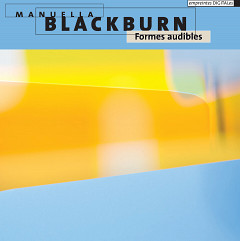
    … an ontologically expansive, electroacoustic orgy. […] on the redoubtable empreintes DIGITALes label… I cannot overstate just how exciting and refreshing this music is.

    Formes audibles in Circuit

    “Critique”, Cléo Palacio-Quintin, Circuit, no. 23:2, October 9, 2013
    Wednesday, October 9, 2013 Press

    Ce premier disque monographique de la compositrice britannique Manuella Blackburn (1984) nous permet de découvrir six de ses œuvres composées entre 2007 et 2011, dont la plupart ont été finalistes ou primées à d’importants concours internationaux. On ne s’en étonne pas, à l’écoute de ces œuvres acousmatiques, empreintes d’une fraîcheur et d’une vitalité réjouissantes. Sa biographie nous informe que la compositrice, diplômée de la University of Manchester a également produit plusieurs œuvres pour instruments et électronique, ainsi que pour la danse. Elle fait aussi régulièrement des performances d’improvisation sur ordinateurs portables avec son duo The Splice Girls depuis 2006. Ces influences de la performance en direct sont probablement liées à l’impression de dynamique gestuelle bien présente dans toutes ces pièces réalisées en studio. On sent toujours le mouvement, le souffle, le phrasé… ces musiques respirent et coulent naturellement. Il y a quelque chose de sincère et de naturel dans les sonorités, souvent peu transformées, et qui ainsi conservent leur présence originale. Les formes sont effectivement bien audibles.

    Vista Points (2009), entièrement composée à partir de sons de guitare électrique, est une œuvre résolument colorée, dont les contrastes entre les moments d’activité et les moments de vide sont parfaitement équilibrés. Switched on (2011) est un fabuleux montage de sons de commutateurs, cadrans et boutons enrobés de fourmillements électriques. Les sons courts «regroupés en grappes complexes, cascades et explosions» créent un monde ludique et animé. On a l’impression qu’Alice au pays des merveilles est entrée dans une boîte à musique! Le style imaginatif de la compositrice se laisse aussi bien entendre dans son exploration de sons captés à Tokyo, dont des enregistrements d’instruments traditionnels. Ces emprunts culturels sont savamment articulés par les stratégies créatives de la compositrice, développées à partir de la spectromorphologie de Denis Smalley. C’est également le langage spectromorphologique qui a alimenté la réflexion et le développement des procédés structurels de création de Kitchen Alchemy (2007), pièce dans laquelle les sons d’une panoplie d’ustensiles de cuisine et d’appareils électroménagers sont transformés en sonorités sophistiquées et dès lors méconnaissables. La pièce Cajón! nous entraîne dans une combinaison très réussie des sons de l’instrument espagnol du même nom, de claquements de mains (palmas de flamenco) et de textures bruitistes. Le résultat est décidément rythmique et enjoué, dans un élan gestuel qui se renouvelle constamment.

    Le disque se termine sur Spectral Space (2008), œuvre inspirée des qualificatifs de l’espace spectral tel que décrit par Smalley. La présence de Denis Smalley se fait ici directement entendre. Les matières sonores sont toutes dérivées de fichiers sonores fournis par le compositeur, ceux-ci ayant préalablement servi à la création de sa pièce Wind Chimes en 1987. Les sons de carillons de céramique et autres sons métalliques d’origine avaient été transformés par Smalley à l’aide du système numérique du studio 123 au Groupe de recherche musicale (GRM) à Paris. Leur qualité sonore et leur clarté étaient remarquables malgré les limitations des outils de l’époque. Manuella Blackburn revisite élégamment ces matériaux en les disposant très habilement dans l’espace spectral. Le tout s’amalgame en couleurs chatoyantes. Malgré les matériaux très distincts utilisés dans chacune des œuvres, on reconnaît toujours aisément la touche de la compositrice. Ces musiques sont sans aucun doute porteuses d’une voix originale à découvrir, et à suivre…

    Ces musiques sont sans aucun doute porteuses d’une voix originale à découvrir, et à suivre…

    Formes audibles in Power-R kábelek

    “Egy különleges CD-ről nem mindenkinek”, Rudolf Radnai, Power-R kábelek, July 18, 2013
    Thursday, July 18, 2013 Press

    Jópár hete — írtam is erről a topikban — összeismerkedtem a Budapest Jazz Klub “hangmesterével” ennek köszönhetően két tápkábelem szolgál azóta is a keverőpultban, még nem jártak 500 órát, de szólnak így is rendesen. Balázs egy fiatal, baromi rendes tag, csak egy baj van vele imádja a elektronikus imrovizációs zenéket. Ez önmagában még nem lenne nagy probléma, de engem is megfertőzött kicsit, vagy inkább úgy mondanám, kinyitott előttem egy ajtót erre a zenei műfajra. Legutóbb, mikor találkoztam vele lelkesen beszélt egy empreintes DIGITALes.com nevű kanadai kiadóról és főleg a kiadó új lemezéről, Manuella Blackburn Formes audibles című CDjéről.

    Ma megkaptam és belehallgattam… szóval erős idegek és nagyon nyitott izlés kell hozzá, ezért is írtam a címben, hogy nem merem mindenkinek ajánlani. Viszont nagyon szól a lemez, mondhatnám azt is, döbbenetes a hangja.

    A fiatal, Manchesterben élő zeneszerző nőnek ez az első lemeze, pedig komoly neve van az elektro-akusztikus zene világában, nemzetközi fesztiválok nagydíjainak egész sorát nyerte meg. A lemezről csak annyit mondanék, hogy minden szám egy önálló témát jár körbe, a második szám (Switched on) például készülékek kapcsolóinak hangjából komponált zeneszám. Érdekes, sajátos világot tár elénk ez a lemez, számítógépektől és mobiltelefonoktól hangos világunkban mintha tükröt tartana elénk a művész, így éltek, ezt hallgatjátok!

    … ezt hallgatjátok!

    Formes audibles in Sound of Music

    “Recensioner”, Magnus Nygren, Sound of Music, July 11, 2013
    Thursday, July 11, 2013 Press

    Med sex skilda stycken på skivan Formes audibles visar den brittiska kompositören Manuella Blackburn fantasi i sitt val av ljudkällor. Vardagliga källor som hemmets på- och av-knappar, kökets utensilier, fältinspelningar, men också utvalda instrument som gitarr, slagverket cajón och traditionella japanska instrument blir utgångspunkter i hennes akusmatiska kompositioner. Och som brukligt är inom denna genre, är Formes audibles en form av porträttskiva med inspelningar hämtade från en period om några år, i det här fallet från åren mellan 2007 och 2011. Sin utbildning fick hon vid universitetet i Manchester och för närvarande är hon lärare i musik vid Liverpool Hope University i England. Ringer det en igenkännandets klocka kan det ha att göra med att hon har varit ”artist in residence” på EMS i Stockholm.

    Karita Oto (2009) är ett av de stycken jag fastnar mest för. Ljudkällorna härstammar från traditionella japanska instrument som hon spelade in vid en resa till Japan. Och här, liksom i övriga stycken, har hon en förmåga att komma mycket nära ljuden. Framförallt vid lyssning med hörlurar framkommer en oerhörd skärpa i ljuden, vid vissa tillfällen hör man hon nära nog klyver dem i sin efterbearbetning. Det finns en tilltalande vidd i kompositionen. Förutom att hon inspireras av kompositören och teoretikern Denis Smalleys teoribygge kring “spectromorphology” och dess uppfattning om rymd (“space”) lyfter den fram motsättningen mellan storstadens förtätningar och zenträdgårdarnas lugn. Således både dramatik och kontemplation.

    Kitchen Alchemy (2007) är mer puttrande (om uttrycket tillåts). Metalliska ljud blandas med rinnande vatten om än Blackburn försöker undvika de vanligaste ljuden av kökets verktyg. Det är en förhållandevis lugn komposition, bort från snabbmatens stress och in i långkokens värld där tid är lika viktig som anrättningens ingredienser.

    Såväl Cajón! (2008) som Vista Points (2009) tar utgångspunkt i reella instrument, slagverket Cajon respektive elgitarr. I båda verken är det fascinerande hur Blackburn behåller delar av instrumentens klanger. Distad elgitarr slår igenom, likaså cajonens karaktäristiskt rasslande perkussiva ljud (instrumentet är en låda av trä instrumentalisten sitter på och slår på med händerna). I Cajón! undersöker Blackburn både rytmiska figurer och instrumentets själva klangfärg (timbre). Elgittarens vassa klangfärg passar den precisionsstarka Blackburn väldigt bra. Här lyckas hon nagla fast ljuden och lyfta fram dess skarpa kanter. Det finns en tilltalande råhet i detta stycke som inte riktigt kommer fram i de övriga.

    Stycket Switched on (2011) färdigställde Blackburn på EMS i Stockholm. Här intresserar hon sig för hemmets alla på- och avknappar och ljuden de alstrar. Speciellt fastnade hon för ljudet av att sätta på en gammal tv, som gav upphov till en serie högfrekventa och statiska ljud innan själva tv:n gick igång. Och kanske hittar man i just det en parallell till en hel del av Blackburns tillvägagångssätt: hon sätter igång en distinkt ljudpuls som spricker ut i flera parallella skeenden. Just detta återkommer i flera av låtarna: en ljudlig punkt förvandlas över tid till något annat, gärna i flera lager. Kanske är det också detta Denis Smalley har i åtanke i sitt teoribygge där han talar om hur ljudets spektra (“Spectro-”) interagerar med hur de förändras över tid (“-morphology”). Jag är novis på området, men kanske är grundtanken så enkel.

    I det avslutande stycket Spectral Spaces (2008) tar hon åter hjälp av Smalley. Även här är det distinkta uttrycket framträdande. Smalleys inspelning av Wind chimes är den ljudliga grunden och med den skapar Blackburn ett nära nog bubblande kosmos. Det är vackert och kittlande.

    Det är vackert och kittlande.

    Formes audibles in Monsieur Délire

    “Listening Diary”, François Couture, Monsieur Délire, July 1, 2013
    Monday, July 1, 2013 Press

    A new name in empreintes DIGITALes’ electroacoustic roster: Manuella Blackburn from the UK, not even 30 years old. Formes audibles features six mid-length works (8 to 15minutes); works that bear the mark of the great French and British acousmaticians, especially Dhomont and Smalley. Each piece focuses on a source (electric guitar, cajón), a place (Japan in Karita oto), a concept (Spectral Spaces). Yet, despite these various approaches, the works here weave a homogeneous and firmly assured musical identity. Sensitive and rich works that fit a “classical” idea of electroacoustic music.

    The works here weave a homogeneous and firmly assured musical identity
  • 1
  • 2
  • 3