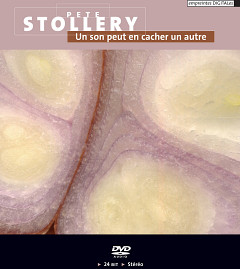
Arc d’apparition; Whisperfield, John Oswald in Neural
Time-based media art is a generic label applied to all the arts involving time as one of the mandatory coordinates to experience the works.

Time-based media art is a generic label applied to all the arts involving time as one of the mandatory coordinates to experience the works.
Die surrealistische Musik des Schotten
empreintes DIGITALes has a reputation of producing electroacoustic music of the highest standards. This is another proof of its status.
This DVD-Audio offers the listener a variety of listening experiences. The music is no longer pressed on CD but on DVD. This allows the label to use much better sound quality (24-bit) and a surround experience. Next to that empreintes DIGITALes gives the music encoded in AAC and MP3 format, for iPod listening.
Let’s first go through the compositions
The second work is based on the sound of people whispering. The work is much longer than the first and moves on at a quiet pace. After a short overture the sound retreats and slowly moves on. There certainly is a cadenza, a rise and fall, like the breath of a sleeper. The piece alternates between some fluttering of whispers and a quiet backdrop of harmonics. Whispers of course consist mainly of noise which is a nice contrast with the other more specific frequencies that can be heard.
Third
By far the best composition on this disc is
Most of the works presented here are quiet. There are no rough edges, just as we can expect from the releases of empreintes DIGITALes. When it comes to pitched frequencies
About the DVD-Audio
I started this review by trying to describe what happened inside those seven compositions. That is however both tedious work and the result of that hard labour will still not be enough to give the reader the right idea about what this music really is. Let’s take a look at what I managed
The opening of a door, the flanged (slowly declining) sound that resembles the peeling off of cellotape. Stop, start again. The same sound types, the same order but slightly differently mixed, edited, placed. Then the distinct sound of a ball in a bowl. Stop, start again. New scene
This work is not as scenic as the first one and concentrates much more on the morphing of sounds. Central sound source is (I think) the sound of a turning coin. Reminding us of course of one of the first Études of
See
So, how shall I proceed to review this release
It is most important to keep your attention with the music. Do not, really, do not start another activity because you will miss out on 80
The whole disc is in this vein. Recordings are crystal clear and edits or the elaborations of these are never cloggy. So, in that corner everything’s hunky dory. I have more difficulty with the musical structure which can be hard to follow, sometimes. At times it seems like the music is designed on a second to second basis. This is especially the case where the sounds remain close to the original (phonographic) recording. There,
We get 7 compositions, ranging from 1993 to 2003, on this disc that is presented in several formats
Die surrealistische Musik des Schotten
So wurde etwa