Sauter au contenu principal
electrocd

Aussi dans le blogue

30 résultats
  • 1
  • 2
  • 3
  • 4
  • 5
  • Les arbres dans Goddeau

    «Kritik», Jurgen Boel, Goddeau, 10 septembre 2008
    mercredi 10 septembre 2008 Presse

    In deze tijden waarin zelfs groepen steeds korter op de bal spelen en pas twee dagen voor de release aankondigen dat hun plaat te downloaden valt, met dien verstande dat een fysiek exemplaar later volgt, is dat laatste een verademing, vooral als het artwork een pareltje is.

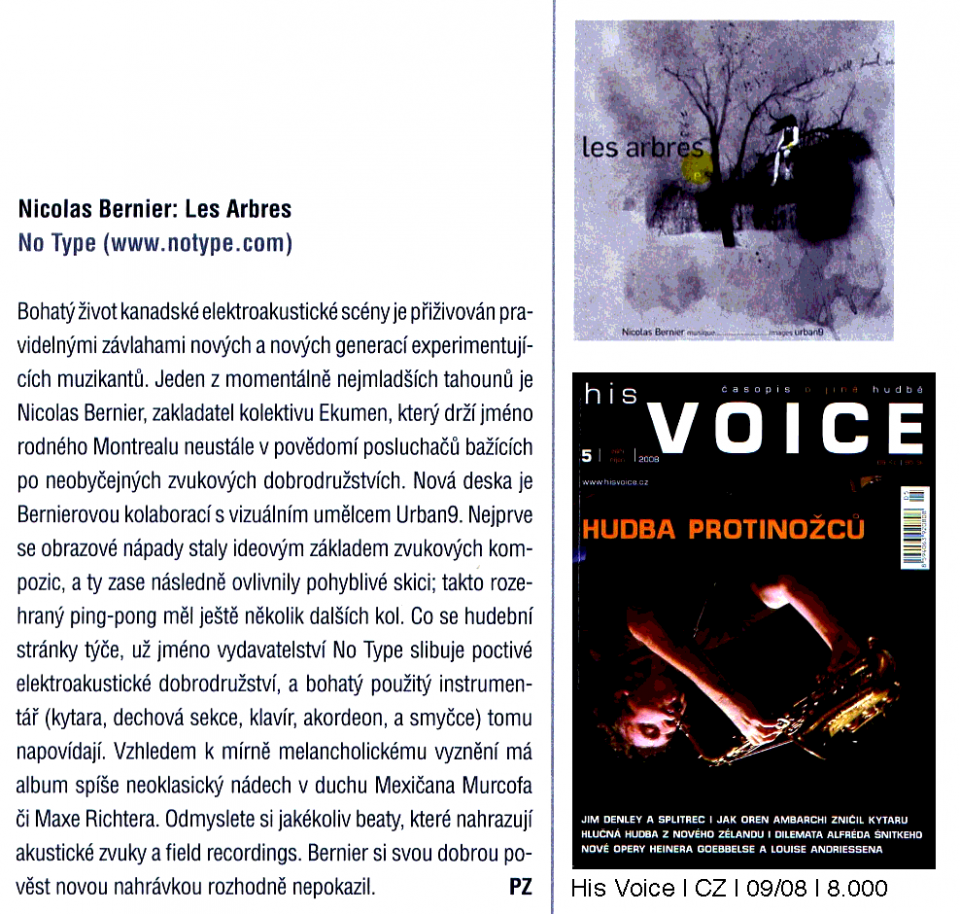
    De Canadese electro-akoestische componist Nicolas Bernier liet zich inspireren door visueel artiest urban9 en vice versa bij het maken van Les arbres. Het album wordt vergezeld van zes tekeningen/collages die elk bij een nummer horen. In de beelden van urban9 overheersen donkere kleuren (verschoten groen en zwartbruine tinten) waartegen haast witte figuren afgetekend staan. De link met de muziek of titels is niet altijd even duidelijk, hoewel in beiden zowel een onbestemd soort droefheid als een onbehagen schuil gaat.

    In // Post verbergt de piano zich vijf minuten lang achter ruislagen, dreigende echo’s en onbestemde klanken. Wanneer ze zich in de tweede helft van het nummer dan toch laat kennen, zweert ze bij etherische melodieën die zelfs in de hogere sferen een onvervuld verlangen en rusteloosheid tentoonspreiden die niet willen behagen maar veeleer het evenwicht verstoren. De afbeelding, enkele kale bomen en een eenzame vrouw maken de luisteraar noch kijker iets wijzer.

    Het verloren gelopen jongetje dat een lammetje vastklemt, belooft niet veel goeds voor // This Is a Portrait. Het nummer laat zich kennen door een vollere klank en een minder instrumentgebonden geluid. De aanwezige cello en accordeon worden pas in de laatste minuut onderscheiden (of aanwezig?) binnen het veelvoud van geluiden. De sfeer van het nummer laat zich minder eenvoudig vatten in vastomlijnde begrippen en roept vooral tegenstrijdige emoties op, die naargelang de eigen gemoedstoestand een invulling krijgen.

    // Piano ontwikkelt zich tot de soundtrack bij een obscure alsook elitaire Aziatische horrorfilm. De piano-impulsen, hartslagen, nauwelijks hoorbare klikken en dies meer creëren samen een gevoel van nakend onheil dat tergend langzaam dichterbij sluipt en nooit zijn ware gelaat toont. Geen wonder dat in de bijhorende afbeelding de gezichten van beide meisjes achter een donkere vlek schuilgaan terwijl hun witte kleedjes nauwelijks iets van hun pracht verloren hebben binnen de allesoverheersende grauwheid.

    Vreemd genoeg loochenen de spelende kinderen (en de boom die ze beklimmen) net de track die ze vergezellen. Want ook al is // Spleen niet zo donker als de andere, de aanwezige accordeon noch cello kunnen verhullen dat ook ditmaal een weifelen en een knagende onzekerheid aan de basis liggen. De dualiteit van afbeelding en muziek is minder prominent aanwezig in // Bora, al blijft alles (in het bijzonder achteraf) voor interpretatie vatbaar.

    De snijdende klanken roepen niet alleen de geest van de wind op maar impliceren ook een blazerssectie die er niet is. Geen enkele andere track op het album weet niet alleen zo goed muziek en titel te verzoenen maar ook minimalistisch electroklanken te koppelen aan een klassiek intermezzo (opnieuw de cello). De trompet op // Ouverture is wel degelijk een echt instrument, al weet Bernier opnieuw hoe alle geluiden en klanken in elkaar over dienen te vloeien.

    Net als in de afbeelding, een vreemdsoortige zeppelin boven een kaal en uitgedund bos, weerklinkt iets tragisch-heroïsch in het nummer. Een verval dat eigenhandig ingezet werd, wordt nog steeds beweend. Wanneer de violen spreken, verdwijnt alles tijdelijk naar de achtergrond om daarna het contrast nog duidelijker in de verf te zetten. De ene huilt terwijl de andere registreert en voortleeft in verminkte vorm.

    In Les arbres vormen de (kale) bomen een rode draad doorheen de begeleidende tekeningen. urban9 weet treffend de (voornamelijk) elektronische composities van Bernier visueel bij te treden door voor eenzelfde mix van grauwe desolaatheid en dubbelzinnige onduidelijkheid te kiezen. Zoals zoveel electro-akoestische composities vergt ook Les arbres veel van de luisteraar: de zes nummers hinten weliswaar naar een bepaalde gevoelsstemming maar een standpunt nemen ze nooit in. De keuze ligt in de handen van wie luisteren (en kijken) durft.

    Les arbres dans Le Lien multimédia

    «Critique», Charles Prémont, Le Lien multimédia, 4 septembre 2008
    jeudi 4 septembre 2008 Presse

    Électroacousticien de formation, musiciens aux multiples projets, nouveau directeur artistique de Réseaux, on ne peut pas dire que Nicolas Bernier a l’âme d’un chômeur. Et ça se ressent dans son dernier disque, Les arbres. Un album soigné, composé avec soin, qui nous emporte dans un monde qui flirte avec une sonorité expérimentale tout en demeurant musique au sens le plus commun du terme. Un effort remarquable de 45 minutes qui nous fait planer et prendre plaisir à décortiquer l’amalgame préparé par l’artiste.

    Album tout en douceur, c’est d’abord une ambiance que nous propose le musicien. Composé avec précision, c’est avec plaisir que notre oreille accroche sur la variété de sons qui nous sont proposés. On perçoit toute la profondeur du compositeur dans sa musique, ses mélodies qui nous portent, qui veulent se faire écouter. L’artiste apporte une touche d’harmonie en utilisant des instruments «organiques» dans plusieurs compositions, ce qui apporte beaucoup à l’ensemble.

    Nicolas Bernier a pris un risque avec un album qui demeure très près de ce qui se fait en électroacoustique. Les amateurs du genre reconnaîtront plusieurs sons et ambiances qui proviennent directement de cette musique électronique pour puriste. L’habileté avec laquelle il réussit à rester près du genre tout en innovant dans la forme est impressionnante. L’album a du succès là où beaucoup de musiques électroniques échouent: il fait le pont entre les amateurs et les néophytes.

    Un album qui mérite qu’on s’y arrête, que l’on soit amateur ou non. Il ne s’agit peut-être pas là de la musique la plus accessible, mais elle n’est certainement pas indigeste. Ceux qui sont déjà plongés dans l’électroacoustique aimeront la fraîcheur et la technique de l’artiste; ceux qui n’ont jamais fait l’écoute de ce genre musical pourront faire une jolie découverte.

    L’album a du succès là où beaucoup de musiques électroniques échouent: il fait le pont entre les amateurs et les néophytes.

    Les arbres dans His Voice

    «Review», Pavel Zelinka, His Voice, 1 septembre 2008
    lundi 1 septembre 2008 Presse
    The images and sounds of Les arbres work both as works of art in their own right and as a multimedia experience which encapsulates its audience in a nostalgic, discreetly melancholic and romantic emotional bubble.

    Les arbres dans Blow Up

    «Recensione», Stefano Isidoro Bianchi, Blow Up, no 124, 1 septembre 2008
    lundi 1 septembre 2008 Presse

    Nato dalla collaborazione col visual artist Urban9, Les arbres del canadese Nicolas Bernier parte su toni soffusi e malinconici per field recordings, pianoforte, chitarra, vibrafono, fisarmonica e archi appenna accennati, sfiorati con timidezza e ritrosia. La poesia dei primi brani si carica poi di soffici nubi jazz e rumorismi gentili che adombano atmosfere leggermente più disturbate pur mantenendo sempre un mood profondamente nostalgico e struggente. È una soundtrack carica di sentimento, che ti entra nella pelle per non uscire più. (7)

    È una soundtrack carica di sentimento, che ti entra nella pelle per non uscire più.
    7

    Les arbres dans Sonomu

    «Review», Stephen Fruitman, Sonomu, 28 août 2008
    jeudi 28 août 2008 Presse

    A real coffee-table book of a package. Housed in its handsome slipcover are a slim CD case and six quality postcards, each featuring a montage by visual artist Urban9, with its title on the back.

    Each title naturally corresponds to a complementary track by composer Nicolas Bernier. The idea behind this project was to collaborate over disciplinary boundaries, allowing the images to inspire the music and the music aid in assembling the visuals. If I understand correctly, this give-and-take process went back and forth through to a final revision.

    The montages of Urban9 are composed on grey on grey backgrounds with patient balance and painful symmetry, which becomes all the more apparent the deeper you look into each image. At the centre of each but one stand photographs of children, removed from their original context in some family album from the Victorian age or the 1940s, to judge by their clothes. In some, faces shine brightly, even preternaturally, while in others they are partially or wholly obscured. Gazing deeper into the frame there are the eponymous trees, of course, featured in every piece. But the trees are uniformly denuded, bereft of leaves and possibly also of life. Gaze even deeper and you find ghost writing, flower X-rays, an owl, and other eggingly incongruous elements, all drawn together to form a very cohesive whole. If I had to pick a favourite, it would be the second image, // This Is a Portrait, with its young schoolboy cradling a lamb in his arms, unexpressive eyes fixed directly on the photographer’s lens, impatient to get this over with.

    I am also very attracted by the music for this piece, which features longtime Bernier collaborator Delphine Measroch on accordion and cello with Bernier on guitar and “audio transfiguration.” This piece is as truly murky and deep with layers as Urban9’s visuals.The strings and accordion even add a hint of French-Canadian folk music, if only by mere presence rather than express style.

    With his computerized hammer and chisel, Bernier has sculpted each piece out of sparse instrumentation — a guitar or two, some brass, piano, strings and the above-mentioned squeeze-box.

    At times his interpretations are much more literal — “sound-effect-y,” if I may coin an unwieldy term — than expected, or necessary. When this happens it appears that more restraint at the computer keyboard would have been preferred.

    However, most of the time his electronics complement his acoustics admirably, lending them just the righ patina. Les Arbres is gloomily enchanting, for example // Piano, where the thoughtful depression of a deep piano note is allowed to swell and subside before venturing a new one. // Bora, an “audio bricolage” according to the composer, is not my favourite track — too much of the sound-effectery mentioned before — but the foghorn rumble he has his sampled trombones emitting is almost physically seductive. The sentimenal violin of Pierre-Olivier Gaudreau on the closing track (perversly titled // Ouverture) is peppered with very unsentimental electronic debris but this sonic juxtaposition only works to enhance the feeling of oneness between the visual art with its layered depth and the musical art’s similarly stratified sonic geography.

    An exciting, possibly even profound work from a young composer, and an introduction to the work of one very interesting visual artist.
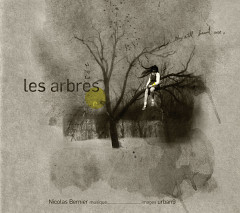
    A real coffee-table book of a package. Housed in its handsome slipcover are a slim CD case and six quality postcards…
  • 1
  • 2
  • 3
  • 4
  • 5