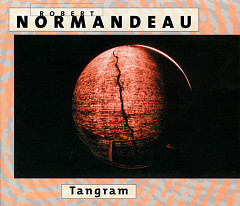
Normandeau freely admits to having been influenced by various other music forms including rock; these influences are obviously audible in most of his works. For example his piece Venture, which was created in 1996, uses as its sole source material the music of Jimi Hendrix, Led Zeppelin, Pink Floyd and other rock artists. Certain pieces on Tangram share some of the common elements which can be derived from rock music, i.e. long determined passages and repetitive rhythms.
Tangram’s first track Bédé (1990) uses onomatopoeia through the voice of eleven–year–old Marie–Helene Blain. The effect is of children giggling, whispering and conspiring together in an ethereal world, tentatively touching the real world like Alice Through the Looking–Glass. Was Charles Lutwidge Dodgson listening to this when he wrote about Alice? Éclats de voix (1991), also uses onomatopoeia through its spoken passage: various sections lead us through processed effects; ghostly mutterings and industrial sound textures which lend a sadness and emptiness to a spectral score, introducing the listener to an elaborate sound world. Spleen (1993), for which the composer was awarded the Main Prize at the Musica Nova 95 International Competition held in Prague, is full of tension built up through a percussive heartbeat, but there is an underlying irritability in the piece like the weariness a traveller may feel at journeys end. An undoubtedly complex work. Track 4 Tropes (1991) contains excerpts from Mozart’s chamber works. Beyond the treated piano and orchestral soundscapes lies a delicate inner core. Normandeau appears to dissect and then reassemble Mozarts music whilst still maintaining the original composers subtle creation of character. The title track Tangram (1992) is at 27:05 minutes — the longest piece on the disc. This powerful piece strains to give birth to the perfect Chinese Tangram, a seven piece geometrical form, finally emerging into fluidity and composure.
Robert Normandeau’s Cinema for the Ear aesthetic lends to his work a depth where meaning, sound and music become one. Either composition on this disc could be placed into a film script, these are soundtracks for the mind, very filmic in structure, and will therefore affect each listener differently creating a personal imaginary element.
I first bought the CD and listened to these compositional works in 1994, found it excellent then and I still find it drives my imagination in the year 2000.