electrocd

Blog

76 results
  • 5
  • 6
  • 7
  • 8
  • 9
  • 10
  • 11
  • 12
  • 13
  • Adam Stanović in RNE3: Atmósfera

    “Crítica”, RNE3: Atmósfera, May 5, 2019
    Thursday, May 2, 2019 Press

    En 2016, Ben Gaunt pidió a Adam Stanovic que produjera una remezcla acústica de su pieza instrumental 16th Century Horror, para flauta, oboe y piano, para lo que le proporcionó las grabaciones prístinas de los tres movimientos de la obra junto con grabaciones en bruto de cada instrumento.

    Stanovic comenzó procesando y desarrollando estas grabaciones a la ligera de manera que mantuvieran referencias claras y sin ambigüedades a la pieza original de Gaunt. De esta manera, intentó ser fiel a la idea de un remix. Sin embargo, mientras trabajaba, se encontró con nuevos materiales y otras direcciones que quiso explorar y comenzó así una separación entre la música de Gaunt y la suya propia lo que finalmente acabó en un corte abrupto con todas las referencias a 16th Century Horror. Así nació lo que escuchamos esta noche Ctrl c.

    Stanovic comenzó procesando y desarrollando estas grabaciones a la ligera de manera que mantuvieran referencias claras y sin ambigüedades a la pieza original de Gaunt. De esta manera, intentó ser fiel a la idea de un remix.

    Assemblance(s) in SilenceAndSound

    “Critique”, Roland Torres, SilenceAndSound, April 29, 2019
    Monday, April 29, 2019 Press

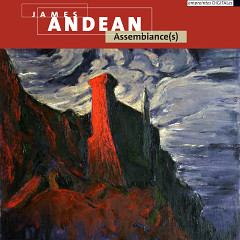
    James Andean navigue sur les eaux d’une électroacoustique nourrie de field recordings, puisés dans notre environnement direct et assemblés de manière à transformer cette matière première en narrations émotionnelles passées par un prisme déformant.

    Assemblance(s) enchevêtre les éléments pour créer des atmosphères chancelantes aux allures de sketches étranges, où tout prend des allures grossissantes ou rapetissantes, selon que l’on soit grand ou petit, doté d’une ouïe fine ou équipé d’un sonotone.

    James Andean déplace les bribes sonores sur d’autres espaces, leur offrant le loisir de devenir quelque chose de différent, d’endosser un habit de lumière sur un plateau de cinéma, de jouer la comédie sur une scène de théâtre, se rapprochant sans équivoque de l’esprit d’un Bernard Parmegiani. On est happé par ces histoires à l’approche cosmologique, projection dans un espace bousculé par les incertitudes et les faux-semblants. Très fortement recommandé.

    Très fortement recommandé.

    Manuella Blackburn in Musicworks

    “Manuella Blackburn’s Landline”, Jennie Punter, Musicworks, no. 133, March 1, 2019
    Wednesday, April 24, 2019 Press

    First-place winner, Musicworks’ 2018 Electronic Music Composition Contest

    In the pantheon of sounds, the tone, whirr, and ring of the rotary phone belong in the “gone but not forgotten” gallery. If someone’s mobile phone rings à la Ma Bell — as opposed to the usual pulsating buzz, pop-tune riff, or synthesized animal sound — we might get nostalgic and think something like, How quaint… that is, if we can even identify the original source of that analog ringing sound.

    Although touch-tone phones hit the market in the 1960s, rotary phones only started disappearing en masse in the early 1980s, when the old telecommunications monopolies in North America and Britain broke up. UK electroacoustic-music composer Manuella Blackburn was seven when the “old-style, shiny black, rotary-dial phone” in her family home was replaced in 1984. Its sound, which stuck with her, and the noises of other landline telephones she has known come together in her playful, poignant, and mesmerizing nine-minute work Landline, first-place winner of Musicworks’ 2018 Electronic Music Composition Contest.

    Many of Blackburn’s compositions explore the sonic depths of familiar household items, such as ice cubes and cups. “I wrote another piece using old-style cameras with film inside, and flashes,” she says, during a lively Skype conversation from her home in Manchester. “When I started the piece that became Landline it was supposed to be about beeps of domestic appliances. I was interested in capturing domestic communication, object and human, but I became more interested in sound materials I could get from phones.”

    Landline was written early in 2018 and had its world premiere in December of that year at the Australian Computer Music Conference in Perth. Since then, the piece has had repeat performances and been very well received, says Blackburn, whose specialty is fixed media (acousmatic music for loudspeakers). “When I have a new work, it’s a delicate time. I put it out there and wonder, How will people react? [Landline] is an interesting one to talk about, because of this idea of endangered sounds.”

    Nearly all the sounds in Landline were derived from different phones Blackburn had access to, including her own landline phone, used so rarely that it had fallen behind some furniture and become caked in dust. The rotary phone Blackburn knew as a child was, not surprisingly, long gone. After trolling through eBay, then searching databases, she came across Conserve The Sound , an online museum for dying sounds of obsolete technology, and was able to find sounds that were close to her vivid memory.

    She sourced phones from her social circle and became interested in the significant differences between them. “I was interested in small sounds. I would often be recording sounds that were not even a second long. I edited these, sequenced them, and then created more interesting passages. Some of the more harmonic passages are derived from dial tones — you know, that sustained hum you hear when you pick up the phone.” (The UK’s dial tone is a combination of sine waves mixed from 350Hz and 450Hz.)

    Even the piece’s percussive sounds are all phone-derived. “I’m getting those sounds from an object by knocking it, with harder attacks to get that lower frequency range,” Blackburn explains. “Most of the material gets processed through several different mechanisms, and might go through pitch shift. There are several different stages to get to the final result. I enjoy using software to loop my materials and create rhythmic passages that extend for longer periods.”

    Blackburn, who has two recordings on the Montréal-based Empreintes digitales label, has held the post of senior lecturer in music at Liverpool Hope University for the past ten years. Blackburn always knew she wanted to create music and moved through different instruments — guitar to recorder, to clarinet, to piano, and so on — as a child. “But it was only when I was introduced to the digital studio and discovered new technologies and computers that the lightbulb went on — I didn’t know I could put the two together and create music!

    When you listen to Landline, the first track on the Musicworks 133 CD, you will hear the close listening, sparkling detail, and sense of journey that is found throughout Manuella Blackburn’s fascinating, growing body of work.


    … you will hear the close listening, sparkling detail, and sense of journey that is found throughout Manuella Blackburn’s fascinating, growing body of work.
    Grains in The Sound Projector

    “Review”, Ed Pinsent, The Sound Projector, April 20, 2019
    Tuesday, April 23, 2019 Press

    We have enjoyed previous releases Growl and Necropolis by Åke Parmerud, the Swedish electroacoustic composer, and now we have Grains (empreintes DIGITALes IMED 18150), the latest collection for this label. As before, we have the monochrome high-contrast sleeve art which appealingly plays with digital “textures” and explores its own imaginary spaces. This time we’re hearing some earlier gems form his 1990s catalogue. The main event might be Grains of Voices, a 1994-95 composition that was commissioned by Swedish radio as a dramatic form of sound-art; we might consider it radiophonic almost, were it not for the lack of a clear linear narrative. Instead, Parmerud is making a generalised statement about the diversity of the human race, by using sampled, found and recorded voices from around the world. He intends thereby to present as much information as he can about the human spirit in a deep / wide sweep; I like the idea it might be seen as “vocal graffiti”. It’s all about different languages and cultures, yet the basic idea is to reveal some commonality, something about our shared humanity. On paper, this may sound a bit “worthy”, like some committee-designed UNESCO statement about mankind, but sonically speaking it’s a compelling jumble with plenty of rich detail; and it refuses to draw any conclusions about what these artificial patterns in sound might mean. As ever with this composer, the craft of assemblage is pretty immaculate; not a wasted moment, lots of concrete events; it’s as much a vocal mosaic as a wall of audio graffiti.

    More human voices on Les objets obscurs taking us even further back to 1991. This is intended as an “audio riddle” in four parts; at one level, we’re invited to guess what we might be hearing as we work through these four short works, plus there’s a friendly French-speaking woman adding some context at the start, with a further textual riddle (I think she’s pretty much asking “what am I?”, but it sounds so much better in French). All of this was done to pay homage to the INA-GRM foundation, which Parmerud respectfully regards as a “very honourable institution”, and which prompted him to try and emulate the historical traditions of musique concrète. Duly noted, but I would say he’s also emulating the surrealist René Magritte at his most playful; I’d say it’s legitimate to “read” a Magritte painting as a visual riddle, of sorts, and everyday objects were massively important to his visual lexicon. Parmerud’s suite contains the “solutions” in the final part, but the answers conceal more than they reveal, and are also intended to set us a new riddle, one without an answer. How metaphysical!

    Still more voices on Alias, a 1990 work which, in a very oblique manner, is attempting to say something about the life and music of Carlo Gesualdo. This Renaissance composer of madrigals is the gift that just keeps on giving, not just to lovers of that genre but also to composers and conceptualists. In 2017, for instance, we noted Alessandro Bosetti with his Gesualdo Translations work, a very bold statement using amateur singers that really challenged our received wisdom about the “chromatics” that have made Gesualdo so famous. Parmerud’s take on the subject is a bit more elusive; the first part remakes a John Dowland song, in order to raise questions about that most fraught of subjects, the relationship between the creator and the work of art. The second half samples some Gesualdo motets, fragments and processes them in an electroacoustic way and blends in music from the first half, thereby attempting to x-ray the inside of Carlo Gesualdo’s brain. Highly effective; even if you have no interest in the subject matter listed above, the musical process here does indeed create convincing impressions of the way the human brain might operate. Fascinating.

    Fascinating.
  • 5
  • 6
  • 7
  • 8
  • 9
  • 10
  • 11
  • 12
  • 13