electrocd

Blog

101 results
  • 9
  • 10
  • 11
  • 12
  • 13
  • 14
  • 15
  • 16
  • 17
  • Le voyage d’hiver in Aufabwegen

    “Kritik”, Guido Sprenger, Aufabwegen, no. 28, March 1, 1999
    Monday, March 1, 1999 Press

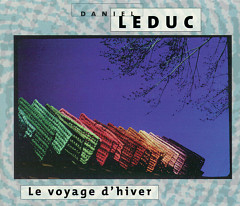
    Daniel Leduc ist von Geburt Frankokanadier, im Stil der französischen Elektroakustik nahe und vom Hazen her Impressionist; wenn nicht gar Romantiker. Seine Vatonung der „Winterreise˝ des romantischen Dichters Wilhelm Müller — die wohl bekannter durch Schumanns Lieder ist — ist unmittelbar und illustrierand: Da feuchl der Wind und knirscht der Schritr, Im Dorfe hörl man Hunde bellen, und Auf dem Flusse gluckst es munter. Um Erwin Potitts amste und stets deulliche Sprechstimme spinnt Leduc filigrane Almosphärne von glasklarer Kalte. Liebeskummer und Herzensschwere, von denen die Texie baichten, sleigert er zu klammer Angst und scharfa Vazweiflung. Das könnte ieicht neiv erscheina’, doch die Romantiker waren selbst der Ansicht, daß in der reinen Naturbetrachtung der Weg zu Transzendenz und Innerlichkeit liegt. Daher evoziert die Kombination von Wort und Geräusch jene Landschaflsgemälde von MüllersZeitgenossen (wie Caspar David Friedrich). die mit dem Bild der Naturzugleich tiefstes Empfinden vamitteln woilten; nur sporadisch schleichl sich ein anachronistisches Telefontulen oder Fliegergebrumm hinein. Neben zwei kurzen Zusatzstockan enthält die Scheibe noch Troposphere, wo Leduc sich mil der Frage befasst: We klingen Wolken? Urwaldschnartemd im Bodennebel, donnerkrachend cine Etage höher, und im außerirdischen Geschwurps der höchsten Sphären hört man einen Engel singen. Ganz schön süß, aber dennoch: Bei Leduc verbindet sich der reinc Ganuß des atmosphärisch genau gesetzten Geräuschs mit unverkopfterZugänglichkeit zu wunderschöner Musik.

    Robert Normandeau in CEC, Sur le vif / Quick Takes

    “Interview”, Ned Bouhalassa, CEC, Sur le vif / Quick Takes, March 1, 1999
    Monday, March 1, 1999 Press

    Ned Bouhalassa: You’ve been composing for nearly ten years pieces for multi–track diffusion. What was your original set–up?

    Robert Normandeau: It was very simple: a Mac IIx computer, an Akai S–1000 sampler, a 16–track analog Fostex recorder and multi–effects units. I also used the same monitoring system as today, with 8 speakers placed around me in the studio.

    NB: How would you compare your present compositional method with that which you used to create Éclats de voix?

    RN: Clearly the biggest difference lies in the format (support) of the completed work. With analog tape, the recording levels of the individual tracks had to be worked out in advance. I had decided that during concert presentations, I didn’t want to play with the levels or the eqs. Today, with a digital format such as Pro Tools, I can set the levels as I go along, and make changes when I add new elements. When I used analog tape, if I perturbed the balance of a mix by adding a new element to a track, I would have to re–write the other tracks that had already been recorded.

    NB: If I compare the works that you realized in the 80’s with those that you composed for a multi–track diffusion system, I find that the later seem to be more abstract, less anecdotal, and that these contain many examples of sound in movement. Would you agree?

    RN: It depends on the Cycle. Tangram, my first real multi–track piece, has referential qualities, and it belongs to a cycle of “Cinema for the ear” works, like Rumeurs (Place de Ransbeck) or Jeu. Other cycles, like the Onomatopoeia Cycle (Eclats de voix, Spleen and Le renard et la rose) and the Citations Cycle (Mémoires vives, Tropes, and Venture) are more abstract. As for my use of movement, to appreciate it fully you have to be in a multi–channel listening environment. The stereophonic collapse of the tracks takes away a great deal.

    NB: Do you think that the ability to hear 8 individual sound sources in your studio increases the polyphonic aspect of your writing?

    RN: Completely. It is essential to true multi–track composition. This aspect of the compositional process is not just an extra element. Otherwise, anyone who transfers a Pro Tools session onto ADAT is realizing a multi–track composition. It’s more complex than that. I’m referring to a specific way of composing that extends the musique concrète way of writing by adding an additional dimension, that of a real space, not the simulated one like the stereophonic soundstage. Stereo was a good idea, a good simulation of our binaural hearing, but this process has reached its end.

    NB: In what other ways has your compositional writing been affected by your set–up?

    RN: The writing itself has changed considerably. When everything has to be thought out with the final format in mind, when mixing technique is no longer part of the writing, the way in which of our intentions are permanently presented becomes a determining factor during the realization of the work. In the course of composing, since nothing can be left to chance or to a latter stage, I must find the proper place for each sound element as I go along. As paradoxical as this may seem, this brings the work of an electroacoustic composer closer to that of an instrumental composer, in that one has to write the definitive musical elements as they come to mind. One aspect that remains different is that the studio composer hears what he or she is doing while composing; a composer writing a score will only get this opportunity in the rehearsal hall, with the musicians present, and only once the work is completed.

    NB: Your works are regularly presented in concert around the world. Do you often have the opportunity to present multi–track versions of your works?

    RN: More and more. Tangram, a work which dates from 1992 and which has rarely been performed, had three multi–track presentations last year alone! I think that this has to do with the fact that this kind of diffusion is now accepted, particularly because the equipment is readily available. I remember that in 1994, the GRM had invited me to present Tangram during their Acousmatic Cycle. When I proposed the multi–track version, they replied that it would be too complicated. This year, five years later, their entire Cycle is called Multiphonie (Multiphonia)!

    NB: With the growing popularity of the DVD format, the average listener will soon be able to hear multi–channel versions of your work in their living room. What do you think of this technology, and do you intend to realize a surround version of one of your works?

    RN: The DVD format is very promising. We’re only waiting for the companies to agree to an audio standard. When that’s done, you can be sure that I’ll be on the front lines, preparing my pieces for this format. It’ll be great when the average listener, as you’ve named him or her, can appreciate multi–track pieces – this presents us with an incredible opportunity to have these works presented in conditions that are even better than those found today.

    Corazón Road in AllMusic

    “Review”, François Couture, AllMusic, February 23, 1999
    Tuesday, February 23, 1999 Press

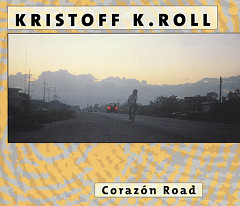
    Corazón Road is an audio travelogue. Carole Rieussec and Jean-Christophe Camps traveled to Central America in December 1990-January 1991. During their pilgrimage in Mexico, Belize, and Guatemala, they recorded street sounds, testimonies, and the daily life of the friends they made. Back in France they worked together to create this electroacoustic suite. Field recordings, treated sounds, speech and snippets of real instruments come together to evoke their trip more than actually narrate it. Corazón Road is a set of memories blurred by elapsed time and the discrepancies found between two subjectivities. This, Kristoff K.Roll’s first album, can be considered as a rehearsal for Le petit bruit à côté du cœur du monde, their next major project following a trip to Western Africa. But where Le petit bruit will be developed both on stage and in the studio, Corazón Road is a studio-only affair and thus feels more conventional in terms of technique and discourse. It remains a gripping, immersive tale. The three main suites (Aquí en Yucatán, Belize City, and Guatemala) are separated by short interludes that bring back the spoken theme established in the prologue Danse de Corazón Road. The cycle ends with the recapitulative Le Pacifique, in which timpani and cymbals evoke the turmoils of the sea. The album was first released in 1993 on SONARt and reissued in 1999 on empreintes DIGITALes.

    … a gripping, immersive tale.

    La pièce, J-Kristoff Camps, Xavier Charles, Kristoff K.Roll, Carole Rieussec in AllMusic

    “Review”, François Couture, AllMusic, February 23, 1999
    Tuesday, February 23, 1999 Press

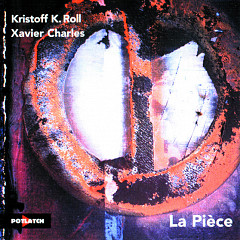
    In La Pièce (“The room”), Carole Rieussec and Jean-Christophe Camps (aka the electroacoustic duo Kristoff K.Roll) took a different direction. Leaving the studio behind, they devised an elaborate set-up allowing them to perform live what most tape music composers do in the studio. Equipped with a sound diffusion system, electronics and instruments they are able to perform music on sounding objects, transform sounds in real time, and play back pre-recorded material. Xavier Charles’ clarinet makes one with the set-up. As an improviser, his discourse fuels the K.Rolls, but he also has control over his sound by playing in a number of microphones, all with different diffusion settings and altered by different electronics. Thus we have in La Pièce Charles’ “true” playing (also miked), the alteration and spacialization of his music through the microphones, the possible alteration of his music by the K.Rolls, the K.Rolls’ prepared material and their live electronics. Sound cluttered? It is not, on the contrary. The music breathes, limited to delicate gestures. Charles’ was already far into the process of stripping down his playing. He focuses on multiphonics and drones, much like what he would do with John Butcher and Axel Dörner for The Contest of Pleasures. The sound poetry of the electroacousticians balances out the aridity of the clarinet to create something challenging but very much absorbing. The K.Rolls would develop something similar for Le petit bruit d’à-côté du cœur du monde with saxophonist Daunik Lazro.

    The music breathes, limited to delicate gestures.

    Alibi in Vital

    “Review”, MM, Vital, no. 163, February 22, 1999
    Monday, February 22, 1999 Press

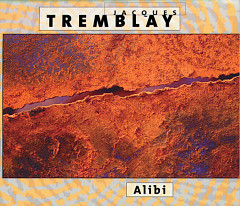
    The most recent catalogue issued by empreintes DIGITALes (yours for the asking, by the way) contains a quotation by one George Nicholson, “… we might say that certain sonic landscapes, thought, colours, certain states and manifestations of the soul would remain forever muted, if electroacoustics had not sprung forth from nowhere — unexpected and inevitable.” This is a sentiment I cannot help but agree with wholeheartedly. Over the past few weeks I’ve had the opportunity to listen to some of the newest music in this genre and have finally had the chance to listen to Alibi, which exemplifies the above quotation most admirably. Compared to most electroacoustic music I’ve heard, the compositions on this CD struck me as being quite sinister and it includes some of the strangest sounds I’ve encountered. Mr. Tremblay studied with all the right people and feels himself to be firmly rooted in the spirit of baroque, which he, together with write Alejo Carpentier, feels to be not so much a historic style, but rather a constant of the spirit. The first (and my favourite) track on Alibi is titled Hérésie ou les bas-reliefs du dogme and concerns itself with the manner in which the heart of man has become “a cave of bandits” shaped by the reigning collective moral ideal, and which ensures his survival amongst great infamies. It is filled with quotes which illustrate the crimes and cruelties committed by man in the name of God. So it is that we hear money-hungry cable preachers, forked tongued papal posturing, Saddam Hussein as a Madman Insane all of which demonstrate the “shift from idealism to materialism, from heart to reason”. Gregorian chants and Tibetan mantras similarly evolve from the pure to the impure as they slide down a slope from the path of fearlessness into the valley of the shadow of distortion.

    Demanding voices lunge out brandishing guilt — where there is no guilt, then guilt will be provided. The tweet and twitter of bat-like demons of the dark fly around in the threatening space, where disease and dis-ease are free to roam and prey on the weak and frail. Definitely not a piece to be listened to in the dark. The following track flows out of this with well-lubricated ease, and I suppose there is a link to be found. It’s called Oaristys and it’s theme is eroticism. Still, it remains quite a foreboding terrain and even the laughter included in it later on does little to alleviate the looming shapes at the edge. Great voice treatments! More darkness in L’Intrus au chapeau de spleen — the elusive unconscious which seeks entry through the crumbling fortress constructed around memory, sometimes persuasive as a gentle lover, sometimes as wild as a bull — “the keeper of our monsters…” Jeu d’ondes is the shortest composition on this CD and it is constructed from recordings of the different sounds found on a sailboat — rustling sail, creaking cables, clattering winches — combined with quotes from radio broadcasts. Of the four empreintes DIGITALes CDs I’ve written about in the last four editions of Vital, I found this the most confrontational, the hardest to assimilate and perhaps, in the end, the CD which contains the ‘deepest’ compositions.

    … includes some of the strangest sounds I’ve encountered.

    Francis Dhomont, Paul Dolden in Le Devoir

    “Densité et classicisme”, François Tousignant, Le Devoir, February 22, 1999
    Monday, February 22, 1999 Press

    Encore une fois vendredi soir, Rien à voir nous en a mis plein les oreilles. L’invité, Paul Dolden, a eu la chance de diffuser trois de ses «classiques», le genre de pièces iconoclastes qui ont fait sa réputation d’enfant terrible de l’électroacoustique. C’était un genre de rétrospective qui force quelques constats. L’extrait du cycle Veils détonne dans le reste de la production. Non pas qu’il s’agisse d’une mauvaise pièce, loin de là, mais parce que le vocabulaire n’y est pas encore abouti — le geste resté mal assuré —, mais parce qu’on y entend trop de gaucheries de réalisation technique. Des coupures trop sèches, des maladresses de montage des petits riens qui, en diffusion en salle, sont magnifiés par la loupe de l’acousmonium.

    Beyond the Walls of Jericho a été l’occasion de prendre véritablement conscience de l’originalité de Paul Dolden. Sans redondance académique, on suit bien le travail sur la transformation du son qui ouvre la porte à la composition puis on embarque dans le fabuleux programme de la pièce.

    Strate de son sur strate de son, l’espace sonore se remplit avec une telle densité qu’on en est vertigineusement étourdi. Le volume atteint des niveaux assez élevés, tant dans l’épaisseur des couches sonores qu’en termes de décibels sans qu’on soit agressé; on en redemande même, comme d’une sensation physique — caresse à la frontière indéfinissable et si intense entre la jouissance et la douleur — qui drogue.

    Ce qui est merveilleux chez Dolden réside dans le fait que, malgré la saturation acoustique, tout reste clair et perceptible, comme dans un grand tutti wagnérien bien dirigé. La gratuité de l’effet s’évacue alors d’elle-même pour ne laisser que l’expression de la sensation. Une belle réussite que va confirmer L’ivresse de la vitesse.

    Ici, Dolden ajoute le rythme, cet obsédant martèlement tiré du rock, pour aller plus loin dans l’exploration. Magicien hypnotique, il joue sur des attentes pour mieux détourner l’attention du concret au profit de l’idée. En sortant, on se dit qu’on a entendu là un créateur qui réussit le pari de visser sans appel son auditeur à son siège et lui faire parcourir un trajet aussi senti que vrai.

    Dhomont

    La soirée consacrée à Francis Dhomont, samedi, fut d’une autre nature. Si on peut reprocher à Dolden une diffusion un peu statique reposant toute sur le poids, celle de Dhomont est d’une lumineuse transparence; le mot perspective prend tout son sens.

    La musique de Dhomont joue sur les niveaux psychologiques de perception, l’encodage et le désencodage du «message». Sa sonorisation fait de même, ramenant à l’avant-plan tel objet égaré au lointain ou laissant glisser dans l’évanescence ce qui, à première vue était riche de sens, mais qui ne révèle que le trivial par lequel on entre dans une dimension autre. (Là-dessus la fascination du compositeur à utiliser le mot «chambre» dans ses titres est à la fois guide et symptôme).

    On peut regretter deux choses, la première, que le compositeur ait présenté des extraits, ce qui dilue le potentiel expressif des pièces ainsi sorties de leur contexte. La seconde, qu’il ait choisi de diffuser une pièce d’art radiophonique, Simulacres: un autoportrait, qui, si on entend bien qu’il a sa place à la radio, tombe royalement à plat en salle et ennuie sans espoir possible. Il le sentait bien, lui qui s’est presque excusé de l’allure pédagogique que son travail prenait en ce contexte. Cela a malencontreusement entaché toute la joie du concert.

    Ceci dit, Dhomont fait ravaler les propos que j’ai tenus précédemment. Oui la forme temporelle médiane peut apporter quelque chose de valable. Sa dernière œuvre, Cosa mentale [titre provisoire de Les moirures du temps], est une magistrale démonstration de maturité. Le cliché n’a pas de sens ici, l’aboutissement des idées, leur mise en forme, prouvent que Dhomont atteint à un classicisme serein où la poésie n’a plus peur de se faire abstraite. Le plaisir du compositeur devant les sons (donc les idées) qu’il manipule laisse entrevoir un bien bel horizon.

    Encore une fois vendredi soir, Rien à voir nous en a mis plein les oreilles.
  • 9
  • 10
  • 11
  • 12
  • 13
  • 14
  • 15
  • 16
  • 17