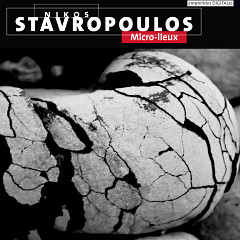
Nikos Stavropoulos is a Greek acousmatic music composer, formally educated in the UK and based in Leeds. His strong academic background links his work to the British school of Simon Emmerson and Denis Smalley but, despite his aesthetic being deeply rooted in that field, Nikos has a very personal perspective and carefully blends his Mediterranean heritage within his work, resulting in a complex structure of cultural references and mythical vestiges.
Micro-lieux is a collection of works composed between 2003 and 2017 and connected together by a very unique standpoint about the nature of granular sounds. In all his pure acousmatic pieces Stavropoulos includes organic elements and constant references to botany, seeds and vegetal corpuscles from which new life can stem and fractally evolve into the most complex and unexpected shapes. His gestures never feel as they were artificially sculpted by human hands, instead they happen gently as if they were the most natural consequence of the interactions occurring between organic agents. The composers behaviour in such setting is maieutic, fertilizing the soil and helping to extract and shape a formal sense from the rhizomatic structure of the natural chaos. Compositions such as Granatum, Ballistichory and Nyctinasty are the best examples of this particular attitude, in which the composer feels more like an Arcadian observer of utopic ecosystems and wanders, body and mind, in an introspective elegy, ready to be infused by the truth of a sonic revelation, an acoustic granular epiphany.
A totally different discourse is necessary for Granicus. Here the martial rhythmic patterns counterpointing the concrete sounds set us in a primitive tribal environment of Doric flavour, while the reference to the battle of the Granicus River — the first major victory of Alexander the Great against the Persian empire in 334 BC — together with the ponderous bass pedal entering about half way through piece, serve to establish an epic narrative that flows strongly throughout the piece.
Once again the electroacoustic consciousness blends with the Greek heritage of the composer: while the interaction between percussion phrasing and electronic sounds shares features with the live electronic performances of Gilles Gobeil, the choice of timbres and pace are reminiscent of percussion pieces by Iannis Xenakis, such as the second movement of Rebonds, Psappha and Peaux from Pleiades.
This is a strong first release for Nikos Stavropoulos, and a very good asset for Empreintes DIGITALes.