Alibi in Hollow Ear
The last two tracks are less conceptually scary, but just as edgy.

The last two tracks are less conceptually scary, but just as edgy.
Canadian composer
Less heart-wrenching subject matter is found in the composition
The electroacoustic work
The final track of this CD is entitled
The contrast is remarkable and the results utterly convincing
Next to the invention of music notation around 1100, the invention of sound-recording seems to me to be the most fundamental technological shift in the history of music. In many ways it has had an even more profound effect on music because it is an “open” technology, not based on a specific artistic content (Western music is so intimately bound to its notation that it is at times hard to distinguish between the two), but rather on the basic material of music – sound and silence. The elaboration of sound recording into multi-track studio technique by electric guitarist Les Paul in the late 1940’s, followed by recent developments in computer hard-disc recording, have created a new “virtual” instrument, capable of transforming any musical performance or sonic event into a sequence of sounds that is totally convincing as a musical gesture, yet bears only a tangential relationship to the original source. In short, silence has become a blank canvas on which to paint sounds, unfettered by the technical weakness (or brilliance) of musicians.
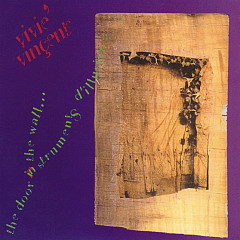
With the notable exception of electroacousticians, new music performers and composers have only slowly warmed to the enormous artistic potential of the recording studio – in contrast to the rock world, which would literally be unimaginable without t he multi-track studio. Harpsichordist vinçente, whose work is deeply indebted to
But I think the harpsichord’s peculiar historical and technical limitations are the strength of this record. The instrument is largely free of the tyranny of the mainstream repertoire that a pianist or a violinist have to contend with – no
The most obvious examples of this approach are the three pieces on the CD on which three separate pairs of stereo microphones are used to capture the sound of the instrument from three different acoustic perspectives, the focus then moved back and forth among them to emphasize the works’ structures and create timbral variation – a technique used by electric guitarists for decades, and one that brings new life to the harpsichord.
The most successful of these pieces is à perte d’espace by François Rose. The work uses highly effective 9th and 11th chord voicings and strong rhythmic gestures to create an almost jazzy sense of energy and forward momentum. The musical space alternates between distance and extreme close-up several times during the work, always in order to underline the inherent musical structure of the piece, never just to create gratuitous sonic effect. This type of imaginative composition, combined with vinçente’s spirited and creative performance, will win new listeners for the harpsichord.
Brian Cherney’s déploration sets up an intriguing compositiona l and recording process, evolving via rapid-fire cross-cuts (both in the writing and the recording) between dense, virtuosic clusters and atonal passages – played with much bravura by vinçente – and more tranquil, tonal music taken from a motet by Josquin des Près. vinçente’s use of a dynamic mix, with the acoustic space constantly evolving, rather then being fixed at a single, static point of view, is brilliantly suited to this work – it would be hard to achieve such a convincing performance in a live setting. Though the piece is overly long (once the process is set in motion, we know where it is going, and there are no surprises), it shows how vinçente’s concept of the studio can add another dimension to a composer’s work. And the final minute of the work is an inspired use of technology
Of somewhat less interest is Rodney Sharman’s five-minute miniature, kore. The work revolves around a series of pleasant harmonies and arpeggios, but seems to lack any fundamental direction, any musical argument. The subtle use of microphony helps create a sense of some movement in the performance, but cannot overcome the overall static nature of the composition.
With Simon Emmerson’s points of departure, we are shown another side of the harpsichord. The lack of acoustic volume and resonance of the instrument, as compared to the piano, has always been viewed as a weakness, but Emmerson takes a different perspective. By using live electronics to enhance and manipulate the harpsichord’s limited resonant capabilities, he creates a fascinating sense of dialogue between the acoustic sound and the electronic artefacts, which would be very difficult to handle in a work for piano and electronics. Delays, flangers, phasers, chorus, and reverb move in and out of the harpsichord sound as vinçente plays Emmerson’s essential linear musical argument at full tilt. This piece opens the door on a Pandor’s box of musical possibilities for harpsichord and live electronics and, given the success of this piece, I would love to hear more of this type of work from vinçente and her composer collaborators in the future.
The curious (to modern ears) timbre of the harpsichord at times makes me think of its roots in a distant European past, when the musical hegemony of Western classical music had not yet been canonized by royalties, publishers, academics, and record companies, and the sense of tone colour, attack, and tuning was more open and flexible – perhaps somewhat closer to the folk music that surrounded it. To my ears, the sound often evokes elements of African or Asian music. Muted notes, micro-intervals, and percussive effects make me think of the cora, the kalimba, the koto, or the pipa, in a way no other modern Western musical instrument could.
vinçente explores this part of the instrument’s nature with several fascinating works involving alternate tunings, either in quarter-tones or in the “agricola” tuning – a microtonal tuning, named for German musician Martin Agricola (1545) that uses a series of asymmetrical pitch adjustments (ranging from +20 cents to –17 cents), based around the note A (440). Bruce Mather’s saumur at times sounds more Byzantine than contemporary, with its highly seductive quarter-tone melismas and evocative use of microtonal harmony. The alternate tuning is used here as a fundamental part of the work’s architecture, not just as a colouristic effect, to create a work of striking beauty. John Beckwith’s on the other hand is somewhat more conventional. He uses the quarter-tones playfully at times, but never really gives himself over to the tuning, always placing the quarter-tones in reference to our modern intonation system. Calliope Tsoupaki’s piece, common passion, is performed in the agricola tuning. Though at times a bit over-long in its thematic elaborations, it is impressively performed by vinçente. Also, the piece emphasizes the subtlety of intonation the harpsichord can achieve and the expressive capabilities of the instrument.
The remaining works on these two CD’s fall more squarely into the modernist camp, while still exploring the instrument’s potential. Wendy Prezament’s 2 pieces for harpsichord and David Eagle’s toccare share a common concern for timbral variation, using the harpsichord’s multiple stops and muting possibilities to create kaleidoscopic textures, which brings forth dramatic performances from vinçente. The opening work on the CD, Barbara Pentland’s ostinato and dance, suffers from the composer’s somewhat academic approach to the instrument, leaving one wishing that she had really let loose and given the performer something to dance about
Pierre Schaeffer’s two-and-a-half-minute miniature, bilude (for harpsichord and tape), does give us something to dance about — specifically, the second Prelude from
The final seven minutes of the record are given over to a conceptual work entitled …the idea of silence…, the title clearly paying homage to
But my point is this
Das vorzügliche kanadische Elektroakustik-Label empreintes DIGITALes stellt in einer Serie neuere Komponisten vor, die in ausführlichen Beiheften ihrc Arbeit erläutem und deren Biographie/Werdegang ebenfalls mitgeliefert wird.
The pieces on this CD provide a powerful retrospective of
Another piece,
An earlier piece
The final piece on the CD,