electrocd

Blog

268 results
  • 20
  • 21
  • 22
  • 23
  • 24
  • 25
  • 26
  • 27
  • 28
  • A_dontigny, Coin Gutter, Diane Labrosse, Christof Migone, Martin Tétreault, No Type in Grooves

    “Mutek 2003 review”, Schepper, Grooves, no. 11, August 1, 2003
    Friday, August 1, 2003 Press

    As in previous years, the range of artists and genres represented at Mutek 2003 was considerable. With over 70 artists from around the world appearing, one had the opportunity to see ‘marquee’ acts like Pole, Coil, and Richie Hawtin, as well as uncompromising artists like Pita, Kevin Drumm, and T. Raumschmiere. Unlike past Muteks, DJ sets were almost entirely absent at this year’s festival (although, for the record, past DJ sets had often been used to bridge the gaps between non-DJ performances). And, in comparison to last year’s ambitious potpourri of concerts, panel discussions, films, and design displays, the 2003 incarnation limited itself to concerts and panel discussions, with seven of the latter. In short, this year felt like a satisfying consolidation of past festivals’ strengths instead of grandiose risk-taking.

    There were label showcases by Mego, No Type, and Minus/Plus 8, and sets of dubby microhouse from EGG (Julien Roy and Guillaume Coutu-Dumont), smooth minimal techhouse from Robin Judge and Jeff Milligan (aka Algorithm and Revolver label head), hard-hitting minimal techno by Ototo (Dimitri and Filip), Jeremy Caulfield, and Matthew Dear (aka False), the latter’s music evoking classic Chain Reaction stylings in its treble and bass detailing. Drone and ambient musics were presented, the most notable instance being the appearance by Thomas Köner and Asmus Tietchens (performing as Kontakt Der Jünglinge) who sculpted a slowly unfurling glacial soundscape. Other artists in this genre included Gary Joynes (aka Clinker), who built a singular drone-like piece of slowly metamorphosing waves, and [sic] (Jen Morris), who created ghostly dronescapes against a diptych backdrop of enigmatic photographs. Electroacoustic sets were offered by the nuanced Coin Gutter (Graeme Scott and Michael Hendrix) and sampling artist Diane Labrosse and Aimé Dontigny, whose collaboration resulted in a tactile, improvisatory dialogue. Set Fire to Flames’ member Christof Migone generated a 45-minute stream of body-generated scraping and whirring sounds accompanied by a video triptych that showed a gaping mouth at left, what appeared in the middle to be a tomato encased within a block of ice lodged within a salivating mouth, and, at right, the nighttime silhouette of a cityscape and bridge. There were infectious jazz-inflected funkhouse from Cobblestone Jazz and celebratory Latin techhouse by Mambotur. Chicago-based Telefon Tel Aviv (Joshua Eustis and Charles Cooper) presented a heavy microdub funk of chiming synths and massive bass drum and snare patterns. But, overall, the most memorable performances were turned in by veterans like Pole, Coil, Richie Hawtin, Monolake, and Señor Coconut.

    In a Saturday afternoon performance that paid tribute to turntable pioneer Raymond Gervais, four turntable titans — Philip Jeck, Marina Rosenfeld, Martin Tétreault, and Martin Ng — provided an hypnotic set that included extended group collaboration as well as individual spotlights. Ostensibly, the proceedings were directed by Tétreault but his was certainly a benign dictatorship; if anything, the pieces often evolved with the others responding to Jeck’s looping grounds. They began by constructing a beautifully measured collage of scraping and scratching sounds amidst ghostly strains of melody. Immediately following this auspicious beginning, they created an equally effective second piece of whistling tones and bell-like percussion effects. While the concert predominantly featured the four playing together, there were brief duos, trios, and solos. Naturally, as is to be expected in an improvisatory setting, some tentative moments emerged when it seemed as if each of the four was waiting for someone to take the lead, but these registered as not unwelcome moments of brief stillness. Each took solo turns: Jeck, using two turntables, one for 12 inch lps and the other for 45s, drowned the sitar from Stoked in showers of surface noise; Rosenfeld’s solo offered a turntable adagio of sorts filled with treble glissandoes, looped crackling patterns, and phantom melodies; Tétreault’s initial musical quotation was gradually buried under huge slabs of static and hiss, his turn ending with furious scratching and a physical attack on his lps; finally, Ng’s solo impressed less as an exercise in musicality and more as one of physical athleticism. To close, the four collaborated upon a carefully sculpted elegiac piece. In sum, this session was engrossing and nuanced—a demonstration of sensitive listening and collaboration by its participants.

    Electroacoustic sets were offered by the nuanced Coin Gutter and sampling artist Diane Labrosse and Aimé Dontigny, whose collaboration resulted in a tactile, improvisatory dialogue.

    Jalons in Testcard

    “Kritik”, MB, Testcard, no. 13, August 1, 2003
    Friday, August 1, 2003 Press

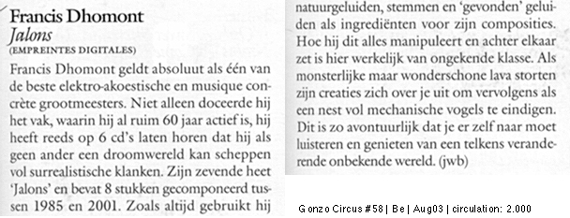
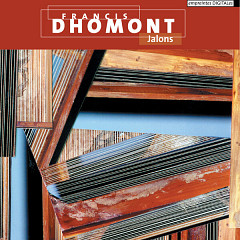
    Die acht zwischen 1985 und 2001 entstandenen Stücke geben einen breit gefächerten Überblick über das musikalische Spektrum von Dhomont, Ehrenmitglied der Canadian Electroacoustic Community, der sich schon in den späten vierziger Jahren Seite an Seite mit Komponisten wie Pierre Schaeffer der Erforschung dessen widmete, was kurz darauf »musique concrète« genannt werden sollte. Die hier versammelten Stücke sind sowohl von der Länge wie auch dem Ausgangsmaterial höchst verschieden. Sie reichen von vergleichsweise determinierter Filmmusik bis zu eindringlichen, politisch motivierten Nummern (Lettre de Sarajevo), mal bildete eine Gitarrenarbeit die Ausgangsbasis zur elektronischen Komposition (En cuerdas), mal dienen die Stücke einer stimmungshaften, fast postimpressionistischen Erinnerungsarbeit, die versucht, eine ganz bestimmte Atmosphäre – in diesem Fall ein Abend in der Provvence (Vol d’Arondes) – akustisch umzusetzen und dabei deren Flüchtigkeit festzuhalten. Die kontrastreichen, sehr dynamischen Arbeiten enthalten neben der facettenreich eingesetzten Elektronik sehr viele perkussive Sounds, selten jedoch genau identifizierbares Material wie Verkehrsgeräusche und Fußstapfen. Dhomonts Klangsprache bleibt meist abstrakt, dabei immer spielerisch, voller Lust an jeglicher Art von Geräusch und also an keiner Stelle karg.

    L’adieu au s.o.s. in EtherREAL

    “Critique”, Fabrice Allard, EtherREAL, July 30, 2003
    Wednesday, July 30, 2003 Press

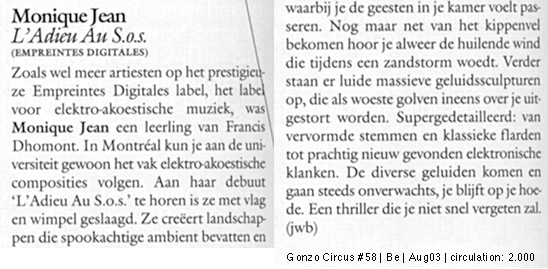
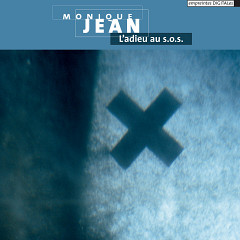
    Monique Jean est une compositrice canadienne sortie de l’université de Montréal où elle a étudié la composition électroacoustique. Mis à part sa production discographique, elle travaille également pour la danse, des installations ou encore des vidéos. Cet album est un ensemble de pièces composées entre 1997 et 2001 dont le temps est omniprésent. Destruction de notre environnement, transformation des mentalités et donc de la nature humaine, immobilité, sont quelques uns des éléments que Monique Jean tente de saisir dans sa musique afin d’en garder une trace et que le temps n’emporte pas tout vers le passé.

    Le premier titre est assez saisissant et présente de façon un peu brutale l’univers de la compositrice. Régulièrement assemblée par des souffles, des cris, des longs glissandos de cordes stridentes, de ronronnement métallique, la musique de Monique Jean est à la fois sombre et éclatante. Ainsi 13’13 pour voix défigurées met en scène des bribes de dialogues brouillés, comme s’il étaient captés par une radio de mauvaise qualité. Bruits de machine, de foule, crissement des roues du métro, circulation (exode?) sont habilement mis en scène avec quelques éléments instrumentaux.

    Sur Danse de l’enfant esseulée elle se consacre à l’arrêt de temps. On commence par un tintement répétitif, comme si l’on bouclait indéfiniment sur une courte période de temps, puis de longs et inquiétants ronronnement métalliques nous glissent vers une ambiance plus calme. L’auditeur se retrouve alors comme en suspension dans un univers paradisiaque avant de revenir vers les sombres ronronnements, cordes stridentes et cris de loups.

    Figures du temps est un triptyque contemporain qui nous donne l’impression que l’apocalypse est proche. Des souffles tournoient de plus en plus rapidement tels les pales d’un hélicoptère dans un rugissement infernal, des bruits divers évoquent des explosions, des extraits de journaux télévisés parlent d’attentats, de massacres et les mélodies se font rares. Entre ces bruitages concrets, ce sont des sonorités électroniques qui contribuent à créer une musique riche, enivrante, ou les passages plus calmes sont les bienvenus.

    Pour finir, low Memory #2 tient son originalité dans la présence d’instruments acoustiques (flûte, piccolo) dont le jeu provoque des notes hésitantes et des souffles qui se marient parfaitement aux sonorités électroacoustiques. On sent alors une présence, de la vie au sein d’un univers hostile.

    Cette hostilité est peut être à l’origine de l’écoute difficile de ce disque. Magnifique pour commencer malgré quelques voix déclamées de façon un peu théâtrale, sur la longueur ce disque risque d’être une véritable source de stress.

    … une musique riche, enivrante…
  • 20
  • 21
  • 22
  • 23
  • 24
  • 25
  • 26
  • 27
  • 28