electrocd

Blog

52 results
  • 1
  • 2
  • 3
  • 4
  • 5
  • 6
  • 7
  • 8
  • 9
  • In Transmediale, Chronopée (2), Waste of Songs in Vital

    “Review”, Frans de Waard, Vital, no. 553, November 21, 2006
    Tuesday, November 21, 2006 Press

    A collaboration of many kinds, this one. Dirk Dresselhaus is at the core. The man from Schneider TM, as well as band member of Locust Fudge, Pancake and Dr Drek has played with Hildur Gudnadottir before, on the CD Good Sound under the banner Mr. Schmuck’s Farm (on the same label as this new one) and also with Ilpo Väisänen is active as Angel. Väisänen is most known for his involvement with Pan Sonic, but also played with Bruce Gilbert, Alan Vega and a forthcoming release with The Hafler Trio. Back when reviewing Mr. Schmuck’s Farm I had no idea who she was, but she is part of Kitchen Motors collective in Iceland, as well as playing the cello with many people on Iceland. In April 2005 the three played together at the Transmediale festival for more than an hour, and the result is now available on CD. This release continues the style set out by Mr. Schmuck’s Farm rather than the music of Angel. One long piece of drone music. The basic rule, so it seems, is that they agreed to start out in a rather soft manner and then make a sweep into noise land and land safely in more quieter realms. The noise part really cracks out here. I believe that the two men pick up the signals produced by Gudnadottir and process these through their own blend of electronics, by which we don’t understand laptops, but all sorts of black boxes with knobs. This has only vaguely something to do with drone music, but it is made on entirely different level than the usual drone suspects of Vital Weekly. Powerful music, as opposed to music that is supposed to lull you to sleep. It’s great to see at least something moving away from the usual path.

    Joe Colley is also someone who shouldn’t need much introduction. Years ago he was active under the name Crawl Unit, but who remembers that? It’s been Joe Colley for some time now and as such he is quite active as a recording artists (solo, but also in collaboration with say people like Francisco López and Jason Lescalleet), performing around the world, and putting up sound installations. His work got recognition at Ars Electronica and Transmediale (but I wonder who would care about that really?). Colley is a man who loves the sound of decay. Things that are on the fringe of being broken beyond repair find a good place in his hands. The last breath of something electrical is in good hands with him. All to easily you could think that Colley deals with ‘just’ noise. Not so at all. He is also a man who loves drones — how he conceives them is not really of great importance, certainly not through a laptop, but he has them. These two ends, the drones and the noise, may seem opposite s but be assured they are in very capable hands. The opening piece Bruise Voltage And Field Error is a loud beast of a broken contact microphone choir and cable hum. The Last Audience closes the CD with a heavy drone piece that could almost be derived from feedback, but it stays away from the real noise bursts. In between the journey went through various stages, various moods (not all that negative, which seems to hover around his work) and various forms. Joe Colley’s music is an unique blend of highly intelligent noise, blending the harsh end with the more soft side, but always remains listenable. From his solo work this is perhaps the best so far.

    The final new release on Oral is by someone of whom I never heard, Mylena Bergeron, and still don’t know anything, other than her working methods. She collects raw, concrete sounds which she then dully processes. In this process she wants to preserve the essence of the sound, which is done in the third phase, harmonization, through methods of editing. She calls her compositions “evocative and narrative sound landscapes”. Many of the pieces here (twelve in total) seem to be made with the sampler. She loops small particles and creates per piece indeed a sort of landscape, or rather a picture of landscape. The original sources are not always to be recognized, even when we hear voices, the supermarket, muzak and such like, but they are embedded in the overall processed sound. It took some time for me to get into this, as at first it all sounded a bit too simple, too easy, but as the CD progressed I got the drift of it, and thought it was quite nice, but perhaps a bit long. Sometimes Bergeron seems to be taking a little too much time to tell her story without knowing where to end it. A bit more concise and perhaps with a couple of pieces skipped, this would have been an absolute gorgeous CD, now it’s just pretty much alright.

    Alter ego in Vital

    “Review”, Frans de Waard, Vital, no. 552, November 14, 2006
    Tuesday, November 14, 2006 Press

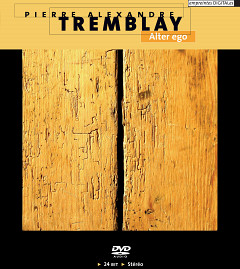
    […] this DVD has no images or film. The sole reason for putting it on a DVD is to make sure it can have 24-bit versions, instead of the regular 16-bit found on a regular CD. Tremblay is a Canadian composer who moved to Britain, where he is a composer at the University of Huddersfield. He is also a member of [iks], a contemporary jazz ensemble, which he formed in 1996. On this DVD there are five pieces, the oldest from 1997 and the most recent from 2004. He certainly has a diverse style: in Binary (Virtual Rapper Remix) he adds the processed of a rapper to a crazy blend of chopped up rhythms. That might be something new for the lovers of empreintes DIGITALes! In his other pieces he offers more ‘regular’ music that we find usually on the releases of this label. Acousmatic music of processed sounds all sort, and normally I do not find this always to be highly interesting, because it’s all rather academic in approach and it moves very much along strict patterns, but Tremblay seems to be adding something of his own, a bit more humor (as in the aforementioned ‘Binary’), but also in his other pieces. It’s hard to define what that is, exactly, but I very much enjoyed this release, as it all sounded quite fresh in an otherwise rigid world of its own.

    … I very much enjoyed this release, as it all sounded quite fresh in an otherwise rigid world of its own.

    Francis Dhomont, … et autres utopies, Francis Dhomont in La Scena Musicale

    “L’événement Dhomont”, Réjean Beaucage, La Scena Musicale, no. 12:3, November 1, 2006
    Wednesday, November 1, 2006 Press

    On n’a pas tous les jours 80 ans, aussi l’anniversaire d’un grand créateur comme Francis Dhomont ne passe-t-il pas inaperçu. Coup d’œil sur les productions qui le soulignent.

    Computer Music Journal (30:3). La revue américaine publiée par MIT Press consacre sa page couverture au compositeur. Rosemary Mountain, qui enseigne l’électroacoustique à l’Université Concordia, y publie sous le titre «From Wire to Computer: Francis Dhomont at 80» un excellent entretien avec le compositeur.

    Circuit, musiques contemporaines (16:3). Le plus récent numéro de la revue publiée par Les Presses de l’Université de Montréal présente un échange épistolaire entre le compositeur Maxime McKinley et Francis Dhomont sur l’évolution et le devenir de la musique acousmatique. Dans le même numéro, un portrait de la société de concerts Réseaux, présenté par Réjean Beaucage.

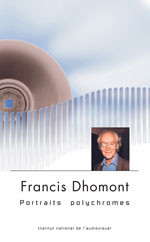
    Portraits polychromes no 10: Francis Dhomont. La série publiée par l’Institut national de l’audiovisuel consacre le 10e de ses Portraits polychromes à Francis Dhomont. Entretien détaillé avec Évelyne Gayou, analyses de François Bayle, Jean-Christophe Thomas, Stéphane Roy, Andrew Lewis, Anna Rubin et Katharine Norman, catalogue [d’œuvres] commenté par Annette Vande Gorne, discographie, souvenirs du compositeur et photos. La totale.

    Francis Dhomont: … et autres utopies (Empreintes DIGITALes, IMED 0682). Le plus récent disque de l’étiquette montréalaise consacré à Francis Dhomont présente cinq œuvres: Here and There (2003), Je te salue, vieil océan! (1998, 2000-04), Voyage-miroir (2004), Corps et âme (2001-02) et Chroniques de la lumière (1989, 2005). Le compositeur y démontre, une nouvelle fois, son étonnante maîtrise du genre.

    Le compositeur y démontre, une nouvelle fois, son étonnante maîtrise du genre.

    Francis Dhomont in La Scena Musicale

    “Hats Off to Francis Dhomont”, Réjean Beaucage, La Scena Musicale, no. 12:3, November 1, 2006
    Wednesday, November 1, 2006 Press

    Composer Francis Dhomont, who is about to turn 80, has always been closely identified with acousmatic music. In the realm of electroacoustics, acousmatic music, which “is shot and developed in studio, heard in a projection room, like cinema” (François Bayle) is probably the most direct descendant of concrete music, unveiled by Pierre Schaeffer in 1948.

    At age 22, in 1948, Francis Dhomont discovered, in parallel with Schaeffer, the surprising virtues of a new medium: recording (on magnetic tape, in his case.) Born in Paris, Dhomont studied under Charles Koechlin (1867-1950, a defender of contemporary music and a stereoscopic photography pioneer) and Nadia Boulanger (1887-1979, one of the most influential teachers of the 20th century), and between 1944 and 1952, he composed pieces for piano, organ, violin, voice, and even a symphonic movement (Dimanche, 1945). However in the 60s, his focus turned entirely to electroacoustic composition. Throughout his career, which continues actively to this day, he has been a passionate defender of electroacoustics against those who, like Pierre Boulez, label it as “do-it-yourselfery”; he has been one of the leaders of the genre through his teachings, particularly at the Université de Montréal, where he mentored numerous composers; he also added to electroacoustics several of its most important works, the majority of which are available under the record label Empreintes DIGITALes.

    By the end of the 70s, Francis Dhomont had moved to Québec, “Two things attracted me to Québec: first of all, a young woman invited me to visit, and it was so pleasant! Furthermore, I was very nicely greeted, namely by the Université de Montréal, who offered me their studio, where I was able to write Sous le regard d’un soleil noir, which has been an important work for me. I was able to feel true warmth in those encounters, and the dean of the Faculty invited me to stay as a resident. I felt great there, and I stayed! There were people in Montréal who were already seriously interested in electroacoustics (I am thinking of Marcelle Deschênes, Yves Daoust, Philippe Ménard, et al.) but I am probably the one who introduced Quebec to the concept of acousmatic music.”

    Chroniques de la lumière (in 1989, on the album Halogènes, under the UMMUS label) was Francis Dhomont’s first work published here on CD, and in 1990 he was included in the 37th volume of the Anthology of Canadian Music published by the Société Radio-Canada.The volume was dedicated to electroacoustic music, and the retained piece was Thème de la fuite, 1984-87. The only thing missing was his own recording with a local label. In 1990, the record label Empreintes DIGITALes was founded in Montréal and has since become one of the best sources for electroacoustics. Its founder Jean-François Denis joined composers Gilles Gobeil and Robert Normandeau the following year to found the concert society Réseaux des arts médiatiques. The ensuing launch of the double-disc Mouvances~Métaphores, was dedicated to Francis Dhomont on his 65th birthday. “It was a wonderful surprise. I had been invited to presentmy music as part of a concert, but I had no idea that the concert was a celebration… for my birthday! And it was also the first concert of Réseaux, so now, our birthdays coincide!” The concert by Francis Dhomont on November 2, 2006, as part of the event Akousma (3), presented by Réseaux, commemorates the 15th birthday of the organization as well as the 80th birthday of the composer!

    By 1997, the concert series Rien à voir, organized by Réseaux, was a success, attracting a rather young public that was discovering the wonders of acousmatic concerts (set in the dark, with an orchestra of about twenty speakers controlled by the composer.) When the series ended in 2004, after its 15th edition, some observers linked its ending with a certain fading of the acousmatic formula, if not of the entire electroacoustic genre. “I am not convinced at all that it is a music of the past,” Dhomont retorts. “I think that, on the contrary, it is still a music of the future. Of course, it is music of research, and, being quite complex, is not destined for entertainment. In that sense, it will never be a success with the general public and I don’t mind that. I know that it bothers some people, some composers who would like their music to be played in front of massive audiences, but I think that these are illusions. Research requires a certain amount of sacrifice, namely that of popular notoriety.”

    Considering that Pierre Schaeffer’s first experimentations with concrete music took place only in 1948, acousmatic music is still quite young and evolving. As it is precisely a research genre, it would be wrong to restrain it to a fixed form.

    In that same line of thought, during the concert series Akousma (3), Elio Martusciello and Ludger Brümmer will present videomusic, Christian Calon will play excerpts from a piece conceived for the stage and the Quasar saxophone quartet will play mixed music (for instruments with electronic modifications or for instruments and tape.) Has Francis Dhomont remained a fierce protector of music in the dark? “Ah! You know, they hadn’t specified to me that there would be videomusic, but I could bring some, because my wife (Inés Wickmann) and I have done some together. Inés is a sculptor and video artist. She has worked with some music of mine, which I have adapted. I am not opposed to video; and the actual working process is so similar.” During a visit to Francis Dhomont in 2001, while discussing the concert he gave at the 10th edition of Rien à voir, he had showed me a few magnetic tapes he was using in his works. I thought I had found the secret to the “Dhomont difference,” as the sounds used by many other composers tended to be very similar, since everyone was using the same sound treatment programs. “No, I don’t use the tapes anymore… It is impossible now… I can’t find anyone who will fix the equipment. I work with computers, like everyone else. Of course, the problem is the same as with tapes. It is important to try not to exploit only the functions that had been intended by the designer. The true solution is to strive to be original! This can be achieved, for example, by using different processors simultaneously, which reduces the risk of sounding like everyone else. The fact remains that there is a style for the «era», but there was also a style in the 18th century.”

    On November 2, 2006, Francis Dhomont will present the North-American premiere of Premières traces du Choucas, a joint commission of Réseaux and Musiques & Recherches (Belgium). It is a preliminary work, part of a current project on Franz Kafka’s universe. Since our last conversation, a videomusic piece called Moirures by Francis Dhomont and Inés Wickmann has been added to the composer’s November 2 program, and it will also be a North-American premiere. [English translation: Luba Marc]
  • 1
  • 2
  • 3
  • 4
  • 5
  • 6
  • 7
  • 8
  • 9