Darren Copeland (1968) is a Canadian composer and sound designer who’s been active in the arts since 1985. The story behind his current status is a bit peculiar. He discovered — by chance — analog synthesizers in the 1980s. He wasn’t interested in their musical implications, but went on to study analog synthesizing of sound and early digital samplers. This obviously awoke an interest in music, though, because in 1989 Copeland moved to Vancouver where he studied electroacoustic composition at Simon Fraser University until 1995.
Through his studies with Barry Truax he became acquainted with the World Soundscape Project, leading him into a predominantly soundscape oriented realm of composition.
In the mid-90s he ventured into various other electroacoustic sub-disciplines, working with theater, radio documentaries, radio drama as well as text-sound compositions.
In 1996-1997 Copeland went into post-graduate studies at the University of Birmingham in England. He is now the Artistic Director of New Adventures in Sound Art, in Toronto, Canada. Of late he has returned once again to purely abstract electroacoustics.
Track 1. They’re Trying to Save Themselves (2002) [3:53]
The subject of this piece is a disputed one; the attacks on World Trade Center in New York. I usually feel a little taken aback at artistic efforts in this direction, concerning contemporary traumas with so strong political, social and other various overtones. Darren Copeland is Canadian, and I suppose it is even harder for a US composer to get into this. I know, though, that John Adams has done this successfully, without hurting anybody or putting himself in harm’s way, with his On the Transmigration of Souls, but then again, Adams has secured a position as an artist who is allowed — in the public and the political eye, as well as from the viewpoint of the cultural establishment in America — to do this, by virtue of his earlier large-scale works like Nixon in China and The Death of Klinghoffer. He kind of brings the public with him, in an unprecedented way. Bruce Springsteen also wrote songs on the subject, on his album The Rising: Empty Sky / You’re Missing / My City of Ruins. It’s a delicate feat that not just anyone should try.
It must be very hard to try something in this area in the USA, since that country is — with a sweeping but, I believe fair, generalization — so completely lost in hypocrisy and double standards, with a total lack of self-knowledge, and pulled only deeper and deeper into destruction by one leader more foolish than the other. The whole world laughs at the USA, but is also afraid of the erratic giant. It’s a bad situation today, with such a dangerous and mentally unstable nation amassing so much power.
It’s clear that one shouldn’t go into this kind of compositional/artistic effort without caution. I composed a text-sound/electroacoustic piece of about 20 minutes on the tragic sinking of the passenger ship Estonia, which went down with more than 800 people in the Baltic Sea in 1994, and people still have a hard time listening to some of the more naturalistic passages in the work. I had been able to record the distress calls and the radio communication between the sinking ship and other ships in the night, and I used these in the piece. I also did a work of similar length about the assassination of Swedish Prime Minister Olof Palme. In fact, I collected three text-sound works on a CD and called it Swedish Traumas.
It was easier for Gavin Bryars when he composed The Sinking of the Titanic!
Ok, that was a long detour. Let’s head on back into Darren Copeland’s opening piece on the CD: They’re Trying to Save Themselves. This is not a major work; I mean, it’s a short piece, barely 4 minutes. It’s a CNN piece; the first CNN piece I can recall reviewing! Seriously, the source sounds are taken from an eyewitness account aired on CNN immediately after the attack. Copeland explains that the spoken words “undergo a number of textural metamorphoses” that evoke the likeness of low-flying aircraft, panicky voices and so forth.
Some parts of this work works, so to say… others don’t. The eerie, rumbling, soaring density brings on that ominous, imminent feeling, and the vocals that are arranged in a rattling kind of way, also work fine — but some very mechanical, very short repetitions don’t work. Copeland should have taken those out, because they destroy what might have been a very somber comment on the situation. Composers seldom fall into that repeat trap these days. It was more common way back when audio software on computers were more novel and you found you could loop sequences for ever, if you wished. Repetitions without any change in any direction just make you irritated. It’s dead meat. However, the final half minute of the piece pretty much makes up for the mistakes earlier on, when the woman is allowed to speak in whole sentences — and I remember that woman on CNN that day too; I also watched her right then. Just to make it clear: I don’t have anything against repetitions in music. I love much of the minimal music from earlier on, and I’m a sound poetry connoisseur — but along with the repetitions there must be a gradual transformation, change, which, after a while, has lead somewhere else. The work needs an overhaul in this respect, and then it will be a quite impressive electroacoustic and text-sound miniature!
Track 2. Streams of Whispers (2002) [12:41]
This is from a sound installation in Toronto. Copeland’s concept was a “place of migration or transition”, and “a current of water through which particles of sound flow”.
The motion is mighty from the onset, in the shape of hardwood spheres, small as peas, soaring forth in a veil of smoke or mist. Whispers tumble in slow-motion inside the general velocity of sound, just on the verge of whisperiness, on the verge of identifiability, but never quite breaking the surface of it. This is the magic of it, this uncertainty of origin, which nonetheless tunes your ears whisperwise!
The shreds of possible whispers soar and turn and tumble on the backdrop of soft, mumbling drone properties, which at times come across like the sound from a distant turbo-prop airplane, seeping down through a crack in the heavens, or through the heavy brick walls of immured rooms of your past. Certain golden insignias propel your associations further into the sub-conscious, down long-forgotten hallways of your mind.
Eerie calls of the wild rise like campfires in the soundscape, deep down the misty valleys of amnesia, stirring memories that rest under the moss of not-here-not-now since centuries.
Gradually, Copeland builds percussive elements from nicely cut slices of whispers, which turn up sharp and piercing, ordered in caustic beads of illwill audio. The drones dissipate, leaving these percussive elements dancing in thin air like moths under a street lamp, before soaring through the sonic imagery of short-wave static and shrieking bucks of the wild through frosty nights under the stars.
Streams of Whispers is a delicate and very beautiful electroacoustic work; a tantalizing spectra of the mind of techno man in the midst of the mystery of nature — a dreamscape journey through involuntary rooms of existence, opening one after the other. “My God, it’s full of stars!”
Track 3. The Wrong Mistakes (2003) [4:34]
Darren Copeland has made use of his mistakes en route here. Instead of deleting or conforming the obvious out-of-place incidents of a work in progress, he decided to work with these anomalies and let them steer the composition.
True, it’s less coherent than usual, but that doesn’t make it less interesting; quite to the contrary. Copeland has — in spite of his warnings — smoothed the edges of all these mistakes, so he’s not going to blow your speakers or freak your mind too much. There is a seamless quality in all this wild man stuff!
In some ways, this is spaced out music, i.e. a modern variant of 1960s’space movie soundtracks. I can almost envision those creepy-crawlies on distant worlds and huge, towering humanoids coming at you like staggering chimneys over the wastelands.
It’s good music! Maybe more people should make more mistakes!
Track 4. On Schedule (2003) [12:22]
I have to quote Copeland on this bit, because what he says fascinates me: “On Schedule is part of a series of compositions called Pieces from Letters for one or two people using computers. In On Schedule the 26 letters of the [English!] alphabet and the number 1 key trigger 27 sound events derived from the harmonic and spectral content of the 27 scheduled train stations from London Waterloo in the United Kingdom to Moskva Byelorusski in Russia.” “A single train recording taken from the World Soundscape Project Collection […] at Simon Fraser University in Burnaby, Canada, was used throughout the piece.”
The sound arrives and passes, jingly, wheezing and mighty; mighty with the power of heavy engines — serious sonorities of the passages of passengers and goods, from one point to another.
The familiar sounds of railway transportation are wrung out of their context and molded in the hands of the composer, pried out of their ordinariness into a realm of listening attention — and even though you recognize their origin, you have the chance to observe and get to know them on another level. Copeland takes some aspects of railway as such and spreads them out across a wider area of perception, bringing hidden properties of these heavyweight sonorities to the surface, and he delivers them packaged in beauty; a beauty he has conjured up out of the passage of trains. Nice!
Track 5. Early Signals (2001) [4:27]
This is a work in celebration of the radio pioneers Marconi and Eckersly, made up of all kinds of aspects of early radio, such as “static, Morse code, pops and squiggles” and the sounds of the great waves of the Atlantic Ocean, which Marconi spanned in his 1901 radio transmission. These characteristic and nowadays even romantic-sounding excerpts are heard in their original shape as well as electronically dressed-up.
After a wheezing, whooshing surge of static, the distant — in time, in the room — voice of legendary Marconi comes on, in this magic act of communication over large distances that would change the world entirely, and which has now, a hundred years later, lead to the unifying intelligence of the Internet network, which has kicked humanity into a quantum leap of evolution, bringing — at least in theory — all knowledge together in a layer of instant communication, making the concept of distance obsolete.
In my mind, three events, three occurrences, have sent humanity into quality quantum leaps that have forever transformed the race:
- The utilization of fire
The art of book printing - The Internet
Marconi’s radio transmission invention was a necessary step leading up to the present, unbelievable state of affairs, in which MIND has become a unifying concept of all glowing brains around the globe. This is in line, also, with the concept GAIA, which represents the Earth as one living entity.
The world seemed so large, so vast — so lonely — at the breaking of Marconi’s invention, and for a while even lonelier when you could hear voices in fragile, fading and emerging calls from across the Atlantic.
Darren Copeland’s Early Signals manages to illustrate all these feelings pretty well. Sometimes a mix of sounds like the one Copeland brings, may come out as a disparate mess of incoherence, but Copeland manages to render all these sounds relevance and significance and a sense of heavy inertia: a motion on ahead, and not least; a magic symbolism that opens up spacious halls of archetypical imagery inside the listener’s fantasy — that man to man, face to face feeling, which so clearly shows that we are what we are only in relation to each other.
Track 6. On a Strange Road (2003) [10:55]
This has to do with traveling, in various ways — traveling on roads.
The idea of roads and moving along them might allow for quite concrete material, but Copeland approaches the motion across asphalt in a soaring dream-state. The abrupt sound at the beginning could be though of as a thunderclap — or a car door banged shut! From that point, a slow drizzle can be sensed, and a gray, distant mist-drone of sorts, which slowly grows in on you, like a gradually tightening ambience, the way moving objects at HIGH speeds are supposed to appear shorter and tighter from the vantage point of a viewer by the imaginary roadside, according to Einstein and his successors. The appearance of this misty drone suggests acceleration — which, to retort to Einstein again, cannot be separated from gravity, i.e., the perception and effect of acceleration is exactly the same as the works of gravity.
Dark episodes of friction fly by like giant, irregular slabs of rock, adding to the feeling of directional motion — but the sound of a calm drizzle confuses perception… or is this a section of your private world (the drizzle calmness) soaring away through time and space (the frictional sounds of darkness and the misty drone)?
On the outside of the musical motion, elastic sonorities lump together. I hear drawn-out church bells twang by like wobbling lumps of jelly. More clearly identifiable families of audio are inserted, like the wet sounds of oncoming traffic on a rainy road at night, the headlights almost blinding you — and I think of the only time in life when I had to own a car, when I lived in Dallas, Texas in 1978-79, and drove to my job as a state-employed inspector at Beto’s and Garcia’s asphalt plant (Zachry’s) towards Grand Prairie 30 kilometers from my home at 6415 Melody Lane, in our Chevrolet Bel Air –72, listening to Al Stewart’s Time Passages on KLIF!
However, Darren Copeland — as the fine artist he is — jerks and pries these familiar sounds slightly out of place, having them slowly edge over into a parallel dimension; that of the shaman travelogue, in which all familiarities take on a transparent veil of charged significance, making sure that each and every grain of time-space-mind existence is fully equipped with meaning down to the last Planck-length superstring!
“Something is going to happen, something wonderful”
Yes, the ultimate sense of traveling at high speed must be that sequence in 2001: A Space Odyssey, which, though shot in the 1960s, still today has the same magic effect on me! Parts of Darren Copeland’s On a Strange Road, conjures up those sensations. Masterly! I hear an alien space-time choir in the sonic distance.
In a while, Copeland has affixed the high pitch drone sonorities of the space-time choir onto the –273,15° Centigrade / –459,67° Fahrenheit (0° Kelvin) keyboard of a starry organ of the intergalactic void, singing to us out of the core significance of ourselves…
It is rare to hear such suggestive and dream-thundering electroacoustics these days. Right off I can only think of one other fresh CD that got close to this: Victoria Jordanova’s and Pamela Z’s rendition of John Cage’s Postcard from Heaven on new label ArpaViva (ArpaViva CD 001).
On a Strange Road is a masterwork, and perhaps the highlight of this collection of Copeland pieces. It constitutes spiritual traveling down Thunder Road; a relaxed soaring through violent wilderness: a Bardo journey in full Enlightenment!
Track 7. Faith-Annihia (1991) [8:55]
The content here is jagged, blistering, scarring — and also distant, soothing… until it gets very silent, perhaps sparsely sprayed with a few rustlings of dry leaves or the almost imperceptible movements of insects through the underbrush…
Mostly, though, Faith-Annihia is iron-bar and steel industry hell; a maze of hard-earned and staggering sonic residue from a material world that is hard and cold and capitalistic: a world turning its back on democracy and human rights and bodily/spiritual health. It’s a tough view on the race for production, no matter what. Karl Marx lies in a pool of blood in this music. Allen Ginsberg’s poem Moloch speaks it the way Darren Copeland tells it in the music of Faith-Annihia:
What sphinx of cement and aluminum bashed open their skulls and ate up their brains and imagination? Moloch! Solitude! Filth! Ugliness! Ashcans and unobtainable dollars! Children screaming under the stairways! Boys sobbing in armies! Old men weeping in the parks!
Moloch! Moloch! Nightmare of Moloch! Moloch the loveless! Mental Moloch! Moloch the heavy judger of men!
Moloch the incomprehensible prison! Moloch the crossbone soulless jailhouse and Congress of sorrows! Moloch whose buildings are judgment! Moloch the vast stone of war! Moloch the stunned governments!
Moloch whose mind is pure machinery! Moloch whose blood is running money! Moloch whose fingers are ten armies!
Moloch whose breast is a cannibal dynamo! Moloch whose ear is a smoking tomb! Moloch whose eyes are a thousand blind windows! Moloch whose skyscrapers stand in the long streets like endless Jehovahs! Moloch whose factories dream and croak in the fog! Moloch whose smokestacks and antennae crown the cities!
Moloch whose love is endless oil and stone! Moloch whose soul is electricity and banks! Moloch whose poverty is the specter of genius! Moloch whose fate is a cloud of sexless hydrogen! Moloch whose name is the Mind!
Moloch in whom I sit lonely! Moloch in whom I dream Angels! Crazy in Moloch! Cocksucker in Moloch! Lacklove and manless in Moloch!
Moloch who entered my soul early! Moloch in whom I am a consciousness without a body! Moloch who frightened me out of my natural ecstasy! Moloch whom I abandon! Wake up in Moloch! Light streaming out of the sky!
Moloch! Moloch! Robot apartments! Invisible suburbs! Skeleton treasuries! Blind capitals! Demonic industries! Spectral nations! Invincible mad houses! Granite cocks! Monstrous bombs!
They broke their backs lifting Moloch to Heaven! Pavements, trees, radios, tons! Lifting the city to Heaven which exists and is everywhere about us!
Visions! Omens! Hallucinations! Miracles! Ecstasies! Gone down the American river!
Dreams! Adorations! Illuminations! Religions! The whole boatload of sensitive bullshit!
Breakthroughs! Over the river! Flips and crucifixions! Gone down the flood! Highs! Epiphanies! Despairs! Ten years’ animal screams and suicides! Minds! New loves! Mad generation! Down on the rocks of Time!
Real holy laughter in the river! They saw it all! The wild eyes! The holy yells! They bade farewell! They jumped off the roof! To solitude! Waving! Carrying flowers! Down to the river! Into the street!
Track 8. Always Becoming Somebody Else (1991-92) [9:07]
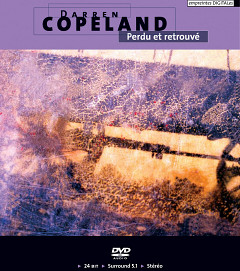
The last track on Darren Copeland’s DVD-Audio on Empreintes DIGITALes handles the peculiar opportunities of trans-realism that Stockhausen has spoken about, meaning connections and sequences that do not or cannot exist in the so-called real world, but which can be rendered at will in the electroacoustic realm. Copeland says that he is working here with “imaginary landscapes that are incomplete in their appearance and as a result are shrouded in dream-like ambiguity.”
I like that a lot: “dream-like ambiguity”. That could be a useful characterization of much good sound art.
Indeed, tiny fragments of balloon frictions (?) and/or specks of electric charges at a relay interlocking plant — or short-wave static sliced in minuscule shreds — open this ambiguous piece of sound art. Very shortly the gray matter of this progression grid interconnects and forms a long, piercing stretch of wobbling interactions that provoke your tympanic membranes into high-frequency vibrations of a painful kind. Copeland is out to out-do David Dunn’s Chaos and the Emergent Mind of the Pond with its submarine phase-shift hydrophone insect recordings (which I almost wasn’t allowed to broadcast on Swedish radio since the heavy phasing might close down the audio reception for some…) and François Bayle’s Motion-émotion with its stark, prickly gnat sonorities! There is more elasticity to Copeland’s piece, though: tiny sounds with up-turned noses caught in beautiful amber worn round the neck by a wonderful Zoë traveler! Glen Clova is poured in golden celebrations of high spirits! Ambiguity is the word of the day!
The roar from Thunder Road is stirring behind the horizon, as flocks of black crows form storm clouds on the move way inside the soundscape. Copeland is a Maestro of dark oil paintings inside large, forgotten halls of Amnesia castles at the periphery of sonic perception!


![Gilles Gobeil [Photo: Isabelle Gardner, Montréal (Québec), March 26, 2006]](https://res.electrocd.com/image.php/image/g/gobeil_gi.7.jpg?width=n2&cropratio=1:1)