electrocd

Blog

87 results
  • 4
  • 5
  • 6
  • 7
  • 8
  • 9
  • 10
  • 11
  • 12
  • La notte fa in Kathodik

    “Recensione”, Marco Loprete, Kathodik, June 22, 2009
    Monday, June 22, 2009 Press

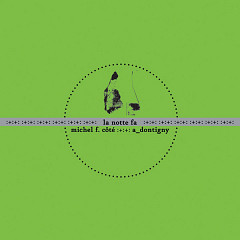
    Era lecito attendersi qualcosina di più da questo disco di Aimé Dontigny (membro, assieme a Érick d’Orion del duo morceaux_de_machines) e Michel F Côté (batterista dei Klaxon Gueule). E ciò anche per via degli ospiti coinvolti nel progetto — Bernard Falaise e Alexandre St-Onge, rispettivamente chitarrista e bassista dei Klaxon Gueule, Alexander MacSween dei Foodsoon (batteria) e Jean René (viola) —, musicisti di straordinaria vitalità creativa, animatori, assieme ai due autori di la notte fa, della scena improv-rock canadese. Ma veniamo al disco in questione. Il lavoro di Dontigny e Côté si colloca nell’ambito dell’avanguardia più sperimentale. Un intreccio di batterie, percussioni, nastri, effetti elettronici, drum machines e cut-up di varia natura (tra i “prelievi”, svettano quelli da Videodrome di Cronenberg, The Mahavishnu Orchestra e Maurice Ravel) costituisce l’ossatura delle partiture improv-electro di ritmi di oggetti, unlisted card number, paxil origami club e naines qui gesticulent (due esercizi di frantumazione di breakbeat con avvolgenti suoni tastieristici a conferire un’atmosfera spaziale), bounce dat ARN, le jazzate lube liqueur e visiones nocturnae, target= “blank_” e the book burner. Pezzi a tratti indubbiamente affascinanti, ma che molto spesso cadono nel già sentito. La sensazione (ma potremmo dire: la certezza) è che Dontigny e Côté possano fare di meglio. la notte fa poteva essere un capolavoro. Così è semplicemente un buon disco.

    la notte fa poteva essere un capolavoro. Così è semplicemente un buon disco.

    Chroniques d’une séduction in Caleidoscoop

    “Review”, Jan Willem Broek, Caleidoscoop, June 21, 2009
    Sunday, June 21, 2009 Press

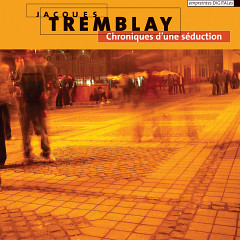
    Naast een nieuwe Mathew Adkins komt het Canadese empreintes DIGITALes label nu ook met een nieuwe cd van de alom geprezen, bekroonde componist en klassiek gitarist Jacques Tremblay. Ditmaal wel een Canadees uit de befaamde musique concrète hoek. Op zijn nieuwste werk Chroniques d’une séduction heeft hij als thema het brede “verscheidenheid” gekozen. Tremblay staat eigenlijk altijd bekend om zijn verscheidene benaderingen van de muziek. Ook hier laveert hij tussen musique concrète, elektro-akoestische muziek, plunderphonics, puur elektronische muziek en akoestische gitaarmuziek. Hierdoor klinkt hij anders dan zijn labelgenoten en maakt hij het voor de luisteraar meestal tot een waar spektakel vol onnavolgbare geluiden. Dat is zeker op deze nieuwe cd het geval. Naast de genoemde genres varieert hij ook binnen de genres door toevoeging van uiteenlopende akoestische instrumenten. De cd is in 3 delen, verspreid over 10 stukken, verdeeld. In het eerste deel gaat hij uit van elementen die onder druk staan. En of dat nou een espressoapparaat is, Bach die er een cantate uitperst of Gainsbourg die erotiserend uit de hoek komt, alles kan in de wereld van Tremblay. Hierdoor krijg je dan allerlei genres door elkaar, van de plunderphonics tot de klassieke en ongrijpbare elektronische elementen. In het tweede deel stoeit hij met musique concrète, de akoestische gitaar en flarden van een countertenor. Dit geeft een surreëel maar wonderschone atmosfeer. Heel mooi is het laatste, derde deel van de cd waar hij stemmen uit diverse landen, van Russisch en Frans tot Arabisch, in zijn musique concrète inbed. Stemmen van volwassenen en kinderen. Hiermee creëert hij een filmisch en spookachtig geheel dat verbluffend mooi en mystiek te noemen is. Het is eigenlijk ondoenlijk een cd als deze te bespreken, dus ga deze verleidelijke pracht vooral zelf beluisteren.

    Sur fond blanc in France Musique

    “Tapage nocturne”, Éric Serva, France Musique, June 18, 2009
    Thursday, June 18, 2009 Press

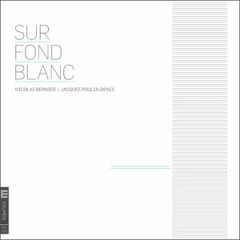
    Nicolas Bernier est entré dans le monde des musiques électroacoustiques par la porte des musiques populaires, un vaste monde qu’il aborde sous diverses formes: acousmatiques, électroniques live, installations, vidéo, musiques pour la danse, le théâtre et le cinéma. Jacques Poulin-Denis a étudié l’électroacoustique à l’Université de Montréal et exerce également la profession de danseur. S’il a beaucoup travaillé en tant que compositeur, Jacques Poulin-Denis a acquis une solide réputation en tant que concepteur sonore pour le théâtre et la danse. Ce nouvel album est intitulé Sur fond blanc, il réunit des œuvres originellement composées pour la danse, plus précisément pour un spectacle intitulé La chambre blanche de l’excellente compagnie chorégraphique montréalaise O Vertigo. On y entend donc de temps à autre quelques sons de pas, de gestes et de voix qui apportent une couleur supplémentaire, un surcroit de poésie et de sensualité à une œuvre qui explore les difficiles thèmes de l’espace intérieur, du vide et de l’absence. Nicolas Bernier et Jacques Poulin-Denis ont réussi à mettre tout cela en son mais sont allés plus loin grâce à la création de vastes paysages sonores, sortes de faux-fuyants musicaux qui ouvrent et propulsent notre imaginaire hors de l’angoisse, hors des murs, hors de l’enfermement. Tout cela dans un bel équilibre entre acoustique et numérique, entre son et musique. Sur fond blanc est un album de musique savante, mais une musique parfaitement accessible et brillamment séductrice.

    … ouvrent et propulsent notre imaginaire hors de l’angoisse…

    [60]Project in Caleidoscoop

    “Review”, Jan Willem Broek, Caleidoscoop, June 18, 2009
    Thursday, June 18, 2009 Press

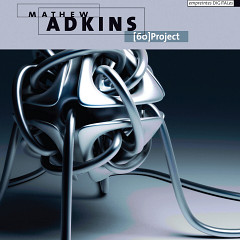
    De Britse componist/muzikant Mathew Adkins is lid van BEAST (Birmingham ElectroAcoustic Sound Theatre). Dit gezelschap houdt zich bezig met de wondere wereld van de elektro-akoestische muziek en musique concrète. Voor degene die deze muziek, waarvan de scepter overigens meestal in handen is van de Canadezen, niet kent is een eerste aanraking een bijzondere. Het is namelijk echt een uniek genre, dat zich dus ook niet echt laat vergelijken met andere genres. Het klinkt vaak alsof de natuur in elektronica is veranderd en je in de realiteit van de Matrix zit. Naar aanleiding van de 60ste verjaardag van musique concrète pionier Pierre Schaeffer is het idee ontstaan om een soort historisch overzicht te geven van significante, wellicht door hem beïnvloedde, werken en daarmee een nieuw origineel werk te creëren. En zo is [60]Project geboren. Adkins heeft druk heen en weer ge-e-maild en materiaal van maar liefst 66 artiesten gekregen om te gebruiken. De geluiden verwerkt hij tot nieuwe creaties, waarin de oorspronkelijke muziek soms niet eens meet te herkennen is. Hij maakt heel oorspronkelijke combinaties, bijvoorbeeld een geënsceneerd vocaal trio van AGF, Iris Garrelfs en Maja Ratkje of een duet van Christian Fennesz en Tim Hecker. Andere artiesten die materiaal hebben geleverd, ik zal ze niet allemaal noemen, zijn Mira Calix, Lawrence English, Natasha Barrett, Vladislav Delay, Francis Dhomont, Si-cut.db, Gilles Gobeil, Francisco López, Gert-Jan Prins, David Toop, Åke Parmerud, Scanner, Terre Thaemlitz, Janek Schaefer en Rechenzentrum. Van label- en genregenoten tot de meest uiteenlopende elektronica artiesten. Mathew Adkins kneedt er zijn unieke musique concrète bouwsels van die steeds weer onverwachte wendingen en geluiden kennen. Hij schept een parallel universum waar het ene biologerende avontuur en experiment na het andere aan de orde van de dag is. Meesterwerk!

    Meesterwerk!

    Les arbres in Neural

    “Sound”, Aurelio Cianciotta, Neural, June 17, 2009
    Wednesday, June 17, 2009 Press

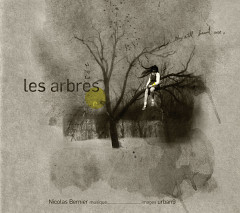
    Acoustic and electronic sounds in Les arbres can be listened to in the form of a delicate but rigorous project, led by Nicolas Bernier, a composer able to activate symmetries between piano and environmental textures, developing intense and expanded melodic tunes. The Canadian author places different elements together in a very controlled manner, imposing more melodic passages alongside synthetic moments, resulting in a meticulously organized audio-transfiguration. Six tracks, each accompanied by an illustration by the visual artist Urban9, following in this case the idea of a network: silhouettes extracted from a photographic family album in the 40s are re-mounted on a similar greyish background with nice drawings of trees. An intimate set, with some obscure forms, is presented in this “sentimental bricolage”, both in visual and musical components. There is a perfect integration of sinuous emotional trajectories, mixed with surrounding sequences where there are also wind instruments, guitars and violins.

    … a perfect integration of sinuous emotional trajectories…

    Matériaux composés in Musicworks

    “Review”, John Keillor, Musicworks, no. 104, June 15, 2009
    Monday, June 15, 2009 Press

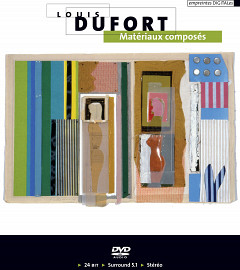
    Dufort has avoided the Stockhausen Trap by being more interesting in reality that in theory. And rarely does new music swing so subtly. While few electronic compositions have managed to charm us the way Ligeti’s Artikulation did, Dufort’s 2008 disc has a rare meta-rhythmic feel that uplifts the listener. Using all the well-travelled blips and bleeps we expect from this genre, there is a brilliant undercurrent of movement happening in all this disc’s seven enthralling tracks. Though the composer chose to release this formidable recording in DVD format (which means it may not work on your stereo), it’s worth the trouble of hooking up your laptop to your best speakers. Dufort knows how to wrangle certain unrefined electronic timbres effectively, and the listener is never forced to wade through periods of moribund portent. The flow of the recording and its occasional bits of instrumental work have an unquantifiable beat that operates on a semi-unconscious level.

    Pervading the larger canvas is an eerie humanity that does not become boring or repetitious. Small episodes of bloopy electronic material seem to be talking directly to the audience. Verbal defenses of Matériaux composés do not seem to suffice when we confront its visceral communicativeness. This disc may be likened to sacred soundscapes for the Information Age.

    … being more interesting in reality that in theory. And rarely does new music swing so subtly.
  • 4
  • 5
  • 6
  • 7
  • 8
  • 9
  • 10
  • 11
  • 12