electrocd
  • This website is also available in English.

Blog

2899 results
  • 296
  • 297
  • 298
  • 299
  • 300
  • 301
  • 302
  • 303
  • 304
  • Podweek in e/i magazine

    “Off the Spine”, Darren Bergstein, e/i magazine, no. 1, March 31, 2003
    Monday, March 31, 2003 Press

    From the innovative, origami paper jewel case (a No Type trademark) right through to the disc’s crunchy megalomania, no analogs exist for ascribing parallels to Podweek. Brillo-techno manufactured in Canada since 1995 (the earliest listed date for the tracks on this collection of ‘œuf-history’), Frédérick Blouin, aka Oeuf Korreckt, is credited with being influenced by Black Dog, Orbital, Rotterdam hardcore, Björk and Autechre. Faint echoes of the latter’s Incunabula crop up here and there (on 1999’s Before Bedtime), and the Rotterdam connection makes its presence known during the bassball stomp of A Ride in Elephant City (nods to Atom Heart circa 1990 as well). Otherwise, styles implode in short order and markers become irrelevant. The most recent work here, 2001’s We Have Arrived, runs the IDM treadmill at modest speed, the whoop and holler of its electronics and snarling snaredrums a bark or two removed from the Dog. Blouin thumbs his nose at the ultra-serious laptop cadre on Screw my Samples, a rollercoaster ride around theme park mountain peaks that, despite the monotone pulse informing its plugins, whirls a singleminded dervish dance replete with pop-mocking beats. On Taco Fiesta, 303 moisture missiles are hurled at you with devilish abandon, the incessant flatulations and strangled synths a turgid mass uncomfortably occupying your colon. Ruffly is a bit less taxing, trashcan-lid cymbal crashes aside, but once it settles into a locked steam-engine groove, it’s simply surrender or die. Œuf to one side, the laptop techie grins, stroking all the Korreckt keys.

    Oeuf to one side, the laptop techie grins, stroking all the Korreckt keys.

    Rhizomes in e/i magazine

    “Off the Spine”, Dwight Loop, e/i magazine, no. 1, March 31, 2003
    Monday, March 31, 2003 Press

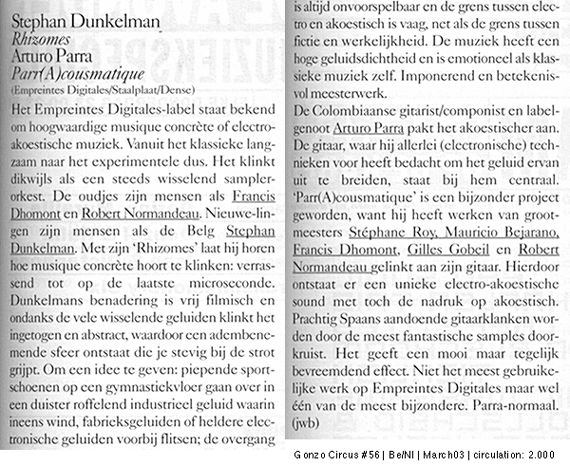
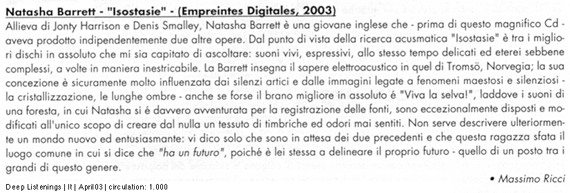
    Belgum-born Dunkelman’s first release on empreintes DIGITALes is the work of an acousmatic composer whose sound sculptures are sought after by many other artists for performance and installation. His music has been utilized in dance (Michele Noiret), sculpture (Charlotte Marchal), painting (Axel Miret), and fashion design (Azniv Afsar). These collaborations have opened up Dunkelman’s repertoire in that they’ve brought into play the ‘space’ that interpretive music demands. In all seven compositions on Rhizomes, he displays a true understanding of the use of silence in elaborate constructions. Time and again, the resonance of the spaces between the sounds give breathing room to Dunkelman’s creative interplay. Nowhere is this more evident than on the disc’s opening track, Metharcana, where the sound is choreographed to sudden rhythmic shifts. One could easily imagine a dancer’s fluid movements to each carefully crahed sound cluster; likewise on Rituellipses, with its halting staccato patterns, where envelopes quickly appear and disappear on a minimalistic aural canvas. The most mysterious and intriguing selection on the disc is the finale, Thru, Above, and Between, Dunkelman’s first ever work composed specifically for radio and sees him realizing his wish of: “wanting to present a resolutely musical alternative for an electroacoustic genre too often influenced by literary thinking. The city… is presented as an imploding dream. Brussels, too dependent on the dreams of others, must constantly look elsewhere to rediscover its own.” The sounds of Brussels—voices, footsteps, rain, trains and automobiles—are used as stitched patterns over echoed drones created from reverberations of the past, present, and future: Dunkelman delivers a record well worth its duration.

    … he displays a true understanding of the use of silence in elaborate constructions.

    Présence III in e/i magazine

    “Off the Spine”, Dwight Loop, e/i magazine, no. 1, March 31, 2003
    Monday, March 31, 2003 Press

    Third in a compilation series by PeP (“armlength production team working on behalf of the Canadian Electroacoustic Community”), this is a worthwhile addition for anyone interested in exploring today’s vital electroacoustic music scene from America’s northern neighbor. The double-CD features 28 artists from seven countries, many making their first appearance on a CEC compilation. A major feature of electroacoustic music that comes with the territory, as with all experimental art forms, is a freedom to express political views about any number of subjects. Art is political and electroacoustic music is a leading art form for many composers expressing deeply held beliefs and realizations. Disc one’s highlights are many, opening with the deep, dark, airy tones of Machine Symphony (by Kristi Allik), recordings of steam engines and other machineries, blended in pleasant rhythmic ostinatos and drones. David Berezan’s In A Cold Light is a haunting short sequence of vistas from his ‘acousmatic documentary,’ exploring perceptions and imaginings re: the northern regions of Canada: stark, cold, crisp sounds from the tundra. Disc two revels in classical minimalism, including compositions making direct environmental ‘statements’: Sophia Male’s Alarm Calls, (canaries in a coal mine), Steven Naylor Irrashaimase (industrial urban Japan), the political Dale PerkinsSubmarine (the Russian Kursk submarine disaster), and even conceptualized sound alterations: Michael MatthewsOn The Outer Edge (manipulated cello), David R Mooney’s The Llama Strut (theremin studies), and Rick Nance’s This Is Not A Model (shapes and masses of metals recorded as they radiated summer heat into a block of frozen carbon dioxide). What’s most pleasing about Présence III is the flow of the mix, as selections are programmed with extreme care and a feel for continuity.

    … a worthwhile addition for anyone interested in exploring today’s vital electroacoustic music scene…

    Chemin de fer in e/i magazine

    “Off the Spine”, Darren Bergstein, e/i magazine, no. 1, March 31, 2003
    Monday, March 31, 2003 Press

    Babin, for all intents and purposes, is a sonic metallurgist, warping surface alloys into soft, pliable mica. Chemin de fer is rank experimentation: corralling her aluminum cones, steel pots, guitar pick-ups and wirewheels, Babin strums, rubs, massages, and fondles them with fingers, bows and additional implements, then runs him through her spirited banks of software. More often than not, she settles for some basic improvising, producing sounds at random, basking in the natural feel of the materials; E is as ambiguous as its title, Babin picking, plucking, prodding and poking her metallic foils to produce disconnected tonalities hovering in the soundheld — they share little in the way of common coin, symptomatic of the disease improv’s critics have warned infects too much of the genre; they’re not necessarily wrong. L’entonnoir allows the laptops’ discreet parameters to work its magic by transforming the composer’s acoustic language into a more tactile wall of sound. Jogging dans la maison hantée beckons glitch into the arena, mouse-clicks and keyboard strokes distorting what little decay there is into a full-on occupational accident. No reason to fault Babin’s choice of soundmaker; however, the ‘rank experimentalist’ ethic has dampened many an improviser’s pursuits, and Babin is far from immune. Chemin de fer is a textbook example of concept overriding execution; great on paper, feckless in resolve. Spread out over 50 minutes, the disparate motions of the metallurgist’s noises fail to cohere. Okay to be avant provided you don’t drop your garde.
    … a sonic metallurgist, warping surface alloys into soft, pliable mica.
  • 296
  • 297
  • 298
  • 299
  • 300
  • 301
  • 302
  • 303
  • 304