electrocd
  • This website is also available in English.

Blog

2899 results
  • 300
  • 301
  • 302
  • 303
  • 304
  • 305
  • 306
  • 307
  • 308
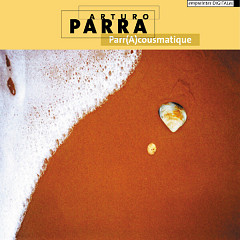
  • Parr(A)cousmatique in Vital

    “Review”, Ios Smolders, Vital, no. 357, January 30, 2003
    Thursday, January 30, 2003 Press

    Next Arturo Parra: this is a guitarist’s view on acousmatic music. I really think that this is the most adventurous of the three releases. The cooperation between musical instrument and tape/computer is difficult because you can identify the instrument from the other sounds, which so easily results in a relation instrument-backdrop. And in a live setting there is the discrepancy between the sound source of the acoustic instrument and the sound from the speakers which separates the two even more. Parra somehow managed to create a very nice balance, though. Parra commissioned works from five composers: Gobeil, Roy, Dhomont, Mauricio Bejarano and Normandeau. These compositions were each the basis for a composition of Parra. So the acousmatic composers didn’t know what Parra was going to do with their piece and Parra composed the guitar on top of what was already there. That is interesting because the guitar is the least versatile instrument here and yet it has to interact with the most versatile abstract noises. Also interesting to know is that the guitar was recorded without any overdubs. In some cases the guitar is tormented and played in extraordinary way but you can also hear melodies, which is quite unusual in an empreintes DIGITALes release. The result is a very dynamic and intense cooperation, very much worth listening to. I most liked the Dhomont cooperation. This “éminence grise” of the acousmatic society never misses a beat.

    … a very dynamic and intense cooperation…

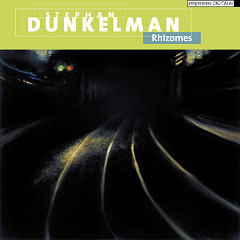
    Rhizomes in Vital

    “Review”, Ios Smolders, Vital, no. 357, January 30, 2003
    Thursday, January 30, 2003 Press

    Stephan Dunkelman’s Rhizomes plays heavily with sound and speed. His sounds seem to flee away from the speakers turned acoustically into large halls (through loads of reverb). Only seldomly does a sound remain at its place. Dunkelman must be a restless person. The acousmatic aspect of his music is according to the book (I think; there must be a book of some sort… I always hear the same sounds and techniques applied to edit them.) but it fails to keep my attention. The soundsources, the treatments, the structure… it’s all too much of the same.

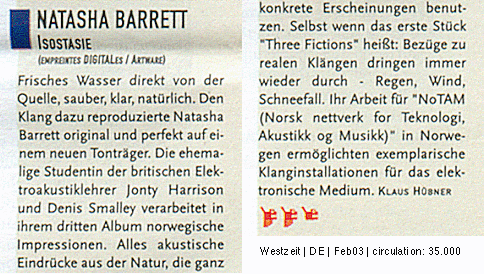
    Isostasie in Vital

    “Review”, Ios Smolders, Vital, no. 357, January 30, 2003
    Thursday, January 30, 2003 Press

    It has been some time that I listened to a new release of electroacoustic music, so imagine I was anxious to hear some new ones that I found on my doormat. empreintes DIGITALes releases the music of mostly classically trained electroacoustic composers. The music is well-produced, sounds perfect. The music is also well-documented and the sleeves are artful as well as tasteful. Very well balanced releases. Let’s get on to the first release, Natasha Barrett’s Isostasie. Of the three cd’s reviewed here this cd breathes the most human atmosphere. Unlike a lot of acousmatic compositions there is room for rest here. Many acousmatic composers tend to create dense layers of complex sounds that whirl around each other like inside a maelstrom. Barrett allows for calmth to get a place in the composition and we even hear a human voice. Sometimes she too uses the cliché of filtered basses to counteract with high pitched fluttering and her structures are not very original. Yet, in the best compositions (like Three Fictions (Northern Mix), Industrial Revelations) a very personal style appears and I’d really like to hear more of that. In other compositions (like in Viva la Selva!) the mimicry of the real world is too obvious, though. I would advise against that. (as if my opinion matters…)

    … this cd breathes the most human atmosphere.

    Throw Down Your Laptops, Books on Tape in Daily Bruin

    “Drootin throws down electrifying debut album”, Andrew Lee, Daily Bruin, January 22, 2003
    Wednesday, January 22, 2003 Press

    About two years ago, Todd Drootin was sitting at his home in Encino, surfing on Napster and trading his music with other tech-happy, independent artists. While online, a man who went by the name Infoslut told Drootin about his mp3 label No Type.

    “I’d never heard of it,” Drootin said. “The entire concept of an mp3 label was just out there to me. But he told me it was a cool thing, just a community that can get a lot of attention.”

    Drootin, who releases and performs music under the moniker Books on Tape, released an EP on the label and received a respectable fan response, but more importantly, No Type planted the seed for his own label Subverseco, which now serves as a home for several other experimental artists. Drootin, a prototypical and self-described beat punk, was raised playing piano, drums and guitar, but the tech-age has turned him into more than just a rock musician.

    “It’s certainly been an exciting time for music right now,” Drootin said. “The indie rockers are finally unafraid to be electronic.”

    Drootin’s debut album, Throw Down Your Laptops — released just over a month ago — isn’t your typical electronic release; it was recorded live, which led to a distinct big-arena rock sound. But its frenetic sound, propelled by obscure samples and sequencers, signals a new direction for So Cal independent music.

    Drootin’s break from traditional rock started about four years ago when he moved from a house to an apartment. He soon realized that he didn’t have room to put his drum kit. He bought a recording device, a sort of digital workstation, to play around on with a friend.

    “We started to explore the possibilities of it, but we couldn’t just sit there and do this all day; we needed to be looping and stuff like that. He was a guitar player, I was a drummer, so those were crazy concepts for us back then,” Drootin said.

    Ever the inquisitive musician, Drootin soon started to get into Los Angeles’ underground-hip hop scene.

    “Eventually, we went in with a sampler, and the idea was that we were going to make hip-hop beats,” he said. “But it just so happened that two white kids from Santa Cruz didn’t have a shot in hell at making hip-hop beats for anybody but themselves.”

    Turning to his own brand of spastic knob-twiddling, his live show gave him the recognition he needed, notably from his current non-mp3-based label Deathbomb Arc records. They were disappointed in Drootin’s first recordings and convinced him that the live atmosphere reflects the essence of his music’s charm.

    As a result, a few of his tracks have been picked up by MTV’s “Real World.” Still, his particular approach to electronic music isn’t the kind that purists would fawn over.

    “It keeps coming back to me that the people really taking interest in what I’m doing are people who are into more eclectic stuff, into rock and jazz and dub,” he said. “When I walk into Amoeba and I go to the techno section, those are not the people listening to my albums. I think it reflects the fact that I didn’t grow up listening to electronic music.”

    That’s not to say he doesn’t have something to offer the so-called purists; Drootin’s approach may be wildly unconventional, but it has the spirit of rock and roll.

    “You’ll see them — laptop users — lean over each other’s shoulders and go ‘check out this trick.’ Then they’ll hit Control+F or something. I don’t see the music in that,” he said. “When I (see) people taking their samplers and completely battering them and doing something totally wrong, that’s when my eyes light up.”

    Books on Tape performs regularly in Southern California, check http://www.deathbombarc.com/ for recent dates.

    Drootin’s approach may be wildly unconventional, but it has the spirit of rock and roll.

    Parr(A)cousmatique in Splendid E-Zine

    “Review”, Andrew Magilow, Splendid E-Zine, January 20, 2003
    Monday, January 20, 2003 Press

    Unless you have a ridiculously expensive stereo system, there’s no way to grasp the breadth of the dynamic material that comprises these five compositions. What’s shrouded by your crummy computer speakers or sub-par jambox is magically unearthed when you wrap a padded pair of speakers around your head. So, don your favorite set of headphones and prepare for a most unusual meeting of guitar virtuosity and electroacoustic improvisation!

    Colombian-Canadian guitarist Arturo Parra commissioned several well-known electroacoustic composers to create stand-alone tape pieces. In turn, the wildly imaginative Parra took each composer’s portion, wrote complementary guitar parts and mixed it all into several dramatically transformed compositions. The result is Parr(A)cousmatique — a CD that delicately balances the six-string with magnetic tape.

    Stéphane Roy, Francis Dhomont, Gilles Gobeil, Mauricio Bejarano and Robert Normandeau each fashion elegant works that fuse synthetic melodies with noisy electrical excursions. It’s important to note that when each composer wrote his respective piece, it was unclear as to how Parra would incorporate it into his own work. While it’s difficult to separate the electroacoustic parts from the guitar in the final product, it’s reasonable to believe that each composition was created with enough power and depth to stand on its own. Consequently, each composer plays a critical supporting role in Parra’s work instead of becoming an anonymous background studio musician.

    After carefully studying each submission, Parra weaved his skillful and innovative guitar-work into the taped material to create the final product, switching effortlessly from Latin-influenced tonalities to frenetic runs to astonishing climaxes. When tape and guitar convene, an incredible reaction occurs. The two melt into a dense concoction of warm, melodic chords and expressive movements that oozes into your ear canals and coils around your grey matter like that creepy brain eating parasite from The Wrath of Khan.

    Unlike many acousmatic releases, there is an amazing amount of poise and grace in the interplay between participants. Neither tape nor guitar is relegated to a secondary role; instead, a unique synthesis of moving melodies and swarming solos occurs, with each artist taking turns developing the mood or rabidly following a particular improvisational idea. La basilique fantôme begins with flamenco guitar that’s readily juxtaposed with Stéphane Roy’s trickling electronics and intense atonal rumblings. Eventually a friendly sonic fight of sorts develops between Parra’s thrilling abilities and Roy’s processed mechanical bleeps, and it remains unresolved until the tune’s final minute.

    The most characteristic piece of the batch is the collaboration with Francis Dhomont, Sol y sombra… L’espace des spectres. Parra’s baroque style creates varying dispositions, ranging from romantic to frantic. While each artist takes turns being the aural focal point, neither is ever overshadowed by the other. You may assume that the electroacoustics would be sonically overpowering, but Parra holds his ground, attacking the fretboard with dazzling dexterity.

    While chaotic in theory, this unusual coupling of electroacoustic tape rendering and intricate guitar works amazingly well; Parra and his collaborators are not only brazen musical explorers, but also quite conscious that melody and structure can work well in an avant-garde setting. Could this be the beginning of a new collaborative genre? Parra has certainly started off with a brilliant release. Let’s hope there’s more to come.

    … prepare for a most unusual meeting of guitar virtuosity and electroacoustic improvisation!
  • 300
  • 301
  • 302
  • 303
  • 304
  • 305
  • 306
  • 307
  • 308