electrocd
  • This website is also available in English.

Blog

2899 results
  • 319
  • 320
  • 321
  • 322
  • 323
  • 324
  • 325
  • 326
  • 327
  • liberum arbitrium, morceaux_de_machines in Ampersand Etcetera

    “Review”, Jeremy Keens, Ampersand Etcetera, no. 2002_7, May 20, 2002
    Monday, May 20, 2002 Press

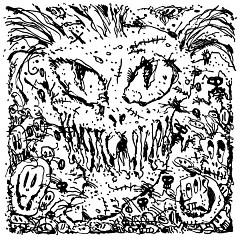
    The evil face embedded in the doodlish ghoulish cover illustration by Guy Boutin juxtaposed with Sophie Dowse gentle watercolours on the inner sleeve is somewhat suggestive of direction, and is furthered by the Anthony Burgess quote (which is the only part of the extensive liner notes in English) about “two kingdoms… the eternal and luminous one of the divine lord’s own making, and the noisome stinking pit of pain and horror… of god’s enemy.” Within those notes “fragilité… construction de tension… danger… source des textures” all support the impression gained from the cover and delivered by the music.

    Aimé Dontigny and Érick d’Orion, morceaux_de_machines, create some of the hardest ambient-noise I’ve heard recently, teetering between the pit of despond and the beautiful city. I thought cut-up would be the end of me – there is an on-going click-pop “melody” which sounds like the soundtrack to a sci-fi battle with choppy cd/tape samples below (either some rap of just aggressive people). As it continues, there is a surprising melodic aspect and a shattered stability. The disconcert continues in multivisión espacial with more rapid pops shoots bloops plips and more over samples, which sound like jazz with guitar flute etc. As time passes the aural assault continues, sharp needles of sounds, more noises, and eventually the surface noises become a merged buzz of sounds, brief dropouts, voices in there, to a quieter final minute.

    When you think it will all be overwhelming, lo-fi soundscape eases the impact a little, with lighter whizzy surfaces over piano and sax, again easing to a quieter end. Or spencer’s percussive bursts melded with loose-cable crackle, all echoed slower and quite visceral. Voice pulses enter, it builds and distorts, and then there is a reverbed voice briefly talking to us (an unexpected directness) before a big layered end. And we are caught quite unaware by the lightness of prime shake: gentle pips and burrs, like a computer control room, soft rhythms and crackles, a distant tone melody: the crackle builds, it is all dense restraint into a percussive end.

    métal scrap is well named as a scraping melody weaves through crackles drums and building noises over a soft solid bed, joined by a voice – possibly Hitler or a Dada-esque speech, hard to say – solid and directed. The squeaks clicks and soft tone pulses that open rothko are almost pastoral, electro-frogs, a slow echo-drum running through and slight increased density and pace, the samply-jump behind providing subtle noise, a little more desperate to the end before a crackle-pop fade. The final track digisex swings back to the more oppositional strategy, here a degraded distant pop sample provides some vocals and a rhythm, the bleeps and peeps over increase, subsumed by a soft and rumbly futz – a sort of bolero – and all breaks down again in the last minutes.

    The beginning of this album threw me onto the back foot, and seemed all noise and aggression, but as I listened through it and on replay I actually warmed to it. m_d_m do achieve the straddling of the inferno and paradise suggested in the notes, creating a surprising and satisfying combination of electro-noise with subtler elements weaving through. Intriguing.

    morceaux_de_machines create some of the hardest ambient-noise I’ve heard recently… a surprising and satisfying combination of electro-noise with subtler elements weaving through. Intriguing.

    Chemin de fer, Magali Babin in Ampersand Etcetera

    “Review”, Jeremy Keens, Ampersand Etcetera, no. 2002_7, May 20, 2002
    Monday, May 20, 2002 Press

    Following the No Type compilation, three new disks from the real world collaboration between David Turgeon and DIFFUSION i MéDIA arrived at Ampersand Etc.

    Magali Babin improvises her sounds on “metallic instruments and objects, which [she has] made, recycled or reinvented,” which go beyond the tin things pictured on the cover, as the notes also mention “a rather small electrical object… guitar pick up,” the mike placement has also had an important impact, as has “the studio work.” However, created originally for a radio show, the pieces here demonstrate the range of her constructions.

    It opens with a more tentative, less structured piece that like many improv albums, tests the listener straight off. Triturations is an amalgam of shimmers pops scrapes twangs voicey-noises shakes subtleties and crackles that twists and changes adding thuds and winds in a complex electroacoustic weave of sounds of unusual colour and timbre. Petit jardin is more straightforward, alternating periods of a strumming with the sound of pebbles dropped in a bowl, with an overall chime, adding a scooping sound near the end. With my french, La corde is appropriately named – scraping and some plucking of a stretched wire accompanied by a percussive thud that sometimes sounds like a ruler being twanged. Monsieur et madame Watt has two components: an electronic buzz with becomes a wave and then a pulse over which there is a light percussive rumbling and scrabble. A tapping rolling scrape in E sounds like the microphone was inside a pipe being played, gradually speeding up, and into the big rolling percussion of L’entonnoir that forms a full-on assault over droning base and light playful tappings over. Jogging dans la maison hantée – was composed with Alain Chenier and Mario Gauthier (from the radio station): sighs and clicks run through as little noises explode over – scrapey rumble, high wail, rubbing noises – that ebb and flow returning wit stretched decay for a little big finale.

    Dramatic flourishes of tapping and a fast rubbing increase in volume and speed in Ma tribu, eventually pulsating. And then the finale, Pluie de homards (which has been mixed with an Ian Nagoski piece apparently) a fabulous conclusion, verging on electro-noise as big hollow resonances whoosh over a light crackling clatter. And nicely completes the trajectory the album has created from its more finely grained opening.

    An unusual and engrossing album. As you read the reviews of the others that make up this first batch from IMNT, it will be obvious that David Turgeon has maintained the unique eclecticism that made/makes the on-line label so fascinating. I hope that there is enough interest in the real world to allow the label to continue this musical exploration. For those in the know, the IMNT releases are packaged in the same card sleeves that are a little like upmarket cigarette packets. This allows for some interesting artwork and extensive liner notes, and maintains the tradition.

    An unusual and engrossing album.

    The Freest of Radicals, No Type in Capital Magazine

    “Review”, Tobias C van Veen, Capital Magazine, May 17, 2002
    Friday, May 17, 2002 Press

    One of the oldest MP3 labels on the Net takes a jump into CD production this month with the release of four new albums, including this double-CD compilation of No Type artists. David Turgeon’s No Type has remained an outsider label, showcasing in-between experimental styles bordering electronic music, noise, minimalism, and musique concrète. At its best, it is challenging, evocative, and stimulating; at is worst — which is rare — it is noisy and too easily pigeon-holed as noise or hardcore. However, this compilation, if a pigeon, ate its own shadow, leaving no hole for it to climb through.

    Such a diverse amount of styles are represented — from Tomas Jirku’s subtle minimal groove I Think I’m In Love to the bass-tone work of Le Chien Borgne and the tonal-cuts of Julie Rousse’s Une à six idées improvisées — that I can only summarise them briefly in parantheses and short comments here. As a purchase — for don’t we all want practical reviews now? — the double-pack is well worth the effort, for its vast depth is breathtaking in its collection of artists and styles whose talents are undeniable. There are few compilations out there that touch upon so many issues in contemporary, we could say non-academic, experimental music. Like BiP-HoP, No Type is dedicated to the odd, the obtuse, and the wicked in the genres of microsound, noise, IDM — it’s really a milieu of all these catchwords, leaving the listener strangely comfortable in a sea of sound despite that fact the she is lost beyond compare, a veritable Alice in the hands of someone who has lost all language, all speech to tell musical directions: above all, Alice is in the land of No Type…

    No Type is dedicated to the odd, the obtuse, and the wicked in the genres of microsound, noise, IDM… leaving the listener strangely comfortable in a sea of sound…

    Podweek in Convergence

    “Critique”, Jean-François Perreault, Convergence, no. 2:6, May 15, 2002
    Wednesday, May 15, 2002 Press

    Bien avant l’arrivée de Windows, les «trackers» étaient les rois des logiciels de composition dans le domaine de la musique électronique, mais l’environnement graphique de l’Oncle Bill a tôt fait de les étouffer, remplacés par des programmes beaucoup plus intuitifs et moins complexes. Ce qui n’est pas un mal en soi. Cependant, Frédérick Blouin de Québec, qui signe sous l’étrange pseudonyme Oeuf Korreckt, s’entête et s’en sert encore des «trakers», nous faisant redécouvrir le son de tout un pan de la musique électronique, séquencé et dominé par des rythmes robotiques. Souvenez-vous de Kraftwerk. Ce n’est pas du tout sans plaisir qu’on écoute Podweek qui comporte de beaux et joyeux moments à la Orbital dans Pochacco et le sensible Alright Well Okay ou le carrément techno hardrore King of the Elephants qui piétinera les cœurs sensibles. Une valeur sûre pour ceux qui sont curieux des sons qu’on n’entend presque plus.

    Une valeur sûre pour ceux qui sont curieux des sons qu’on n’entend presque plus.

    Chemin de fer in Convergence

    “Critique”, Jean-François Perreault, Convergence, no. 2:6, May 15, 2002
    Wednesday, May 15, 2002 Press

    Magali Babin, c’est une «patenteuse», une vraie. Plus jeune, dans la cuisine de ses parents, elle ne devait pas être un cadeau, probablement prête à taper sur tout ce qui fait du bruit. Plusieurs années plus tard, elle ne démord pas et fait de la musique avec tout ce qui lui tombe sous la main. Dans Chemin de fer, elle utilise une multitude d’objets métalliques fabriqués, recyclés, réinventés; la très belle pochette de son disque nous l’indique clairement, d’ailleurs. Fait intéressant: sept des neuf pièces sont improvisées, proposant des œuvres très personnelles et sensibles. Ça démarre en grande avec Triturations, une paisible pièce qui semble nous glisser dans un costume de scaphandrier, mille pieds sous l’océan. Dire qu’en réalité, la musicienne ne fait que frotter des casseroles et autres trouvailles à côté d’un micro! Le tout est réalisé avec la joyeuse complicité de Mario Gauthier et ca paraît.

    … des œuvres très personnelles et sensibles.

    Cache 2001 in AllMusic

    “Review”, François Couture, AllMusic, May 10, 2002
    Friday, May 10, 2002 Press

    In 2001 the Canadian Electroacoustic Community (CEC) held its second Jeu de Temps/Times Play competition. Cache 2001 presents (in alphabetical order) the 11 top-scoring compositions presented by young emerging Canadian artists. Most of these composers have yet to step away from their academic studies to find their own voice, but this year’s crop is impressively good nonetheless. They all feature excellent production values and obvious sound wielding talent. Let’s point out a few highlights. Nicolas Basque’s Polyèdres is a rich tapestry of sounds organized in a complicated structure—very good and among the most mature works on this CD. Guillaume Coutu Dumont produces interesting sets of variations from a voice sample in Arianne Secret but it runs a bit long. The shimmering textures in Andrea Holtslander’s soundscaping Steam, Billow introduce a charming pause. Finally, Warren Spicer’s I’ll Distract Myself While You Cry Like a Boxer Tears, besides sporting the oddest title, presents a good amalgam of elongated sounds that recall Koji Asano’s works from 2000-2001. The other pieces have their moments and are satisfactory in general, but they lack that special something that would make them more than forgettable. Cache 2001 is not directly available on the market, but it was sent worldwide to radio stations and organizations supporting electroacoustic music.

  • 319
  • 320
  • 321
  • 322
  • 323
  • 324
  • 325
  • 326
  • 327