electrocd
  • This website is also available in English.

Track listing detail

L’ivresse de la vitesse

Paul Dolden

L’ivresse de la vitesse

  • Paul Dolden
  • Year of composition: 1992-93
  • Duration: 15:47
  • Instrumentation: stereo fixed medium
  • ISWC: T0708465228

Stereo

ISRC CAD509410890

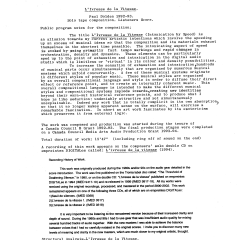
The title L’ivresse de la vitesse (Intoxication by Speed) is an allusion towards my current artistic intentions which involve the speeding up of an excess of musical ideas so that the composition and its materials exhaust themselves in the shortest time possible. The intoxicating aspect of speed is evoked by using primarily fast tempo markings and rapid changes in orchestration, density and dynamics. These elements can be particularly sped up to the point of exhaustion and intoxication in the digital audio studio which is limitless or ‘virtual’ in its colour and density possibilities.

To increase the sensation of exhaustion and intoxication, hundreds of musical parts occur simultaneously that are organized by numerous musical systems which unfold concurrently. A few of these musical systems originate in different styles of popular music. These musical styles are organized by an overall compositional language and style in order to diffuse their direct effect or reference point, and to create an internally coherent music. This overall compositional language is intended to make the different musical styles and compositional systems implode inwards, creating new identities beyond their worn-out historical reference points, and to produce what I hope is like seduction: undeniably attractive and yet simultaneously unexplainable. Indeed any work that is totally complicit in its own absorption, so that it no longer makes apparent sense on the surface, will exercise a remarkable fascination. In short, an art work fascinates by its esotericism which preserves it from external logic.


L’ivresse de la vitesse was realized in the composer’s studio with assistamce from the Canada Council for the Arts (CCA) and in particular from a Media Arts Audio Production Grant. It was premiered on May 28, 1994 at the 3rd Annual Festival of Experimental Music organized by the London Musicians’ Collective (UK). L’ivresse de la vitesse was awarded the 2nd prize at the 3rd Prix international Noroit-Léonce Petitot (Arras, France, 1994); the 1st prize in the Musica Nova 1994 International Competition of Electroacoustic Music (Prague, Czech Republic); the 1st Mention in the Stockholm Electronic Arts Award (Sweden, 1995); and the Jean A Chalmers Award for Musical Composition (Toronto, Canada, 1995).

Composition

Premiere

  • May 28, 1994, Concert, London (England, UK)

Awards


Scores

Physics of Seduction. Invocation #3

Paul Dolden, Peggy Lee

Physics of Seduction. Invocation #3

  • Paul Dolden
  • Year of composition: 1992
  • Duration: 18:28
  • Instrumentation: cello (or viola or violin) and stereo fixed medium
  • Commission: Richard Armin, with support from the CCA
  • ISWC: T0705085193

Stereo

ISRC CAD509410900

What compositional strategy can the contemporary artist use in order to produce a subversive charge in the face of a world drained of substance, meaning, value and difference? One approach is to use the materials of repression and extend their logic to such an extreme or excess that they implode from within. By using an extreme amount of ‘ordinary’ musical sounds and gestures, their reality becomes more real than real. In other words, the sounds escape the networks of meaning and association which have built up the reality of our world. In addition, with an extreme or excess of sounds, it is possible for speed to become faster than fast and thus for everything to become instantaneous. In this condition linear time and temporal reality are transcended. This compositional strategy, involving an escalation to extremes, means that the materials themselves disappear as they implode inward and take on new appearances. The realm of seduction involves the strategies of appearances. As a contemporary composer, all that I can hope for is that I have provided the physics, or the interaction of motion and energy, for your own seduction.


Physics of Seduction. Invocation #3 was recorded and produced at the composer’s studio. It was commissioned by Richard Armin with assistance from the Canada Council for the Arts (CCA) and premiered by him on April 5, 1992 in Montréal as part of the cello festival Le violoncelle à toutes les cordes. Versions of this piece exist for viola and tape and for violin and tape.

Composition

Premiere

  • April 5, 1992, Richard Armin, cello • Le violoncelle à toutes les cordes, Montréal (Québec)

About this sound recording

… the recorded cello part was performed by Peggy Lee in March 1994.

Recording

  • March 1994, Paul DoldenPersonal studio, Vancouver (British Columbia, Canada)

Performers


Revenge of the Repressed. Resonance #2

Paul Dolden, François Houle

Revenge of the Repressed. Resonance #2

  • Paul Dolden
  • Year of composition: 1993
  • Duration: 7:10
  • Instrumentation: soprano saxophone (or alto saxophone or tenor saxophone) and stereo fixed medium
  • Commission: François Houle, with support from the CCA
  • ISWC: T0705075337

Stereo

ISRC CAD509410910

As the end of the second millennium approaches, we increasingly deal with the angry fallout from our historical legacy. Everyone identifies with a sub-culture, each of which claims some form of victimization and self-justification. Society turns into a constant search for what has been repressed and denied and, like a pack of wild dogs, we search for some form of revenge for our victimization. However, given that our lives have basically become an extension of the mediascape, and real power lies elsewhere, we become trapped in an endless life-sized Nintendo game seeking justice and revenge.

Correspondingly, popular music has become a monotonous driving beat to serve the same function as military bands once fullfilled for soldiers going into war. Part of the Resonance cycle visits these musical garbage dumps in order to use their energy and to give them a compositional language that they are void of. Moreover, if In a Bed Where the Moon Was Sweating. Resonance #1 deals with intimacy or sex and Revenge of the Repressed. Resonance #2 deals with violence, then this music might have the potential to be consumed by the media consciousness that it tries so hard to distance itself from.


Revenge of the Repressed. Resonance #2 was recorded and produced at the composer’s studio. It was commissioned by François Houle with assistance from the Canada Council for the Arts (CCA). The work was premiered by François Houle on November 7, 1993 at a Vancouver New Music Society concert. A version of this work exists for alto sax and tape and another version exists for tenor sax and tape.

Composition

Premiere

  • November 7, 1993, François Houle, soprano saxophone • Concert, Vancouver (British Columbia, Canada)

About this sound recording

… the recorded soprano sax part was performed by François Houle in December 1993.

Recording

  • December 1993, Paul DoldenPersonal studio, Vancouver (British Columbia, Canada)

Performers


Dancing on the Walls of Jericho

Paul Dolden

Dancing on the Walls of Jericho

  • Paul Dolden
  • Year of composition: 1990
  • Duration: 16:14
  • Instrumentation: stereo fixed medium
  • Commission: Montréal musiques actuelles / New Music America, with support from the CCA
  • ISWC: T0705498958

Stereo

ISRC CAD509410920

Dancing on the Walls of Jericho is the second of a three-part composition, which philosophically addresses the idea of revolution. Part two continues from where part one, Below the Walls of Jericho, had ended. Part one acted as a metaphor for the idea of social change through revolution. Therefore part one was primarily concerned with the vertical monolith and its tearing down by the anonymous massed texture of four hundred tracks of sound. By contrast, part two celebrates this tearing down with a constant polyrhythmic dance on the rubble and the use of extroverted soloistic gestures.

All three parts are concerned with similar materials and gestures: the unaltered or unprocessed digital recording of hundreds of tracks of acoustic instruments from the Western and Eastern musical traditions, extensive polyrhythmic interplay between the hundreds of tracks of sound (at times fourty different tempos are used at the same time), contrasts in the way the instruments are played in a soft or loud manner, and contrasts of extreme consonance and extreme dissonance (ie: Just Intonation versus textures of seven octaves, in which each octave has fourty-eight different notes).


Dancing on the Walls of Jericho was realized at the composer’s studio in 1990. It was commissioned by Montréal musiques actuelles / New Music America festival with assistance from the Canada Council for the Arts (CCA). The work premiered at the Les Loges theatre during the Montréal musiques actuelles / New Music America festival on November 1, 1990. Of the many performers in Dancing on the Walls of Jericho and Beyond the Walls of Jericho, special mention must be made of Marko Novachcoff of Detroit (Michigan, USA) who played most of the soloistic gestures on the reeds, winds and brass instruments. The composer performed the soloistic gestures on all the bowed and plectrum string instruments.

Composition

Premiere

  • November 1, 1990, Montréal musiques actuelles / New Music America, Acousmonium: Concert 3: Grandes premières, Théâtre Les Loges, Montréal (Québec)

Physics of Seduction. Invocation #2

Paul Dolden, Vivienne Spiteri

Physics of Seduction. Invocation #2

  • Paul Dolden
  • Year of composition: 1991
  • Duration: 13:18
  • Instrumentation: harpsichord and stereo fixed medium
  • Commission: Vivienne Spiteri, with support from the CCA
  • ISWC: T0705073488

Stereo

ISRC CAD509410930

Speed creates pure objects. It is itself a pure object, since it cancels out the ground and territorial reference points, since it runs ahead of time to annul time itself, since it moves more quickly than its own cause and obliterates that cause by outstripping it. Speed is the triumph of effect over cause, the triumph of instantaneity over time as depth, the triumph of the surface and pure objectality over the profundity of desire. Speed creates a space of initiation which may be lethal; its only rule is to leave no trace behind. Triumph of forgetting over memory, an uncultivated amnesic intoxication.


The tape portion of Physics of Seduction. Invocation #2 was realized at the composer’s studio in 1991. It was commissioned by Vivienne Spiteri with assistance from the Canada Council for the Arts (CCA). The work was premiered by Vivienne Spiteri on August 1, 1992 at the NEMO festival in Aarhus (Denmark). Physics of Seduction. Invocation #2 was recorded by Vivienne Spiteri for the compact disc comme si l’hydrogène… the desert speaks on J&W Records (J&W 931).

Composition

Premiere

About this sound recording

… the recorded harpsichord part was realized in the DIEM studio in Aarhus (Denmark) in 1992. The final mix of the tape and live part was done in the composer’s studio in 1993.

Recording

Mixing

  • 1993, Paul DoldenPersonal studio, Vancouver (British Columbia, Canada)

Performers


Physics of Seduction. Invocation #1

Paul Dolden

Physics of Seduction. Invocation #1

  • Paul Dolden
  • Year of composition: 1991
  • Duration: 15:47
  • Instrumentation: electric guitar and stereo fixed medium
  • Commission: Tim Brady, with support from the CCA
  • ISWC: T0708613153

Stereo

ISRC CAD509410960

All great systems of production and interpretation, including musical discourses, increasingly appear as a large futile body. A universe that can no longer be interpreted in terms of psychological relations, or in structures or oppositions, must be interpreted in the terms of play, challenges, duels, and the strategy of appearances — that is in terms of seduction. Moreover seduction threatens all orthodoxies with their collapse as it is a black magic for the deviation of all truths.

I can no longer discuss my music in terms of structures and narrative unfolding (ie: Below the Walls of Jericho, In the Natural Doorway I Crouch, Caught in an Octagon of Unaccustomed Light and The Melting Voice Through Mazes Running [these are recorded on the compact disc The Threshold of Deafening Silence, Tronia Disc, TRD 0190]). These stories and ideas was only intended for those whose imagination were so weakened by the virtual reality of the mediascape that they needed a visual analog or a story for the music. The music always began where words ended, and the best that I can hope for is that I have provided the physics, or the interaction of motion and energy, for your own seduction.


Physics of Seduction. Invocation #1 was recorded and produced at the composer’s studio in 1991. It was commissioned by guitarist Tim Brady with assistance from the Canada Council for the Arts (CCA). The work was premiered by Tim Brady on May 1, 1991 at the Music Gallery in Toronto (Canada). Physics of Seduction. Invocation #1 was performed by Tim Brady for the 1992 compact disc Imaginary Guitars on the Justin Time Records label (JTR 8440-2).

Composition

Premiere

  • May 1, 1991, Tim Brady, electric guitar • Concert, The Music Gallery, Toronto (Ontario, Canada)

About this sound recording

… the recorded electric guitar part was performed by Paul Dolden in June 1993.

Recording

  • June 1993, Paul DoldenPersonal studio, Vancouver (British Columbia, Canada)

Performers


In a Bed Where the Moon Was Sweating. Resonance #1

Paul Dolden, François Houle

In a Bed Where the Moon Was Sweating. Resonance #1

  • Paul Dolden
  • Year of composition: 1993
  • Duration: 9:02
  • Instrumentation: clarinet and stereo fixed medium
  • Commission: François Houle, with support from the CCA
  • ISWC: T0705075279

Stereo

ISRC CAD509410950

Part of the Resonance Cycle plays with the notion of intimacy in music. Like all my music the tape portion is recorded with close-miking techniques which is intended to produce a fateful intimacy with the sound sources. In this case the soloist is often surrounded with their own sound creating a dissolving of the singular with ‘the other,’ which is in fact the performer reflected back in a narcissistic fashion.

Beyond these elements, the Resonance Cycle also uses voice, which is perhaps the most intimate and seductive sound of all because it represents the body covered with appearances, illusions, traps, animal parodies and sacrificial simulations. However, like in all my music, these elements are multitracked to create a situation of excess and perhaps to leave us sweating in our bed of memories.

As for the philosophical and æsthetic intentions of the hand percussion parts it is well known to any consumer of media music that in order to be considered artistic you have to have an African percussionist. Like the other elements in my music, the African percussionist turns into a dense tribe of sounds, implying some form of primitive seduction or perhaps a post-modern revenge.


In a Bed Where the Moon Was Sweating. Resonance #1 was recorded and produced at the composer’s studio. It was commissioned by François Houle with assistance from the Canada Council for the Arts (CCA). The work was premiered by François Houle on November 7, 1993 at a Vancouver New Music Society concert.

Composition

Premiere

  • November 7, 1993, François Houle, clarinet • Concert, Vancouver (British Columbia, Canada)

About this sound recording

… the live clarinet part was recorded by François Houle in December 1993.

Recording

  • December 1993, Paul DoldenPersonal studio, Vancouver (British Columbia, Canada)

Performers


Beyond the Walls of Jericho

Paul Dolden

Beyond the Walls of Jericho

  • Paul Dolden
  • Year of composition: 1991-92
  • Duration: 16:25
  • Instrumentation: stereo fixed medium
  • ISWC: T0704767430

Stereo

ISRC CAD509410940

In part three of the Walls Cycle, Beyond the Walls of Jericho, the discourses of social theory and personal history that informed the first and second movements of music are perceived to be futile. This abandonment of history and time in the final movement acts as a metaphor for our present and future culture in which hyper-speed and violence make everything, including history, simultaneously present. In other words the acceleration of our culture in terms of images and ideas creates a point at which everything seems to be happening at once and the maintenance of a linear historical perspective, with its revolutionary eruptions, is no longer meaningful.

This simultaneity is musically alluded to several times in the composition by the use of several hundred solos occurring at once. Each solo has its own narrative and history but when all of them are combined together such narrative structures dissolve into one large sound field, often without clear beginning or ending. This breakdown of a linear time perspective and the resulting loss of our musical and social subjectivity creates a feeling of absence and a perception of stasis. However one virtue of this constantly temporary and mobile state is that it allows for the remapping of experience and existence or, in other words, allows us to reinvent ourselves.

In this manner my final thoughts on the revolutionary potential of music is that it lies in the æsthetic moment of perception. It is at that moment of æsthetic perception in which our day-to-day realities dissolve and there is a suspension of linear time that the possibility of new thought or feeling, revolutionary or otherwise, can begin.


Beyond the Walls of Jericho was realized at the composer’s studio in 1991 and ’92. It was premiered at the Association pour la recherche et la création électroacoustiques du Québec (ACREQ) Clair de terre concert series at the Planétarium de Montréal on February 5, 1992.

Composition

Revision

Premiere

  • February 5, 1992, Clair de terre III: Concert 3 — Musique excessive, Planétarium de Montréal, Montréal (Québec)

Veils

Paul Dolden

Veils

  • Paul Dolden
  • Year of composition: 1984-85
  • Duration: 28:30
  • Instrumentation: stereo fixed medium
  • ISWC: T0707223731

Stereo

ISRC CAD509420010

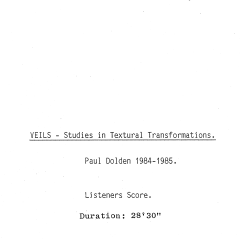
Veils, subtitled Studies in Textural Transformations, is a series of textures or walls of sound which act as an invitation for the listener to explore an environment where new acoustic sensations and associations can be discovered. The texture, a sustained chord of usually 14-56 notes, is constantly transforming by changing the instrument type that is articulating the sound (ie: from strings to voice, to brass, to piano, to marimba, to glass, etc). No electronic effects were used and only straight recordings and mixing of acoustic instruments were used. However, the sound source or instrument type at any moment is not usually obvious to the listener, hence the sound sources are ‘veiled.’ This veiled sound is created by three main factors: the extensive multitracking (from 180 to 280 tracks of the same instrument are used at any one moment), the tuning of the chords (microtonal intervals which do not occur in our normal 12-Tone Equal Tempered Tuning System), and the recording method of close miking in a dead acoustical space which brings out aspects of each instrument type that we normally do not hear. The title also aludes to a real veil where one can switch between seeing individual strands and viewing the overall pattern. In Veils it is imagined that the listener can freely drift from one type of perception to another (ie: micro to macro level or individual layer to mass effect).


The recording stages of Veils were realized at the composer’s studio and the premixing and final mastering took place in the Sonic Research Studio of Simon Fraser University (SFU) (Vancouver, BC). The piece premiered on August 19, 1985 at the International Computer Music Conference (ICMC ’85) in Vancouver (BC). The work won 2nd prize in the Electroacoustic category of the Bourges International Electroacoustic Music Competition (Bourges, France, 1986); the 3rd prize of the Luigi Russolo International Competition (Varese, Italy, 1986); and it was awarded a 1992 Euphonie d’or “as one of the twenty most significant works from two decades of the Bourges Awards.”

Preparation

Composition

Premiere

  • August 19, 1985, ICMC 1985: Listening Session 1, Simon Fraser University – Theatre, Burnaby (British Columbia, Canada)

Awards

Mixing


Scores