
strings.lines
Nicolas Bernier / Pierre-Yves Martel, Chris Bartos
It is sweet, it is bitter. It is fragile, it is rough. It is sentimental, it is cool. It feels spontaneous, it has been carefully constructed — there’s no end to the list. — Tokafi, Allemagne
Trois disques pour trois directions opposées, mais toujours ce même régal au moment d’aborder et de se plonger dans les travaux du maestro Montréalais. — Goûte mes disques, Belgique
- Compositeur·trice(s): Nicolas Bernier
- Interprète(s): Pierre-Yves Martel, Chris Bartos
- Image de couverture: Urban9
CD (CRONICA 053, 2010)
- Cet article n’est pas disponible via notre site web. Nous l’avons catalogué à titre informatif seulement.
- Cet article peut être téléchargé et/ou écouté sur le site nicolasbernier.bandcamp.com.
- 1strings.lines (2008-10), 41:18
- 1line (strings), 2:55
- 2line (a), 10:35
- 3line (b), 5:25
- 4line (c), 8:24
- 5line (horizon), 14:02
- Étiquette: Crónica Electrónica
- CRONICA 053
- 2010
- Durée totale: 41:18
- 127 mm × 142 mm × 4 mm
- 35 g
Sur le web
Notes liminaires
About strings.lines
The “lines” in the title originates from here
The pieces presented in this edition are studio compositions of layers from the two stages of the work, blending both worlds while trying to keep a sense of the original materiality and timbres, but not refraining from using other sounds and sources whenever necessary.
— [x-10] [source
Quelques articles recommandés


La presse en parle
Kritik

Und plötzlich war da diese Stimmgabel. Nicolas konnte nicht aufhören den ganzen Tag daran zu denken. “Dieser Ton
Review
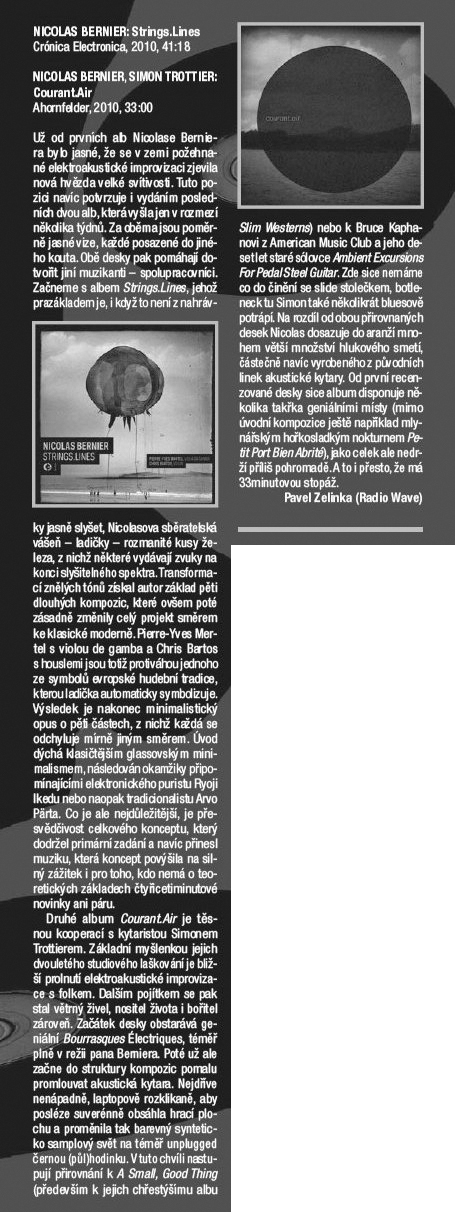
Interview with Nicolas Bernier
To the outside observer, Canada must sometimes seem as though it were founded on paradoxes. An industrial powerhouse sporting some of the leading cultural metropolises, it is also torn one of the most thinly populated countries on the planet, with vast, uninhabited planes opening up right next to its sprawling economic centres. It should seem only logical that a nation as complex as this should give birth to an artist like
Could one regard the strong contrasts in your music as a direct reference to the contrasts of Canada, with a big city like Ottawa lying next to vast patches of wild nature
Clever
What are the fundamentals of this dichotomy
It’s all about this love/hate relationship with the computer. I admire the computer in a way. As a freelancer, I can do so much work, from business to communication and creation with one single piece of electronics — truly incredible. And I can take the core of my studio and travel with it to anywhere in the world. On the other hand, the computer is such a boring, anonymous, unpleasant interface, especially when it’s time to make music. It is making everything virtual and I still hope to live in the real world, a world that I can feel with all my senses, not only from a computer screen. So I find ways to work in the real world. Performance is one way of achieving this, collaboration and field recording are others.
Is that why the term “handmade" is so prominently featured in your biography
Yes, that’s how I manage to beat that computer down
How has this influenced your perspective on recording in the field
In 2009, I spent a lot of time in the Canadian West. It is the perfect cliché of what a foreigner will imagine Canada to be like
How do you feel about the idea that if we attune our senses and expectations, we are constantly surrounded by the most wonderful music
I’ve always thought it difficult to make any clear statement with music unless it uses voice. During the Iraq war, I composed an electroacoustic piece with a rapper singing an anti-war, anti-Bush text, but it didn’t really work out. Nobody but me actually heard that piece. I would situate myself far from the
In which way did folk and acoustic music, as typical symbols of purity, play a role in your early musical education
This question of purity is interesting because what one could consider as pure in my early musical education is, in fact, not so pure. This is, in a way, because I started with real instruments and punk rock. I began my musical life within a wall of distortion. Now I deal extensively with timbre, with unidentified materiologies. But stage performance and distorted guitars remain my own personal folk, my roots. And I think that sometimes I still make use of that punk rock energy and those hooks when composing musique concrète or audio performances. One thing I have to mention is that even in my punk rock phase, I was immediately attracted to blending all the different kinds of music I loved, from jazz or new age to grindcore.
You indeed seem to consider these genres as options in a giant toolbox. Can you trace this back to the music that surrounded you when you were young
I’ve definitely always considered music as a “field of possibilities”, to paraphrase
How and when did sound as a musical element enter into your world
It entered progressively. It entered timidly in my early teenage years by trying to produce weird chords, weird rhythms and so forth. The big bang occurred when I arrived in Montréal. I brought my band from rock to improv-based ambient rock. Sound was entering more deeply into the practice and I was discovering modern music. I soon attended my first concert of electroacoustic music. It took place in complete darkness, with no performers on stage, nothing to see, everything to be heard. That was a turning point. There was something I did not understand about it — and I loved it. So I’ve tried to understand it better to be closer to that unknown.
You seem to have a special relationship with sound.
Yes, I am in a relationship with sounds. No doubt
How has this relationship changed over the years
It’s hard to say. I think that it began with a poetic relationship and grew into a more technical one. I am not a technical guy at all, but I am becoming more sensitive to technique — maybe because I feel that my relationship with sound is now mature.
In the notes to
In that single object, the tuning fork, I’ve found not only a symbol of my musical objectives, but also of my general interest for that dichotomy between the old and the new. I think it has something to do with the relation between the inside of the mind and the real outside world. I like to spend time on old bazaars and in antiquaries. When I compose, I think I feel closer to antiquaries than to avant-garde artist. In the meantime, I just love to be in a white museum room or to listen to minimal electronic music. I feel there is this obsession for clarity and sobriety in the art world. This is maybe what would segregate the official and the underground scene. The underground is more rough, more drafty, the works are less organized, they don’t give an impression of perfection. So maybe I feel closer to the underground, maybe it is still that punk-rock thing running after me, bearing me to not cross-over into the official realms. This obsession for dust is also a counter-reaction to my tool, the oh so white — or grey or black but please not beige — the oh so sterile laptop. With
Tuning forks, as the project suggests, have become symbols of the occident’s entire musical heritage. In which way has this lineage and tradition played a role in your life
There this extremely purist approach in electroacoustics, based on space and timbre as the most important parameters for music. When I started out with electroacoustics, instead of falling into the endless possibilities of creating completely new sounds, I quickly faced the fact that the timbres of traditional musical instrument are the most high-class timbres of all. They’ve been developed over centuries to achieve perfection and richness. So I never really understood why one should not use them when doing sound art. I am not that much engaged in occidental classical music. I am engaged in it, but for me it is just another aspect of this giant toolbox called music. What
It’s funny to bring that project up. I’ve put it in my list of works just because I don’t want to forget it and also because I don’t want to forget that
When did you decide you wanted to be an artist
After those years, I’ve tried to convinced myself that music was not an option, as you could barely live as a musician. But you cannot decide to become an artist. There’s a force that make you involved in what you like the most. It’s not a choice, you either do it or you don’t. When I was about eighteen, I tried to convince myself that I had to study something more common. So I studied radio, which I thought was close to music but it’s not at all, and marketing — I actually wanted to be a graphic designer. Always keeping some rock and improv projects, I worked as a web programmer/designer for almost ten years. And that’s how I made my musical education
With its Honorary mention at the Prix Ars Electronica 2009,
It was a huge highlight indeed
Would it be correct to refer to
I’ve always been producing like crazy actually. I just can’t help it
What have been your main compositional challenges over the past two years
One of my main challenges was… to find myself
In the preface to
I would never say that sound is the art form, not in an absolute way. Of course it is for me because it suits my personal interests. But this is only a personal matter. Besides, as soon as you get into a concert hall or exhibition space, it’s not just about sound anymore. It’s a ritual, it’s a show, it’s always a multi-sensorial, multi-aspect experience. Shows are great. But this is maybe why I love so much to compose for a fixed medium — CD, digital, DVD — because I know that some of the audience will be appreciating the work quietly, in the intimate setting of their homes, not expecting any spectacular show but with the more modest aim of simply listening to the music. Besides, there are art forms that impress me even more. In dance, for example, all you basically need is a body. Most of the shows are complex and involve music, stage design and lighting. But in its most simple form, when the movement of a body can move me, this is a truly amazing thing.
Concerning the abolition of boundaries, we come back again to that question about this giant toolbox, this “field of possibilities”. I just don’t see the point of segregation. The world is rich and sharing this richness is about all we can do here. A couple of years ago, when I was active in different fields of sound creation, I was putting all my different approaches into different boxes made for different sensibilities, different people. But over the years, those different approaches have all collapsed into one entity made of various components, that still can be identified as one single thing. I hope you are following me
Perhaps one could say that
Yes, they are combining tonal perspective alongside some noise, drones, clicks, acousmatic gesture, pop and rock influences. When I did
And still, despite aiming at the eradication of borders, your artistic world is not without its delimitations.
I guess there is always a frontier after all
As you can see, I am not in a good position to label myself. I guess there are people better equipped at doing this. But my fundamental objective would probably be to make music that feels human despite the fact that is made with a computer. The fundamental aesthetic of my work will probably always rely somewhat on the tension between conceptual rigidity and intuition.
Nicolas Bernier toujours au sommet de son art
On a beau réaliser des dossiers exhaustifs sur le bonhomme, il semblerait qu’on ait toujours un temps de retard sur la discographie de
On clôture la marche par
Critique
Kritik
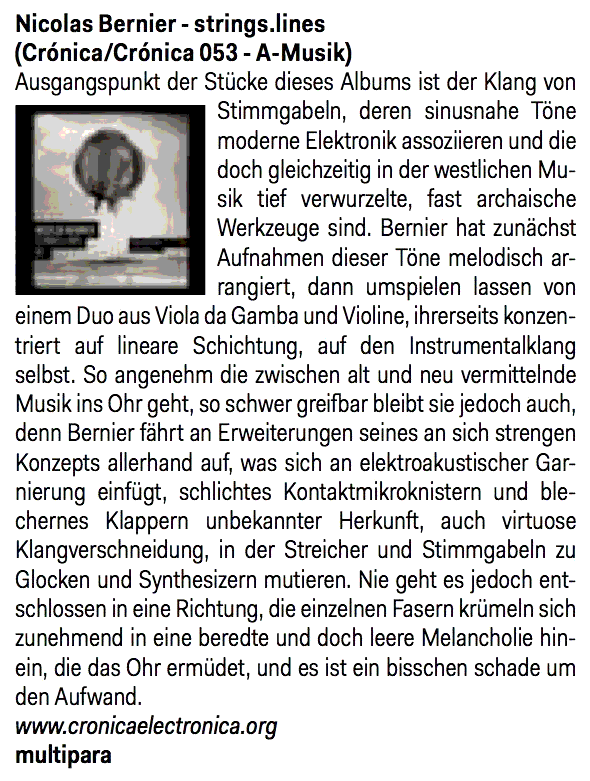
Ausgangspunkt des Stücke dieses Albums ist der Klang von Stimmgabeln, deren sinusnahe Töne moderne Elektronik assoziieren und die doch gleichzeitig in der westlichen Musik tief verwurzelte, fast archaische Werkzeuge sind.
Review
The glacial gloom conveyed from the strings is actually closer to work by backwards-looking contemporary composers like
Critique
Créées entre 2008 et 2010, les 5 pièces qui composent
Kritik
Review
Released a couple of months before
Although released in quick successions, these three records stem from totally different ideas, the resulting pieces, while bearing some common elements, revealing
Recensione
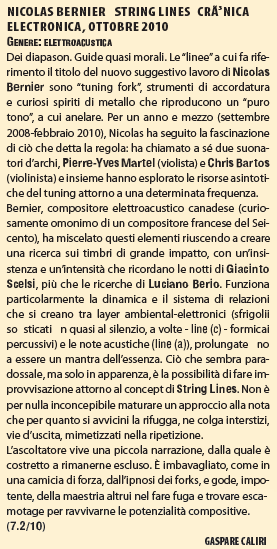
Dei diapason. Guide quasi morali. Le “linee” a cui fa riferimento il titolo del nuovo suggestivo lavoro di
Kritik
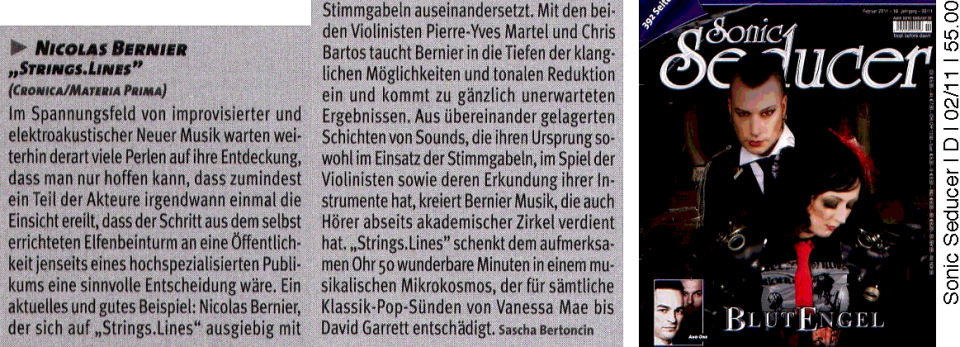
Im Spannungsfeld von improvisierter und elektroakustischer Neuer Musik warten weiterhin derart viele Perlen auf ihre Entdeckung, dass man nur hoffen kann, dass zumindest ein Teil der Akteure irgendwann einmal die Einsicht ereilt, dass der Schritt aus dem selbst errichteten Elfenbeinturm an eine Öffentlichkeit jenseits eines hochspezialisierten Publikums eine sinnvolle Entscheidung wäre. Ein aktuelles und gutes Beispiel
Recensione
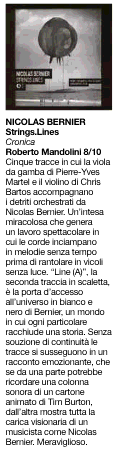
Cinque tracce in cui la viola da gamba di
Critique
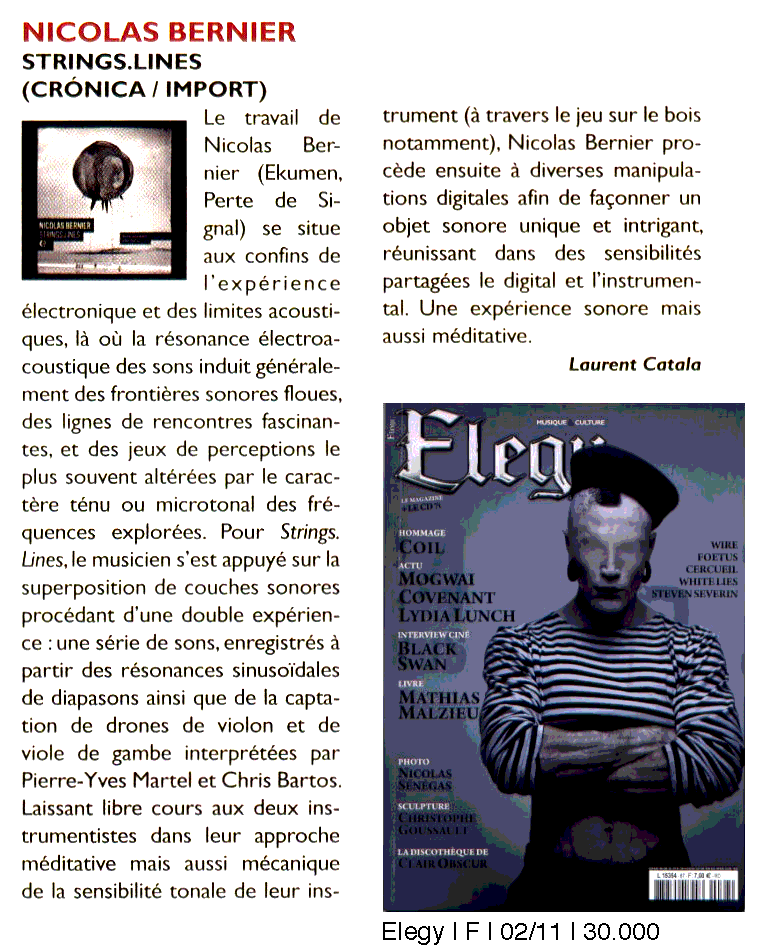
Le travail de
Voile et vapeur
Kritiek
De Canadees
Review
It’s only a few weeks ago that I reviewed
Tapage nocturne
À ne pas confondre avec le compositeur du 17e du même nom. Ce musicien de musique électroacoustique québécois excelle dans les performances sonores, les installations et la vidéo. Collectionneur d’anciennes machines à écrire et de diapasons (dont certains atteignent les limites de l’oreille humaine), il a su créer son univers musical très personnel, utilisant des sonorités acoustique et électroniques générées par ces objets du passé et les technologies les plus récentes. Un matériel de création sonore représentatif des normes et des règles de nos musiques occidentales mais dont l’utilisation inventive et non conformiste donne, une fois encore, naissance à de très belles compositions intimistes et délicates.
Journal d’écoute
Quelle joie de voir le Montréalais
Review
Review
Product Review
Portugal’s Crónica label presents a captivating showcase from Montréal-based electroacoustic composer,
Blogue
-
dimanche 1 mai 2011 / Presse
-
mardi 22 mars 2011 / Presse
It is sweet, it is bitter. It is fragile, it is rough. It is sentimental, it is cool. It feels spontaneous, it has been carefully constructed — there’s no end to the list. Suite
-
mardi 8 mars 2011 / Presse
Trois disques pour trois directions opposées, mais toujours ce même régal au moment d’aborder et de se plonger dans les travaux du maestro Montréalais. Suite