[This text was also printed in SAN Diffusion (RU), 1 novembre 2000]
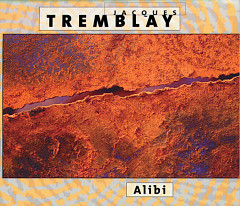
The recent Jacques Tremblay compact disc, Alibi, includes six pieces dating from 1990-1995. Mr. Tremblay is a young composer who explains in the program notes that he began as a guitarist and encountered electroacoustic music as a “revelation.” Further, he grounds his work in the use of concrete sound, both vocal and ambient, and favors a rich, dark sound palette. The “typical” sonic makeup of the first three pieces, in particular, are so varied and rich, yet oddly similar to each other, that listeners may prefer to listen to the CD in the following order: tracks 1, 4, 2, 6, 3, 5.
The first work, Hérésie ou les bas-reliefs du dogme (1990), is a relatively long 21-min piece, which includes extended recordings of an American fundamentalist Christian preacher along with snippets of Frank Sinatra and Muslim and Gregorian chant. The extended “rant” of the preacher is countered with French dialogue which I could not follow, but which another reviewer characterized as “papal posturing.” Most of the quoted speech is enmeshed in a rich stew of repetitive, mechanical sounds, and long stretches of bell-like overtones emphasizing upper partials over repetitions of tonic and dominant. Occasional stretches of Tibetan horns and Gregorian chant (sung by a woman, yet another heresy!) gradually distort and slither away. The religious spirit is perhaps viewed here through the lens of those dark, Spanish baroque paintings, all blood, fire, and damnation, although religion itself is viewed as the evil. The piece inscribes a long 18min arc, pauses, and then has a 3-min coda of similar material. I am not altogether convinced by this large-scale form, but certainly Mr. Tremblay has a feel for climactic intensity and gnarly sounds which get under your skin.
Oaristys (1991) is described as following “the stages of a hypothetical night of love,” and is divided into six movements: Call of Desire, Approach, Embraces and Sensuous Delight, Animal Urges, Scattering, and Inflection. This work is highly sensual, but ominous as well. But then, great passion is often companion to a sense of danger, of vulnerability before the beloved other, even as union occurs. Mr. Tremblay draws from both these sides of the erotic experience. Waves, bird-like calls, cello quotes from a Bach Sarabande, and the stylized vocalizations of a Japanese Noh actor all enmesh the listener in a sinuously rich texture. The second section loops and cycles erotic feminine laughter with percussive patterns reminiscent of bird calls. The composer characterizes this section as a remake of the Erotica movement of Symphonic pour un homme seul by Pierre Schaeffer and Pierre Henry. Sounds progressively expand, speed up, reappear, distort, and disappear in a mercurial trajectory, and the succeeding four movements follow each other until ending with a slow, brooding finale.
The third work, L’intrus au chapeau de spleen (The Intruder with a Spleen Hat), is a mysterious sonic stew which incorporates favorite Tremblay strategies — multi-layered repetitive mechanical sounds, sinuously morphing gestures — but allowing a bit more silence to frame individual gestures. A mysterious, watery, and nocturnal world is evoked, conveying the sense of what boils and roils beneath otherwise ordinary surfaces.
Rictus nocturne (1992), again in six movements, evokes the jam session of jazz. I quote the composer: “Each movement follows its own story and develops a compositional problem: montage; play-sequence, of density; of silence; and of sketched, improvised and edited sequences from object instruments.” The jazz idiom, though, is absent in the composer’s own music, though it is intermittently quoted. Interestingly, this piece includes the most introspective and quiet music heard on the disc to this point. What Mr. Tremblay seems to love most of jazz is its quiet balladic side as well as the needle noise of old records which he riffs upon.
Jeu d’ondes quotes Maurice Ravel’s Jeu d’eau, and also includes quotes from historic recordings of reflections on the problems of creating an FM network for radio broadcast. Delightful confections of boat noises, much of it frothy and effervescent, make this a tasty morsel.
La robe nue (The Naked Dress) uses string sounds for a good deal of its material, as well as bells, train, and a horse. The composer evokes Marcel Proust’s Cambray, the first book of Remembrance of Things Past. Mr. Tremblay returns to a reflective mood, giving individual sounds room to gently resonate. This piece is extremely effective in maintaining a languorous, yet musically compelling, texture throughout.