Sauter au contenu principal
electrocd
  • This website is also available in English.

Blogue

195 résultats
  • 16
  • 17
  • 18
  • 19
  • 20
  • 21
  • 22
  • 23
  • 24
  • Bleak 1999 dans Somamag

    «Tonträger», Von Falk, Somamag, 9 mars 2004
    mardi 9 mars 2004 Presse

    Tomas Jirku hier mal anders, als man ihn beispielsweise von seinen Releases auf Force Inc. oder Intr_version kennt. Auf seinem 5. Album, welches, wie der Titel schon nahelegt, Material aus 1999 beinhaltet, zeigt er sich von seiner dunklen Seite. Minimale Beats gehen einher mit diversen Radio-Samples, weissem Rauschen und düsteren, schwermütigen Melodielinien, welche dem Ganzen eine beklemmende, trostlose Atmosphäre verleihen. Die Tracks tragen die Bezeichnungen diverser Medikamente — Clindamycin, Cefuroxime, Haloperidol, Lorazepam, Tranylcypromine, … und wie ein Gemisch aus all diesen klingt das Ganze dann auch — ein musikalischer Medikamentencocktail sozusagen. Zu Risiken und Nebenwirkungen…

    Rumors of War dans Liability Webzine

    «Chronique», Fabien, Liability Webzine, 8 mars 2004
    lundi 8 mars 2004 Presse

    Le thème de ce disque est, chacun l’aura compris en voyant les intitulés des titres, la guerre. Cette guerre qui a jalonné le vingtième siècle comme la peste et qui grâce à la médiatisation l’a encore rendue plus ignoble. Il n’y a aucune fierté à faire la guerre et on y trouve aucun honneur. J’enfonce des portes ouvertes me direz-vous mais les aficionados de la bonne guerre sont encore nombreux et il y en a encore qui lui trouve une quelconque vertu. De là on ce que l’on trouve cela normal il n’y a pas loin. Triste monde. Les leçons de l’Histoire ne se retiennent pas ou si peu.

    Ce duo composé par les romains Maurizio Martusciello et Filippo Paolini nous proposent de nous rafraîchir un petit peu la mémoire. Les deux hommes qui ont formé ce groupe en 1997 ont pris pour habitude de faire des expérimentations électroacoustiques que ce soit sous forme de compositions ou d’improvisations. Sur Rumors of War le duo est relativement accessible et propose des compositions post-apocalyptiques à la noirceur évidente. On a l’impression de rentrer dans un vaste no man’s land où rien ne pourrait survivre. Rumors of War est une œuvre sombre et guère optimiste mais le thème abordé par les deux italiens ne l’est pas beaucoup. Cependant et malgré une certaine lenteur et un minimalisme omniprésent les morceaux dégagent une force peu commune. La guerre, finalement, c’est la misère humaine, le recours des faibles et l’absence d’humanité. Metaxu se veut le relais de ce sentiment. Qu’a t’on à gagner dans la guerre? Metaxu donne a réponse: la désolation. Ce disque est comme une sorte de requiem moderne, celui de l’humanité dans sa globalité, du moins celle qui se laisse attirer par des idées extrêmes. Le message que Metaxu veut laisser passer est somme toute assez clair: n’oubliez pas!

    … malgré une certaine lenteur et un minimalisme omniprésent les morceaux dégagent une force peu commune.

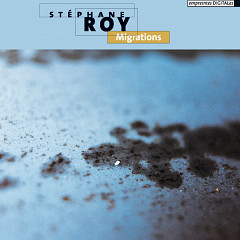
    Migrations dans Sonoloco Record Reviews

    «Review», Ingvar Loco Nordin, Sonoloco Record Reviews, 4 mars 2004
    jeudi 4 mars 2004 Presse

    Stéphane Roy (1959) is a well-educated man, with a doctorate degree in electroacoustic composition and a PhD in musicology – but he sounds good anyway! He has spent some years in the US Midwest, but now resides in Montréal.

    The idea and concept of immigration, of migrations, of peoples and people journeying for better lives, traveling the roads of hope, have inspired the title – and the content – of this CD. Roy says that “this radical displacement expresses a desire for freedom that transcends territorial and cultural borders.”

    Yes, we all should know and remember; remember how a few individuals crossed the Bering Straits to Alaska many thousands of years ago, to seep down into the continent, slowly expanding into all the different Indian tribes across the Americas (a theory lately supported by DNA analysis), and I, for one, remember well the third of all Swedes that emigrated to the U.S.A. in the 19th century and early 20th century; a fact that I think all these racists of late in Sweden ought to ponder some on.

    The first work on the CD is Appartenances (Belongings). A vibrating spinning-top, dancing in the gutter, disposed-off newspapers flickering in the wind that blows up the avenue… a loud, richly timbralled thud – and a maddening spinning-top vibrato…

    A number of street-vise vexations embellish Roy’s first piece on the CD, and – perhaps – some sampled and disfigured car horns get caught in the whirlwind of the cityscape, the soundscape – but Roy has really – as he also indicated – taken the sounds off of the streets into a formidable manipulative catharsis, so that only your utmost imagination can detect any connection whatsoever, to a street scene of the northern city of Leonard Cohen and the Lady of the Harbor… Voices blend in, towards the end, but they’re mostly indiscernible as to intelligible content, and, I think, of different lingual descent. Formidable!

    The transformation into part 2 of Appartenances isn’t smooth or nice, but I suppose Roy wanted it that way. What follows, though, is incredibly intricate and detailed, sometimes just hinted, electroacoustics. There a sweeping, elastic insect motions as well as watery trickles and thin, hardly audible folk orchestras deep inside the theories, as the likeness of voices, forlorn and disguised and probably just remembered or hallucinated, staccato by, smoothed and withheld. Fast, rock n’ rollish rhythms in the soundscape move easily in and out of earshot, until the tempo falls drastically, into some meditation on a city and its secret thoughts. Beautiful! The music touches you like warm summer gusts out of asphalt streets, your body walking by itself down the sidewalks of Quebec!

    The third part of Appartenances opens in droning thoughtfulnesses, coats and layers on coats and layers, like varnish on hardwood, thoughts and dreams and fleeing moments caught in the glare… A tender and very close female voice soars about your senses, without Eros but full of Agape, the relief on un-body lifting your unselfish thoughts on high, where they sail about like seagulls on the wind, free of guilt and rebirth.

    The voice comes down with a scrubbing harshness of gently applied delay and chorus, until it begins to mimic a young school girl trio all by itself; a daydream of sidewalks of Canada, picturing street-side gardens of lilac arbors and Om Kalsoum addicts sipping refreshing fluids in the afternoons, legs outstretched, dreams among the leaves.

    The second piece (tracks 4 – 6) is Trois petites histoires concrètes dedicated to Pierre Schaeffer

    A signal haze, a mist of electric calls, a submarine or shortwave matter, taken seriously… and the piece is on its way, but be careful when listening through earphones, for loud, albeit nicely polished spheres do appear, quickly and without warning – with the exception of this warning of mine. Roy’s magic hand is a work here in all its mastery, because I can testify to the beauty and glare of this, the intricacy and the tightly knitted patterns of sometimes infinitesimal specks of audio, which, praise be, grow into magically swelling barrels of sound, tumbling down the alleys of North America like fat French immigrants, high on red wine and lovemaking!

    The wood incision makes things even nicer, opening a space between high-rise trees where the songbirds fly in electrocardiogram motions, from hideout to needle hideout. Stéphane Roy does not leave this idyllic atmosphere be, for he brings in the whole industry of forestry, blanking out those birdies in the fumes of heavy machinery…

    The last piece is Masques et parades. The tragic-comic nature of the circus is the lifeblood of this work. The circus provides a marvelous metaphor to bring together irrationality and drama, jubilation and self-control: a show spiced up with extreme moments and paradoxical quests where celebration and tragedy hold hands. Following this example, Masques et parades stages the opposite dimensions of introspection and mask, sides hidden and revealed, darkness and light, drama and derision. The work consists of three sections. The lively, euphoric, even brotherly mood of the first, Exultation, contrasts sharply with the grotesque feel and irrational, iconoclastic nature of the second, Burlesque. Noir silence, the last section, draws its inspiration from the art of trapeze, metaphor of the compensatory work done by our psychological mechanisms in answer to the destabilizing assaults of a troubling world out of which one must make sense.

    This begins very differently, compared to other get-goings on this CD; a bumpy rhythm, almost comical, later picking up some orchestral residue while hopping down the path, grabbing some atmospheres along the way, of spacious premises, allowing for little bells and prickly tinies too… 0It’s a quick, fun, electroacoustic show-off that leaves no mouth unsmiled! It’s a detailed and extremely varied piece of music, enjoyable and surprising, touching and fun, transparent but sometimes tight and dense, with interspersed reminiscences from 19th century Russian avenues in the snow (thinking about a poem by Lawrence Ferlinghetti).

    It’s hard to keep cool hearing this. I’d like to play this loud for those ignorant buddies of mine who will have nothing to do with electroacoustics, those dance band swingers and women chasers in their upper, divorced and aging middle-ages. I’d bang this piece in their somnambulistic heads, to make colors and motions appear behind their eyelids.

    The second section of this last piece mangles and cuts and shreds sounds into flying flakes of some kind of reality, an impossible puzzle of existential parts that eventually will come to rest in the most outrageous patterns; a kind of essence of humanism across this bluish sphere of ours. Laughter is suddenly thrown in as just another ingredient, but Roy manages to make this completely maddening progression of shortcuts really work in an over-arching flow, a curvature of thorny bliss that encompasses one and all and everything! Right on! Great!

    The last part of the last piece begins with a consoling or just all-knowing female uttering the words “l’immobilité”, at first just like an all-knowing female would, and then chorused and birdied, sounding like a bunch of colibris trembling in the air in front of you, slowly hovering up, down, left, right, in a minuscule motion. A male voice also enters, and later the voices whisper and chew the words, while the electroacoustics amplify or subdue the morphemes in brilliant auditory applications, making everything stick, come together in a wondrous web of sounds. Thins start getting faster and more relentless, but a safe female voice cuts down like an ax, stopping the force of sounds. This exchange between voices, one at a time, male or female, and a tremendous, fast electroacoustism, keeps on keeping on, in a flabbergasting, ear catching amassments of splendid ideas! I am impressed!

    … a tremendous, fast electroacoustism, keeps on keeping on, in a flabbergasting, ear catching amassments of splendid ideas! I am impressed!

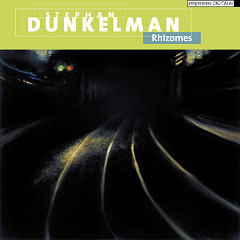
    Rhizomes dans Audion

    «Review», Alan Freeman, Audion, no 49, 1 mars 2004
    lundi 1 mars 2004 Presse

    There tends to be a lot of electroacoustic albums around these days inhabiting the realm of sonic creation invented by the likes of François Bayle and Pierre Henry, sometimes so much so (as in the case of this release) that you tend to “train-spot” those mentors well-known techniques. Mr. Dunkelman, however, doesn’t filch all his ideas from elsewhere and he does through in some very bizarre quirks and diversions. You can tell he’s also delved into the “plunderphonics” field, and his use of abrupt splicing and serious “clunks” can be a mite unnerving. A lot of environmental, street sounds and cityscapes also feature. It’s one to absorb with many listens, each yielding a new experience as one grows familiar with it.

    Sings the Blues dans South of Mainstream

    «Review», Compgeekgirl, South of Mainstream, 1 mars 2004
    lundi 1 mars 2004 Presse

    I’ve been listening to this album on and off for over a month. In fact, this disc is thus far the one I’ve had to listen to the most before feeling capable of writing a review that would do it justice. This was a hard review. Look at the rating and you’ll see that the difficulty didn’t have anything to do with a less than stellar listen. This is an invasive and infectious listen that I felt I needed to really research (listen to often) to be able to write a sound review.

    How to describe the overall sound? Well, it isn’t the blues, let me get that straight first and foremost. It’s instead a comglomerate of vast and varied electronic styles, mixing together to create a sound mixture that’s always fresh and interesting, never too much of that same beat or blip. And it’s more still, as some of these electronically created tunes definitely rock. And it’s a one man show, making it all the more impressive. Todd Drootin stands tall and delivers a diverse and driven listen.

    I found the first couple of tracks a little listless, though quite listenable, with moments that drew me in, like the rolling rhythmic sound of See You In Tokyo which segues into some bloops and blips that would make the Art of Noise proud. She’s Dead To Me is a frantic, energetic onslaught of dysfunctional, but downright cool electronic noise.

    I really got into the album around the sixth track, Girls Up Front, which has the sort of soulful female backing vocal samples that you might expect on a Fat Boy Slim project, along with a cool rolling rhythm punched up with faster rhythmic punches. Death In the Sex Shop is much harder, faster and more raw, with a definite frantic appeal. This song should be gracing an extreme sport video rather than some of the sycophantic emo/power pop punk currently holding that honor. Siberian Soundsystem brings to mind Ministry, KMFDM and early Orgy. It’s very dark, but still has an infectious pace. Frisson is also dark, but instead of frantic energy it’s appeal is it’s somber, sedate delivery.

    You’d think the mish-mash of sounds would prove distracting, but they don’t. This is one of those albums that has you sitting on the edge of your seat, waiting to see what the next song will do, how it will “feel”. Will it be another dark and dangerous offering, or an indie-electronic wonder that will get your ass out of the seat and on your feet.

    This is the kind of disc you need at your older 20-something/early 30-something party. It will get your guests away from the snack table and cause them to hover around the stereo wanting to know who this is, what the next song will sound like, and where they can get a copy.

    … an indie-electronic wonder that will get your ass out of the seat and on your feet.

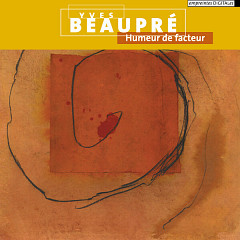
    Humeur de facteur, Yves Beaupré dans La Scena Musicale

    «L’année des clavecins Yves Beaupré», Réjean Beaucage, La Scena Musicale, no 9:6, 1 mars 2004
    lundi 1 mars 2004 Presse

    C’est devant tout le milieu québécois de la musique de concert qu’Yves Beaupré, facteur de clavecins, est allé cueillir le 25 janvier dernier le prix Opus Reconnaissance à un facteur d’instruments. Le Conseil québécois de la musique lui a remis ce Prix, accompagné d’une bourse de 5000$ offerte par la Société de développement des entreprises culturelles (SODEC), pour l’ensemble de son œuvre, qui compte plus de 100 instruments livrés au Canada, aux États-Unis et en Europe.

    Le facteur, complice du musicien

    Cette distinction montre combien le travail des luthiers, facteurs et autres artisans importe dans la démarche artistique des musiciens. Cette importance peut difficilement être mieux démontrée que dans le travail d’Yves Beaupré. Depuis 1982, il permet aux musiciens d’explorer le répertoire baroque sur des instruments fidèles à leur époque de référence.

    Pour Yves Beaupré, «le Prix Opus apporte une notoriété qui aide le travail mais elle met surtout en évidence le travail accompli». Les instruments qu’il fabrique ont déjà permis à des centaines de musiciens de participer au renouveau de la musique baroque.

    Un bon instrument fait toute la différence pour le musicien. Le claveciniste Luc Beauséjour remportait trois Prix Opus en janvier dernier: «En faisant des clavecins bien réglés, inspirants, dont l’univers sonore permet de bien traduire la musique, le travail d’Yves Beaupré m’a forcément aidé car l’instrument, qui est en fait la ‘voix’ de l’interprète, est un précieux allié lors du travail de répétition ou lors d’une prestation en concert.» Bien qu’il n’enregistre pas exclusivement sur les clavecins Yves Beaupré, Luc Beauséjour fait presque tous ses concerts avec ceux-ci. Il possède personnellement un clavecin français à deux claviers fait en 1998, d’après Hemsch et Blanchet (deux facteurs parisiens du milieu xviiie siècle).

    La démarche artistique de l’artisan

    Depuis plus de 20 ans, les clavecins Yves Beaupré ont acquis une réputation enviable grâce à leur excellente sonorité, leur mécanique fiable, leur stabilité et leur apparence soignée. Comme beaucoup d’autres artisans, Yves Beaupré a d’abord débuté comme musicien. Il a choisi le clavecin pour le baccalauréat en interprétation à l’Université de Montréal, où Réjean Poirier lui a enseigné. C’est par nécessité qu’il en est venu à fabriquer son premier instrument à la fin du bac en 1977. Après l’étude approfondie des principales collections d’instruments anciens (Paris, Anvers, Édimbourg, Washington, etc.), Yves Beaupré a su s’inspirer des éléments les plus convaincants et les plus représentatifs des grandes écoles de facture.

    Tous ses instruments sont fabriqués suivant les principes de la facture traditionnelle: choix des matériaux, mesures et conception acoustique. Réjean Poirier, le doyen de la Faculté de musique de l’Université de Montréal, connaît bien la démarche d’Yves Beaupré: «Les anciens ont porté à un haut niveau de perfection la facture du clavecin. Les facteurs d’aujourd’hui n’ont pas à réinventer le clavecin, mais ils n’ont pas non plus à se limiter à faire des copies serviles. Un praticien chevronné comme Yves Beaupré a développé une compréhension profonde de chaque type d’instrument. Chaque fois qu’il reprend un plan, il modifie certains détails afin, par exemple, de donner plus de stabilité, d’enrichir le timbre dans un certain registre, mais tout cela sans jamais dénaturer le lien avec le modèle.» Danièle Forget, sa complice dans le travail et dans la vie, décore avec goût et maîtrise chaque instrument, selon l’esthétique qui leur convient.

    Luc Beauséjour dit encore: «Ce sont de très bons instruments, spécialement depuis une dizaine d’années. Ils ne sont pas toujours puissants mais la qualité de leur timbre fait leur force. Les meilleurs instruments de Beaupré sonnent particulièrement bien en enregistrement. L’égalité du toucher dépend du grand talent qu’a Yves Beaupré à tailler avec minutie les becs qui pincent les cordes. De plus, les instruments sont décorés sobrement et avec goût.»

    Réjean Poirier se souvient des crises d’orientation de son élève: «Encore aujourd’hui, il ressent le besoin de toucher à autre chose. Maintenant, c’est la composition électroacoustique! Je dois admettre que, là aussi, il fait de fort belles choses.»

    Fasciné par le travail sur la sonorité, c’est tout naturellement qu’il en est venu à enregistrer les bruits produits par son travail en atelier pour ensuite se faire électroacousticien et produire un disque très original intitulé Humeur de facteur (Empreintes Digitales, IMED 0160)

    Acquéreurs et utilisateurs

    Les clavecins d’Yves Beaupré sont utilisés par plusieurs musiciens reconnus en plus d’avoir été aquis par plusieurs universités et orchestres canadiens. À Montréal et à Toronto, on peut penser à Christopher Jackson, Paul Jenkins, Catherine Perrin, Rachel Taylor, Yves G. Préfontaine et William Wright.

    … un disque très original…
  • 16
  • 17
  • 18
  • 19
  • 20
  • 21
  • 22
  • 23
  • 24