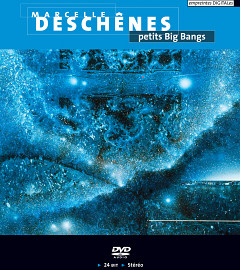
Marcelle Deschênes (1939) is an experienced art worker in various disciplines like composing, piano playing, teaching, multimedia, photography, video art, radio art and more. Her teachers include legends like Pierre Schaeffer, François Bayle and Guy Reibel.
Track 1. Big Bang II (1987, 1995) [7:40]
Marcelle Deschênes’ music here is part of a multimedia installation by George Dyens, dealing with a post-nuclear situation void of human beings. This is the end of the world as we know it.
The work was composed in 1987 for the multimedia work and then remixed in 1995 by Louis Dufort.
The sound world that opens its vast plains is eerie, as it ought to be, after a war that tore us all away into flakes of soot. Deep murmurs vibrate, panning strangely, while sharp, gray sand sounds penetrate the hypothetical listener’s eyes and ears and nostrils with radiating grains that will light flares inside all his cells.
The doomsday audio of this scary music reminds me of a short electronic piece by Folke Rabe from 1985 called Cyclone, which Folke says is almost to depressive to hear.
Somewhere midway into this layered, soaring aftermath a sound reminiscent of a distant choir appears; an angelic procession deep inside matter and radiation; messengers from another dimension far beyond the pettiness of Bush-time stupidity… or is it just the wind howling through shreds of armored trucks littering the memories of the dead?
Even farther into this dark vision, grotesque vocal mimicries call forth images from the transient bardo states between lives, which all men have to travel collectively, given the civilization crash circumstances of this music, dodging the scarecrows of their own conscience on their futile, shadowy journey towards re-birth.
Track 2 — 3. Griffes (2000-) [21:36]
Track 2. Indigo (2000) [10:40]
Griffes is a work in progress; its first two parts presented here. Marcelle Deschênes has let herself become inspired by the psychoanalytic research of Clarissa Pinkola Estés and Marie-Louise von Franz. It’s all about archetypical wild females from myths, dreams and tales.
The ambience is… spacious, immense… overpowering like thunder, but also harboring the still, convincing vocals of long-ago faiths… for a short instance, until big slabs of ice and rock audio crash right in front of you, bringing up unidentified monks in deep chanting. Just about here the ambience changes into a small, closed-in area, which in turn is transformed into dark drones and more violent granite tumbleweeds rocketing away in massive slides.
This is very unusual, mighty compelling electroacoustic music; the feeling resembling Pierre Henry’s Le Livre des morts égyptien – which is based on the sounds of a piano, but which conveys the same dark ambience and fateful moor roars in the distance as Deschênes’ Indigo.
The imperceptible transformations from totally alien landscapes under the glaciers to the soaring beauty of angelic choirs and the deep murmurs of monks in a hidden-away monastery in Tibet, to the side of a rippling brook or the humid heat at a Pacific beach, sharpens the attention of the listener. I take this sounding art more seriously than most of the things I’ve heard lately, in electroacoustics. Marcelle Deschênes has her very own voice in this art form. It doesn’t matter that this piece indeed quotes Bernard Fort, Gilles Gobeil and Jean-François Laporte. Marcelle Deschênes weaves her own tapestry around these quotes. Listening to her is like sweeping a magician’s black cloth around your shoulders.
Track 3. Le bruit des ailes (2000, 2002) [10:54]
Marcelle Deschênes has a motto for this piece: “To all those who feel the urge to stretch their wings” – and surely, if you haven’t, you have lived in vain, for sure, in vain!
In Le bruit des ailes the composer utilizes the sounding testimonies of ice storms, erupting volcanoes and nuclear tests! She also quotes some of her own pieces: Écran humain (1983), Lux (1985), D-503 (1987) and Ludi (1990).
I might insert here that I read the rich and poetic, complex notes that are provided for each piece on the CD, without knowing who wrote them, but I see now that Deschênes wrote them herself, so she is absolutely a writer and a poet!
The looming, rumbling sound that opens the event is so low-pitched that you almost feel it more than you hear it, in your anatomy, like an eruption from within, the way climate change and disappearances of livelihoods would sound, did they sound… These are worlds trembling at the prospect of annihilation and doomsday transformation. I get the notion of a kinship with Pierre Henry again, since he also brings these dark nuances into play all through the lower chakras. Fluttering of birds’ wings out of dry leaves and underbrush suddenly brings the focus up very close, right in your face, in a body-tight off-guardness, as opposed to the murmur of the threat in the distance. I can feel the smell of humid fear as doom looms. I can feel animal fear right up my nostrils.
After a little while these sounds all transform into a trans-real realm, clicking into a thought-stream that soars into shaman layers of existence that shoot like jet streams above the transient circuits of daily familiarities.
Sudden violent eruptions crash right by, avalanches of snow and mud, overwhelming lahars sweeping everything away in their massive torrents. My earphones almost can’t withstand this kind of audio. They weren’t made with volcanic eruptions in mind.
As I write this, a jetliner at an airport a few kilometers away roars to a start, bound for Stanstead in England, and for a moment I’m not sure what is Deschênes; what is Ryanair! The airwaves mix in this Cagean soundscape of the moment.
This tumbling rock and debris motion also transform into an embellished drone of surreal beauty. Deschênes handles these gliding passages from brute naturalism to Apollonian mindscapes with expertise, bringing you clear from pain to soaring pleasure in alleviating ascensions into space shuttle orbits, high above the mud strife of daily life. Into this lucid sphere of lightness and mind hall atmospheres she introduces splintered glass sonorities that tinkle and twinkle like stars in the void and their piercing reflections on a nocturnal sheet of crusted Lapland snow. Many whirls and eddies in the sound sweep by, confusing the overall motion with their deviations. Static crackling and eerie birdcalls mix into the drone episode, further amplifying the sense of imminent danger.
Suddenly the course of events slow down, as if encountering thick glue or congested time… and the music moves dreamlike, in a manner of a held-back chronology, clamped between the palpability of the Here and the Now in an impossible dimensional loop. Everything is forced to stop and think, as time and space curl up in a super-gravitational grip. Time is taking a time-out.
A wave motion of jingling, jangling jawbone audio washes the shores of perception, as time towers in the distance, ready to crash in on us again… Beautiful overtone drones carrying earth-colored atmospheres with violet birdcalls surround you like some hesitating dawn, yawning at the periphery of existence. High-pitch events talk to you on an ascended level of communication, while all sorts of things happen all through the lower realms, in this illusionary confinement of the body. Time still gathers strength at a hypothetical horizon.
Towards the end of Le bruit des ailes time breaks through the latticework of stolen moments in a dimensional upstream, crashing down on the listener in bits and pieces of decades and centuries and millennia and a splintering storm of heres and nows, causing an auditory mish-mash of history to fall by into a future that proves just as arbitrary as any randomly encountered section of the space-time continuum. God does play dice…
Track 4. Lux (1985) [23:16]
Lux is the audio part of a multimedia presentation by Renée Bourassa. It contains quotes from Alain Thibault’s OUT (1985) and Quarks’ Muzik (1983), as well as Deschênes’ own deUs irae (1984). Texts by Shaw, Rutherford, Oppenheimer, Kant and Bourassa are also quoted. Vocals are provided by Gaël Andrews.
The change alone from the alien desolation and distant danger of the preceding work raises an eyebrow (mine!). Here we seem to tread a fairytale out of the Grimm Brothers in a sound-poetic setting. The repetitious, dribbling words of desire at the outset take on grotesque qualities as the goblin retreats into Deschênes’ soundscape while more intelligible, purely human sentences of reasoning argue up front.
The composer ventures into a great electroacoustic tradition here, from the French school, sporting names like Bernard Heidsieck, Henri Chopin, Antonin Artaud, François Dufrêne and certainly Michel Chion; that great tradition of speech permutations, electronics and melodrama, which has also been richly represented on the two famous series from Bourges: Cultures électroniques and Chrysopée électronique – that particular segment of electroacoustic music, musique concrète and melodrama that I enjoy the most!
It’s a long work, which changes drastically along the way, even including sections with funkhouse drum machines that I don’t like much, but you got to take it, the bitter with the sweet… The elastic, extended Tibetan monks are more in my line of duty, so to say! Their voices are spread out like a layer of honey across rye bread, until falling silent, giving way to prickly, glassy dots of pointillism, in turn mixing with backwards speech blurred and obscured by neighbor wall filters, but clearly audible wordings are poured down your back, concerning the Manhattan Project and the first great steps towards annihilation along the path of sincere human stupidity.
Track 5. Moll, opéra lilliput pour six roches molles (1976) [22:55] for 2 clarinets, 3 trombones, 3 percussion groups, toys and tape.
This work is an old acquaintance of mine, since it appeared on Cultures électroniques 7 in 1994, in the section Coda mémoire. It won the mixed music 1st prize in Bourges 1978.
This work is dedicated to our temporary body, in a series of 17 miniatures that rose out of Deschênes’ “prolonged and obsessive” observations of little stones on the beach at St Laurent. The work has to do with “the slow wearing-down caused by the passage of time”. Deschênes deliberates on these events, lifting them to a level where they show significance on micro and macro levels, the way the universe works, on the level of galaxies and on the level of the atomic jitter.
One drop falling into water… The space that is apparent from the echo suggest a subterranean facility of some kind; a sewage, perhaps, or the forlorn landscapes of Tarkovsky’s zone in Stalker – or the dangerous habitat of the dark beings of The Time Machine, the Morlocks…
And this is only one single drop hitting the surface. Then starts a panning, gray, mighty wind event, hither and thither, sweeping you this-a-way and that-a-way. After a while this gushing wind seems to transform into waves rolling onto a beach. These are the smoothing and evening forces of nature on solid states of matter.
Instruments and voices mix in with the wind and the waves in a brilliant way. This is done so sensitively and yet so intrusively and almost brutally, that it makes me want to laugh! It’s state of the art electroacoustics; the mixed form. Outlandish! If you haven’t heard this you have no idea what electroacoustic composition can be, in the hands of a poetic expert! Fantastic! I don’t know to what extent the musicians play live. I suppose they’re pre-recorded and then mixed in. Either way, their efforts bring the arts a bit further towards enlightenment. It’s an intellectual as well as an emotional and purely artistic pleasure to hear this work!
Marcelle Deschênes 1968 (self portrait)
So many things happen. The wind and the waves cease, and all the small sounds of the instruments and from tapes and electronically generated sources rise and shine in a bewildering and all but smoldering top-of-the-line menagerie of auditory excellence!
Midway a wild bamboo percussion dance stirs the dust from the hard earthen floor of the village meeting-place, while Tibetan monks blow their giant horns up the slopes, echoing back and forth through the mountain passes where prayer fliers rattle in the wind.
A gentle, jazzy miniature edges over into a dreamy electroacoustism, which breaks and stoops forward, elastically… into beautiful, layered sighs out of the vast fatigue of existence. Jingly hinges screech from inside a passing moment. For a while, the music is a magnifying glass, passed across the minute details of the duration. Spells are cast and broken in sharp percussive exclamations. Lingering thoughts extend through the stratosphere in pitches high as the sky; tracers across the canopy of heaven. This music makes me happy. A little child’s nursery rhyme comes naturally under these open skies: yet another spirit lighting up in these parts of the universe!
Track 6. Big Bang III (1992) [2:38]
This music is also designed for a multimedia installation by George Dyens. Has to do with celebrating life in all its forms and the far of its demise…
Marcelle Deschênes concludes this amazing and wonderful CD with a short piece sporting the classical insignia of the French style electroacoustics of the latter part of the 20th century, in harsh progressions through dark landscapes, across terrains that can only be approximately sensed through a perceptual haze. Sometimes the thoughts come at you in large, irregular slabs of dense matter; at other times they’re fragmented into grains of auditory morphemes; sprays of anguish showering you in droning episodes of amnesia…
Marcelle Deschênes has given me one of my most intense sound art experiences ever.