Sauter au contenu principal
electrocd

Blogue

65 résultats
  • 1
  • 2
  • 3
  • 4
  • 5
  • 6
  • 7
  • 8
  • 9
  • En orbite dans Vital

    «Review», Dolf Mulder, Vital, no 944, 11 août 2014
    lundi 11 août 2014 Presse

    Et/Ou is a collaboration of Martin Tétreault and Michael Langevin. They started in 2007 and released a first album in 2013: En orbite and so En chute libre is their second statement. Tétreault needs no introduction here. He is a longtime avant garde composer and player with the turntable as his main instrument. Langevin has a history as a drummer in the heavy metal band Voivoid. Also he was and still is engaged in numerous experimental outfits and projects. In most pieces ont his album Langevin drums with a pulse or beat. The patterns sound rather simple and not very demanding. Repetition is an important characteristic like in Duo02. They are completed by noisy textures produced by Tétreault. Their music surely arises from dialogical interplay between the two. The ingredients both players supply, do not lead in each piece to something that arises above the combination of both ingredients. The sound constellations by Tétreault offer far more depth and complexity and make a contrast with the rather straight drumming. So let us say, it is an unusual work and for that reason an interesting one. Maybe I miss the point here, but their improvisations didn’t inspire me.

    … it is an unusual work and for that reason an interesting one.

    Krishna’s Flute dans The Flute View

    «CD Review», The Flute View, 1 août 2014
    vendredi 1 août 2014 Presse

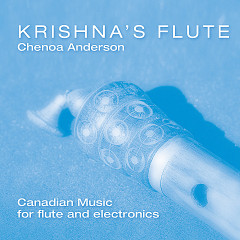
    Chenoa Anderson has a new CD for flute and electronics by Canadian composers. She is one of Canada’s leading interpreters of new music, seeking exciting new composers and repertoire. This CD is a selection of some of these new works.

    There are six pieces on the CD and they all employ interesting electronic writing and challenging flute parts, utilizing many extended techniques for the flutist. Having just completed my first composition for flute and electronics myself, it seems to me that flute and electronics is a special form, giving us a chance, as flutists to create dramatic sound paintings that can abstractly or literally tell a story.

    The CD includes works by Keith Hamel, Derek Charke, Brent Lee, John Oliver, WL Altman, and Ian Crutchley. All of them employ variously, processors, samplers, software synthesizers, pre-recording, looping, multi tracks, reverb and more to extend the flute sound. With and without scores the pieces are very evocative and Anderson plays them with conviction and thoughtfulness creating dramatic sound paintings and telling stories. In fact while I listened I was thinking, “this CD is a compendium of all the sounds you can make with a flute!” These pieces require deep listening, but I think you will enjoy the experience very much.

    … interesting electronic writing and challenging flute parts, utilizing many extended techniques for the flutist.

    Dominique Bassal dans Musica Kaleidoskopea

    «Composer Profile: Dominique Bassal», David Leone, Musica Kaleidoskopea, 25 juillet 2014
    vendredi 25 juillet 2014 Presse

    Composer and sound engineer Dominique Bassal studied electroacoustic music at a time where that discipline was at the cutting edge of audio technology. He started working in commercial music production as an arranger, producer, and studio manager, where he applied avant-garde techniques to the world of pop music, narrow and conservative at the time. However, starting in the mid-1980s, positions shifted, the music industry taking the lead in assimilating technological progress. When Bassal came back to electroacoustic in 2001, he found himself able to share the knowledge and know-how of the industry with a discipline enfeebled by years of inadequate financing and academic isolation.

    Since then, Bassal has gained recognition within the global electroacoustic community for his passionate commitment to increase the professional aspect of electroacoustic music production. He is the author of the unique and innovative document The Practice of Mastering in Electroacoustics (December 2002) and its online extension Mastering in Electroacoustics: State of Affairs (eContact 9.3, April 2007; English version: November 2007). Bassal has been empreintes DIGITALes’ mastering engineer since 2004; he has mastered a significant number of the label’s CD-Audio’s and DVD-Audio’s. He has also presented his research work in seminars all across Canada and the UK.

    Winner of the 2002 edition of Jeu de temps / Times Play, Bassal has been a jury for this competition since 2003. His works have been performed in various settings, such as the ÉuCuE concert series (Concordia University, Montréal), the 3rd Festival Musica Acusmatica (Cagliari, Sardinia), and more recently in Manchester, Keele, Birmingham, and Bangor.

    Bassal’s music is the result of two separate artistic processes, one qualitative and the other proceeding from aesthetics.

    The qualitative aspect of his work submits the generation and organization of sound materials to production standards inherited from his background in audio production and mastering. A part of these standards are production-oriented and aimed at achieving a general feeling of auditive comfort: rich spectral content, integrity of transients, balanced spatialization, and, most importantly, transparent layers without compromising on density. The other part of these standards are reception-oriented and revolve around the concept of narrative dynamism: visually evocative vocabulary freed from the conceptual diktat, conscious use of the spectacular and the fascinating, maintaining interest, balancing comfortable narrative episodes and elements of surprise…

    The esthetic aspect of Bassal’s artistic process is based on polyphonic ambiences — arrangement of intense spaces that can be cold and relentless, tense and disquieting, or strange and luxuriant. And no compromise whatsoever content-wise: no message of serenity or resignation, no praise for any tangible or “spiritual” power, no toning down the description of a world where cynicism and cruelty seem rampant on a cosmic scale.

    The questions

    What is your earliest musical memory that, in looking back, has proved to be significant regarding your career as a composer?

    I have several “first memories,” the conflicting nature of which is most likely central to my intellectual development regarding music.

    I come from a family of Levantine businessmen and industrialists, that had gradually moved to Egypt between 1850 and 1920. Their least concern was certainly music. However, one day – I must have been three or four years old – I entered the living room, normally forbidden to the children, and I heard an English-speaking singer on the radio – probably Elvis – whose voice caused me to “glow” inside.

    A few years later, after we emigrated to Québec, and in a context in which the music of The Beatles was still considered scandalous, my parents did not hesitate to have us children imitate for visitors the “primitive” dance performed by the mop-topped young band. Hearing on the radio (it may have been A Hard Day’s Night or perhaps it was Help!) I pathetically attempted to feign the same contempt for the song expressed by the adults, but deep down, I found it very exciting. However, as a child of eight years old, freedom of expression is somewhat of an illusion.

    My parents then bought a turntable and since no one else used it, I installed it in my room. I would let it play constantly, night after night, but the only records available at home were a box of the nine Beethoven symphonies conducted by René Leibovitz, whose lightness and clarity must have had a profound influence, although subconsciously, on me.

    At 14, I felt the need to run with the pack, and I absolutely had to be “cool”. So, I bought Sgt. Pepper’s Lonely Hearts Club Band, but my disappointment was intense. I could not bear the indulgence in squealing sounds, the out-of-tune guitars, and the whole sound seemed to me disjointed and unsophisticated on this record. Leibovitz had done its work. After hearing several more disappointing records, I finally managed to enjoy the sound of the eponymous album by The Doors, which was more professionally produced and this allowed me to forget Beethoven for some years.

    Are there composers who have been influential or relevant regarding your own work? Has this changed over time?

    Composers? Not really. I could cite Parmegiani, but the truth is that the musicians who really influenced me have been complete unknowns; anonymous geniuses no one has heard of, trying their luck in the world of popular music. These are phenomenal talents, outlandish, whose strange and intensely original character is almost always an insurmountable obstacle to success. While the kind that rises to the top is the pleasant, conservative, somewhat moronic and intensely histrionic type. In actuality, there is a ruthless filter, quite absurd, that is imposed by the complete venality of the people responsible for the production and distribution of popular music, and it guarantees increasing mediocrity of the genre.

    Musical talent is distributed very democratically in the human race, so that the “high birth” does not guarantee anything in this regard. Which implies that, in the refined world of the recording studios, and among the avant-garde in which I later was seriously involved, I always felt a pathetic lack of real talent…

    Would you mind speaking a little concerning your working process, i.e., do you have a regular schedule for writing; do you use a computer for composing (either for creating pre-composition materials or notation), if so, do you find that it inhibits your process? What other technology, if any, do you use?

    The computer was, for me, a real liberator: I could finally, in avant-garde, try to compensate, alone – and without having to flatter, reassure or pretend to “feel” with anyone – for the deficit mentioned above… at least in theory. In practice, it was not until after 2005 that real Hi-Fi technology appeared in digital audio and sufficiently powerful virtual instruments were available to achieve my aspirations.

    Of course, there is no option for me to compose every day: it is economically impossible. I subsidize my composing by mastering for labels, among others, vanguard – again, thanks to Mr Leibovitz.

    Please describe a recent work and provide a link to an audio clip.

    My new album, Poupées mathématiques (2014) is presented as a music-only Blu-ray, in hi-definition 7.1, 5.1 and stereo mixes (96 kHz/24-bit, lossless DTS-HD Master Audio encoding); in terms of accessibility and playback quality, this format is currently unmatched for electroacoustic music.

    Poupées mathématiques also marks the beginning of a true desire to experiment with ways out of the “acousmatic cul-de-sac.” Sound quality alone will not make listeners forget about decades of opacity abuse. The time-tested recipe are well known: texts consisting of love prayers, middle-class melancholy, personal exaltation; prehistoric dance rhythms, and harmonic combinations that were almost all pioneered in the 16th century. These antiquated resources, from which “approved” music genres keep drawing limitlessly, are incompatible with the basic – and still valid – acousmatic statement, which is to refuse imposed reality and to build utopian, fascinating, and paradoxical ambiences.

    Without these recipes, can we interest musically the contemporary human brain, perhaps the most heavily formatted brain of all time? Can we recycle these ancient pressure points, if only to openly reveal their bloated absurdity, their brainless sentimentalism, their cynical authoritarianism, their elemental moralism? Is it possible to reconcile audiences with the notion of avant-garde creativity freed from “rebel” sonic attitudes? The challenge of Poupées mathématiques can be summed up very briefly: to make the only artistic project worth undertaking clearer and more relevant, the project of lighting the way to the end of mindlessness.

    Is it possible to reconcile audiences with the notion of avant-garde creativity freed from “rebel” sonic attitudes?

    Who Has the Biggest Sound? dans New Music Buff

    «The Biggest Sound, Paul Dolden’s Eclectic Musical Visions», Allan J Cronin, New Music Buff, 21 juillet 2014
    lundi 21 juillet 2014 Presse

    […] So this Starkland release is the fifth CD devoted entirely to Dolden’s work. His work appears in several collections, most notably the sadly out of print Sombient Trilogy (1995) which places Dolden’s work in context with many of his peers including Maggi Payne, Denis Smalley, Stuart Dempster, Elliott Sharp, Ellen Fullman, Maryanne Amacher and Francis Dhomont among many others. Perhaps the San Francisco based Asphodel records will re-release this set or it could even wind up on one of those treasure troves of the avant-garde like Ubuweb or the Internet Archive. It is worth seeking out.

    Dolden’s work is pretty consistently electroacoustic, meaning it contains live musicians along with tape or electronics. And while this is still true on the disc at hand Who Has the Biggest Sound? would be difficult to stage in a live setting. Its dense complexities would require very large forces. The specter of Glenn Gould and his ultimate reliance on studio recordings rather than the unpredictable nature of live performance looms here.

    The album is very competently composed, produced, mixed and mastered by Paul Dolden. The recording is consistent with the high sonic standards by which Starkland is known. Executive producer Tom Steenland contributes the appropriately enigmatic cover art. Starkland’s genius here is in promoting this amazing artist.

    This disc contains two very different works, each in several sections. Who Has the Biggest Sound? (2005-08) is the major work here. Dolden’s intricate methods are put to very effective use in this sort of virtual electronic oratorio describing the search for the sonic Holy Grail with mysterious poetic titles to each of the 15 different sections. In my notes taken during multiple listenings (this is not a piece I think most listeners will fully grasp the first time through, I certainly did not) I struggled to describe this music.

    In it I heard some of the collage-like elements of John Cage’s Roaratorio and Alvin Curran’s Animal Behavior. Certainly there are elements of free jazz and the sort of channel changing style of music by the likes of Carl Stalling and John Zorn. I flashed back to the overwhelming complexity of a live electronic performance I once heard by Salvatore Martirano and felt nostalgic for the sounds of Robert Ashley’s similarly electroacoustic operas.

    Repeated listenings revealed more depth and coherence. Dolden reportedly spent hundreds of hours in the studio mixing this magnum opus so I didn’t feel badly that it initially eluded my intellectual grasp.

    The second work The Un-Tempered Orchestra (2010) is described in the liner notes as owing a debt to Harry Partch and while that’s certainly true I would suggest that it owes a debt to other masters of microtones such as Ben Johnston, Alois Haba, Ivan Wyschnegradsky and perhaps even La Monte Young, Tony Conrad, James Tenney and John Schneider among many others. It is cast in six sections which, curiously, do not have the poetic titles accorded to the sections of the previous work and which are generally ubiquitous in Dolden’s output.

    That being said, Un-Tempered Orchestra in its six brief sections shares much of the same sound world as the former work. It is more intimate in style and is similarly difficult to anchor in any specific tradition. It is in part an homage to Bach whose Well-Tempered Clavier celebrated the introduction of equal temperament tuning which would become the standard tuning system for the next 200+ years. This is a deconstruction, if you will, of that system and explores some of the endless possibilities of alternate tunings.

    This is a fascinating and intriguing release which will spend many more hours in my CD player. It is a great new addition to the quirky but ever interesting catalog of Starkland Records and a welcome example of a composer at his peak. It is available though the Starkland Records website as well as through Amazon. Highly recommended.

    This is a fascinating and intriguing release which will spend many more hours in my CD player.

    En orbite dans Improv Sphere

    «En chute libre», Julien Héraud, Improv Sphere, 18 juillet 2014
    vendredi 18 juillet 2014 Presse

    ET/OU est la rencontre inédite de deux figures des musiques expérimentales québécoises: Martin Tréteault, platiniste renommé des musiques improvisées et Michel Langevin, batteur qui a longtemps participé au groupe de métal Voivod. Ce duo s’est formé il y a déjà plusieurs années et marche vraiment très bien.

    De son côté, Tréteault aborde les platines de manière percussive, tandis que Langevin aborde la batterie de manière sonore et abstraite. Mais là, ce sont les détails. Car avant tout, Tréteault explore les particularités abrasives des platines, des diamants et des préparations, et Langevin joue tout de même de manière très rythmée, très rock même souvent. Et c’est ce qui fait le charme de ce duo, de l’improvisation très rock, avec de beaux patterns rythmiques binaires et entraînants, mais aussi des excursions violentes et puissantes dans les domaines les plus parasitaires des platines.

    ET/OU propose avec En chute libre une suite de huit improvisations axées sur la puissance du rythme binaire et des textures noisy, mais aussi sur les possibilités rythmiques des platines préparées et les possibilités exploratrices des instruments acoustiques (la batterie). Un disque parfois puissant et dansant, parfois explorateur et abstrait, le fruit d’une rencontre inattendue mais très juste. Car les deux musiciens se complètent et s’entendent très bien, ils jouent chacun leur jeu, tout en tenant compte des particularités de l’autre, et c’est ce qui fait la richesse de cette collaboration entre la noise, le métal et l’improvisation libre.

    Un disque parfois puissant et dansant, parfois explorateur et abstrait, le fruit d’une rencontre inattendue mais très juste.

    À l’ombre des ondes dans EtherREAL

    «Critique», Fabrice Allard, EtherREAL, 16 juillet 2014
    mercredi 16 juillet 2014 Presse

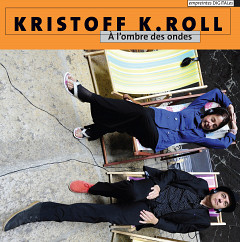
    Kristoff K.Roll est un duo français formé par J-Kristoff Camps et Carole Rieussec que l’on avait eu plaisir à voir en live lors de l’édition 2012 du festival Présences «électronique». C’est la première fois que l’on écoute leur musique sur disque et une surprise de les retrouver chez Empreintes Digitales, une structure québécoise renommée dont nous nous sommes déjà fait l’écho.

    À l’ombre des ondes s’inscrit dans le cadre des “Siestes audio parlantes” développées par le duo. Avant tout présentées en live, ces pièces sont faites pour être écoutées au casque, allongé, les yeux mi-clos, déroulant un univers à mi-chemin entre rêve et réalité, conscient et subconscient, dans la brume de la somnolence. Ces travaux ont été présentés à de multiples reprises via un dispositif de 80 casques et autant d’auditeurs qui se sont notamment retrouvés à La Friche la Belle de Mai (Marseille) ou encore dans les jardins du Centre Pompidou—Metz.

    Grâce à cet album il est désormais possible de se prêter au jeu de ces siestes à tout moment, chez soi, dans un parc, où encore sur la plage puisque l’on est en pleine période estivale.

    Pour être franc, il vaut mieux être conscient quand on rédige une chronique, et nous n’avons pas encore écouté cet album en respectant les quelques conseils fournis par le duo. Pour autant, le plaisir est bien là et l’album se révèle vite attachant avec ces quelques personnes qui nous ouvrent les portes de l’intime en racontant leurs rêves.

    À l’ombre des ondes n’est pas un disque comme les autres: le duo construit une musique ambient-concrète, particulièrement douce, feutrée, faite de field recordings, tonalités électroniques et narration. L’auditeur est projeté dans un parc ou jardin, un avion passe dans le ciel, des enfants jouent, les insectes chantent et un homme nous raconte son rêve. Une voix nonchalante, que l’on trouvera familière, sympathique, nous embarque dans les méandres d’un rêve, sa folie, ses revirements improbables, ses incohérences qui apportent à la fois humour et une douce folie. Le rêve débute par un avion au dessus de plantations, faisant écho aux enregistrements ambiants qui semblent être à la fois une illustration et un moyen de brouiller les pistes entre rêve et réalité.

    Un train qui passe, des bruits de rue sous la pluie, des murmures sous la résonance de cloches, des pas dans des couloirs et escaliers, écoulement d’eau et clapotis contre la coque d’un bateau, puis un autre rêve, très descriptif, d’une ville imaginaire parcourue de canaux. Certains sont très précis comme ici, d’autres très vagues, flous, presque oubliés par leurs auteurs à l’image de l’hésitant Récit de rêve.

    On ne saura pas expliquer pourquoi on est particulièrement sensible à certains rêves, moins à d’autres. L’histoire, la façon de la raconter, la fluidité, l’humour, la voix… Après une superbe séquence d’un néon qui claque, c’est le rêve d’une jeune femme qui retient notre attention, alors qu’elle voit débarquer des amoureux en vélo, en voiture, en deltaplane, avant de se voir investie d’une mission dont elle ne connait pas vraiment le but…

    Un disque tendre, habité, féérique.

    Un disque tendre, habité, féérique.
  • 1
  • 2
  • 3
  • 4
  • 5
  • 6
  • 7
  • 8
  • 9