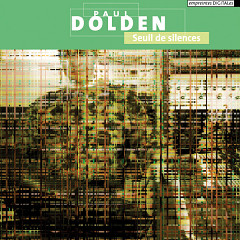
Since there has been a considerable stylistic and compositional shift in Paul Dolden’s music between this, his first album for empreintes DIGITALes and the last one I reviewed, (Histoires d’histoire), I would like to explore this release and possibly / hopefully give some insight as to how his sound evolved. Seuil de silences has a bit of a tangled history. The genesis of this release was in 1990 with The Threshold of Deafening Silence on the now defunct Tronia label. I wasn’t aware of it at the time but listening to it now, three decades on I can say that what he was doing was fairly groundbreaking, if not, downright extreme for it’s time. I would even go as far as to say, our world hasn’t caught up to these four pieces yet.
Using 1990 tape technology, Dolden was able to achieve a sound that was sonically massive AND compositionally advanced for what was generally considered “ambient” music back then. In fact, if you (mistakenly) dropped him into that category you would have been discounting his musical and technical skills. I’m not on a mission to belittle in any way the fine talents of musicians like Steve Roach or Robert Rich but clearly, this release finds Dolden walking a very different sonic pathway. There were some similarities, possibly his use of untuned and tuned percussion presented at times a sort of ritualistic/tribal feel to the music that was popping up at the time. His technique of recording hundreds of tracks of acoustic instruments and then layering them on top of each other enabling him to explore different (micro) tonalities and timbres within the “note” did not share any similarities though, and this is what I think separated him from the Ambient crowd and placed him squarely within the Acousmatic zone.
In 2003, empreintes DIGITALes released Seuil de silences (Threshold of Silences). This release shared 3 of the tape compositions from Threshold of Deafening Silence plus two more compositions featuring live soloists and tape. The shared tracks were remastered by Dolden using up to date, state of the art studio gear. There are some major aural differences in this release compared to the 1990 predecessor. Seuil de silences has a much larger bass presence. Thankfully, this does not muddy up the sound and, in fact, adds even more drama and power to the compositions, something that I didn’t think was possible. It also seems to be generally louder and more “in your face” than the 1990 version. Again, given the fact that these pieces display an absurd amount of power and intensity to begin with, adding more loudness may sound like overkill to some, although I’m not one who thinks this is so. Finally, there were some musical content changes made that resulted in changing the times of the pieces by a small amount. Since I haven’t A-B’ed these versions on a granular level, I can’t really speak to these changes but, I believe they are minor… realizing the composer may think differently.
About the album, right out of the gate we have Below the Walls of Jericho. This is part one of a “Jericho” triptych that continues with his next 2 albums, Intoxicated by Speed 1 and 2. I can’t stress enough how searingly intense this piece gets in places. Realizing that Acousmatic music is meant for the listener to interpret in their own personal way without concerning (and distracting) themselves with such trivial things as sound sources or the “how” of creating the music… one can’t help but wonder “how” exactly did Dolden come up with this malevolent entity of sound? Instead of wasting space talking about process, if interested you can read liner notes and other commentary by the composer here.
There are aspects that stand out for me though. His controlled use of dynamics is unparalleled. There are parts throughout that can easily lull you into a serene state of catatonia only to be bludgeoned back into the real suddenly and without warning. Contrastingly, there are moments where you can see it coming. You can hear and feel the build and you know you are about to experience a wheezing, screaming, utterly menacing harpy encounter and there is absolutely nothing you can do about it.
Then there is his penchant for ending a phrase in a very dry manner. Let me try and explain this… you are reaching the tail end of a passage that is constructed with up to 400 tracks of wind, reed, string, choir, and metal percussive instruments. The passage ends suddenly and without warning. The ending is not a hard cut as if you are turning off a light switch but it’s an ending where the instruments themselves just simply stop playing. It all sounds very natural and you can even hear residual noises of the musicians lifting their fingers from their instruments or the fading ring of struck metal decaying into the ether. The effect is riveting, and it’s something that really needs to be heard rather than described with puny words.
Everything about this recording seems up close and personal as if you were living inside the sound. Remember the movie Fantastic Voyage from the 60’s? It’s like that… you know!
My personal experience with this music is, first and foremost trying to wrap my head around the sheer immensity of the sound stage. Sometimes I’ll spend the length of an entire album of Dolden music just marveling at its vastness. If I do happen to get past this stage, the body aspect kicks in. I begin to feel it, in all its bone-shaking splendor. Everything I’ve mentioned is part of the physical world but if you are able to peel back the onion layer and start to experience it on a cerebral level, well that’s when the game really begins.
Paul Dolden is one of the most innovative artists out there right now. He has actually done a second remaster which he is posting to his Bandcamp page. Among other released and unreleased pieces, he has made available the piece Below the Walls of Jericho with this new remaster. He considers these the definitive versions of his works. The fact that he’s under the radar is criminal. Have a listen, see for yourselves.
A final word, as in all Acousmatic music, a good sound system will enhance your experience by orders of magnitude. My preferred way of listening is through decent earbuds augmented with a DAC/headphone amp. A YouTube video through computer speakers is not optimal so, if you can, try and listen on a good system of your choice.